

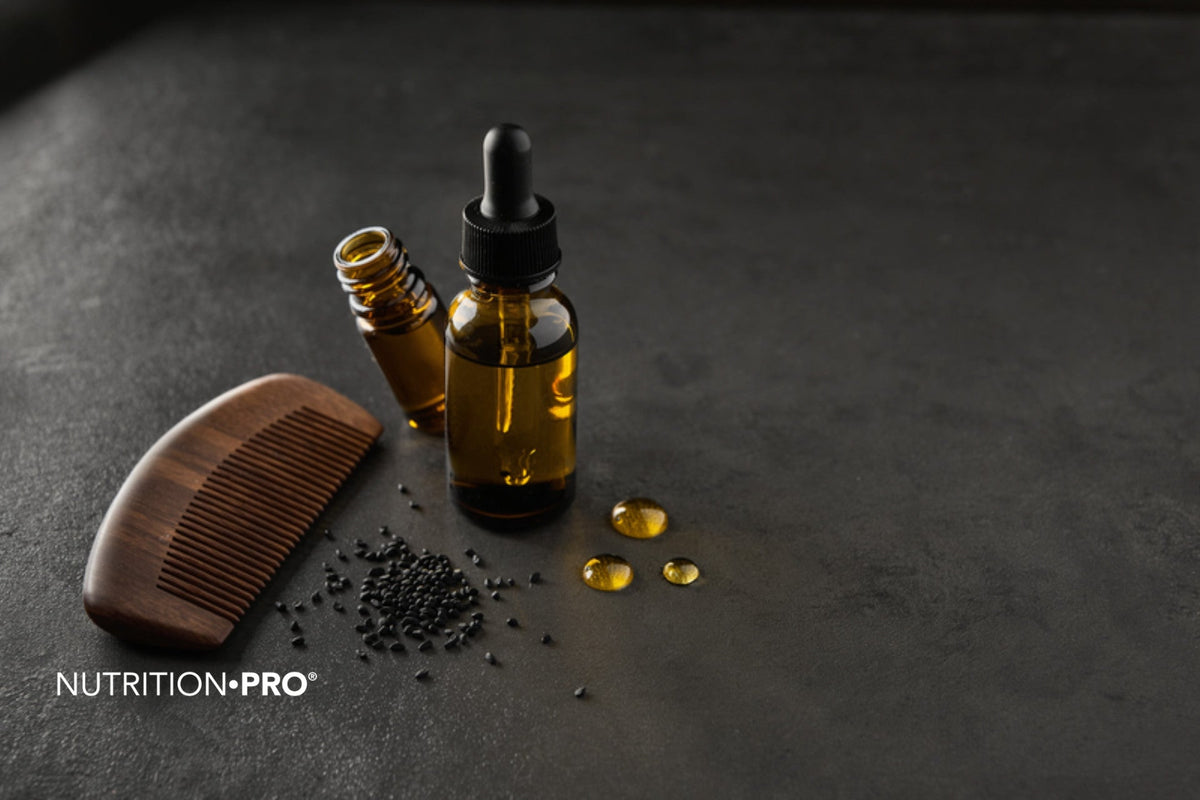
A few drops of black, peppery oil massaged into the beard: black seed oil has joined grooming rituals. It is said to make hair softer, soothe itching and calm breakouts. Studies shed light on some of these uses, through the skin and its fatty acids, but none have been conducted on the beard itself.
This guide brings together work identified via PubMed: composition, skin barrier, trials on acne and eczema, laboratory data, published contact allergies, and then practical advice. For the scalp, see our article onblack seed oil for hair.

What studies say : an oil rich in linoleic acid, with highly variable thymoquinone content. A black seed hydrogel reduced acne by 78% in 60 days in 60 patients, and an ointment improved hand eczema. Antimicrobial and anti-inflammatory effects come mainly from laboratory and animal studies.
What you need to know : no trial has been conducted on the beard or on its growth. Contact allergies are published, including one case linked to beard cosmetics.
- What black seed oil contains
- The skin under the beard, a particular area
- Skin barrier and softness: the role of fatty acids
- Acne and eczema: skin trials
- Microbes and inflammation: mainly laboratory findings
- What no study has tested: the beard
- Contact allergies: published cases
- How to use it properly on the beard: practical advice
- Itching: when to consult
- Frequently asked questions
What nigella oil contains
Nigella oil is extracted from seeds of Nigella sativa, or black cumin, and is composed almost entirely of fatty acids. A Romanian team analyzed nigella oil used in its research by chromatography:linoleic acid, an omega 6, andoleic acid, an omega 9, represented approximately 89% of the fatty acids, and palmitic acid, a saturated fatty acid, 6.10%. This analysis covers a single oil; the composition varies depending on the seed origin and extraction method.
A smaller fraction concentrates researchers' attention: volatile compounds dominated by thymoquinone. Its content varies greatly.
Thymoquinone content ranged from 3.08 to 809.4 mg per 100 g, a difference of approximately 1 to 263 (editorial calculation). A result obtained with one preparation therefore does not automatically transfer to another.
Khaikin E, Chrubasik-Hausmann S, Kaya S, Zimmermann BF. 2022;14(17):3501. DOI: 10.3390/nu14173501
Our Ethiopian nigella oil is a 100% nigella seed oil cold-pressed and unfiltered; its data sheet indicates a thymoquinone content of 4.4% and, per 100 g, 58.19 g of polyunsaturated fatty acids, 26.40 g of monounsaturated and 15.28 g of saturated. Differences between origins are detailed in our article onnigella oil from Egypt or Ethiopia.
Skin under facial hair, a particular zone
Under facial hair, the skin is permanently covered and often shaved at the edges. A pilot study conducted on 50 men compared the skin of the beard area to that of the rest of the face: it was warmer, less hydrated and its barrier function was diminished. These measurements were taken on a shaved area and do not directly describe skin under a long beard.
The beard area also has its own conditions, including pseudofolliculitis barbae, a chronic inflammation with papules and pustules around hairs, on the beard and neck, which mainly affects dark skin. A 2023 review of its treatments cites prevention, antibiotics, corticosteroids, keratolytics, depilatory creams and laser, with topical treatments as first-line. Nigella does not appear there. For a beard oil, therefore, three points matter: its composition, its tolerability, and prolonged contact, since it is rarely rinsed off.
Skin barrier and softness: the role of fatty acids
The softness of a beard depends on the oily film that sheathes the hair and on skin hydration. A 2017 review of plant oils applied to the skin notes that most remain on the surface, where they limit water loss, and emphasizes the role of their composition:linoleic acid is associated with repair and integrity of the skin barrier, whereasoleic acid, when applied repeatedly, tends to weaken it. The authors thus report that an application of olive oil, rich in oleic acid, increased water loss through the skin in adults.
Oils rich in linoleic acid compared to oleic acid are considered more favorable for repairing the skin barrier.
Lin TK, Zhong L, Santiago JL. 2017;19(1):70. DOI: 10.3390/ijms19010070
This review does not address nigella oil, and no identified study measured skin hydration in humans after its application: its richness in linoleic acid makes it a plausible candidate, nothing more.
Tested alone on acne-prone skin in a small double-blind Belgian trial against placebo, linoleic acid applied for one month reduced the size of microcomedones by approximately 25%, these invisible plugs that precede pimples, whereas no changes were observed in placebo areas. This is pure linoleic acid, in patients with mild acne, not nigella oil on a beard.
Acne and eczema: skin trials
The most comprehensive synthesis is a systematic review with meta-analysis published in 2022. It included 14 clinical studies on nigella and skin (eczema, acne, psoriasis, vitiligo and others) in 732 participants, of whom 69% were women. In the 4 trials combined in meta-analysis, the chances of improvement were multiplied by 4.59 with nigella (95% confidence interval from 2.02 to 10.39). The authors call for further research to confirm or refute efficacy.
In 60 patients with acne, a nigella hydrogel standardized in thymoquinone, applied twice daily for 60 days, reduced the overall severity score by 78% on average, compared to 3.3% with placebo gel. Comedones, papules and pustules decreased significantly, and no adverse effects were reported.
Soleymani S, Zargaran A, Farzaei MH, et al. 2020;34(11):3052-3062. DOI: 10.1002/ptr.6739
This is a formulated gel in acne patients, not pure oil on a beard; no trial addressed pseudofolliculitis.
Inhand eczema, an Iranian trial compared a nigella ointment, betamethasone, a potent dermocorticoid, and an emollient base in 60 adults in three groups of 20, twice daily for 4 weeks. Nigella and betamethasone improved eczema severity and quality of life faster than the emollient base, with no significant difference between them. Only 19 patients in the nigella group, 15 in the betamethasone group and 18 in the emollient group attended at least one follow-up consultation. With such small sample sizes, this does not demonstrate equivalent efficacy.
These trials and other skin data are detailed in our guide onnigella oil for skin, acne and eczema.
Microbes and inflammation: mostly laboratory findings
The skin under the beard harbors bacteria and yeasts, against which nigella has been tested in the laboratory. In a Polish study in vitro, a seed extract rich in thymoquinone and thymoquinone alone slowed and killed strains of Staphylococcus aureus, including methicillin-resistant strains; thymoquinone was active at 4 to 16 µg/mL, and a 1% extract preparation in vaseline also inhibited bacterial growth on agar. Several authors of this work are affiliated with a private company.
Another team formulated gels from a seed extract, up to 15%, which inhibited in vitro Staphylococcus aureus and the acne-associated bacterium. Against fungi responsible for ringworm, some of which affect the beard, a seed extract and thymoquinone slowed in vitro several fungal strains in the laboratory, with minimal active concentrations of 0.125 to 0.25 mg/mL for thymoquinone, compared to 0.00095 to 0.0155 mg/mL for griseofulvin, a reference antifungal.
On the inflammation front, the data are animal-based: in mice, in an atopic dermatitis model, thymoquinone given orally or applied to the skin reduced lesion thickness, IgE and several inflammatory messengers.
A culture plate does not reproduce skin, sebum, or the balance of its microbes. These studies do not show that an oil on the beard prevents folliculitis or ringworm, which require medical advice.
What no study has tested: the beard
It must be stated clearly: no clinical trial has tested a beard oil, any beard oil whatsoever, nor nigella oil applied to the beard. At the time of writing, a search in PubMed crossing nigella and beard returns only a single publication, and it is a case of allergy, presented below. Softness, appearance and itching have never been measured with this oil.
As for growth, no study has shown that nigella oil makes the beard grow or thickens it; data on the scalp do not apply to it. Some indirect elements remain, sufficient to make it a reasonable care oil, not to attribute specific effects on the beard to it.
Contact allergies: published cases
Allergic contact dermatitis to nigella oil has been published since at least 1997, with a case described in Munich after topical use. This was followed by a nigella oil ointment in 2002, a severe bullous eruption in 2012 in a 53-year-old woman who had applied and ingested the oil for two weeks, then a hypersensitivity syndrome, called DRESS, after topical use in 2022. Their frequency is not known: these are isolated cases or small series.
Three women, with a median age of 27, were hospitalized for severe acute contact dermatitis from nigella oil, with more than 15% of skin detachment and fever. Their patch tests with the oil were all positive.
Gaudin O, Toukal F, Hua C, et al. 2018;154(9):1062-1065. DOI: 10.1001/jamadermatol.2018.2120
A Parisian team identified in 2020 the thymoquinone as the allergen responsible, with a cross-reaction with tert-butylhydroquinone, then described five new cases. The most studied compound in nigella is therefore also the one that can sensitize.
The case most directly related to our subject was published in 2023 by French dermatologists: a severe allergic contact dermatitis called conjugal dermatitis from nigella seed oil, due to repeated contact with beard cosmetics.
Stop the oil immediately and consult quickly in case of redness that extends beyond the application area, intense itching, blisters or bubbles, target lesions, skin detachment, fever, or facial swelling. These reactions can occur several days after starting applications, including in a close contact.
Other precautions, including possible interactions with internal use, are gathered in our article: is nigella oil dangerous?
How to use it properly on the beard: practical advice
No trial has defined how to apply nigella oil to a beard. The steps below are general advice for caution, not study results.
Also think of those around you: if your partner shows redness on the face or neck, the oil is among the suspects to report to the doctor.
The information sheet for our Ethiopian nigella oil recommends, for external use, a prior test on a small area of skin. It is not recommended for children and pregnant or nursing women, and medical advice is suggested if undergoing treatment. No trial has tested this oil: the results presented above concern the preparations from the studies.
Itching: when to consult
When the beard grows or the skin is dry, a care oil can provide comfort. But itching can reveal a condition that is treatable, for which no data supports relying on nigella oil. The chart summarizes, as general advice, the signs that justify medical consultation.
| Situation | Why consult |
|---|---|
| Small bumps around hair follicles, on the beard and neck | Pseudofolliculitis or folliculitis is treated with appropriate measures |
| Round patch, broken hairs, crusts | Beard ringworm requires antifungal treatment |
| Redness after a new oil or new balm | Contact allergy is confirmed by patch testing |
A 100% Ethiopian black seed oil, cold-pressed and unfiltered, with 4.4% thymoquinone, in a 100 ml bottle. For external use, apply a few drops massaged for 2 to 3 minutes then rinsed, after a test on a small area of skin.
View the Ethiopian black seed oilDo you prefer a flavorless format for internal use? Discover our Egyptian black seed oil capsules.
Frequently asked questions
Is black seed oil good for the beard?
No trial has tested it on the beard. It is rich in linoleic acid, associated with a healthy skin barrier, and small studies on skin are favorable. It can serve as a care oil, after a tolerance test.
Does black seed oil make the beard grow?
No study has shown that it makes the beard grow or thickens it. Research on the scalp does not concern the beard.
Does black seed oil make the beard softer?
This has never been measured. Like any vegetable oil, it forms a greasy film on the hair and skin, which causes the sensation of softness.
Does black seed oil soothe itching under the beard?
No trial has verified this. On dry skin, a care oil can provide comfort; persistent itching with bumps, patches or scales warrants medical advice.
Does black seed oil help against beard bumps?
In 60 acne patients, a black seed hydrogel reduced the severity score by 78% in 60 days, compared to 3.3% under placebo. This gel is not pure oil, and no trial has focused on the beard.
Is black seed oil antibacterial?
In vitro, thymoquinone inhibited golden staphylococci, including resistant strains, at 4 to 16 µg/mL. These laboratory results do not demonstrate an effect on human skin.
Can black seed oil cause an allergy?
Yes. Allergic contact dermatitis has been published since 1997, sometimes severe, and thymoquinone is an identified allergen. A severe case, termed conjugal, was linked to repeated contact with beard cosmetics containing black seed oil.
How do you perform a tolerance test?
Apply one drop morning and evening to a small area of healthy skin, at the elbow crease or under the jaw, for several days. Without redness or itching, proceed to the beard, starting diluted.
How many drops to apply to the beard?
A few drops, distributed in the palm then massaged into the skin. Our oil is intended for external use with a few drops massaged for 2 to 3 minutes, then rinsed with clear water.
How to store black seed oil?
Bottle tightly sealed, away from light and heat. A slight sediment is normal for an unfiltered oil; a rancid odor indicates it should no longer be used.
To learn more
Sources
The studies cited below were identified via PubMed.
- Pop RM, Vassilopoulou E, Jianu ME, et al. Nigella sativa oil attenuates inflammation and oxidative stress in an experimental model of myocardial infarction (with analysis of the oil's fatty acids). BMC Complementary Medicine and Therapies, 2024;24(1):362. PMID 39375628. DOI
- Khaikin E, Chrubasik-Hausmann S, Kaya S, et al. Thymoquinone content in commercial Nigella sativa products to identify a promising and safe study product. Nutrients, 2022;14(17):3501. PMID 36079759. DOI
- Wu Y, Konduru R, Deng D. Skin characteristics of Chinese men and their beard shaving habits. British Journal of Dermatology, 2012;166(Suppl 1):17-21. PMID 22385031. DOI
- Dalia Y, Khatib J, Odens H, et al. Review of treatments for pseudofolliculitis barbae. Clinical and Experimental Dermatology, 2023;48(6):591-598. PMID 36840647. DOI
- Lin TK, Zhong L, Santiago JL. Anti-inflammatory and skin barrier repair effects of certain plant oils applied to skin. International Journal of Molecular Sciences, 2017;19(1):70. PMID 29280987. DOI
- Letawe C, Boone M, Piérard GE. Digital image analysis of the effect of linoleic acid applied to skin on acne microcomedones. Clinical and Experimental Dermatology, 1998;23(2):56-58. PMID 9692305. DOI
- Nasiri N, Ilaghi Nezhad M, Sharififar F, et al. The therapeutic effects of Nigella sativa on skin diseases: systematic review and meta-analysis of randomized controlled trials. Evidence-Based Complementary and Alternative Medicine, 2022;2022:7993579. PMID 36518853. DOI
- Soleymani S, Zargaran A, Farzaei MH, et al. Effect of a Nigella sativa L. hydrogel on acne vulgaris: a double-blind randomized clinical trial. Phytotherapy Research, 2020;34(11):3052-3062. PMID 32548864. DOI
- Yousefi M, Barikbin B, Kamalinejad M, et al. Comparison of the therapeutic effect of black seed applied topically with betamethasone and [an emollient base] in hand eczema. Journal of the European Academy of Dermatology and Venereology, 2013;27(12):1498-1504. PMID 23198836. DOI
- Gawron G, Krzyczkowski W, Lemke K, et al. Use of Nigella sativa seed extract in preparations against methicillin-resistant Staphylococcus aureus and effects on the viability of human dermal fibroblasts. Journal of Ethnopharmacology, 2019;244:112135. PMID 31377263. DOI
- Nawarathne NW, Wijesekera K, Wijayaratne WMDGB, et al. Development of novel topical cosmeceutical formulations based on Nigella sativa L. active against acne-related microorganisms. The Scientific World Journal, 2019;2019:5985207. PMID 31485198. DOI
- Aljabre SH, Randhawa MA, Akhtar N, et al. Antidermatophytic activity of an ethereal extract of Nigella sativa and its active principle, thymoquinone. Journal of Ethnopharmacology, 2005;101(1-3):116-119. PMID 15908151. DOI
- Aslam H, Shahzad M, Shabbir A, et al. Immunomodulatory effect of thymoquinone on atopic dermatitis. Molecular Immunology, 2018;101:276-283. PMID 30031280. DOI
- Steinmann A, Schätzle M, Agathos M, et al. Allergic contact dermatitis to black cumin oil (Nigella sativa) after topical use. Contact Dermatitis, 1997;36(5):268-269. PMID 9197967. DOI
- Zedlitz S, Kaufmann R, Boehncke WH. Allergic contact dermatitis to an ointment containing black cumin oil (Nigella sativa). Contact Dermatitis, 2002;46(3):188. PMID 12000337. DOI
- Gelot P, Bara-Passot C, Gimenez-Arnau E, et al. Bullous toxiderma to Nigella sativa oil. Annales de Dermatologie et de Vénéréologie, 2012;139(4):287-291. PMID 22482483. DOI
- Gaudin O, Toukal F, Hua C, et al. Association between severe acute contact dermatitis due to Nigella sativa oil and epidermal apoptosis. JAMA Dermatology, 2018;154(9):1062-1065. PMID 30073256. DOI
- Kurihara F, Soria A, Lepoittevin JP, et al. Thymoquinone, the allergen responsible for contact dermatitis from Nigella sativa oil, with cross-reaction to tert-butylhydroquinone. Contact Dermatitis, 2020;83(2):132-134. PMID 32232855. DOI
- Seiller H, Kurihara F, Chasset F, et al. Tert-butylhydroquinone, a marker of sensitivity to Nigella sativa oil: five new cases. Contact Dermatitis, 2021;84(6):447-449. PMID 33236781. DOI
- Fargeas M, Calugareanu A, Ben-Said B. Drug hypersensitivity syndrome (DRESS) following topical use of Nigella sativa oil (black cumin). Contact Dermatitis, 2022;87(2):203-204. PMID 35419842. DOI
- Assier H, Kouby F, Ingen-Housz-Oro S, et al. Severe allergic contact dermatitis from Nigella sativa seed oil through repeated contact with beard cosmetics. Contact Dermatitis, 2023;88(3):245-246. PMID 36494318. DOI


