

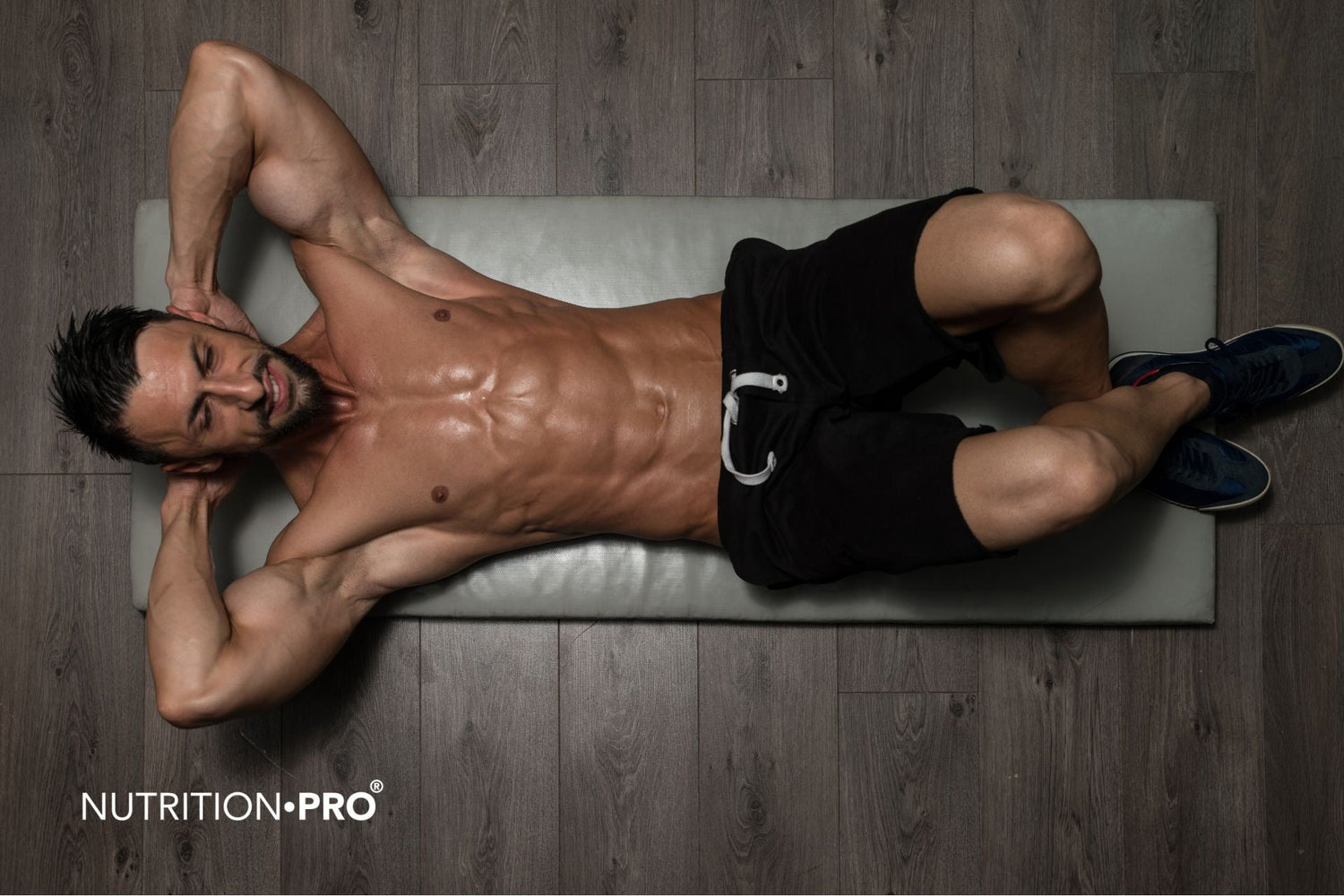
You've been doing crunches for months, your abs are hard as rock when you flex them, and yet: still no six-pack in sight. Frustrating, right?
Here's the truth the fitness industry doesn't really like to highlight: your abs are already there. Everyone has them. If they're not visible, it's not because they're too weak or too small, it's because they're hidden under a layer of fat. And to melt that fat, it's not ab exercises that matter most, but what you put on your plate. We'll explain exactly why, and especially how to go about it.


To have visible abs, it's not enough to build the abdominal muscles: you need to lower your body fat percentage that covers the muscles. Now fat is not lost locally ( spot reduction doesn't exist): it melts globally, as a result of a calorie deficit. This is why nutrition accounts for approximately 80 % of the result, and training 20%. Abs become visible around 10-12% body fat in men, 18-20% in women. Priority nutritional levers: moderate calorie deficit, high protein intake (satiety + muscle preservation), and consistency. Exercises and supplements are supporting tools, not miracle solutions.
- The truth no one tells: your abs are already there
- The number that really matters: body fat percentage
- Why crunches aren't enough (the myth of spot reduction)
- 80% on the plate: the calorie deficit
- Protein, the number one ally for definition
- Supplements that can help (and those that don't work miracles)
- And training then? The 20% share
- Your concrete action plan
- Frequently asked questions
The truth nobody tells you: your abs are already there
Let's start by deconstructing the most widespread belief. When someone says "I want to get abs," they generally imagine they need to build a muscle that doesn't exist yet. That's wrong. The rectus abdominis (the muscle that forms the famous "six-pack") is present in absolutely everyone, athlete or not. Its segmented shape in "squares" is anatomical: it's drawn by bands of connective tissue that cross the muscle.
If you don't see your abs, it's therefore not because they're absent or insufficiently developed. It's because they're masked by a layer of subcutaneous fat, the kind that lodges just under the skin, above the muscles. As long as this layer is thick, you can have the most powerful abdominals in the world: they'll remain invisible.
This distinction changes everything in strategy. The problem isn't "how do I build my abs," but "how do I remove the fat hiding them." And that's a question that's fundamentally nutritional, not a question of number of repetitions. That's why the famous saying "abs are made in the kitchen" is, essentially, correct.
Understanding this spares you months of misdirected effort. Many people intensify their ab sessions thinking that "it will eventually pay off," when they never touch the lever that matters: lowering their overall body fat.
The number that really counts: body fat percentage
Since ab visibility depends on the thickness of the fat layer, there is a much more useful indicator than your weight on the scale: your body fat percentage. It's the percentage of your body weight made up of fat. The lower it is, the thinner the layer covering your abs, and the more they show.
Here are the generally accepted benchmarks. Keep in mind that they are approximate : two people at the same percentage may have different results depending on their fat distribution (some store more around the belly, others elsewhere).
The abdominals appear clearly, even at rest. The famous well-defined "six-pack."
Athletic silhouette, abs sketched when tensed but obscured at rest. The midline is barely visible.
The abs are there, but covered by a layer of subcutaneous fat that completely masks them.
Apparent definition. In women, the threshold is higher: this is physiological and healthy.
Toned and athletic silhouette, abs suggested. A realistic and healthy goal for many.
Beware of extremes. Aiming for a very low body fat percentage is neither necessary nor desirable for health, particularly in women, where a minimal threshold of fat is essential for hormonal balance. The goal is not the lowest possible percentage, but a healthy level where you feel good. If your relationship with your body or eating becomes a source of suffering, talk to a healthcare professional.
How do you know your percentage? Several methods exist, from simple visual estimation (by comparing to reference photos) to bioimpedance scales (practical but approximate), to more precise measurements like DEXA. For an aesthetic goal, visual estimation and tracking your progress in the mirror and in photos are more than sufficient. The exact number matters less than the trend : are you going down, month after month?
Key takeaway: your standard scale doesn't tell you much. You can weigh "heavy" with little fat (lots of muscle) or "light" with a soft belly. It's the body fat percentage, not the weight, that determines whether your abs show.
Why crunches aren't enough (the myth of spot reduction)
This is probably the most costly misconception in terms of time and motivation. Many believe that by doing hundreds of crunches, they will "burn" belly fat in that specific spot. This belief has a name: spot reduction (or "spot reduction" in English). The problem is, it doesn't work.
The science is clear on this point. According to a randomized controlled trial by Vispute et al. 2011, published in the Journal of Strength and Conditioning Research, six weeks of intensive abdominal exercises (seven exercises, five days a week), with no dietary changes, produced no reduction in abdominal fat, waist circumference, body fat percentage, or weight. Participants only improved their abdominal muscular endurance (DOI: 10.1519/JSC.0b013e3181fb4a46).
In other words: doing ab exercises makes your abs stronger and more enduring, but doesn't touch the layer of fat covering them. This makes sense when you understand the mechanism: when the body draws on its fat reserves to produce energy, it does so globally, according to a genetically determined distribution, not at the location of the muscle being worked.
This doesn't mean abdominal exercises are useless, far from it (we'll return to this below). But they serve to develop and strengthen muscle, not reveal it. To reveal it, you need to remove the fat, and to remove the fat, you need to act on your body's overall energy balance. This is where nutrition comes into play.
The same logic applies to sweat belts, local "fat-burning" creams, electrostimulation devices sold as miracle solutions for the belly: none of them can target fat in a specific area. If a method promises to "melt belly fat" without affecting the rest, be cautious.
80% on your plate: the caloric deficit
If localized fat reduction doesn't exist, how do you lose fat? By a simple and unavoidable principle: the caloric deficit. Your body expends energy every day (to function, move, digest). When you provide it fewer calories than it expends, it compensates by drawing on its reserves, namely fat. This is how, and only how, body fat percentage decreases.
And that's precisely why nutrition matters more than exercise when it comes to visible abs. Creating a deficit by eating a little less is far easier and more reliable than trying to "burn" the equivalent through exercise. A telling example: a slice of cake can represent 400 calories consumed in two minutes; burning it would require nearly an hour of steady running. It's therefore far more effective to manage inputs (your plate) than to chase outputs (exercise).
Hence the famous distribution " 80% nutrition, 20% training ". It's not a scientific formula down to the exact percentage, but it reflects a reality: most of your results come down to what you eat. We expand on this idea in our article 20% training, 80% on your plate.
How to create a deficit healthily
The goal isn't to starve yourself. A moderate deficit (around 300 to 500 calories below your needs) is the most sustainable and most respectful of muscle. Too aggressive a deficit causes rapid weight loss, but a significant portion comes from muscle and water, which is counterproductive when you're trying to sculpt your figure. A few simple principles, without having to count every calorie:
- Reduce highly caloric and low-satiety foods: added sugars, sodas, alcohol, ultra-processed products, fried foods. These are the main sources of "empty" calories.
- Increase the volume of satiating foods with low caloric density: vegetables, fiber, lean proteins. They fill your stomach for few calories.
- Take care of your hydration: water aids satiety and the sensation of hunger is sometimes just thirst.
- Aim for consistency, not perfection: a deficit maintained over time always beats a drastic diet abandoned after two weeks.
For more on fat loss in general, our guides 27 science-backed tips to lose weight and 15 common mistakes preventing weight loss will give you the details on effective strategies.
A bloated belly isn't always fat. If your belly looks swollen especially at the end of the day or after meals, it could be bloating (water retention, digestion, gas), not just fat. In that case, working on your digestion already changes things visually. See our articles how to get a flat belly and reduce water retention.
Protein, the number one ally for definition
If you were to optimize just one parameter of your diet to reveal your abs, it would be your proteinintake. They play two decisive roles when you're trying to lose fat without losing the muscle that defines your physique.
First role: satiety. Proteins are the most satiating macronutrients. A meal rich in protein keeps you full longer and reduces cravings, making the caloric deficit much easier to maintain without suffering from hunger.
Second role: muscle preservation. In a deficit, the body risks drawing not only from fat, but also from muscle. Yet it's precisely the muscle (especially abdominal) that you want to preserve to have a sculpted physique. High protein intake helps preserve this lean mass during fat loss.
This dual benefit is documented. According to a review by Leidy et al. 2015 in the American Journal of Clinical Nutrition, higher-protein diets (around 1.2 to 1.6 g per kilogram of body weight per day, with approximately 25 to 30 g per meal) promote, under caloric restriction, a greater fat loss, better preservation of lean mass, and increased satiety effect compared to lower-protein diets (DOI: 10.3945/ajcn.114.084038).
How to increase your protein intake
In practice, distribute your proteins throughout the day and include a source at each meal. Good sources: eggs, poultry, fish, lean meat, dairy products, legumes, tofu. If you struggle to meet your needs through food alone (common when dieting and eating less), a convenient protein source can bridge the gap. Our article 20 highest-protein foods gives you practical ideas.
Supplements that can help (and those that aren't miraculous)
Let's be honest from the start: there is no supplement capable of melting belly fat or revealing abs by magic. Any product that promises this is exaggerating. The foundation remains, and always will be, the caloric deficit and protein. That said, some supplements can play a support role by making it easier to maintain your deficit, which is the main challenge for most people.
Satiety fibers (konjac)
<<<34>>> Glucomannan glucomannane, the konjac fiber, swells when in contact with water in the stomach and provides a feeling of fullness. Taken before meals with a large glass of water, it can help reduce portions and better tolerate the deficit. It's one of the most consistent supports for those struggling with hunger.
Protein powder
Not a weight loss product per se, but a practical tool to easily meet your daily protein goal, especially when appetite is reduced by the deficit. A aid to satiety and muscle preservation.
So-called "fat burner" supplements
Consider these with realism. Some active ingredients (caffeine, green tea) can slightly support energy expenditure or alertness, but their actual effect on fat loss is modest and never replaces the deficit. Don't attribute powers to them that they don't have.
The right mindset: a supplement can facilitate the hardest part (maintaining the deficit without breaking), but it's your overall diet that produces results. Discover our selection in the Weight Loss collection and our supplements in the Cutting.
Dietary supplements do not replace a varied and balanced diet or a healthy lifestyle. They are not recommended during pregnancy or breastfeeding, and some may interact with treatments. If in doubt, consult your doctor or pharmacist. Konjac should always be taken with a large glass of water to avoid any risk of obstruction.
And training then? The 20% part
Having emphasized nutrition, let's put exercise back in its proper place: those famous 20%. Training is not useless, it is complementary. Simply, it doesn't work the way most people believe. Here are its three real roles.
1. Build your abs so they stand out more. A trained abdominal muscle is thicker and more defined. Once the fat is removed, trained abs will be more prominent and more aesthetic than abs that have never been worked. Ab exercises therefore serve to prepare the ground, not to reveal.
2. Increase overall energy expenditure. This is where cardio and strength training really help with fat loss: not by targeting the belly, but by increasing total calories burned, which deepens the deficit. In this regard, the most effective training isn't necessarily abs exercises, but exercises that engage many muscles (squats, lunges, pull-ups) and cardio.
On this subject, science confirms that exercise acts on fat globally, including abdominal fat. According to a meta-analysis by Maillard et al. 2018 in Sports Medicine, pooling 39 studies,high-intensity interval training (HIIT) significantly reduces total, abdominal, and visceral fat mass, without targeting it locally (DOI: 10.1007/s40279-017-0807-y). The effect comes from energy expenditure and metabolic adaptation, not local fat burning.
3. Preserve muscle during the deficit. Strength training sends your body the signal to maintain muscle mass even in caloric restriction. Combined with adequate protein intake, it ensures that weight loss comes primarily from fat, not muscle.
In summary: train to build and preserve muscle and increase your expenditure, but rely on your plate to melt away the fat. To structure all this, a framework like the Spartan Cutting program combines both dimensions.
Your concrete action plan
Let's summarize everything above into a clear course of action. Here, in order of priority, is what to focus your efforts on to reveal your abs.
Decrease sugar and ultra-processed products, increase vegetables and proteins. Konjac, taken before meals, helps reduce hunger and maintain the deficit.
View konjac →
Satiety and muscle preservation during a deficit. Eggs, poultry, fish, legumes, and a convenient protein to fill the gap on busy days.
View proteins →
Strength training and cardio to burn calories and preserve muscle, plus core work to build a stronger midsection. A structured plan you can sustain long-term.
View the program →And above all, the fourth pillar, invisible yet decisive: patience and consistency. Revealing your abs takes months, not days. Healthy fat loss is around 0.5 kg per week. Quick fixes mainly lead to losing water and muscle, followed by gaining it back. Consistency always beats sporadic intensity.
Frequently asked questions
Why can't I see my abs even though I do ab exercises?
Because your abdominal muscles are there, but hidden under a layer of subcutaneous fat. Doing ab exercises strengthens the muscle without burning the fat covering it. According to a randomized trial (Vispute 2011), six weeks of abdominal exercises alone, without dietary changes, reduced neither abdominal fat nor waist circumference. To see your abs, you need to lower your body fat percentage, which depends primarily on nutrition.
At what body fat percentage do abs become visible?
Generally, abdominal muscles become visible around 10 to 12% body fat in men and 18 to 20% in women. These are guideline figures that vary depending on body composition and fat distribution. Between 15 and 18% in men, abs are outlined but veiled at rest. Above 20%, they remain hidden despite training.
Is it true that abs are made in the kitchen?
Yes, largely true. Making abs visible depends mostly on lowering body fat percentage, which relies on approximately 80% nutrition (caloric deficit and protein intake) and 20% training. You cannot burn fat from one specific area by working it: fat decreases globally, and it's the caloric deficit that triggers it.
Can you target belly fat with exercises?
No. Spot reduction (losing fat from one specific area by exercising those muscles) doesn't exist. Ab exercises strengthen the muscle but don't specifically burn belly fat. Fat is lost globally, according to a pattern unique to each person, through the effect of a caloric deficit.
How long does it take to have visible abs?
It depends on your starting body fat percentage and the size of your caloric deficit. With healthy fat loss of around 0.5 kg per week, it often takes several months to go from a level where abs are hidden to where they're visible. Consistency and patience beat quick fixes, which mainly result in losing muscle and water.
Do you need to do abs every day?
No, it's neither necessary nor optimal. Like any muscle, your abs need recovery. Two to three sessions per week are enough to develop them. And remember, multiplying ab sessions won't reveal your six-pack if body fat percentage remains high: nutrition is the priority.
Learn more
- Body fat percentage
- Percentage of body weight made up of fat. It is this, not weight, that determines ab visibility.
- Subcutaneous fat
- Layer of fat located just under the skin, above the muscles. This is what covers and hides the abdominals.
- Caloric deficit
- A situation where you consume fewer calories than you expend. The only mechanism that reduces fat mass.
- Spot reduction
- The (false) idea that you could burn fat from a specific area by working the muscles there.
- Lean mass
- Everything in the body except fat, including muscle. The goal is to preserve it during fat loss.
- Rectus abdominis
- The abdominal muscle that forms the "six-pack." Present in everyone, its segmentation is anatomical.
- Vispute SS, Smith JD, LeCheminant JD, Hurley KS. The effect of abdominal exercise on abdominal fat. J Strength Cond Res. 2011;25(9):2559-64. doi:10.1519/JSC.0b013e3181fb4a46
- Maillard F, Pereira B, Boisseau N. Effect of High-Intensity Interval Training on Total, Abdominal and Visceral Fat Mass: A Meta-Analysis. Sports Med. 2018;48(2):269-288. doi:10.1007/s40279-017-0807-y
- Leidy HJ, Clifton PM, Astrup A, et al. The role of protein in weight loss and maintenance. Am J Clin Nutr. 2015;101(6):1320S-1329S. doi:10.3945/ajcn.114.084038
About this article Written by the Nutrition•pro team based on clinical trials and meta-analyses indexed on PubMed. This article is informational and does not replace medical advice or personalized follow-up. If your relationship with food or your body becomes a source of distress, speak with a healthcare professional. Discover our editorial methodology.


