

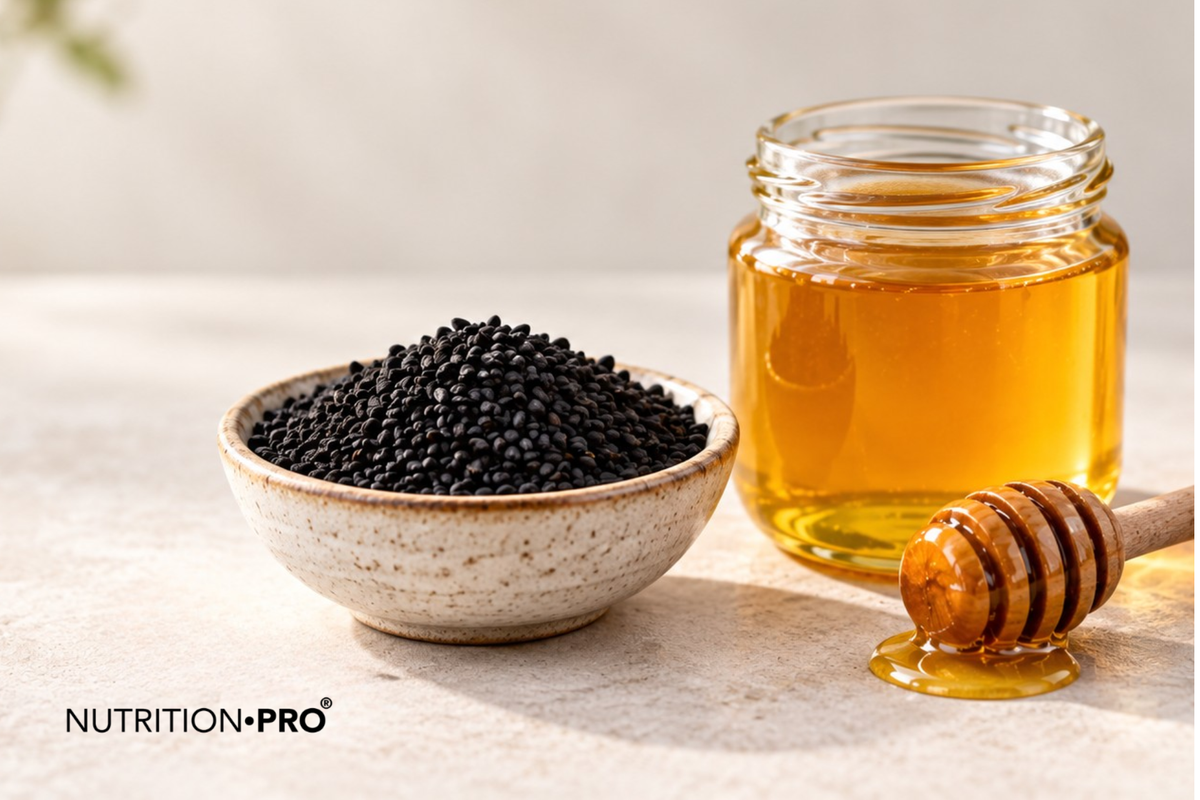
A teaspoon of ground nigella seeds in a teaspoon of honey, in the morning on an empty stomach: this is one of the oldest traditional remedies of the Mediterranean basin and the Middle East, passed down from generation to generation long before thymoquinone was discussed. And it is one of the rare traditional combinations to have been tested as such, honey included, in randomized trials.
This page brings together what these trials show about the mixture itself, what dozens of trials show about nigella alone, what can and cannot be attributed to honey, the preparation as it was tested, and the precautions that honey imposes, particularly when nigella lowers blood sugar and honey raises it.

On the mixture itself: two randomized placebo-controlled trials. The first, in 70 patients with functional dyspepsia, shows that a preparation of nigella oil in honey taken for eight weeks reduces digestive symptoms and Helicobacter pylori infection rate. The second, in 313 patients hospitalized for viral respiratory infection, reports symptom resolution twice as fast, with results of unusual magnitude that no independent team has yet reproduced.
On nigella alone: meta-analyses of 31 to 82 trials show modest but reproducible effects on fasting blood glucose, HbA1c, blood pressure, LDL cholesterol, and inflammation markers. On honey: no honey-only arm in the trials, so we don't know what it contributes beyond making nigella pleasant. And one caution: nigella lowers blood sugar, honey raises it, and the respiratory trial used 70 g of honey per day.
The two trials on the nigella and honey mixture
Functional dyspepsia: nigella oil with honey, eight weeks
70 patients with functional dyspepsia confirmed by endoscopy, receiving 5 ml of nigella oil mixed with honey per day or placebo for 8 weeks, in addition to standard antisecretory treatment: dyspepsia severity score and Helicobacter pylori infection rate significantly lower in the nigella group (p less than 0.001). No serious adverse effects.
Mohtashami R et al., Journal of Ethnopharmacology, 2015. DOI 10.1016/j.jep.2015.09.022
This trial is interesting for three reasons. It tests the traditional Persian formulation exactly, nigella oil and honey, rather than a laboratory extract. It uses an objective criterion, the urease test for H. pylori, alongside the symptom score. And it is conducted as a complement to standard treatment, not in place of it. Its limitations are those of the authors themselves: 70 patients, eight weeks, a single center, and a call for longer studies.
Viral respiratory infection: seeds and honey, thirteen days
313 adults hospitalized for moderate or severe viral respiratory infection, receiving honey (1 g per kg per day) and nigella seeds (80 mg per kg per day) or placebo, in addition to standard care, for up to 13 days: symptom resolution time reduced by approximately half (4 versus 7 days in moderate forms, 6 versus 13 in severe forms), faster viral clearance, and mortality in severe forms of 4% versus 18.9%. No adverse effects attributed to treatment.
Ashraf S et al., Phytotherapy Research, 2022. DOI 10.1002/ptr.7640
The format is solid: randomized, multicenter, versus placebo, prospectively registered, 313 patients. But three things call for caution. The magnitude of effects is incomparable to what a dietary supplement usually produces, and results this spectacular demand an independent replication that does not yet exist. The doses are enormous: for a 70 kg adult, nearly 6 g of seeds and 70 g of honey per day, the equivalent of four tablespoons, in a monitored hospital setting. The setting is that of hospitalized patients under standard care, not self-medication at home. We report this trial because it exists and it is well-designed. We are not turning it into advice.
What nigella alone shows in meta-analyses
On nigella taken alone, the literature is extensive: dozens of randomized trials, compiled in recent meta-analyses. The effects are real, consistent from one synthesis to another, and modest.
Doses of 200 to 4,600 mg per day, durations of 1 to 48 weeks: significant improvement in weight, BMI, waist circumference, systolic and diastolic blood pressure, fasting blood glucose, HbA1c, total cholesterol, LDL, triglycerides, CRP, IL-6, TNF-alpha, and several markers of oxidative stress and liver function.
Jafari A et al., Pharmacological Research, 2025. DOI 10.1016/j.phrs.2025.107882
Weight reduced by 1.59 kg, BMI by 0.51, systolic pressure by 3.25 mmHg, diastolic by 2.75 mmHg, fasting blood glucose by 18.6 mg/dL, HbA1c by 0.56 point. No effect on waist circumference, waist-to-hip ratio, insulin resistance, or insulin levels. The authors describe the improvements as modest and call for caution given the variability in trial quality.
Musazadeh V et al., Endocrinology, Diabetes and Metabolism, 2026. DOI 10.1002/edm2.70207
Fasting blood glucose reduced by 21.4 mg/dL, HbA1c by 0.44 point, total cholesterol by 18.8 mg/dL, LDL by 19.5 mg/dL. No effect on insulin, triglycerides, liver enzymes, weight, or BMI. Effects are better beyond 1 g per day and with the oil form.
Karimi M et al., Complementary Therapies in Medicine, 2025. DOI 10.1016/j.ctim.2025.103174
Black seed significantly reduces CRP, TNF-alpha, and malondialdehyde, and increases total antioxidant capacity and superoxide dismutase.
Lan X, Xia Y, Prostaglandins and Other Lipid Mediators, 2024. DOI 10.1016/j.prostaglandins.2024.106945
Three findings emerge. Black seed has a documented metabolic effect, on blood glucose and lipids, on a scale comparable to other reference plants such as berberine. It has a measurable anti-inflammatory effect on blood markers. And its effect on weight is marginal, one and a half kilos in overweight patients, none in diabetics: it is not a weight loss product, no matter what some websites claim.
Honey: vehicle, or more than that?
The two trials on the combination compare black seed plus honey to placebo. Neither has an arm with honey alone or black seed alone. It is therefore impossible, based on these data, to say whether honey adds something to black seed, or if black seed adds something to honey. This is a real limitation that we prefer to acknowledge.
What we otherwise know about honey: it has documented antibacterial properties, related to its osmolarity, acidity, and hydrogen peroxide production, as well as polyphenol content that varies by origin. It is used in hospital settings for certain wounds. These properties make a distinct contribution to dyspepsia or respiratory infection plausible. Plausible, not proven.
What is certain is its role as a vehicle. Ground black seed is bitter, peppery, slightly acrid; the oil is even more so. Honey makes daily intake pleasant, and a pleasant intake is one that lasts. In an eight-week trial like the one on dyspepsia, adherence is part of the result. Tradition understood this before protocols did.
The preparation, as tested
Trial doses versus commercial forms
| Source | Form | Dose per day | What this represents |
|---|---|---|---|
| Dyspepsia trial | Oil + honey | 5 ml of oil | One teaspoon |
| Respiratory trial | Seeds + honey | 80 mg/kg of seeds, 1 g/kg of honey | Approximately 6 g of seeds and 70 g of honey for 70 kg, in a hospital setting |
| Meta-analysis of 82 trials | All forms | 200 to 4,600 mg | From capsule to tablespoon |
| Meta-analysis diabetes | Oil preferably | More than 1 g | At least one small teaspoon of oil |
| Our organic black seed powder | Ground seeds | 3 to 4 g per teaspoon | Within the range studied for seeds |
| Our Ethiopian black seed oil | Cold-pressed oil, thymoquinone 4.4% | 5 to 15 ml (1 to 3 teaspoons) | The dyspepsia trial dose, and beyond |
| Our oil capsules | Oil in capsules | 1 g | Low end of trials, without the taste |
The three forms we sell fall within the studied ranges; the difference is a matter of degree. Powder is the form of the traditional honey mixture. Oil is the form closest to the best-designed trials, and its thymoquinone content of 4.4% is high for an unfiltered oil. Capsules are suitable for those who cannot tolerate the taste, accepting the lowest dose.

Precautions: sugar, blood glucose, children, liver
Honey is a sugar. Approximately 80% carbohydrates, predominantly fructose and glucose; one teaspoon provides about 6 g. For a diabetic person, this counts. And the combination creates a particular situation: black seed lowers blood glucose in a documented way, honey raises it. Under antidiabetic treatment, the dual effect should be discussed with a doctor. The 70 g of honey per day from the respiratory trial are incompatible with uncontrolled diabetes.
Never honey before one year. Honey can contain spores of Clostridium botulinum that an infant's intestines cannot neutralize. This is an absolute contraindication, with no exception or minimum quantity.
15 clinical trials in children: no statistically significant adverse effects, but a limited number of studies, heterogeneous doses and forms, and a call for higher-quality studies to establish efficacy, dose, and form.
Abumadini MM et al., Journal of Pediatric Pharmacology and Therapeutics, 2025. DOI 10.5863/JPPT-24-00044
Antidiabetics and antihypertensives : black seed strengthens their effect, monitoring necessary. Anticoagulants : theoretical interaction, medical advice recommended. Pregnancy : not recommended at supplement dose, culinary use in small quantities is traditional. Stomach : concentrated oil can irritate at high doses, start with a small amount with meals. Liver : rare cases of liver damage have been reported with concentrated extracts; unusual fatigue, dark urine, pain under the right ribs require stopping and consulting a doctor. Our article on the dangers of black seed oil details these points.
Frequently asked questions
The combination
What are the benefits of black seed and honey?
On the combination itself, two randomized trials exist. The first, in 70 patients suffering from functional dyspepsia, shows that a preparation of black seed oil in honey taken for eight weeks reduces digestive symptoms and Helicobacter pylori infection rate compared to placebo. The second, in 313 hospitalized patients with viral respiratory infection, shows faster resolution of symptoms. On black seed alone, meta-analyses of dozens of trials show modest effects on blood sugar, blood pressure, cholesterol, and inflammation markers. Honey, for its part, was not tested separately in these trials.
Does honey add something to black seed, or is it just a vehicle?
The two trials on the combination have no honey-only or black seed-only arms: they do not allow us to know what each component contributes. Honey has documented antibacterial and antioxidant properties in other studies, and it makes black seed, which is bitter and peppery, much easier to take daily. The honest answer is that honey is at minimum an excellent vehicle, and possibly more, though the trials don't prove it.
What to think of the black seed and honey trial on viral respiratory infection?
It's a good-sized randomized multicenter trial, 313 patients, versus placebo, which reports symptom resolution twice as fast and substantially reduced mortality in severe cases. Its results are, however, of an unusual magnitude for a supplement, it has not been replicated by an independent team, and the doses used are enormous: 80 mg of seeds per kilo, or nearly 6 g for an adult, and 1 g of honey per kilo, or 70 g of honey per day. It should be read as an interesting signal, not as proof, and it justifies no self-medication in a severe infection.
Preparation and dosing
How to prepare black seed with honey?
The traditional preparation: a level teaspoon of freshly ground black seed, about 3 to 4 g, mixed with a teaspoon of raw honey until forming a paste, taken in the morning on an empty stomach. The version from the dyspepsia trial uses 5 ml of black seed oil mixed with honey, once daily. Seeds must be ground: whole, they release few of their compounds.
How much black seed per day?
Trials cover a range of 200 to 4,600 mg per day depending on the form. For seed, 1 to 3 g per day is the most studied order of magnitude, or a level teaspoon of ground seeds. For oil, 1 to 5 ml per day. The meta-analysis in diabetics observes better results beyond 1 g per day and with the oil form. Our seed powder is dosed by teaspoon; our Ethiopian oil at 1 to 3 teaspoons.
Seeds, powder or oil: what to choose?
Ground seed is the traditional food form, the gentlest, that of the classic honey blend. Cold-pressed oil concentrates lipophilic compounds including thymoquinone, and it's the form used in the dyspepsia trial and the one that stands out best in the meta-analysis in diabetics. Oil capsules avoid the taste but typically provide 1 g per day, the low end of trials. If the goal is easy daily use, seeds with honey; if the goal is to align with the trials, oil.
Black seed alone
Does black seed lower blood sugar?
Yes, in a documented way. A meta-analysis of 16 trials in type 2 diabetics shows a fasting blood sugar decrease of 21 mg/dL and HbA1c decrease of 0.44 points, with a decrease in total cholesterol and LDL. Another, covering 31 trials and 2,145 participants with metabolic diseases, confirms decreases in fasting blood sugar and HbA1c. This is precisely why the mixture with honey, which is sugar, must be discussed with a doctor in case of treated diabetes.
Does black seed lower blood pressure?
Modestly. The meta-analysis of 31 trials reports a systolic pressure decrease of 3.25 mmHg and diastolic of 2.75 mmHg. This is a real but small effect, on the same order as a salt reduction. It justifies caution in people already treated for hypertension, not a replacement of treatment.
Does black seed cause weight loss?
Very little. The meta-analysis of 31 trials in metabolic patients finds an average weight decrease of 1.59 kg and BMI decrease of 0.51 points, with no effect on waist circumference or waist-hip ratio. In diabetics specifically, another meta-analysis finds no effect on weight. An effect on the order of one and a half kilos, in people who have weight to lose, is not a weight loss argument.
Precautions
Is honey compatible with diabetes?
Honey is a sugar: approximately 80% carbohydrates, mostly fructose and glucose. A teaspoon provides about 6 g. This is not forbidden, but it counts toward the carbohydrate intake, and the combination with black seed, which lowers blood sugar, creates a double movement to monitor in a person under antidiabetic treatment. The respiratory infection trial used 70 g of honey per day, a quantity incompatible with unmonitored diabetes.
Can you give black seed with honey to a child?
No honey before one year, without exception: risk of infant botulism. Beyond that, black seed was the subject of a review of 15 pediatric trials with no statistically significant adverse effects, but the authors emphasize the small number of studies and lack of established dosing. In practice, food use in small quantities is traditional; use as a supplement in children requires medical advice.
What precautions should be taken with black seed?
Black seed lowers blood sugar and blood pressure: caution with antidiabetics and antihypertensives, whose effect it can strengthen. Theoretical interaction with anticoagulants. Not recommended at supplement doses during pregnancy. Unfiltered black seed oils, concentrated in thymoquinone, can irritate the stomach at high doses. Rare cases of liver damage have been reported with concentrated extracts: stop and consult if experiencing unusual fatigue or dark urine.
Glossary
- Thymoquinone
- Major compound of black seed essential oil, to which most of its anti-inflammatory and antioxidant effects are attributed. Its content in an oil varies from less than 1% to more than 4% depending on origin and processing method.
- Functional dyspepsia
- Chronic upper digestive discomfort, heaviness, early satiety, heartburn, with no visible lesion on endoscopy.
- Helicobacter pylori
- Stomach bacterium involved in gastritis and ulcers, detected by urease test, breath test, or biopsy.
- HbA1c
- Glycated hemoglobin, reflecting average blood glucose over the past two to three months. A decrease of 0.5 points is clinically significant.
- Umbrella review
- Review that synthesizes not individual trials but all existing meta-analyses on a question.
- Infant botulism
- Severe poisoning of infants by Clostridium botulinum toxin, whose spores can be present in honey. Reason for the absolute prohibition of honey before one year of age.
- Cold-pressed
- Mechanical extraction without heating, which preserves volatile compounds including thymoquinone.
Sources
- Mohtashami R, Huseini HF, Heydari M et al. Efficacy and safety of honey based formulation of Nigella sativa seed oil in functional dyspepsia: a double blind randomized controlled clinical trial. J Ethnopharmacol. 2015;175:147-152. doi.org/10.1016/j.jep.2015.09.022
- Ashraf S, Ashraf S, Ashraf M et al. Honey and Nigella sativa against COVID-19 in Pakistan (HNS-COVID-PK): a multicenter placebo-controlled randomized clinical trial. Phytother Res. 2023;37(2):627-644. doi.org/10.1002/ptr.7640
- Jafari A, Mardani H, Faghfouri AH et al. Does Nigella sativa supplementation improve cardiovascular disease risk factors? A comprehensive GRADE-assessed systematic review and dose-response meta-analysis of 82 randomized controlled trials. Pharmacol Res. 2025;219:107882. doi.org/10.1016/j.phrs.2025.107882
- Musazadeh V, Jahangir M, Mahmoudinezhad M et al. The effect of Nigella sativa supplementation on cardiometabolic health in patients with metabolic diseases: a GRADE-assessed systematic review and meta-analysis. Endocrinol Diabetes Metab. 2026;9(2):e70207. doi.org/10.1002/edm2.70207
- Karimi M, Pirzad S, Pourfaraji SMA et al. Effects of black seed (Nigella sativa L.) on cardiometabolic indices in type 2 diabetic patients: a systematic review and meta-analysis of RCTs. Complement Ther Med. 2025;90:103174. doi.org/10.1016/j.ctim.2025.103174
- Lan X, Xia Y. Alleviating effects of Nigella sativa supplements on biomarkers of inflammation and oxidative stress: results from an umbrella meta-analysis. Prostaglandins Other Lipid Mediat. 2024;176:106945. doi.org/10.1016/j.prostaglandins.2024.106945
- Abumadini MM, Ahmad S, AlYahya W, Amalraj C, AlGindan Y. Clinical uses of Nigella sativa in pediatrics: a systematic review and meta-analysis of randomized controlled trials. J Pediatr Pharmacol Ther. 2025;30(5):580-592. doi.org/10.5863/JPPT-24-00044


