

Bonjour, très satisfaite, je le recommande 😊
 0
0
Your cart is empty
Continue shopping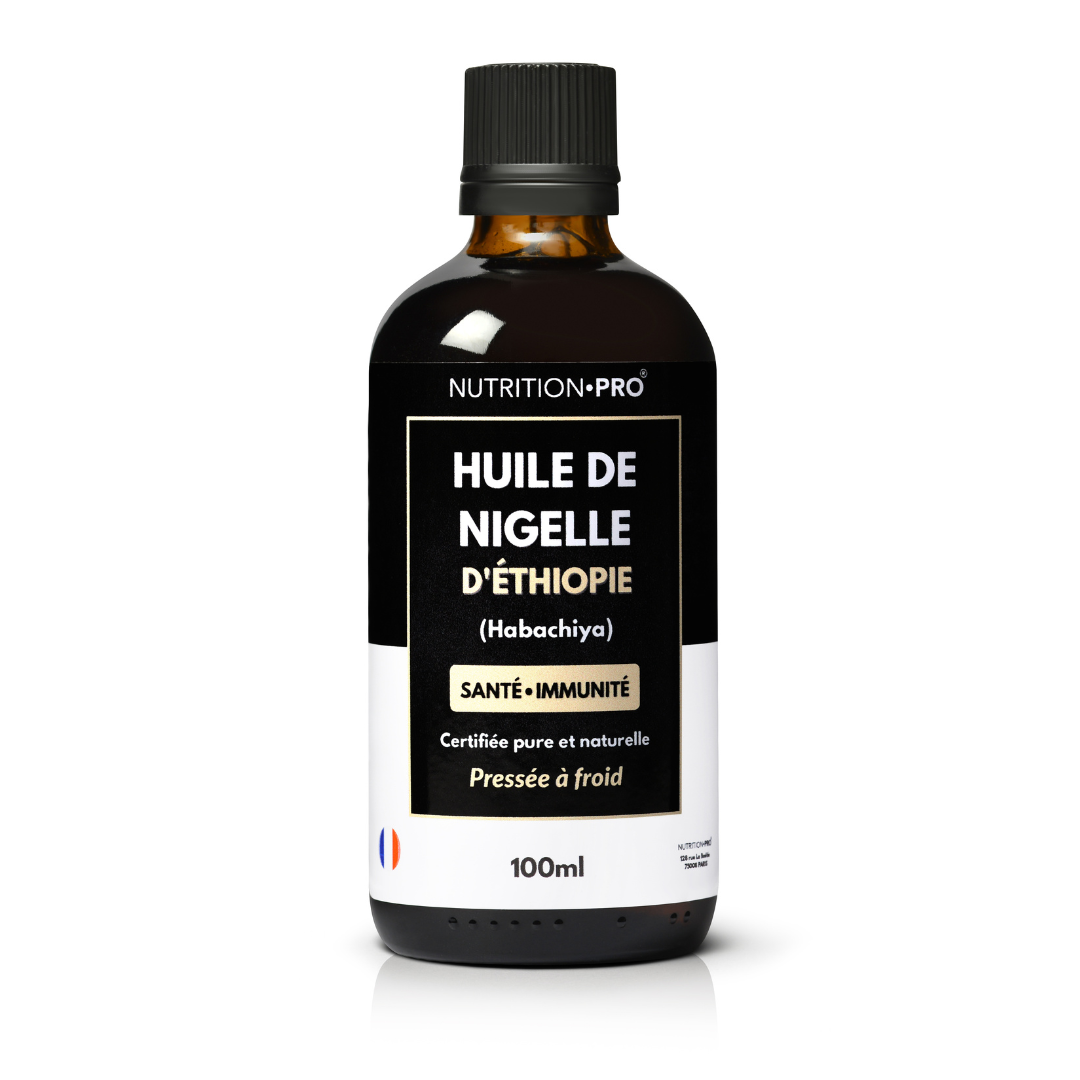
 MADE IN FRANCE


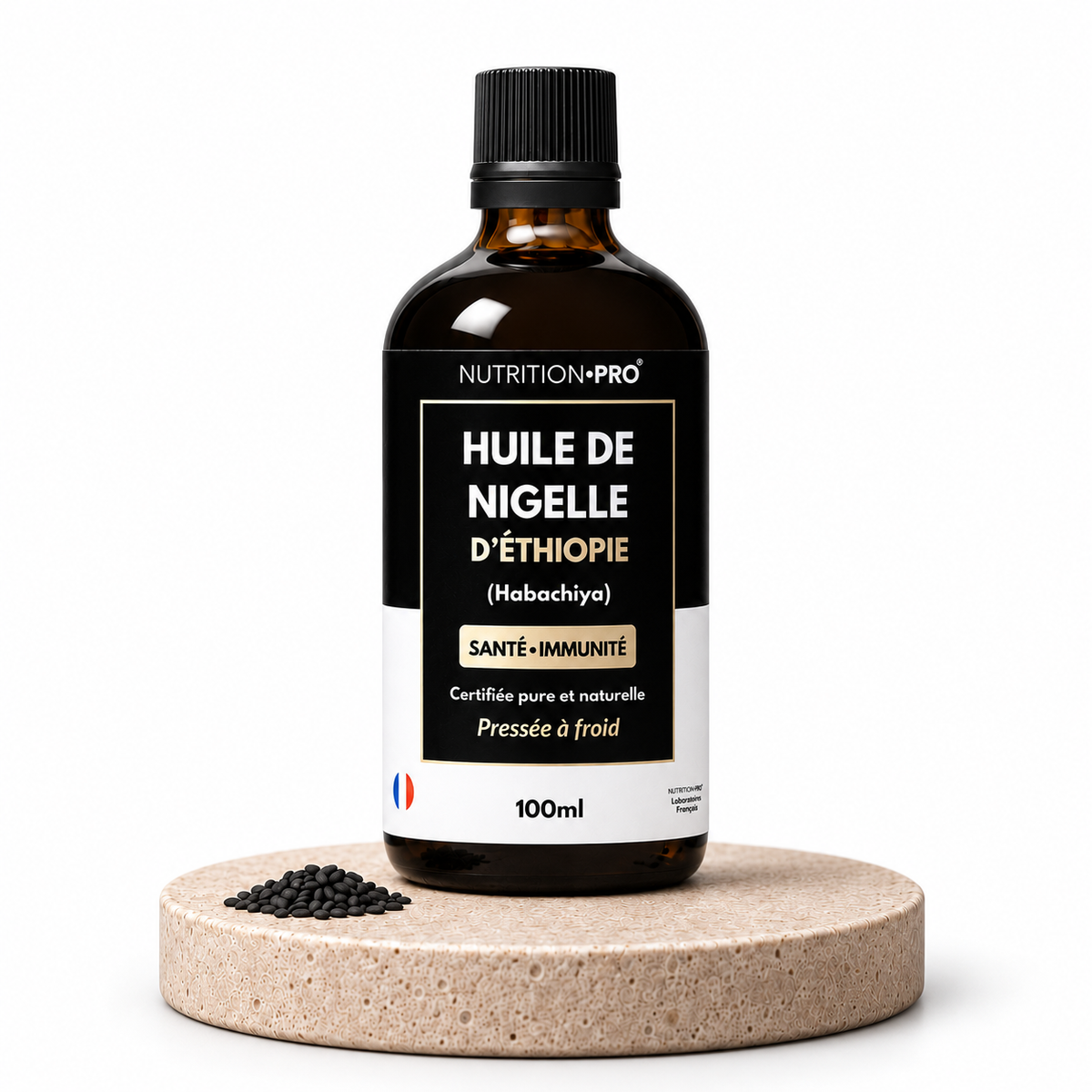
Black seed oil, world-renowned for its powerful medicinal properties, is one of the most consumed vegetable oils as a dietary supplement. Extracted from the precious seeds of Nigella sativa (a herbaceous plant), also known as black cumin seed, it stands out for its exceptional richness. Our oil is particularly distinguished by a thymoquinone level of 4.4%, one of the highest concentrations on the market.
Our Ethiopian black seed oil, natural and unfiltered, is made from rigorously selected seeds certified pure to over 99%. To preserve all its properties, the extraction is carried out by cold pressing, without any chemical treatment.
Naturally rich in omega-6 and omega-9, it also contains vitamins, trace elements and many bioactive compounds that actively contribute to maintaining optimal health.
This oil is intended for dual use: it can be used both internally for its benefits and externally for cosmetic applications.
Scientific studies confirm the exceptional properties of the black seed (black cumin seed), rich in over a hundred active compounds. A true concentrate of health and beauty benefits, it contains essential fatty acids, antioxidants, vitamins and minerals, making black seed oil a natural treasure recognized since Antiquity.
In addition to its general health benefits, this oil can also be applied externally.
Hair benefits:
Skin benefits:
Thanks to its high concentration of active ingredients and premium quality, this black seed oil is ideal for those looking for a natural, effective and versatile product.
Nutritional values per 100 g:
| Composition | Per 100 g |
|---|---|
| Energy | 876 kcal |
| Fat | 97.3% |
| — of which saturated | 15.28 g |
| — of which monounsaturated | 26.40 g |
| — of which polyunsaturated | 58.19 g |
| Carbohydrates | <0.1 g |
| Protein | <0.5 g |
Daily dose: 1 to 3 tsp (internal use)
Black seed oil, world-renowned for its powerful medicinal properties, is one of the most consumed vegetable oils as a dietary supplement. Extracted from the precious seeds of Nigella sativa (a herbaceous plant), also known as black cumin seed, it stands out for its exceptional richness. Our oil is particularly distinguished by a thymoquinone level of 4.4%, one of the highest concentrations on the market.
Our Ethiopian black seed oil, natural and unfiltered, is made from rigorously selected seeds certified pure to over 99%. To preserve all its properties, the extraction is carried out by cold pressing, without any chemical treatment.
Naturally rich in omega-6 and omega-9, it also contains vitamins, trace elements and many bioactive compounds that actively contribute to maintaining optimal health.
This oil is intended for dual use: it can be used both internally for its benefits and externally for cosmetic applications.
Scientific studies confirm the exceptional properties of the black seed (black cumin seed), rich in over a hundred active compounds. A true concentrate of health and beauty benefits, it contains essential fatty acids, antioxidants, vitamins and minerals, making black seed oil a natural treasure recognized since Antiquity.
In addition to its general health benefits, this oil can also be applied externally.
Hair benefits:
Skin benefits:
Thanks to its high concentration of active ingredients and premium quality, this black seed oil is ideal for those looking for a natural, effective and versatile product.
Nutritional values per 100 g:
| Composition | Per 100 g |
|---|---|
| Energy | 876 kcal |
| Fat | 97.3% |
| — of which saturated | 15.28 g |
| — of which monounsaturated | 26.40 g |
| — of which polyunsaturated | 58.19 g |
| Carbohydrates | <0.1 g |
| Protein | <0.5 g |
Daily dose: 1 to 3 tsp (internal use)
Overall rating: 4.7 / 5 from 232 reviews.
Bonjour, très satisfaite, je le recommande 😊

Excellent j’adore pour les cheveux et la chute

C’est une huile que je consomme régulièrement et que je connais bien. Celle-ci est fidèle à ce que l’on peut attendre d’une huile de nigelle de qualité.

Un produit naturel et efficace ! L'huile de nigelle Nutrition-Pro est de grande qualité, aux multiples bienfaits pour la peau, les cheveux et l’immunité. Facile à utiliser et 100 % authentique, je la recommande vivement pour une routine bien-être complète.

Cette huile est très bonne est une guérison

Salam a3laykoum wa Rahmatallah wa Barakatouh Très bon produit

Très bonne qualité donc vraiment efficace.

Très bon produit, je recommande

Super huile qui protège bien contre les petits virus qui circule ainsi que l’es protocole chimiothérapie atténue les effets secondaires Je recommande

je recommanderais,livraison rapide et conforme.Quand au produit bravo,efficace.En quelques jours arret de la chute de cheveux.

Excellente qualité. utilisée au quotidien.

Slm. Huile de très haute qualité. Et très bonne marque.
He comprado este producto porque tiene la potencia y calidad que otros no tienen.
Merci beaucoup 👍
Apparement une huile tres complete et j en prend une cuillerèe par jour en meme temps que la vitamine A
Thnx!
Super transaction, a l'écoute quand nous rencontrons des petit soucis lors de la livraison, ils sont réactif bravo Vous pouvez commander les yeux fermés
Bien
Huile de nigelle extra bien corsée rien a voir avec les autres huiles, la qualité est présente
This brand is the best. We have tried other brands...there were no good, no brand of soft gels is good...we had it test it. This one taken every night for 2 weeks gives you ; Cure for Stomach ulcers...it cure my ulcer No parasites Strong immune system Amazing for inflammation of intestines Works wonders in menstrual sintomas Flat belly Going every morning to the toilet If you have animals st home you should take it
Meilleur qualité vraiment et sa ce ressent merci je continuerai à prendre chez vous
Incroyable produit
Best product
Huile de nigelle a un petit arrière goût que je n'arrive plus a supporter.
Je recommande
Parfait !
Top
.
SUPER EN CAS DE RHUME ET DE MAUX DE GORGE
Efficace 👍
Très bon produit !! 👍
Huile de T.bonne qualité. Concentration 5*. Produit top
C’est génial je recommande
Excellent produit
Bon produit !!! Je recommande. Merci nutrition pro.
Je viens de commencer Je vous dirais plus tard Cordialement
Je recommande Super produit
Super
Pour l instant je l utilise pour mes cheveux et j aime bien
efficace sur les douleurs
Black seed (Nigella sativa) and its cold-extracted oil come from the same plant, but differ significantly in concentration, bioavailability and use.
Both are beneficial, but their effects are not comparable: the oil is the most concentrated and active form.
Black seeds have been used for centuries in traditional Eastern and Ayurvedic medicine.
They naturally contain fibre, essential fatty acids, vitamins and antioxidants, as well as thymoquinone, the main active compound.
However, when consumed whole or simply ground:
They are therefore ideal for maintaining digestive health, flavouring dishes or supporting general wellbeing, but their potency remains lower than that of the oil.
Cold-pressed black seed oil is obtained from the seeds without chemical treatment.
This process extracts all the fat-soluble active compounds, particularly thymoquinone, polyphenols and essential fatty acids.
This makes it:
While the seed works slowly, the oil works quickly and deeply, particularly on:
Choose the oil if you want a comprehensive, fast action on health, skin, hair or immunity.
It offers optimal bioavailability and concentrates all the active compounds in black seed.
Choose the seeds for culinary or preventive use, adding them to dishes, infusions or baked goods.
They remain useful for maintaining digestive comfort and providing mild antioxidant support.
Combining both forms is ideal: seeds in cooking for everyday use, and oil taken internally as a course or applied externally for a targeted action.
Nutrition•pro Ethiopian Black Seed Oil, made from 100% pure seeds and cold-pressed, embodies the most authentic, potent and natural form of black seed, ideal for a complete health course or quality cosmetic care.
Black seed oil, also known as nigella seed oil or black cumin oil, is a vegetable oil obtained by first pressing of black cumin seeds.
Our Ethiopian black seed oil is produced with a constant concern for quality and authenticity.
Here is the detailed manufacturing process that guarantees its exceptional purity:
By following these precise steps, we ensure that our black seed oil is among the purest and most natural on the market, thus offering our customers an exceptional product for their well-being.
Black seed oil is a versatile product that can be used in different ways depending on your needs.
Here are some tips on using it:
Internal use:
External use:
For inhalation: For a moment of respiratory wellbeing, add a few drops of black seed oil to hot water and inhale the steam.
Nutrition•pro Ethiopian black seed oil can be taken internally to enjoy its full benefits for health, immunity and general vitality.
Obtained through cold pressing and unfiltered, it retains all its essential fatty acids, antioxidants and natural active compounds, particularly thymoquinone, the main molecule responsible for its effects.
The recommended dose depends on your goal and digestive tolerance:
This spacing allows gradual absorption and maintains continuous immune system support.
When using it for the first time, always start with ½ teaspoon per day for a few days to give your body time to adjust.
Taking black seed oil on an empty stomach optimises its intestinal absorption and enhances its effects:
This is the ideal time to strengthen the immune system and stimulate digestion.
Black seed oil can be:
It is recommended never to cook it, as heat destroys some antioxidants and alters thymoquinone.
For a lasting effect, a 1 to 3 month course is recommended and can be repeated several times a year.
Black seed oil works deeply, particularly on:
Consistency matters more than quantity: 1 spoonful every day for several weeks is better than irregular doses.
Nutrition•pro Ethiopian black seed oil, 100% pure and cold-pressed, provides a powerful natural course to support immunity, vitality and overall health.
The taste of black seed oil is very particular and recognizable among all vegetable oils.
It directly reflects its quality, freshness and richness in active ingredients.
A pure, cold-pressed and unfiltered black seed oil, like that of Nutrition•pro, has an intense and aromatic flavor, typical of Nigella sativa.
Authentic black seed oil presents a vivid and complex flavor, often compared to that of a spicy essential oil.
It releases peppery, bitter and slightly spicy notes, with a warm sensation at the back of the throat due to thymoquinone, the major active compound of the seed.
Its taste profile evokes both:
These pronounced aromas are a guarantee of purity and effectiveness: the more flavor the oil has, the more natural active ingredients it contains.
A black seed oil that is too neutral, too light or without bitterness is often:
These processes attenuate the flavor, but also the concentration of thymoquinone and antioxidants.
In other words: the less flavor it has, the less active it is.
For people sensitive to the aromatic power of black seed oil, there are several simple ways to soften its taste:
These tips preserve all its effectiveness, without altering its benefits.
Nutrition•pro Ethiopian Black Seed Oil, by its intense and natural aromatic flavor, testifies to its exceptional purity and richness in thymoquinone.
It is a living and powerful oil, ideal for internal and external use, in the service of health and overall well-being.
Thymoquinone is the main bioactive compound naturally present in black seed (black cumin seed). It gives black seed oil many of the properties recognised for centuries.
A powerful natural ingredient, thymoquinone is distinguished by its antioxidant effects, helping combat oxidative stress and cellular ageing. It also has recognised protective properties, making it a key component in supporting overall wellbeing.
By acting at the heart of the body's defence mechanisms, it helps strengthen internal balance, while contributing to improved skin and hair appearance when used externally.
This is why the thymoquinone level is an essential quality indicator: the higher it is, the more concentrated in active compounds, and therefore effective, the black seed oil is.
Thymoquinone is the main active compound of black seed oil, responsible for most of its benefits. The higher its level, the more concentrated and potentially effective the oil is. With a level of 4.4%, our oil is among the richest on the market, guaranteeing superior quality and optimal power.
Our primary commitment is to offer top-quality items while adopting a transparent approach.
We take great pride in disclosing the conclusions of the examinations carried out at Eurofins and SAI Chimie laboratories in order to establish the trust of our customers in our product.
The investigations conducted by these renowned laboratories make it possible to verify the purity of cold-pressed black seed oil, as well as its content of essential fatty acids, vitamins and minerals.
Black seed oil, also known as black cumin oil, is a natural treasure offering a wealth of health and beauty benefits.
It contains a diverse range of chemical compounds contributing to its unique composition. These include thymoquinone, often highlighted for its specific role. It also contains vitamin E, along with molecules such as nigelline and nigellone. Carotenoids, which are natural pigments, also form part of its composition. Black seed oil is also rich in essential minerals, including zinc, iron and magnesium. It contains essential oils that give it distinctive aromatic characteristics. Not forgetting essential fatty acids, such as omega 3, linoleic acid and oleic acid, which complete this oil's biochemical profile.
Together, these compounds make black seed oil a valuable skincare ally, addressing a wide range of needs.
Here is a list of this valuable oil's potential benefits:
This list shows the variety of potential health, beauty (cosmetic) and wellbeing benefits of black seed oil. However, results may vary from person to person, and it is best to consult a healthcare professional before adding it to your routine.
Black seed oil, extracted from black cumin seeds, is famous for its beneficial effects on hair, in particular:
For whom?
Ideal for:
How to use it?
In your homemade beauty recipes, it integrates perfectly as:
Used for its skin benefits, black seed oil offers remarkable effects on the skin:
For whom?
Perfect for:
How to use it?
In your skincare rituals, it lends itself to various uses:
Recognising quality black seed oil is essential to enjoying its full benefits.
Origin, purity, extraction method, colour and packaging determine the active compound content, particularly thymoquinone, the molecule responsible for most of black seed's health effects.
Not all black seed oils are equal.
Nigella sativa seeds grown in Ethiopia are recognised as having the highest thymoquinone concentration in the world.
They produce an oil that is:
Nutrition•pro Ethiopian black seed oil comes from 100% pure seeds, certified at over 99%, carefully selected for their potency and purity.
A cold-pressed oil retains all its essential fatty acids (omega-3, 6 and 9), vitamins (A, E and B) and natural antioxidants.
This gentle method, without solvents or refining, protects sensitive molecules such as thymoquinone, polyphenols and tocopherols.
Heated or refined oils lose a significant proportion of their nutrients and effectiveness.
Nutrition•pro oil is cold-pressed, without additives or chemical treatment.
An authentic, unfiltered black seed oil always has:
An oil that is too pale, odourless or clear has probably been refined, filtered or diluted with other vegetable oils (such as sunflower), greatly reducing its benefits.
A quality oil should always show on its label:
A brand transparent about its origin and production method is a sign of reliability and professionalism.
An unfiltered oil is often darker and slightly cloudy, a positive sign.
It contains more active microparticles from the seed, enhancing its effectiveness on health, skin and hair.
Packaging is equally essential:
A high-quality black seed oil should meet all the following points:
Nutrition•pro Ethiopian Black Seed Oil meets all these criteria.
Natural, unfiltered, cold-pressed and highly concentrated in thymoquinone, it offers maximum effectiveness in supporting immunity, vitality, skin and hair.
Our black seed oil, being unfiltered and very concentrated, requires some precautions of use:


