

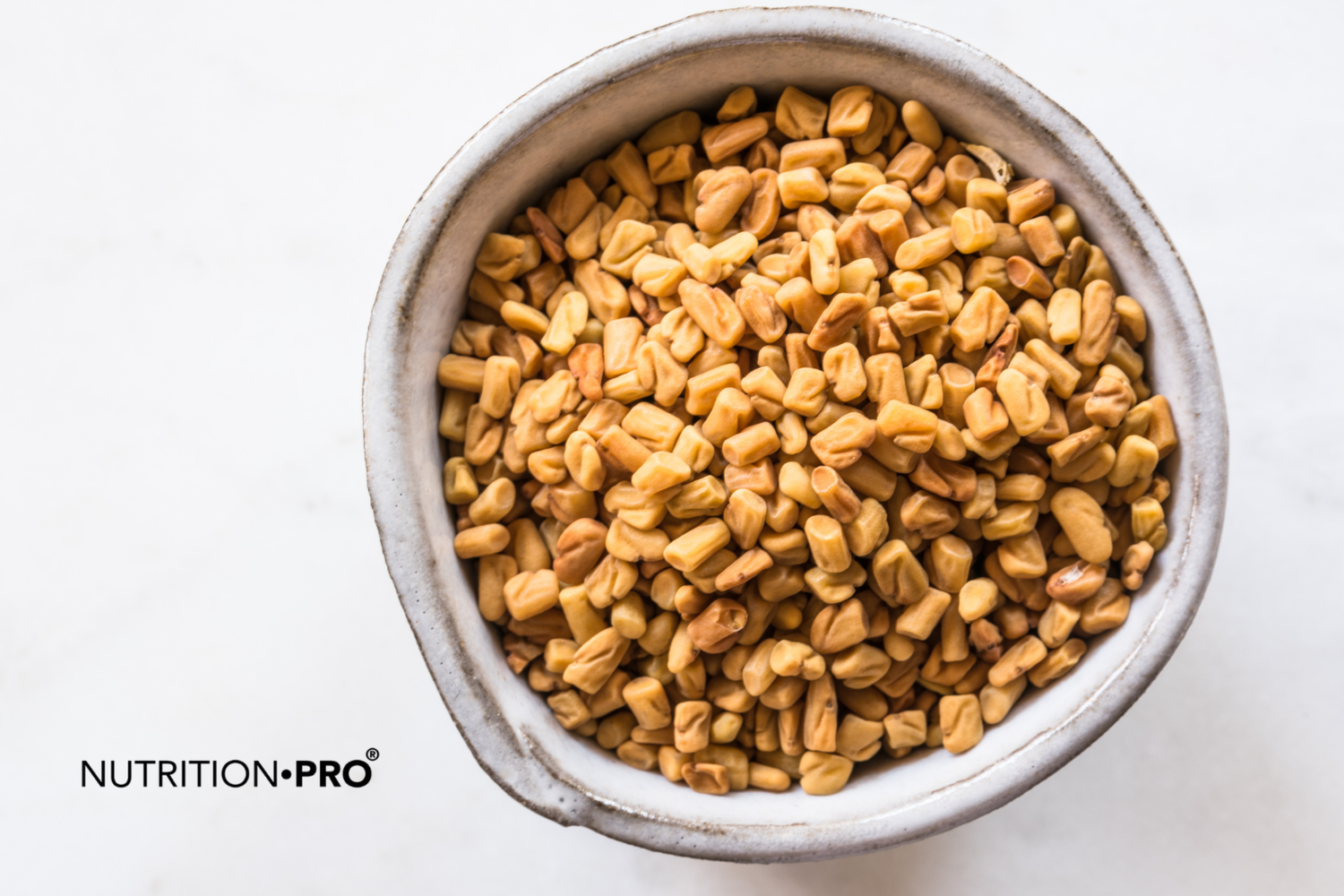
On fenugreek, it's the subject where data is most abundant and most consistent. Not testosterone, not lactation: blood sugar. Five meta-analyses have been published on this question alone, and four of them found a significant reduction in glycated hemoglobin.
This article provides the figures from each, explains why they don't all agree on fasting blood sugar, compares fenugreek against five other plants in a direct comparison, and details the point that matters most: this subject concerns people often under treatment, and this entirely changes the course of action.

What the meta-analyses found. Onglycated hemoglobin, the signal is most consistent: -0.85 points in a 2014 meta-analysis, -0.58 in 2020, -0.88 in 2023, and a significant reduction confirmed by a fourth. On fasting blood sugar, three analyses found a significant reduction, including -0.96 mmol/l and -12.94 mg/dl, a fourth one did not.
The comparison between plants. A network meta-analysis covering 44 trials and 3,130 participants compared six plants: on fasting blood glucose, apple cider vinegar comes out ahead of fenugreek, turmeric and cinnamon. But onglycated hemoglobin, only two show significant results, apple cider vinegar and fenugreek. The deciding condition: significant effects only appear at medium to high doses and in people with diabetes. The critical point: risk of additive hypoglycemia with antidiabetic treatment.
- Five meta-analyses, figure by figure
- Glycated hemoglobin, the most consistent result
- Fenugreek compared to five other plants
- By what mechanism, and the indication provided by HOMA-IR
- The deciding condition: dose and profile
- Interactions and safety, the key point not to miss
- In practice
- Frequently asked questions
Five meta-analyses, figure by figure
| Meta-analysis | Fasting blood glucose | Glycated hemoglobin |
|---|---|---|
|
2014, Nutrition Journal 10 trials |
-0.96 mmol/l (CI -1.52 to -0.40) |
-0.85% (CI -1.49 to -0.22) |
|
2020, Complement Ther Med 12 trials |
-12.94 mg/dl (CI -21.39 to -4.49) |
-0.58% (CI -0.99 to -0.17) |
|
2023, Medicina 14 trials, 894 participants |
Not significant (p = 0.76) |
-0.88 (CI -1.49 to -0.27) |
|
2023, Int J Mol Sci 10 trials, 706 participants |
Significant reduction | Significant reduction |
|
2023, network meta-analysis 44 trials, 3,130 participants |
Significant decrease (SMD -19.64) |
Significant, one of only two |
Four out of five meta-analyses found a significant decrease in glycated hemoglobin, with similar magnitudes, between 0.58 and 0.88 points. This is a remarkable convergence for a plant ingredient, and it deserves to be highlighted.
On fasting blood glucose, there is less agreement: a 2023 analysis found no significant effect where three others did. The authors of several of these studies identified the same explanation: significant heterogeneity between trials, reaching up to 85% in one of the analyses, linked to differences in populations, doses, and preparations used. Several also noted that the methodological quality of the included trials often remains low and called for rigorous double-blind trials.
Glycated hemoglobin, the most consistent result
A useful clarification before the figures. Fasting blood glucose is a snapshot taken at a single moment, sensitive to the previous meal, sleep, and stress.Glycated hemoglobin reflects average blood glucose over the past two to three months . This is why it serves as a reference in diabetes monitoring, and why an effect measured on it has far greater significance than a variation in point-in-time blood glucose.
Yet it is precisely on this marker that results are most consistent. A notable fact: in two of these meta-analyses,heterogeneity in glycated hemoglobin was zero, whereas it reached 80 to 85% on fasting blood glucose. In other words, trials diverge greatly on the point measurement and agree on the underlying measure.
Fenugreek compared to five other plants
This is the most useful finding in this report. A network meta-analysis published in Diabetes & Metabolic Syndrome compiled 44 randomized trials totaling 3,130 participants to compare six plants among themselves in people with type 2 diabetes.
| Plant | Effect on fasting blood glucose | Effect on glycated hemoglobin |
|---|---|---|
| Apple cider vinegar | The strongest in the comparison (DMS -28.99) | Significant |
| Fenugreek | Second (DMS -19.64) | Significant |
| Turmeric | Significant (DMS -13.15) | Not significant |
| Cinnamon | Significant (DMS -9.73) | Not significant |
The authors conclude that several of these plants can be considered a useful adjuvant in glycemic control of type 2 diabetes, and encourage healthcare professionals to integrate them into standard care.
Adjuvant means in addition to a treatment, never in place of it. This is the framework in which these results make sense, and it is also what makes it essential to discuss it with your doctor: adding an adjuvant to a treatment means modifying the therapeutic equation.
Also note the internal hierarchy. On fasting blood glucose, fenugreek comes behind apple cider vinegar. But on glycated hemoglobin, the baseline marker, only two of the six reach significance, and fenugreek is one of them. Turmeric and cinnamon, though very present on store shelves for this use, do not achieve this. We devote a dedicated article to apple cider vinegar, the other plant of the duo.
By what mechanism, and the clue given by HOMA-IR
Meta-analyses do not merely measure blood glucose: some also measureHOMA-IR, an insulin resistance index. And there, the result is different.
The 2023 meta-analysis covering 706 participants reports significant reductions in fasting blood glucose, blood glucose two hours after glucose load, and glycated hemoglobin, but no significant reduction in HOMA-IR.
If blood glucose drops without insulin resistance improving in a measurable way, the most likely mechanism is not improved insulin sensitivity, but an action upstream, in the digestive tract : a slowing of gastric emptying and carbohydrate absorption.
This aligns with the seed's composition, particularly rich in soluble fiber, including galactomannans, which form a viscous gel and slow the passage of sugars into the bloodstream. This also explains why the effect appears on blood glucose after a carbohydrate load, and why the whole seed, with its fibers, is the form tested in this literature.
Honest caveat: this is a coherent reading of the results, not a mechanistic demonstration. The absence of a significant effect on one marker does not amount to proof of absence of effect.
The condition that decides: dose and profile
The meta-analysis published in Nutrition Journal brings the most actionable element to this review. Its authors sought to explain the significant heterogeneity between trials, and they partially resolved it.
Their conclusion: the heterogeneity is explained in part by diabetic status and by dose. Significant effects on fasting blood glucose and blood glucose two hours after a carbohydrate load were found only in studies administering medium to high doses of fenugreek, and in people with diabetes.
| Profile | What the data suggest |
|---|---|
| Person with diabetes, medium to high dose | This is the configuration in which significant effects appear |
| Person with diabetes, low dose | Effects not found to be significant |
| Person without diabetes | Effects not found to be significant on these criteria |
On doses, an honest clarification: the studies refer to "medium or high" doses without a single threshold emerging, as trials used highly variable preparations and quantities. This is moreover one of the limitations that the authors point out, calling for trials using a well-characterized preparation at adequate dose. Follow the instructions on your product's label, and discuss the amount with your doctor if you are concerned.
Interactions and safety, the key point not to miss
Let's start with what the data say about tolerability, as they are rather good. The 2023 meta-analysis involving 706 participants reports thatno hepatic or renal toxicity was observed, and no serious adverse effects associated with fenugreek, despite minor digestive effects in some studies. The authors conclude that fenugreek improves glycemic control and lipid profile safely.
If fenugreek lowers blood sugar, and if an antidiabetic treatment lowers blood sugar, then the two together lower it further. It is the very mechanism of efficacy that creates the risk, and this is why it cannot be dismissed out of hand.
Concretely: a hypoglycemia can occur, with tremors, sweating, weakness, dizziness, confusion. If you are taking an antidiabetic treatment, whatever it may be, discuss it with your doctor first, not after. Only they can decide if the addition is relevant and, if necessary, adapt monitoring. Never modify a treatment on your own based on an article, including this one.
Other situations requiring medical advice
- Anticoagulant treatment, a situation in which fenugreek requires precautions.
- Pregnancy, where it is not recommended.
- Known allergy to legumes, as fenugreek belongs to this botanical family.
- Scheduled surgery : inform the team of any supplement use, as you would with any product affecting blood sugar or coagulation.
- And more broadly, any ongoing treatment.
One final word on a benign but disconcerting effect: fenugreek frequently gives urine and perspiration a maple syrup odor. This is harmless and reversible upon discontinuation, but it's better to know about it and mention it if a medical examination is planned.
In practice
This is the area where fenugreek has the strongest evidence, and it's also the one that requires the most precautions. Four out of five meta-analyses find a significant decrease in glycated hemoglobin, and in a direct comparison among six plants, only two achieve this. However, effects appear in diabetic individuals, at moderate to high doses, that is, in a population most often under treatment. A real effect is not an effect without consequences: here, it should be discussed with a doctor.
Frequently asked questions
What the studies show
Does fenugreek lower blood sugar?
This is the area where its evidence is strongest. Four out of five meta-analyses find a significant decrease in glycated hemoglobin, between 0.58 and 0.88 points. On fasting blood sugar, three analyses find a significant decrease, including one of 0.96 mmol/l and another of 12.94 mg/dl, while a fourth finds no significant effect.
Why do results differ from one analysis to another?
Due to significant heterogeneity between included trials, reaching up to 85% in one analysis. This is due to differences in populations, doses, and preparations used. Several authors also note that the methodological quality of trials often remains weak and call for rigorous double-blind trials.
Why emphasize glycated hemoglobin rather than fasting blood sugar?
Because it reflects average blood sugar over the preceding two to three months, whereas fasting blood sugar is a single snapshot sensitive to the previous meal, sleep, or stress. It is also on this marker that results are most consistent: in two meta-analyses, heterogeneity was zero while it reached 80 to 85% on fasting blood sugar.
Is a drop of 0.85 points in HbA1c significant?
It is a magnitude that matters in diabetology, and not a cosmetic variation. However, this does not make it a treatment, and it does not authorize anyone to change theirs. But it explains why this topic is taken seriously in scientific literature, unlike other traditional uses of the same plant.
How does fenugreek compare to other plants?
A network meta-analysis covering 44 trials and 3,130 participants compared six plants in people with type 2 diabetes. On fasting blood sugar, apple cider vinegar ranks first ahead of fenugreek, turmeric, and cinnamon. But on glycated hemoglobin, only two stand out as significant: apple cider vinegar and fenugreek. Turmeric and cinnamon do not achieve this.
Does fenugreek affect anything other than blood sugar?
Meta-analyses also report effects on the lipid profile: decrease in total cholesterol and triglycerides, increase in HDL cholesterol in one study, decrease in total and LDL cholesterol in another. However, no significant difference was found on body mass index.
Mechanism and conditions
How does it work?
A detail in the results provides strong evidence: blood sugar decreases but the HOMA-IR insulin resistance index does not decrease significantly. This points toward an action upstream, in the digestive tract, rather than toward improved insulin sensitivity. This is consistent with the seed's richness in soluble fiber, which slows gastric emptying and carbohydrate absorption. This is a coherent reading of the data, not a mechanistic demonstration.
Do you need to be diabetic for it to work?
That is what the data suggests. The meta-analysis published in Nutrition Journal sought to explain the heterogeneity between trials and attributes it in part to diabetic status and dose: significant effects on fasting blood sugar and post-load blood sugar were found only in studies administering moderate to high doses in people with diabetes.
What dose should you take?
No single threshold emerges. The literature refers to moderate or high doses without a reference quantity being established, as trials use widely varying preparations and amounts. This is also a limitation noted by the authors, who call for trials using a well-characterized preparation at sufficient dose. Follow your product's instructions and discuss it with your doctor if applicable.
Seed powder or standardized extract?
On this specific subject, it was fenugreek seeds that were tested in meta-analyses, not a standardized extract. This is a notable difference from other uses of the plant. Since the soluble fibers in the whole seed likely participate in the mechanism, the complete form is consistent with available data.
How long before you see results?
The relevant marker, glycated hemoglobin, reflects two to three months of average blood glucose: this is the timeframe on which trials measure an effect. Judging based on capillary blood glucose taken one morning makes no sense, as daily variability far exceeds the expected effect.
Safety and precautions
Is fenugreek safe?
Data are reassuring regarding toxicity. The meta-analysis involving 706 participants reported that no hepatic or renal toxicity was observed and no serious adverse effects associated with fenugreek, despite mild digestive effects in some studies. The primary risk is therefore not toxicological, but related to interactions.
What is the risk if I'm already taking an antidiabetic medication?
Hypoglycemia, from the additive effects. It is the very mechanism of efficacy that creates the risk: if fenugreek lowers blood glucose and your treatment does too, together they lower it more. Tremors, sweating, weakness, dizziness, or confusion should raise concern. Discuss this with your doctor before taking it, and never modify your treatment on your own.
Can it replace my treatment?
No, under no circumstances. The term used by the authors themselves is adjuvant, meaning in addition to a treatment and never in its place. Stopping or reducing antidiabetic treatment without medical advice carries serious consequences. Fenugreek sits alongside diet, physical activity, and treatment, never in front of it.
Are there other interactions?
Precautions are recommended in case of anticoagulant treatment. Add to this pregnancy, where fenugreek is not advised, known allergy to legumes since it belongs to this botanical family, and scheduled surgery, a situation in which any supplement use must be reported to the team. More broadly, any ongoing treatment warrants professional advice.
Why do my urine smell like maple syrup?
This is the most characteristic effect of fenugreek, on urine as well as perspiration. It is benign and disappears upon discontinuation. One useful point, however: if a medical examination is planned, mention fenugreek use, as an unusual odor could raise questions for the medical team.
Can you take it without being diabetic, as prevention?
Significant effects were not found in non-diabetic individuals on the studied criteria. This does not mean there is nothing, but that available data do not demonstrate it. If you are prediabetic, this is a profile included in some trials, and the question is better posed to your doctor rather than decided alone.
Can fenugreek be combined with apple cider vinegar?
These are the only two plants in the comparison that significantly move glycated hemoglobin, which makes the idea tempting. But no trial has evaluated this combination, and more importantly, combining two substances acting on blood glucose mechanically increases the risk of hypoglycemia in a treated person. This is typically the kind of combination not to decide on alone.
What should you take away about fenugreek and blood glucose?
That this is the best documented area for this plant, with four out of five meta-analyses finding a significant decrease in glycated hemoglobin. That in a direct comparison between six plants, only two move this marker and fenugreek is one of them. That effects appear at moderate to high doses in diabetic individuals. And that since this population is most often treated, the question falls within a medical conversation and not an isolated purchase.
Glossary
- Glycated hemoglobin (HbA1c)
- Reflection of average blood glucose over the past two to three months, the reference marker for diabetes monitoring.
- Fasting blood glucose
- Blood sugar level measured while fasting, a snapshot sensitive to conditions the previous day.
- Blood glucose two hours after load
- Measurement taken two hours after ingestion of 75 g of glucose, during a tolerance test.
- HOMA-IR
- Index calculated from fasting blood glucose and fasting insulin levels, reflecting insulin resistance.
- Adjuvant
- Element added as a supplement to a treatment, never in its place.
- Galactomannans
- Soluble fibers abundant in fenugreek seed, forming a viscous gel in the digestive tract.
- Heterogeneity
- Degree of divergence between results of trials included in a meta-analysis.
- Network meta-analysis
- Method allowing comparison of treatments with each other, including without direct confrontation.
Sources
The studies cited below were identified via PubMed.
- Neelakantan N, et al. Effect of fenugreek consumption on blood glucose: meta-analysis of clinical trials. Nutrition Journal, 2014;13:7. DOI
- Kim J, et al. Effect of fenugreek in type 2 diabetes and prediabetes: systematic review and meta-analysis of randomized controlled trials. International Journal of Molecular Sciences, 2023;24(18):13999. DOI
- Kumar S, et al. Comparative efficacy of six plants in managing glycemic status in type 2 diabetic patients: systematic review and network meta-analysis. Diabetes & Metabolic Syndrome, 2023;17(8):102826. DOI
- Khodamoradi K, et al. Effects of fenugreek on cardiometabolic risk factors in adults: systematic review and meta-analysis. Complementary Therapies in Medicine, 2020;52:102416. DOI
- Shabil M, et al. Effect of fenugreek on hyperglycemia: systematic review and meta-analysis. Medicina, 2023;59(2):248. DOI


