

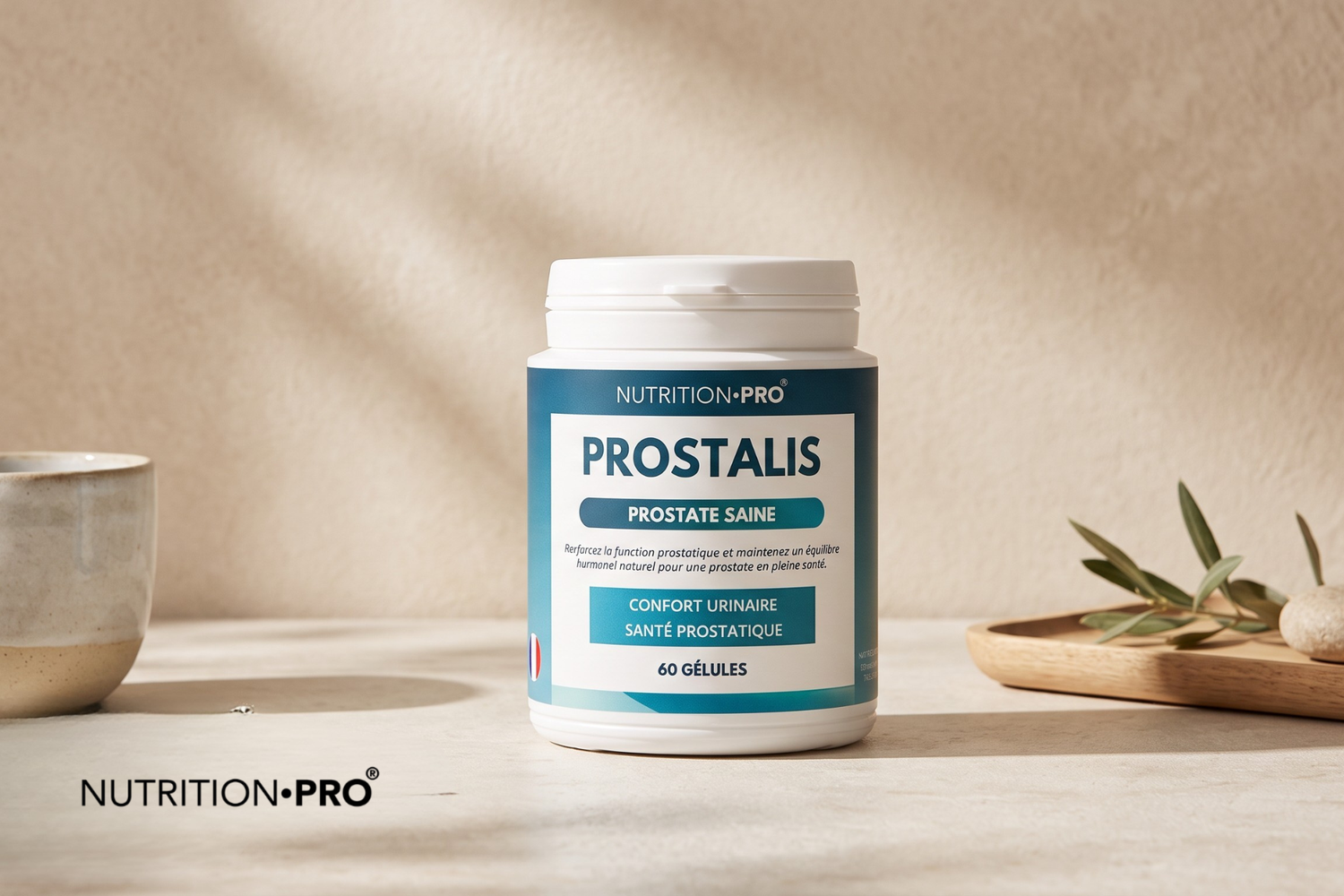
If you typed "Prostalis" into a search engine, you probably came across two things that have nothing to do with each other: our complex of seven plants manufactured in France, in a bottle of 60 capsules, and another product bearing the same name, in a box of 30, with a different composition, sold by sites presenting themselves as pharmacies. This page begins by clearing up this confusion, because it is the first question we receive from our customer service team.
Next, we do what we do for each of our products: detail the composition capsule by capsule, report what published clinical trials say about each of the plants, including when they are less favorable than industry advertising, state where Prostalis dosages compare to those in studies, publish verified reviews without filtering, and precisely indicate where the product is sold and where it is not.

Two products, one name. Nutrition•pro's Prostalis can be identified by four markers: the manufacturer's name on the label, a bottle of 60 capsules, a composition of seven plants beginning with African plum tree and nettle, and an identifiable sales channel. The product with the same name comes in a box of 30, combines tribulus, ginseng, lycopene and vitamin C, and presents itself as a treatment for prostatitis, which no dietary supplement is.
What studies say about our plants. African plum tree and nettle have the most favorable data, a Cochrane review for the former, a trial of 620 men over six months for the latter. Serenoa repens is well tolerated but its isolated efficacy is disputed by the most recent Cochrane review. Pumpkin seed, fireweed, and quercetin each have a positive trial, but at doses higher than those in Prostalis. Maitake has no clinical data on the prostate. What to remember: a combination of plants at moderate doses, well tolerated, not a medication, and never a substitute for a consultation when urinary symptoms develop.
- Two products bear the name Prostalis: how to tell them apart
- Prostalis composition, capsule by capsule
- What studies say about each of the seven plants
- Prostalis dosages compared to trial dosages
- Customer reviews, including reservations
- Where to buy Prostalis, and where it is not sold
- How to take it, and when to consult instead
- Frequently asked questions
Two products bear the name Prostalis: how to tell them apart
Prostalis is the name we gave in 2024 to our prostate complex. Since then, a second product has appeared under the same name, sold by a network of sites in French, English, Spanish, and Italian. It has no connection with Nutrition•pro. Here is what sets them apart, point by point:
| Prostalis by Nutrition•pro | The product with the same name | |
|---|---|---|
| Manufacturer | Nutrition•pro, French company, Paris 8th, identified customer service | No identifiable manufacturer on the sites selling it |
| Packaging | Bottle of 60 capsules, 30 days | Box of 30 |
| Composition | African Plum, Nettle, Serenoa repens, Pumpkin, Maitake, Willowherb, Quercetin | Tribulus, Ginseng, Lycopene, Pumpkin, Vitamin C |
| Displayed Status | Dietary Supplement, compliant labeling | Presented as a treatment "against prostatitis", with "instructions" and "dosage" |
| Where it is sold | nutritionpro.fr, partner pharmacies and health stores, major online marketplaces | Sites presented as French pharmacies or healthcare facilities, without registration number with the Order |
| Displayed Reviews | Verified reviews collected after purchase, positive and reserved opinions published | Series of reviews all dated the same day, "pharmacist recommendations" not verifiable |
A merchant site that presents itself as a French pharmacy must display its registration number with the National Order of Pharmacists and the address of the physical pharmacy. "Instructions" with "therapeutic indications" on a dietary supplement is a red flag: no supplement has the right to present itself this way. And if customer reviews all bear the same date, they were not collected after purchase.
If you ordered a Prostalis product in a box of 30 from one of these sites, it is not our product, and we can neither guarantee its composition nor handle a complaint about it. Write to us at serviceclient@nutritionpro.fr if you have any doubt about a product sheet.
The composition of Prostalis, capsule by capsule
The complete composition appears on the label and on the product sheet. Here it is for one day, or two capsules:
| Ingredient | Part Used | Dose for 2 Capsules |
|---|---|---|
| African Plum (Pygeum africanum) | Bark | 300 mg |
| Stinging Nettle (Urtica dioica) | Root | 300 mg |
| Serenoa repens (Saw Palmetto) | Berry | 160 mg |
| Pumpkin (Pumpkin seed) | Seed | 160 mg |
| Maitake (Grifola frondosa) | Fruiting body | 100 mg |
| Small-flowered willowherb (Epilobium parviflorum) | Aerial parts | 100 mg |
| Quercetin | Japanese Pagoda tree flowers | 100 mg |
The capsule shell is made of HPMC, a plant-based cellulose: no animal gelatin, making the product compatible with a vegetarian diet. It contains no artificial colors, preservatives, or unnecessary fillers.
The choice of plants is not original, and that is intentional: these are the five most studied plants in urology for male urinary comfort, supplemented by two active ingredients with antioxidant properties. The following section examines what research actually says about each one.
What studies say about each of the seven plants
We report here the randomized trials and systematic reviews indexed on PubMed, with their DOI identifier. Some results are favorable, others less so. We present them in the order of the doses in the formula.
African plum tree: a favorable Cochrane review, based on short-term trials
18 randomized trials, 1,562 men: twice as likely to report an overall improvement in symptoms compared to placebo, nocturia reduced by 19%, maximum flow rate increased by 23%.
Wilt T et al., Cochrane Database of Systematic Reviews, 2002. DOI 10.1002/14651858.CD001044
The authors note trials of small size, with an average duration of 64 days, variable doses and preparations, and tolerability comparable to placebo. The African plum tree is the plant in Prostalis with the oldest and most consistent data, but the literature has not been substantially expanded since.
Stinging nettle: one large trial, but only one
620 men, 6 months: IPSS score improved from 19.8 to 11.8 with nettle compared to 19.2 to 17.7 with placebo, maximum flow rate improved by 8.2 mL/s versus 3.4, post-void residual reduced from 73 to 36 mL. No adverse effects identified.
Safarinejad MR, Journal of Herbal Pharmacotherapy, 2005. PubMed 16635963
The design is solid and the sample size substantial. The limitation is that it isa single trial, from a single center, and the author himself calls for replication. To date, this has not occurred at this scale.
Serenoa repens: well tolerated, isolated efficacy debated
27 trials, 4,656 participants: Serenoa repens alone provides little or no difference in urinary symptoms and quality of life in the short term compared to placebo, with a high level of evidence. Uncertainty remains about its role when combined with other plants.
Franco JVA et al., World Journal of Men's Health, 2024. DOI 10.5534/wjmh.230222
This is the least favorable result on this page, and we report it as-is. Two complementary meta-analyses nuance the picture without contradicting it:
4 trials, 1,080 patients, at least 6 months: effect equivalent to tamsulosin on IPSS score, quality of life and post-void residual, with significantly fewer ejaculation disorders and libido decrease.
Cai T et al., American Journal of Men's Health, 2020. DOI 10.1177/1557988320905407
20 studies: no significant difference in sexual function between Serenoa repens and placebo. The widespread online concern about a negative effect on sexuality is not confirmed.
Paulis G et al., Archivio Italiano di Urologia e Andrologia, 2021. DOI 10.4081/aiua.2021.4.475
Honest reading: Serenoa repens is one of the best-tolerated plants in urology, including on sexual function, but its efficacy as monotherapy against placebo is not established by the best available evidence synthesis. Its place in Prostalis is part of a combination, which the Cochrane review specifically says remains to be documented.
Pumpkin seeds: whole seeds, not the extract
1,431 men aged 50 to 80: 58.5% responders with 10 g of whole seeds per day, compared to 47.3% under placebo. The extract in capsules at 500 mg twice daily did not stand out from placebo.
Vahlensieck W et al., Urologia Internationalis, 2014. DOI 10.1159/000362903
This result matters for reading the formula: the active form in the trial is whole seed at 10 g per day, an amount impossible to fit into a capsule. The 160 mg of pumpkin seed in Prostalis is not intended to reproduce this effect.
Fireweed: one positive trial, on a related species
128 men: significant decrease in post-void residual and nocturia, IPSS score improvement, no hepatic or renal toxicity, with 500 mg per day of Epilobium angustifolium extract.
Esposito C et al., Biomedicine and Pharmacotherapy, 2021. DOI 10.1016/j.biopha.2021.111414
Prostalis uses Epilobium parviflorum, the species traditionally used in Central Europe, at 100 mg. The two species share their main compound of interest, oenothein B, but the trial was on the other species and at a dose five times higher.
Quercetin: a small older trial, on pelvic pain
30 men suffering from chronic pelvic pain: symptom score went from 21 to 13.1 under quercetin at 500 mg twice daily, compared to 20.2 to 18.8 under placebo. 67% improvement of at least 25% versus 20%.
Shoskes DA et al., Urology, 1999. DOI 10.1016/s0090-4295(99)00358-1
Preliminary trial, very small sample size, dose of 1,000 mg per day versus 100 mg in Prostalis. Quercetin is present here for its antioxidant profile, not to reproduce this result.
Maitake: no clinical data on prostate
We found no published clinical trial evaluating maitake on urinary symptoms or prostate comfort in men. Its presence in the formula is based on its mushroom profile rich in beta-glucans and antioxidant compounds, not on clinical evidence. We prefer to state this clearly rather than attribute to it a role that no study assigns to it.
Prostalis doses compared to trial doses
A seven-plant formula cannot contain each one at the dose used in monotherapy trials: the capsule does not allow it. Here is where Prostalis stands:
| Plant | Dose in Prostalis | Dose in trials | Reading |
|---|---|---|---|
| African Plum | 300 mg of bark | 50 to 200 mg of extract | Comparable order of magnitude, different form |
| Nettle | 300 mg of root | Root extract, 6 months | Comparable order of magnitude |
| Serenoa repens | 160 mg of berry | 320 mg of lipid extract | Below |
| Pumpkin | 160 mg of seed | 10 g of whole seeds | Well below |
| Willowherb | 100 mg, E. parviflorum | 500 mg, E. angustifolium | Below, neighboring species |
| Quercetin | 100 mg | 1,000 mg | Well below |
| Maitake | 100 mg | No trials | No reference |
What this concretely means: Prostalis is a combination of plants at moderate doses, of which the first two are in the studied order of magnitude, and of which the five others are present as complementary ingredients. It is not designed as a monotherapy at clinical trial dose and should not be read as such. Anyone who promises you the effect of a trial with a 500 mg capsule containing seven ingredients is not reading the studies.
We sell Prostalis, and that is precisely why this page reports the unfavorable Cochrane review on Serenoa repens and the absence of a trial on maitake. You know the exact composition, the dose of each plant and the studies that exist or do not exist. It is up to you to decide with full knowledge of the facts, and up to your doctor to be consulted if a symptom develops.
View ProstalisCustomer reviews, including reserved ones
The reviews displayed on the Prostalis product page are collected by a third-party tool from customers who actually ordered, a few weeks after delivery. We do not filter them. At the time of writing, there are 21, for an average rating of 4.4 out of 5.
What stands out, by frequency:
- Comfort felt after a few weeks, expressed cautiously by most: "the product works quite well", "I notice an improvement", "a good change".
- The absence of adverse effects on sexual function, highlighted by a customer who compares it with the treatments he had previously used. This is consistent with the meta-analysis by Paulis cited above.
- Customer service responsiveness and delivery, which are mentioned in several reviews but say nothing about the product's effectiveness.
- A reserved review, which we keep online: a 63-year-old customer did not "really see the expected effect". Another is waiting for their test results to comment.
A methodological note: customer reviews are not worth a clinical trial. They measure satisfaction, not an effect, and are subject to the placebo effect like any perceived benefit. We publish them because they are real, not because they prove anything. The series of five-star reviews all dated the same day found on sites selling the homonymous product have none of these characteristics.
Where to buy Prostalis, and where it is not sold
Nutrition•pro's Prostalis is distributed through three channels:
| Channel | What you find there | How to recognize it |
|---|---|---|
| nutritionpro.fr | Direct price, subscription with no commitment with 25% discount, home delivery or pickup point | The website address and Nutrition•pro name |
| Partner pharmacies and parapharmacies | The same product, blister pack of 60 capsules | Registration number with the Board displayed, pharmacy address, sheet mentioning Nutrition•pro |
| Major marketplaces | The same product, shipped by us | Nutrition•pro indicated as seller or as brand |
We do not sell through sites presenting themselves as pharmacies or health facilities without being ones, nor through pages displaying limited-time discounts on a "box of 30". If you find a Prostalis on a site that doesn't belong to any of the three categories above, verify the manufacturer on the label. In case of doubt, a photo of the label sent to serviceclient@nutritionpro.fr is enough for us to respond to you.
How to take it, and when to consult instead
Frequent urges that persist, weakening stream, increasing nighttime urination: these are reasons for consultation, not purchase. A doctor has treatments with proven efficacy, alpha-blockers, 5-alpha-reductase inhibitors, and surgical solutions when indicated. And certain signs require immediate consultation : blood in urine, pain, fever, inability to urinate. Prostalis does not diagnose anything, does not treat anything, and must never delay proper medical care.
Frequently asked questions
The product and its namesake
What is Prostalis?
Prostalis is a dietary supplement from Nutrition•pro, a French brand, that combines seven plants traditionally used for male prostate and urinary comfort: African cherry, stinging nettle, Serenoa repens, pumpkin seeds, maitake, willowherb, and quercetin. It comes in a bottle of 60 vegetable capsules, providing 30 days of supply at 2 capsules per day.
Why are there two different products called Prostalis?
Because a second product, unrelated to Nutrition•pro, is marketed under the same name by a network of multilingual websites. Its composition is different (tribulus, ginseng, lycopene, pumpkin, vitamin C), as is its packaging (box of 30), and it is presented as a treatment for prostatitis, which no dietary supplement is authorized to be. The two products have only the name in common.
How to recognize Nutrition•pro's Prostalis?
Four key markers: the manufacturer name Nutrition•pro on the label, a bottle of 60 capsules, a list of seven plants starting with African cherry and nettle, and an identifiable sales channel: nutritionpro.fr, a partner pharmacy or parapharmacy, or a major online marketplace. If any of these four points doesn't match, it's not our product.
Composition and Studies
What is the exact composition of Prostalis?
For 2 capsules, or one day's dose: 300 mg of African cherry (bark), 300 mg of stinging nettle (root), 160 mg of Serenoa repens (berry), 160 mg of pumpkin (seed), 100 mg of maitake, 100 mg of small-flowered willowherb (aerial parts), and 100 mg of quercetin derived from Japanese Sophora. The capsule is made of HPMC, of plant origin, without animal gelatin.
What do studies say about Serenoa repens?
The Cochrane review updated in 2024, covering 27 trials and 4,656 participants, concludes that Serenoa repens used alone provides little or no difference in urinary symptoms compared to placebo in the short term. Two complementary meta-analyses show efficacy comparable to tamsulosin over six months with fewer effects on sexuality, and no negative effect on sexual function compared to placebo. It is therefore a well-tolerated plant whose isolated efficacy is debated.
Is African cherry documented?
Yes, by a Cochrane review of 18 randomized trials and 1,562 men. Participants taking Pygeum africanum were twice as likely to report an overall improvement in their symptoms compared to placebo, with a 19% reduction in nocturia and a 23% increase in maximum urinary flow rate. The authors emphasize that the trials were short, small in size, and heterogeneous in their dosing.
And stinging nettle?
A six-month randomized double-blind trial in 620 men observed an IPSS score shift from 19.8 to 11.8 under nettle, versus 19.2 to 17.7 under placebo, with improvement in flow rate and a decrease in post-void residual. This is solid data in its format, but it relies on a single trial and its author himself calls for confirmation.
Are pumpkin seeds effective?
The GRANU study, conducted over one year in 1,431 men, compared whole seeds, capsule extract, and placebo. Whole seeds at 10 g per day yielded 58.5% responders versus 47.3% under placebo. The capsule extract showed no distinction from placebo. The 160 mg of pumpkin contained in Prostalis is far below the dose of whole seeds tested, which is important to know.
Why quercetin in a prostate supplement?
Because of a double-blind trial conducted in 30 men suffering from chronic pelvic pain: at 500 mg twice daily for one month, the symptom score dropped from 21 to 13.1, versus 20.2 to 18.8 under placebo. This is a small preliminary trial, and Prostalis provides 100 mg per day, a dose five to ten times lower.
Do willowherb and maitake have studies?
Willowherb yes, with a six-month randomized trial in 128 men on an extract of Epilobium angustifolium at 500 mg, showing a decrease in post-void residual and nocturia. Prostalis uses a closely related species, Epilobium parviflorum, at 100 mg. Maitake, on the other hand, has not been the subject of any published clinical trial on the prostate: its presence is based on its antioxidant profile, not on clinical evidence.
Do Prostalis doses match those in the studies?
Not all of them, and we prefer to be transparent about it. African cherry and nettle are in the range of studied doses. Serenoa repens is below the 320 mg of lipid extract used in trials, pumpkin and quercetin are well below. Prostalis is designed as a combination of seven plants at moderate doses, not as a monotherapy at clinical trial dose.
Reviews and Purchase
What do customers say about Prostalis?
The 21 verified reviews collected after purchase give an average rating of 4.4 out of 5. The most frequent comments concern perceived urinary comfort and the absence of adverse effects on sexuality. One customer indicates not having obtained the desired effect. We publish all reviews, including reserved ones.
Where to buy Prostalis?
On nutritionpro.fr, with one-time purchase or subscription without commitment with 25% discount, in partner pharmacies and parapharmacies, and on major marketplaces where Nutrition•pro is an identified seller. We do not sell through sites that present themselves as pharmacies without being licensed ones.
Is Prostalis sold in pharmacies?
Yes, through our online pharmaceutical and parapharmaceutical partners. However, be careful: several sites that look like French pharmacies sell the homonymous product in a box of 30, with reviews dated the same day and pharmacist recommendations that cannot be verified. A real online pharmacy displays its registration number with the Order.
Use and Precautions
How to take Prostalis?
Two capsules per day with a large glass of water, preferably with a meal. One bottle covers 30 days. Studies on prostate plants cover durations of three to twelve months, which supports regular intake over several months rather than a trial of a few days.
Does Prostalis have side effects?
Clinical trials on its plants report tolerability comparable to placebo, including on sexual function for Serenoa repens. Mild digestive discomfort remains possible with any plant taken in capsule form. The product is reserved for adults and not recommended for pregnant or nursing women. If you are undergoing treatment, especially hormonal or prostate-related, seek the advice of your doctor or pharmacist.
Is Prostalis compatible with prostate treatment?
Not without medical advice. Several of its plants act on the same targets as certain medications, Serenoa repens having been compared to tamsulosin in trials, for example. If you are taking an alpha-blocker, a 5-alpha-reductase inhibitor, or hormone therapy, discuss it with your doctor before adding a supplement.
When should one consult a doctor rather than supplement?
As soon as a urinary symptom develops or worsens, and immediately in case of blood in urine, pain, fever, or inability to urinate. These signs require medical diagnosis, not a supplement. A man over 50 with urinary problems should discuss it with his doctor, who has access to treatments with proven efficacy.
Glossary
- IPSS
- International Prostate Symptom Score, a 7-question questionnaire scored from 0 to 35, used in all cited trials to measure urinary discomfort.
- Nocturia
- The need to wake up at night to urinate. One of the most bothersome and most measured symptoms in trials.
- Post-void residual
- Volume of urine remaining in the bladder after urination, measured by ultrasound. The higher it is, the less complete the emptying.
- Maximum flow rate (Qmax)
- Maximum velocity of the urine stream, in milliliters per second. A weakening flow is a sign of obstruction.
- Tamsulosin
- Reference alpha-blocker medication for urinary disorders related to the prostate, used as a comparator in several trials on Serenoa repens.
- Cochrane Review
- Independent systematic synthesis of all available trials on a question, considered the highest level of evidence.
- HPMC
- Hydroxypropyl methylcellulose, plant-based cellulose used to manufacture gelatin-free capsules.
Sources
- Franco JVA, Trivisonno LF, Sgarbossa N et al. Serenoa repens for the treatment of lower urinary tract symptoms due to benign prostatic enlargement: an updated Cochrane review. World J Mens Health. 2024;42(3):518-530. doi.org/10.5534/wjmh.230222
- Cai T, Cui Y, Yu S et al. Comparison of Serenoa repens with tamsulosin in the treatment of benign prostatic hyperplasia: a systematic review and meta-analysis. Am J Mens Health. 2020;14(2). doi.org/10.1177/1557988320905407
- Paulis G, Paulis A, Perletti G. Serenoa repens and its effects on male sexual function: a systematic review and meta-analysis of clinical trials. Arch Ital Urol Androl. 2021;93(4):475-480. doi.org/10.4081/aiua.2021.4.475
- Wilt T, Ishani A, Mac Donald R, Rutks I, Stark G. Pygeum africanum for benign prostatic hyperplasia. Cochrane Database Syst Rev. 2002;(1):CD001044. doi.org/10.1002/14651858.CD001044
- Safarinejad MR. Urtica dioica for treatment of benign prostatic hyperplasia: a prospective, randomized, double-blind, placebo-controlled, crossover study. J Herb Pharmacother. 2005;5(4):1-11. PubMed 16635963
- Vahlensieck W, Theurer C, Pfitzer E et al. Effects of pumpkin seed in men with lower urinary tract symptoms due to benign prostatic hyperplasia in the one-year, randomized, placebo-controlled GRANU study. Urol Int. 2014;94(3):286-295. doi.org/10.1159/000362903
- Esposito C, Santarcangelo C, Masselli R et al. Epilobium angustifolium L. extract with high content in oenothein B on benign prostatic hyperplasia: a monocentric, randomized, double-blind, placebo-controlled clinical trial. Biomed Pharmacother. 2021;138:111414. doi.org/10.1016/j.biopha.2021.111414
- Shoskes DA, Zeitlin SI, Shahed A, Rajfer J. Quercetin in men with category III chronic prostatitis: a preliminary prospective, double-blind, placebo-controlled trial. Urology. 1999;54(6):960-963. doi.org/10.1016/s0090-4295(99)00358-1
- Nutrition•pro. Prostate: what do studies really say about plants. Read the article


