

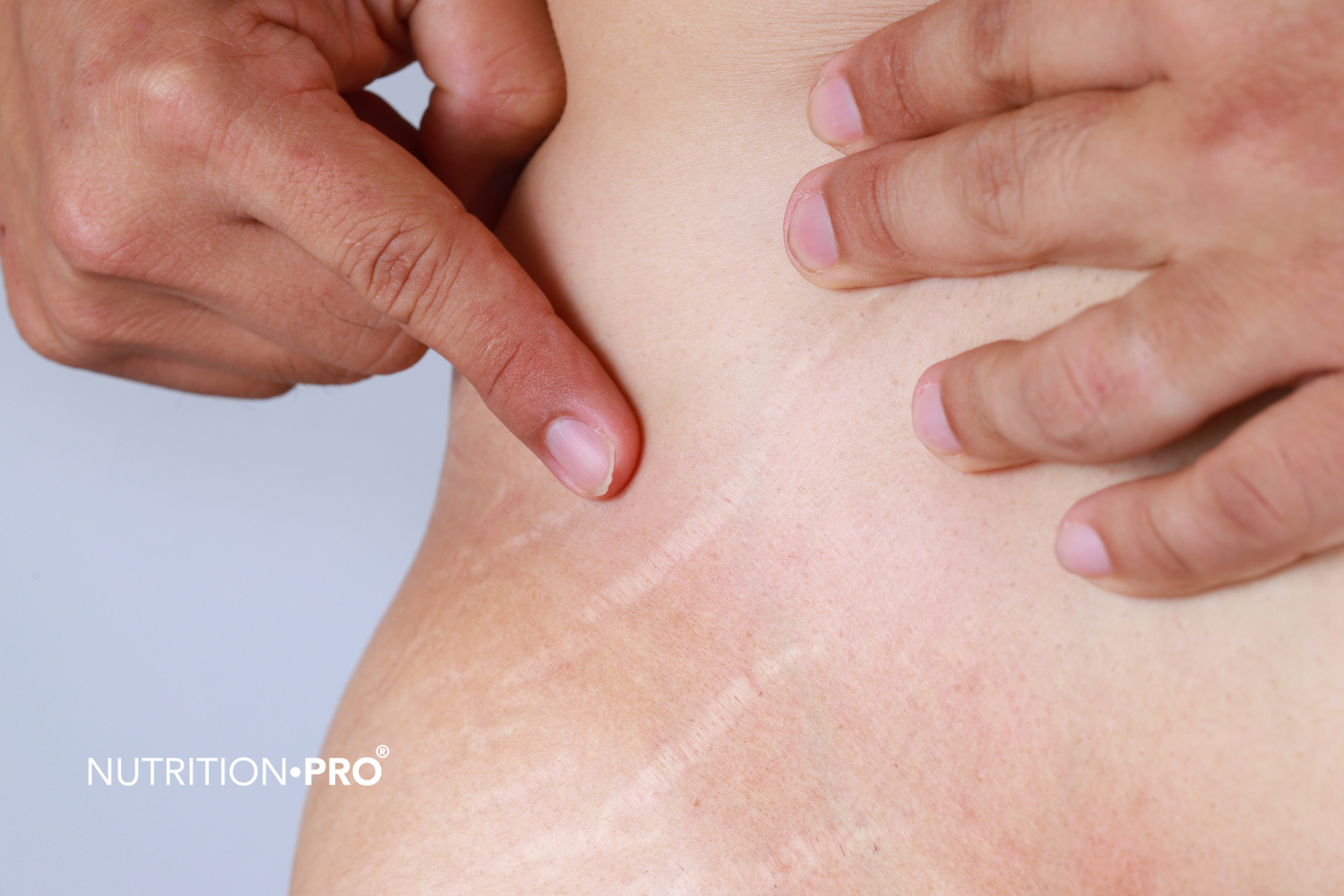
It's one of the most profitable markets in cosmetics, and one of the least evidence-based. On stretch marks, the gap between what packaging promises and what clinical trials show is striking. A Cochrane review covering six randomized trials and 800 women found no quality evidence in favor of any cream to prevent stretch marks during pregnancy.
This article states what is established, and states it plainly. What actually happens in the skin, why the two best-selling ingredients are explicitly described as ineffective, the rare approaches that hold up, the decisive distinction between red stretch marks and white stretch marks, and the only nutrient with an authorized claim in this area. We sell collagen, and you will see that this article assigns it no role here.

The mechanism. A stretch mark is a dermal lesion : under rapid mechanical stretching, the collagen and elastin fibers break. It's a scar, not surface dryness. It affects according to studies 50 to 90% of pregnant women, and it is benign.
Prevention. The Cochrane review, six trials and 800 women, found no high-quality evidence in favor of a topical preparation. Cocoa butter andolive oil are explicitly described as ineffective. Limited evidence leads: centella asiatica, almond oil massage. Weak evidence: hyaluronic acid.Treatment: the red stage responds better than the white stage, and options fall under dermatologist care. The only regulatory lever: vitamin C , which contributes to normal collagen formation to ensure normal skin function. Health information. This article synthesizes clinical trials identified via PubMed and the European framework for health claims. It does not replace medical advice and makes no health claims for a dietary supplement regarding stretch marks, as no such claims are permitted. During pregnancy, any questions about weight gain or skin care fall under medical supervision, and no dietary restrictions should be undertaken alone. Multiple stretch marks appearing suddenly without obvious cause warrant a medical consultation.800
What actually happens in the skin
A stretch mark is not a surface mark. It is a dermal lesion, the deep layer of skin, the one that contains the framework of collagen andelastin.
The mechanism is described as follows in recent literature: under the effect of rapid mechanical stretching, collagen and elastin fibers break, leading to disorganization of the extracellular matrix and a change in fibroblast activity, the cells that produce this framework. What appears on the surface is the visible consequence of a deep scar.
If the lesion is located in the dermis, then a preparation applied to the surface must cross the epidermis to hope to change anything there, which most cosmetic formulas do not do or do very little. And most importantly: a stretch mark is not a dryness problem. Hydrating stretched skin improves comfort, which is a legitimate objective, but it does not act on the process that creates the mark. The entire commercial logic of the product line is nevertheless based on this confusion. This is what explains, even before looking at the studies, why results are so disappointing.
Who is affected, and why
Published estimates place between 50 and 90% the proportion of women developing stretch marks during pregnancy, depending on the populations studied. In other words, it is the majoritycase, not the exception.
And pregnancy is not the only situation involved. Stretch marks appear whenever the skin undergoes rapid stretching: growth spurts in adolescence, significant weight variation, marked muscle gain. Certain treatments, particularly corticosteroids, and certain endocrine conditions also promote them.
| Risk factor | Modifiable? |
|---|---|
| Young maternal age | No |
| Family history of stretch marks | No |
| Weight gain during pregnancy | Partially, and only within the framework of medical monitoring of pregnancy |
| Corticosteroids, endocrine disorders | Falls under medical management |
Two of the three main risk factors cannot be modified, and no preparation has demonstrated the ability to prevent stretch marks. This leads to something that deserves to be stated clearly: failing to prevent them does not reflect any negligence. These marks are benign, extremely common, and their appearance depends largely on factors beyond anyone's control. The market promotes the opposite idea, and that is what makes this topic more anxiety-inducing than it should be.
Essential clarification: during pregnancy, the question of weight falls exclusively under medical monitoring. No dietary restriction should be undertaken alone for the purpose of limiting stretch marks.
Prevention: the verdict from the Cochrane review
The Cochrane reviews are the reference standard for synthesizing clinical trials: standardized methodology, bias risk assessment, quantitative analysis. The one dedicated to topical preparations for preventing stretch marks during pregnancy included six randomized trials totaling 800 women.
Its conclusion, verbatim: the authors found no high-quality evidence supporting the use of any of the topical preparations in the prevention of stretch marks during pregnancy. The difference between preparations containing active ingredients and placebo or no treatment did not reach statistical significance, and sensitivity analysis excluding studies at highest risk of bias confirmed this result.
The authors conclude there is a clear need for rigorous and larger randomized trials, including on products that women commonly use.
What the literature says ingredient by ingredient
| Ingredient | Level of evidence |
|---|---|
| Cocoa butter | Not effective for preventing stretch marks or reducing their severity |
| Olive oil | Not effective. Two dedicated randomized trials, including one on 360 women, found no significant difference compared to no treatment |
| Centella | Limited evidence of prevention or reduction in severity |
| Bitter almond oil massage | Evidence limited, possible effect |
| Topical hyaluronic acid | Evidence weak |
| Tretinoin | Promising for reducing the severity of recent stretch marks, but contraindicated during pregnancy |
The two ingredients that the literature explicitly says do not work, cocoa butter and olive oil, are precisely the two most present in products sold for this use. And the only one that appears truly promising, tretinoin, is contraindicated during pregnancy, that is, unavailable at the exact moment when the majority of stretch marks appear. We address this point in our article on the dangers of retinol during pregnancy.
The rare leads that hold up
Two things deserve to be retained from the previous table, provided they are presented with their actual level of evidence.
Centella is the ingredient that stands out most regularly, with evidence qualified as limited. It's modest, and it's more than for the rest of the range.
Massage is the most interesting hypothesis, and it is rarely formulated. In virtually all trials, applying a product involves massaging the area. The review in the British Journal of Dermatology also mentions massage as a possible component of the effect observed with almond oil. In other words, part of any potential benefit could come from the action rather than the formula, which would explain why products of very different compositions produce comparable results, that is, modest ones.
Comfort, a legitimate objective not to be confused with prevention
A randomized double-blind trial involving 160 women compared aloe vera gel and sweet almond oil to a base cream and no treatment. Instructive result: both preparations reduced itching anderythema, and limited the spread of stretch marks on the surface, but they did not have no effect on the number or diameter of stretch marks.
That's exactly the distinction to remember. Taut, itchy skin during pregnancy is a real discomfort that it's legitimate to relieve. But relieving this symptom is not preventing the lesion, and packaging that confuses the two is selling you something other than what it contains.
Red or white: the decisive distinction
| Red or purple stretch mark | White stretch mark | |
|---|---|---|
| Name | Striae rubra, recent stage | Striae alba, old stage |
| What's happening | Inflammatory phase, vascularization still active | Established scar, pearly, stabilized structure |
| Response to interventions | Better: this is the window of opportunity | Significantly more limited |
| What can be targeted | Reduce severity and appearance | Improve texture and appearance, without elimination |
If you're considering treatment, the moment when the mark is still red is the right time. Once the stretch mark turns white, the options become considerably reduced.
Regarding existing options, a review published in 2025 states the finding with useful frankness: despite the number of treatments available, ranging from topical agents to energy-based devices, no therapy has demonstrated consistent and lasting efficacy across all patient populations.
Lasers, microneedling, radiofrequency, intradermal injections, various combinations: these approaches aim to remodel the dermal matrix and stimulate fibroblast activity. They can improve appearance and texture. They do not eliminate a stretch mark, and their results vary from person to person. A dermatological consultation helps determine what's realistic in your specific case, rather than chaining pharmacy purchases. And let's remember: certain treatments, including retinoids, are contraindicated during pregnancy.
Oral collagen and vitamin C
The reasoning is tempting, and we would have every commercial interest in letting it slide: a stretch mark is a rupture of collagen fibers, so consuming collagen should help.
This reasoning doesn't hold up, and for the same reasons we detail in our article on the relationship between glycine and collagen. Providing one brick doesn't direct construction: collagen synthesis is a process regulated by cellular signals, cofactors, and mechanical constraints. And most importantly, no data demonstrates an effect of collagen peptides on stretch marks, nor is any health claim authorized for these peptides in the European Union.
A single authorized claim explicitly links a nutrient, collagen and skin: that of vitamin C, which contributes to normal collagen formation to ensure normal skin function. It is solid, it is based on a perfectly established mechanism, vitamin C being the cofactor of enzymes that stabilize the triple helix of collagen.
A clarification that matters as much as the claim itself: it does not concern stretch marks, and no one has the right to present it that way. It concerns normal skin function, which is different. A brand that slides from one to the other steps outside the regulatory framework, and this is a shift you will often see.
We sell marine collagen, and this article has just explained that nothing demonstrates its benefit on stretch marks. We therefore attribute no effect to it in this area, and we attribute none to any supplement. What we give you on our products is the source, composition and analytical controls, with the claims that regulations allow and not one more. If you're looking for collagen for other reasons, our dedicated guide reviews the actual state of the evidence.
Read our collagen guideWhat to do, in practice
Stretch marks are benign dermal scars, very common, largely determined by factors beyond anyone's control. No cream has demonstrated its ability to prevent them, and the two best-selling ingredients are explicitly ineffective. What does exist falls within the dermatologist's domain, works better early on, and improves without erasing. The rest is commerce, and it thrives on guilt that has no basis.
Frequently Asked Questions
Understanding Stretch Marks
What exactly is a stretch mark?
It's a lesion of the dermis, the deep layer of skin. Under the effect of rapid mechanical stretching, collagen and elastin fibers break, leaving a visible linear scar on the surface. So it's not a surface problem or dry skin issue, contrary to what the logic of moisturizing creams suggests: the lesion is beneath the epidermis, where a cream can barely penetrate.
How many pregnant women are affected?
Published estimates range from 50 to 90% of women depending on sources and populations studied. In other words, it's an extremely common phenomenon, not an anomaly. It's useful to remember this, as these marks generate real anxiety when they present no health risk: they are benign, and their impact is purely aesthetic and psychological.
What are the risk factors?
Available reviews primarily identify young maternal age, family history of stretch marks, and weight gain during pregnancy. Two of these three factors cannot be changed. The third falls under medical pregnancy monitoring, never under dietary restriction decided alone, which would be dangerous for both mother and child.
Do stretch marks only occur during pregnancy?
No. They occur whenever skin undergoes rapid stretching: growth spurts in adolescence, rapid weight gain or loss, significant muscle mass gain. Certain treatments, notably corticosteroids, and certain endocrine pathologies also favor their appearance. Numerous stretch marks appearing suddenly without obvious cause warrant medical attention.
Should you feel guilty about having stretch marks?
No, and this may be the most useful message of this article. Stretch marks affect the majority of pregnant women, they depend largely on non-modifiable factors like age and family history, and no preparation has demonstrated its ability to prevent them. Failing to avoid them therefore reflects no negligence: it reflects the fact that, to date, no reliable method exists to do so.
Prevention and Creams
Do anti-stretch mark creams work?
The Cochrane review dedicated to this question, based on six randomized trials and 800 women, concludes there is no quality evidence in favor of any topical preparation to prevent stretch marks during pregnancy. The difference observed between active preparations and placebo did not reach statistical significance. This is the highest level of evidence available on this question, and it is clear.
Are cocoa butter and olive oil effective?
No, and yet these are the two best-selling ingredients on this market. A review published in the British Journal of Dermatology explicitly concludes that cocoa butter and olive oil are effective neither for preventing stretch marks nor for reducing their severity. Two randomized trials specifically dedicated to olive oil, one involving 360 women, find no significant difference compared to no treatment.
Are there any serious leads nonetheless?
A few, with a limited level of evidence that must be stated as such. The British Journal of Dermatology review identifies limited evidence for centella, and possibly for bitter almond oil massage. It qualifies the evidence concerning hyaluronic acid as weak. Tretinoin appears promising for reducing the severity of recent stretch marks, but its use is limited by its contraindication during pregnancy.
Is it the product or the massage that works?
This is a serious hypothesis and rarely stated. In most trials, applying a product is accompanied by massaging the area, and the British Journal of Dermatology review specifically mentions massage as a possible component of the effect observed with almond oil. In other words, part of the benefit could come from the action rather than the formula, which would explain why very different products yield comparable results.
Should you moisturize your skin during pregnancy?
This has not demonstrated an effect on the appearance of stretch marks, but it addresses another, real need: comfort. A randomized trial of aloe vera and sweet almond oil showed a reduction in itching and erythema, but no effect on the number or diameter of stretch marks. Relieving taut, itchy skin is a legitimate objective in itself, provided it's not confused with prevention.
Are plant oils useless?
Regarding stretch mark prevention, available data does not support them, particularly for olive oil tested in two randomized trials. Regarding skin comfort, they have their place. The distinction to retain is this: an oil can improve how it feels without modifying the dermal process. That's not nothing, but it's not what the packaging promises.
Treatment
What's the difference between red and white stretch marks?
The recent stretch mark is red or purplish—this is the inflammatory stage, and it's when interventions have the best chance of working. Over time, it fades to become a white, pearlescent, and permanent scar in structure. This distinction is the most useful in this subject: if you're considering treatment, the moment when the mark is still red is the right time.
Can a white stretch mark disappear?
Making it disappear completely, no. A review published in 2025 recalls that, despite the number of available treatments, no therapy has demonstrated consistent and lasting efficacy across all patient populations. What does exist falls within the dermatologist's domain and aims to improve appearance and texture, not to erase: lasers, microneedling, radiofrequency, injections. Results are variable and generally partial.
Is tretinoin a solution?
It appears promising for reducing the severity of recent stretch marks according to the British Journal of Dermatology review, but its use is explicitly limited by its pregnancy category. Retinoids are contraindicated during pregnancy due to risk to the unborn child. So it's an option that, precisely, cannot be used at the time when most stretch marks appear, and requires a prescription.
When should you consult?
Consult a dermatologist if you want treatment, ideally at the red or purplish stage when options are most effective. Also consult, without delay, in cases of numerous stretch marks appearing suddenly without obvious cause, or accompanied by other signs such as unexplained weight gain or significant fatigue: certain endocrine pathologies manifest this way and require diagnosis.
Supplements and Regulation
Does collagen supplementation prevent stretch marks?
There is no evidence for this, and no health claims are authorized for collagen peptides in the European Union. The reasoning that starts from the composition of a stretch mark—a rupture of collagen fibers—to conclude that consuming collagen would prevent the problem is the same logical leap we document elsewhere: providing one brick does not pilot construction, and collagen synthesis is a regulated process.
What is the only nutrient with an authorized claim on skin?
Vitamin C, which contributes to normal collagen formation to ensure normal skin function. It is the only authorized claim that explicitly links a nutrient, collagen, and skin. Important clarification: it does not address stretch marks, and no one has the right to present it that way. It simply constitutes the only solid regulatory foothold in this entire dossier.
What should we think of market promises?
The gap between the commercial volume of this market and the level of available evidence is among the largest in the entire cosmetic sector. A product that promises to prevent or erase stretch marks makes a claim that no quality data supports. The vocabulary used by a brand remains the best indicator of its credibility, here as elsewhere.
What should we take away about stretch marks?
That they are a benign dermal lesion, very common, linked to a rupture of collagen and elastin fibers. That prevention by creams has no quality evidence, and the two most-sold ingredients are explicitly described as ineffective. That the red stage is when dermatological treatment has the best chance of working. And that vitamin C is the only nutrient with an authorized claim linking collagen and skin.
Glossary
- Stretch mark (striae distensae)
- Linear dermal lesion resulting from the rupture of collagen and elastin fibers under rapid stretching.
- Striae gravidarum
- Name given to stretch marks appearing during pregnancy.
- Striae rubra
- Recent stage, red or purple, inflammatory, where interventions respond best.
- Striae alba
- Old stage, white and pearlescent, corresponding to an established scar.
- Dermis
- Deep layer of skin containing the collagen and elastin framework.
- Elastin
- Protein that gives skin the ability to return to its original shape after stretching.
- Extracellular matrix
- Network of proteins and molecules that supports cells in the dermis.
- Cochrane Review
- Methodological synthesis of reference evaluating all available trials on a question.
Sources
The clinical studies cited below were identified via PubMed.
- Brennan M, Young G, Devane D. Topical preparations for the prevention of stretch marks during pregnancy. Cochrane Database of Systematic Reviews, 2012;11:CD000066. DOI
- Korgavkar K, Wang F. Stretch marks during pregnancy: a review of topical prevention. British Journal of Dermatology, 2015;172(3):606-615. DOI
- Garelli A, et al. Efficacy of autologous micrograft technology in the treatment of stretch marks. Journal of Cosmetic Dermatology, 2025;24(7):e70321. DOI
- Soltanipoor F, et al. Effect of olive oil on the prevention of pregnancy stretch marks: a randomized controlled clinical trial. Complementary Therapies in Medicine, 2012;20(5):263-266. DOI
- Soltanipour F, et al. Effect of olive oil and Saj® cream in the prevention of pregnancy stretch marks: a randomized controlled clinical trial. Complementary Therapies in Medicine, 2014;22(2):220-225. DOI
- Hajhashemi M, et al. Effect of aloe vera gel and sweet almond oil on pregnancy stretch marks in nulliparous women. Journal of Maternal-Fetal & Neonatal Medicine, 2017;31(13):1703-1708. DOI
- European Commission. Register of authorized nutrition and health claims, entry relating to vitamin C and normal collagen formation. ec.europa.eu
- European Parliament and Council. Regulation (EC) 1924/2006 on nutrition and health claims made on foods. eur-lex.europa.eu


