

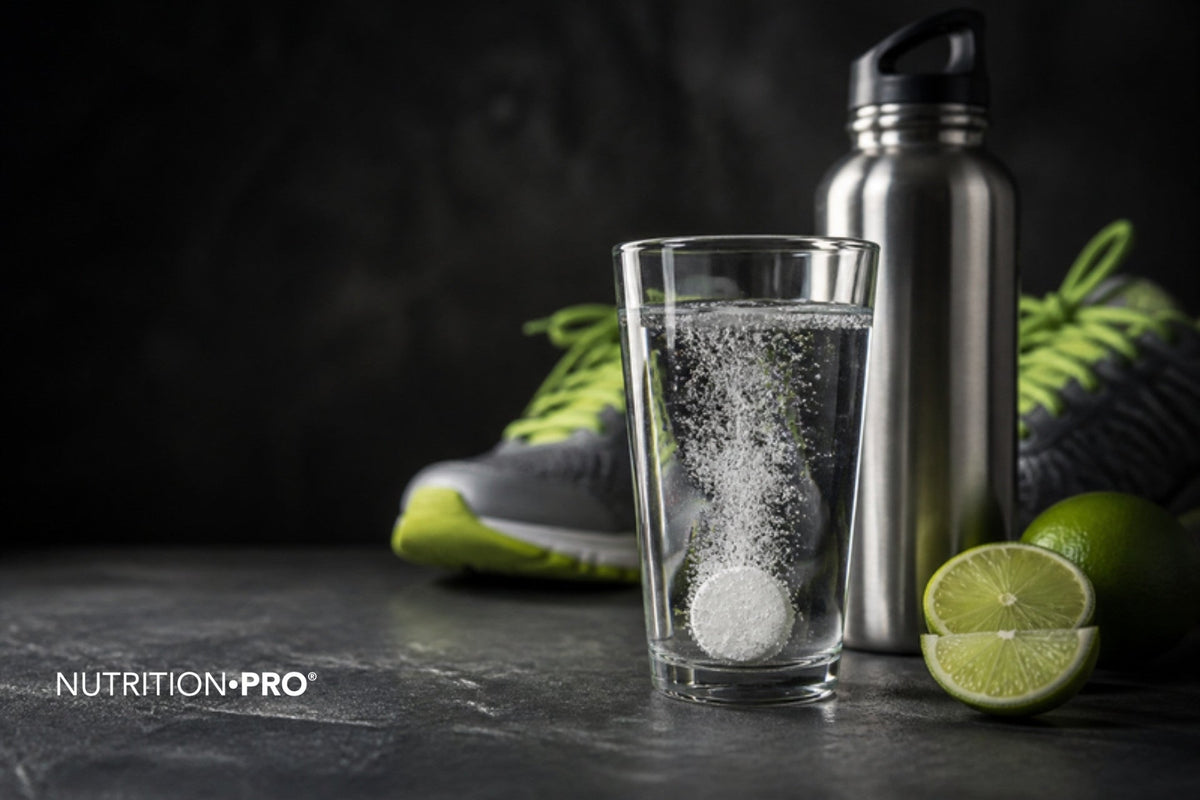
In 13 trained cyclists, a highly salted drink consumed before exercise extended cycling at 32 °C from 78.7 to 98.8 minutes on average. In an ironman-distance triathlon, conversely, salt tablets taken during the race changed neither the finish time nor blood sodium levels in 413 triathletes. Sodium matters, but not all the time, nor at just any moment.
This guide follows the session, before, during, and after, based on trials identified via PubMed, including null trials: sodium and fluid quantities studied, rehydration, thirst or plan, team sports and strength training.

Before and during : arriving hydrated matters more than loading up on salt. For a session lasting less than an hour, water drunk to thirst is usually sufficient. Beyond that, especially in heat, an expert consensus recommends a drink with 0.5 to 0.7 g of sodium per liter, and in trials sodium slows the decline in blood sodium; on performance, trials mostly yield null results.
After : sodium's role is most clear. Drinking 1 to 1.5 times the weight lost, with a sufficiently salted drink or salty meal, retains water; a drink with almost no sodium left a deficit of 689 ml several hours later. And drinking beyond thirst remains the main cause of exercise-induced hyponatremia.
- What exercise causes you to lose
- Before exercise: arriving hydrated
- Before exercise: should you load up on sodium?
- During exercise: when water is enough
- During exercise: when sodium matters
- Sodium and performance: positive and null trials
- How much to drink: to thirst or according to a plan?
- Team sports and strength training
- After exercise: rehydrating and retaining water
- Drinking too much: the risk of hyponatremia
- Our Electrolytes compared to studied quantities
- The plan before, during, after, and precautions
- Frequently asked questions
What exercise causes you to lose
Sweat evacuates the heat from exercise and carries away mainly water. According to an expert consensus on exercise in the heat, a rate of 1 to 1.5 liters per hour is common during sustained exercise in heat, and some people exceed 2.5 liters ; a 2019 review on hydration, from a meeting co-organized by a sports drink manufacturer, reports typical losses of 0.5 to 1.9 liters per hour.
The main electrolyte lost is sodium : 20 to 70 mmol per liter of sweat according to this consensus, or 0.46 to 2.4 g of sodium per hour for 1 to 1.5 liters of sweat (editorial calculation). With a range of one to five between athletes, no single amount suits everyone.
These losses are reflected in heart rate and temperature. In 8 trained cyclists pedaling for 2 hours at 33 °C, compensating for 0, 20, 48 or 81% of sweat loss resulted in weight losses of 4.2, 3.4, 2.3 and 1.1%, and the increase in internal temperature and heart rate followed dehydration step by step. A 2018 review, published in a supplement supported by a sports drink manufacturer, sets the benchmark at 2% of body weight: beyond that, dehydration is accompanied by poorer temperature regulation and, in many hot, long or intense conditions, by a decrease in aerobic performance. However, the heat consensus notes that in some studies of trained cyclists, for one hour up to 33 °C, losses of up to 4% did not alter performance.
One millimole of sodium weighs approximately 23 mg, and 1 g of table salt contains approximately 0.4 g of sodium. The equivalencies in this article, including volumes for 70 kg, are editorial calculations based on these reference points.
Before exercise: arrive hydrated
The heat consensus recommends drinking approximately 6 ml of water per kilogram, 2 to 3 hours before training or competition in the heat, and every 2 to 3 hours on hot days preceding it : approximately 420 ml for 70 kg (editorial calculation). To check your status, the 2019 review suggests three signals upon waking: a weight drop of more than 1.1% compared to normal, thirst and dark urine ; two signals together suggest probably insufficient water intake. In an elite rugby team, more than 80% of players started training already with a water deficit, according to their urine.
Caffeine does not compromise this preparation. According to a meta-analysis of 16 studies, at a median dose of 300 mg, it increases urine volume by 109 ml on average, a small effect (effect size of 0.29).
At rest, caffeine increased urine production (effect size of 0.54) ; during exercise, the effect was no longer significant (0.10). Women were more sensitive to it. The authors consider the concern about water loss unjustified when caffeine precedes exercise.
Zhang Y, Coca A, Casa DJ, et al. J Sci Med Sport 2015;18(5):569-574. DOI : 10.1016/j.jsams.2014.07.017
Our Pre Workout Booster is taken 20 to 30 minutes before training in 250 to 300 ml of water, which counts toward pre-session hydration, and provides 200 mg of caffeine per dose. Our guide on caffeine before sport details the timing of intake.

One dose per day maximum, on training days only, never late in the day, starting with half a dose. It is not recommended for children, adolescents, pregnant or nursing women and people sensitive to caffeine, should not be combined with other sources of caffeine and requires medical advice if taking medications or with cardiovascular disorders. Its vitamin C (80 mg) and magnesium (56.3 mg) are added to those of two Electrolytes tablets (80 and 60 mg) : 160 and 116.3 mg on the same day (editorial calculation).
Before exercise: should you load up on sodium?
Two double-blind trials by the same team tested, before exercise at 32 °C, a drink containing 164 mmol of sodium per liter versus a drink containing 10 mmol: 10 ml per kilo, consumed in seven portions over one hour, starting 105 minutes before departure. In 8 trained runners, the salty drink increased plasma volume by 4.5%, versus 0%. At the same time before stopping, internal temperature was lower (38.9 versus 39.3 °C) and perceived effort was less, and the run lasted longer, whether stopping came from the temperature limit (57.9 versus 46.4 minutes) or exhaustion (96.1 versus 75.3 minutes); heart rate tended to be lower, without significant difference.
In 13 trained cyclists, approximately 628 ml of a drink containing 164 mmol of sodium per liter consumed before exercise extended the cycling time to exhaustion at 32 °C to 98.8 minutes, versus 78.7 minutes with the 10 mmol drink. Internal temperature rose more slowly: 1.2 °C per hour, versus 1.6 °C.
Sims ST, Rehrer NJ, Bell ML, Cotter JD. J Appl Physiol 2007;103(2):534-541. DOI: 10.1152/japplphysiol.01203.2006
The benefit is not always found in performance. In 20 healthy young adults, 355 ml of soup containing 167 mmol of sodium per liter, taken 45 minutes before 90 minutes of moderate exercise, improved fluid balance compared to water (−251 versus −657 g), but the performance measured afterward did not differ from that obtained with water or a sports drink at 16 mmol per liter.
For 70 kg, the drink in these trials provided approximately 115 mmol of sodium, or 2.6 g, more than four times the 26 mmol of two tablets of our Electrolytes (editorial calculation). In case of high blood pressure, kidney disease, or heart disease, this type of loading should not be considered without medical advice.
During exercise: when water is enough
During a short session, according to the 2019 review, the risk of dehydration is low during efforts of 45 minutes or less, and the 2018 review estimates that drinking to thirst can be sufficient for efforts of less than one to one and a half hours, in cool conditions or at moderate intensity.
Drinking a lot does not necessarily help a short, intense session. In a meta-analysis of 9 cycling studies conducted between 20 and 33 °C, drinking approximately 0.29 ml per kilo per minute, or 1.2 liters per hour for 70 kg (editorial calculation), reduced performance by 2.5% over one hour at high intensity, compared to drinking nothing. Beyond one hour, drinking improved it: +2.1% between one and two hours of moderate effort, +3.2% beyond that.
The heat consensus indeed recommends sodium, 0.5 to 0.7 g per liter, and carbohydrates, 30 to 60 g per hour and up to 90 g beyond two and a half hours, for exercises lasting more than one hour.
Carbohydrates provide energy for long efforts; sodium helps maintain water balance. Our Electrolytes provide 1 g of glucose per 2 tablets: when carbohydrates matter, they are taken with another source—sugary drink, gel, or food.
During exercise: when sodium matters
Replacing large sweat losses with pure water dilutes the sodium remaining in the blood. The sodium in the drink slows this drop in sodium concentration, the concentration of sodium in the blood.
In 10 endurance athletes cycling for up to 3 hours at 34 °C while replacing their sweat, blood sodium decreased by 2.48 mmol per liter per hour with distilled water, versus 0.86 with a sports drink containing 18 mmol of sodium per liter; one participant dropped to 128 mmol per liter with water, and the lower the blood sodium, the shorter the effort. In 13 active men exercising at 30 °C for 3 hours of walking and cycling, then 45 minutes of hill walking, while drinking as much as they lost, final blood sodium was 137.3 and 136.7 mmol per liter with drinks containing 36.2 and 19.9 mmol of sodium, versus 134.5 and 134.4 with water or flavored water; none experienced cramps.
These effects on blood are not always reflected in performance. In 13 female athletes running for 4 hours while drinking 1 liter per hour, mild hyponatremia appeared in 46% with a drink containing 680 mg of sodium per liter, 69% at 410 mg, and 92% with water, which the authors attribute to fluid overload; performance did not differ. In 11 men cycling for 3 hours at 34 °C while drinking as much as they lost, 60 rather than 21 mmol of sodium per liter maintained blood sodium and plasma volume, for identical exercise duration. A 1991 trial in 8 participants found no significant difference in blood sodium between water and a drink containing 25 mmol per liter over 6 hours of cycling at 30 °C.
As a reference point, one tablet of our Electrolytes in 500 ml of water gives 0.6 g of sodium per liter, or approximately 26 mmol (editorial calculation): within the 0.5 to 0.7 g per liter range of the consensus, between the two salty drinks in the 30 °C trial. The comparison concerns quantities, not an effect: no trial has tested our tablets. Our NP Isothermal Water Bottle, made of stainless steel, holds 500 ml: the capacity of one Electrolytes tablet diluted for the session.
Sodium and performance: positive and null trials
During a long-distance triathlon of approximately 12 hours in Cape Town, salt tablets taken at will, 1 to 4 per hour, provided on average 3.6 g of additional sodium. Compared to placebo or no tablets, they did not change finishing time, blood sodium, weight change, or rectal temperature.
Hew-Butler TD, Sharwood K, Collins M, et al. Br J Sports Med 2006;40(3):255-259. DOI: 10.1136/bjsm.2005.022418
During a triathlon of the same format, a non-randomized trial giving approximately 700 mg of sodium per hour to 38 triathletes did not significantly change blood sodium compared to triathletes without salt. In 9 cyclists, 700 mg of salt per hour, or approximately 275 mg of sodium (editorial calculation), did not change the time of a 72 km time trial at 14 °C (171 versus 172 minutes), but increased drinking by 160 ml per hour. In 11 endurance athletes, 1,800 mg of sodium over 2 hours did not change cardiac drift, skin temperature, or the subsequent exhaustion test. In 9 runners in a 5-hour race at 30 °C, salt replacing 100% of sodium lost in sweat did not change fluid balance, heart rate, or rectal temperature.
One exception: in 26 randomly assigned triathletes, 113 mmol of sodium total, approximately 2.6 g (editorial calculation), taken before and during an actual half-distance triathlon, was associated with a shorter race time than with placebo (P = 0.04), with no effect on strength or power loss, in a single trial.
Cramps also do not follow sodium: in a 161 km race, among 280 runners, the use of sodium tablets, weight change, and blood sodium did not differ between those who experienced cramps and others, cramps being associated with their history and muscle damage. Our article on cramps and their solutions details other leads.
| Trial | Sodium provided | Performance | Evidence level |
|---|---|---|---|
| Hew-Butler, 2006 | 3.6 g over approximately 12 hours | No effect | Randomized trial, 413 triathletes: high |
| Speedy, 2002 | Approximately 700 mg per hour | Sodium levels increased, no significant difference between groups | Non-randomized trial: low |
| Cosgrove, 2013 | Approximately 275 mg per hour | No effect over 72 km | Randomized crossover trial, 9 cyclists: moderate |
| Earhart, 2015 | 1,800 mg over 2 hours | No effect | Randomized crossover trial, 11 athletes: moderate |
| McCubbin, 2024 | 100% of losses, 5 hours at 30 °C | No effect on temperature | Randomized crossover trial, 9 runners: moderate |
| Del Coso, 2016 | Approximately 2.6 g | Faster race time | Randomized trial, 26 triathletes: moderate |
| Hoffman, 2015 | Variable, during the race | Cramps unrelated to sodium | Observation, 280 runners: low |
How much to drink: by thirst or according to a plan?
A 2019 meta-analysis compared thirst and a plan in 82 participants over an average of 96 minutes at 28 °C. With a plan, they drank 1,073 ml per hour and lost 1.0% of their body weight; by thirst, 505 ml per hour for 2.1%. Thirst showed superior performance of 0.98%, a difference the authors considered probably negligible: over 1 to 2 hours, both strategies are equivalent.
In 10 trained runners, a half-marathon on a treadmill at 30 °C was run drinking water by thirst (384 ml per hour) or according to a plan (1,380 ml per hour). The plan reduced body weight loss (1.3 versus 3.1%), rectal temperature (39.1 versus 39.4 °C) and heart rate (171 versus 175), without changing the time: 89.6 versus 89.8 minutes.
Dion T, Savoie FA, Asselin A, et al. Eur J Appl Physiol 2013;113(12):3011-3020. DOI: 10.1007/s00421-013-2730-8
In the heat, in highly trained athletes, the plan may prevail: in 10 elite cyclists acclimatized, over 30 km at 31.6 °C, drinking at each kilometer to compensate for losses limited body weight loss to 0.5%, versus 1.8% ad libitum, and the final climb was 5.1% faster.
The 2018 review reserves the plan for efforts exceeding 90 minutes, especially in heat, intense efforts with heavy sweating and performance goals; thirst is sufficient for shorter, cooler or more moderate efforts, and you should never drink to the point of gaining weight. On a bike, over one to two hours, the 2017 meta-analysis associates gains with 630 to 840 ml per hour for 70 kg (editorial calculation based on 0.15 to 0.20 ml per kilogram per minute).
Weigh yourself without clothes before and after a typical session, noting what you drink. One kilogram lost corresponds to approximately one liter of sweat: 70.0 kg before, 69.2 kg after and 500 ml consumed in one hour gives 1.3 liters per hour (editorial calculation). According to the 2019 review, the method remains reliable for efforts lasting less than 2 to 3 hours.
Coolness also matters. In 8 men cycling to exhaustion at 35 °C, a drink at 4 °C rather than 37 °C, consumed before and during exercise, extended the effort from 52.0 to 63.8 minutes; the heat consensus notes that cold drinks appear most useful before exercise.
Team sports and strength training
In team sports, access to beverages depends on regulations: according to the 2019 review, soccer provides few opportunities to drink, unlike tennis or basketball, structured by breaks. In 17 basketball players aged 17 to 28, dehydrated by 1 to 4% before an 80-minute simulated match, timed exercises were slower by 20 seconds at 2% and 57 seconds at 4%, with 6 then 10 fewer successful shots; at equal hydration, a carbohydrate and electrolyte drink performed no better than water flavored with 18 mmol of sodium per liter. In rugby, the 2017 review on exercise-induced hyponatremia reports asymptomatic hyponatremia in approximately one-third of a small group of players tested after an 80-minute match.
In strength training, a meta-analysis of 28 publications shows that a water deficit established before tests reduces muscular endurance by 8.3%, strength by 5.5% and anaerobic power by 5.8%, with no significant effect on anaerobic capacity or vertical jump; the decline appeared less in trained practitioners. Conversely, the elite rugby players mentioned earlier drank 196% of lost sweat during strength training sessions, compared to 56% during endurance sessions, and the 2017 review reports a case of symptomatic hyponatremia after 2 hours of strength training followed by tennis. We identified no trials testing an electrolyte drink on strength training performance: for a typical session, water drunk according to thirst remains the reference.
After exercise: rehydrating and retaining water
In 12 men dehydrated by approximately 2%, more fluid needed to be consumed than the losses to restore balance, with a sufficiently salty drink: at 61 mmol of sodium per liter, urine over the following seven and a half hours reached a median of 260 ml after a volume equal to losses, 602 ml at 150% and 1,001 ml at 200%. Without enough sodium, drinking more essentially results in urinating more.
In 6 men dehydrated by 1.9% at 32 °C, a drink equal to 1.5 times the weight lost, 2,045 ml on average, was consumed with 2, 26, 52 or 100 mmol of sodium per liter. Five and a half hours later, the water balance remained negative at 689 and 359 ml with the two least salty drinks, and returned to equilibrium with 52 and 100 mmol: −2 and +98 ml.
Maughan RJ, Leiper JB. Eur J Appl Physiol Occup Physiol 1995;71(4):311-319. DOI: 10.1007/BF00240410
Better water retention does not guarantee a better next session: in 8 men dehydrated by 2%, drinks with 40 or 50 mmol of salt per liter reduced urine compared to a drink without sodium, but the time to exhaustion effort, 4 hours later, did not differ between the four drinks. And a meal does just as well: in 8 volunteers dehydrated by 2.1% at 34 °C, a meal with water left a balance close to equilibrium 6 hours later (−29 ml), compared to deficits of 337 and 373 ml with a sports drink at 21 mmol of sodium per liter; the meal provided more sodium (63 versus 42 mmol) and potassium.
The heat consensus advises, if recovery is short, to drink 150% of weight lost within the hour, with electrolytes; otherwise, more realistically, 100 to 120%, preferably with a meal including salty foods.
With our Electrolytes, one tablet in 250 ml gives approximately 52 mmol of sodium per liter, the concentration that restored balance in 1995; in 500 ml, approximately 26 mmol, that of the drink that left a deficit of 359 ml (editorial calculations). But the trial involved drinking 2 liters, or approximately 106 mmol of sodium, four times the 26 mmol of two tablets. After an ordinary session, the meal and water provide the essentials; one tablet after the session, as our instructions suggest, is a practical supplement to this, though no effect can be inferred from it.
Drinking too much: the risk of hyponatremia
Exercise-induced hyponatremia refers to serum sodium below 135 mmol per liter during or just after exercise. Its main cause, according to the 2017 review, is drinking beyond thirst, often with inappropriate secretion of antidiuretic hormone, which causes water retention and can be stimulated by exercise, pain, nausea, heat or non-steroidal anti-inflammatory drugs. Among 2,135 endurance athletes weighed before and after their event, 11% had gained weight; among them, 11% had serum sodium below 129 mmol per liter, and arrival serum sodium decreased as weight increased.
Sodium in the drink reduces but does not prevent the drop in case of excess fluid: sports drinks, less concentrated than blood, do not protect those who drink too much. One tablet of our Electrolytes in 500 ml gives approximately 26 mmol of sodium per liter (editorial calculation), far from the 135 to 145 mmol per liter of blood. According to the 2017 review, drinking according to thirst during and just after exercise prevents hyponatremia in temperate climates for efforts lasting less than 17 hours. Our article on truly effective electrolytes details marathon data.
After prolonged exercise, especially if you have drunk heavily or gained weight, nausea or vomiting, headaches, drowsiness, convulsions, confusion, disorientation or unusual behavior should prompt a call to emergency services (15 or 112). Do not give large quantities of water to drink: severe forms, with altered consciousness, require urgent medical treatment.
Our Electrolytes compared to studied quantities
One tablet provides 300 mg of sodium, two tablets (8.6 g) 600 mg, or 1.5 g of salt. The instructions provide for one tablet in at least 200 ml of water, to be drunk after effervescence ends, and maximum 2 tablets per day. The concentration therefore depends on the volume of water, and the total remains capped at 600 mg of sodium per day.
| One tablet in | Sodium per liter | Reference in studies |
|---|---|---|
| 200 ml | 1.5 g, approximately 65 mmol | Close to the 61 mmol drink from the trial on volume consumed after exercise |
| 250 ml | 1.2 g, approximately 52 mmol | The concentration which, consumed at 2 liters, restored balance in 1995 |
| 500 ml | 0.6 g, approximately 26 mmol | Within the range of 0.5 to 0.7 g per liter of the consensus for exercise lasting more than one hour |
| 750 ml | 0.4 g, approximately 17 mmol | Close to sports drinks at 18 to 21 mmol tested in the laboratory |
These concentrations are editorial calculations. In total amounts, the long trials provided well more than the 26 mmol of two tablets: 69 and 201 mmol in 3 hours in the 34 °C trial, approximately 106 mmol in the 1995 rehydration, 156 mmol on average over the long-distance triathlon (editorial calculations). Sodium also comes from meals and other sports drinks, and the limit of 2 tablets per day must be observed. The potassium, magnesium, and vitamin C in the tablets correspond to no quantity tested in the trials presented here.
Test any new drink during training, especially since our tablets contain polyols, which have a laxative effect in case of excess. Their sodium comes from the sodium bicarbonate in the formula: comparisons are based on sodium quantity.
The before, during, after plan, and precautions
This practical plan assembles the study benchmarks for 70 kg: adapt the volumes to your weight and sweat rate.
High blood pressure : in a meta-analysis of 85 trials, blood pressure follows approximately linearly with sodium intake, and the reduction obtained by cutting salt is more marked in people with high blood pressure; our Electrolytes provide 1.5 g of salt per dose, to be discussed with a healthcare professional in case of high blood pressure or a low-salt diet. Kidney or heart disease, medical treatment : medical advice before any additional salt intake. Pregnancy and breastfeeding : our Electrolytes and our Pre Workout Booster are not recommended. Children : medical advice; our tablets should be kept out of reach of young children. Polyols : possible laxative effect in case of excess. Allergens : possible traces of gluten, soy and milk.
Effervescent lemon-lime flavored tablets, in a tube of 20, for 10 days at 2 tablets per day. Two tablets provide 600 mg of sodium, 300 mg of potassium, 120 mg of chloride, 60 mg of magnesium and 80 mg of vitamin C. One tablet in 500 ml during the session, another after.
See ElectrolytesOur guide on truly effective electrolytes details the situations where they matter most.
Frequently Asked Questions
Should you take electrolytes before or after exercise?
Before, the goal is mainly to arrive hydrated. During, sodium matters most beyond one hour, in the heat and with heavy sweating. After, it clearly helps retain the water you drink: this is when its role is most evident in the trials.
When should you take electrolytes during a session?
Especially for efforts lasting more than one hour, in the heat or with heavy sweating, with a drink containing 0.5 to 0.7 g of sodium per liter according to expert consensus. For a session of less than one hour, water consumed according to thirst is sufficient in most cases.
How much sodium per hour during prolonged exercise?
Losses range from approximately 0.46 to 2.4 g of sodium per hour in the heat depending on the individual. The trials presented provided approximately 275 mg to 1.5 g of sodium per hour according to our calculations, with effects mainly on blood sodium and rarely on performance.
How much should you drink during exercise?
According to thirst for most sessions, which has given performance comparable to a structured plan over 1 to 2 hours in a meta-analysis. Beyond 90 minutes in the heat, a plan based on your sweat rate can help, while never gaining weight.
How much should you drink after exercise?
Approximately 1 to 1.5 liters per kilogram lost, ideally with a meal containing salty foods. Without enough sodium, some of the water is lost in urine: a drink with almost no sodium still left a deficit of 689 ml several hours later.
Do electrolytes improve performance?
Rarely when taken during exercise: in a long-distance triathlon or a 72 km time trial, sodium did not change performance, with one exception in a half-distance triathlon. Before exercise in the heat, highly salted drinks prolonged effort in two small trials.
Should you take electrolytes for weight training?
For a standard session, water consumed according to thirst is sufficient: we identified no trials showing an effect of an electrolyte drink on weight training performance. The essential thing is to arrive hydrated, as a water deficit reduces muscular endurance by 8.3% and strength by 5.5%.
Can you drink too much during exercise?
Yes. Drinking beyond your thirst is the main cause of exercise-associated hyponatremia, a drop in blood sodium below 135 mmol per liter. Gaining weight during an event signals excess drinking, and the sodium in a sports drink does not protect when you drink too much.
Do electrolytes prevent cramping?
The evidence does not point in that direction. In a 161 km race, cramping was not related to sodium tablets or blood sodium, but to a history of cramping and muscle damage.
Sources
The studies cited below were identified via PubMed.
- Sims ST, Rehrer NJ, Bell ML, Cotter JD. Sodium loading before exercise, fluid balance and endurance in women in the heat. Journal of Applied Physiology, 2007;103(2):534-541. DOI
- Hew-Butler TD, Sharwood K, Collins M, et al. Sodium supplementation is not necessary to maintain serum sodium levels during [long-distance triathlon]. British Journal of Sports Medicine, 2006;40(3):255-259. DOI
- Racinais S, Alonso JM, Coutts AJ, et al. Consensus recommendations for training and competing in the heat. British Journal of Sports Medicine, 2015;49(18):1164-1173. DOI
- Maughan RJ, Leiper JB. Sodium intake and rehydration after exercise in humans. European Journal of Applied Physiology and Occupational Physiology, 1995;71(4):311-319. DOI
- Hew-Butler T, Loi V, Pani A, Rosner MH. Exercise-associated hyponatremia: 2017 update. Frontiers in Medicine, 2017;4:21. DOI
- Sims ST, van Vliet L, Cotter JD, Rehrer NJ. Sodium loading aids fluid balance and reduces physiological strain in trained men exercising in the heat. Medicine and Science in Sports and Exercise, 2007;39(1):123-130. DOI
- Cosgrove SD, Love TD, Brown RC, et al. Fluid and electrolyte balance during two preseason sessions in elite rugby players. Journal of Strength and Conditioning Research, 2014;28(2):520-527. DOI
- Lee JK, Shirreffs SM, Maughan RJ. Ingestion of a cold drink improves endurance capacity in the heat. Medicine and Science in Sports and Exercise, 2008;40(9):1637-1644. DOI
- Noakes TD, Sharwood K, Speedy D, et al. Three independent biological mechanisms of exercise-associated hyponatremia: data from 2,135 weighted performances. Proceedings of the National Academy of Sciences of the United States of America, 2005;102(51):18550-18555. DOI
- Belval LN, Hosokawa Y, Casa DJ, et al. Practical hydration solutions for sports. Nutrients, 2019;11(7):1550. DOI
- Montain SJ, Coyle EF. Influence of graded dehydration on hyperthermia and cardiovascular drift during exercise. Journal of Applied Physiology, 1992;73(4):1340-1350. DOI
- Kenefick RW. Drinking strategies: drinking to a plan or to thirst. Sports Medicine, 2018;48(Suppl 1):31-37. DOI
- Zhang Y, Coca A, Casa DJ, et al. Caffeine and diuresis at rest and during exercise: a meta-analysis. Journal of Science and Medicine in Sport, 2015;18(5):569-574. DOI
- Johannsen NM, Lind E, King DS, Sharp RL. Effect of electrolyte ingestion before exercise on fluid balance in men and women. Medicine and Science in Sports and Exercise, 2009;41(11):2017-2025. DOI
- Holland JJ, Skinner TL, Irwin CG, et al. The influence of beverages on cycling endurance performance: a meta-analysis. Sports Medicine, 2017;47(11):2269-2284. DOI
- Vrijens DM, Rehrer NJ. Sodium-free fluid ingestion decreases plasma sodium concentration during exercise in the heat. Journal of Applied Physiology, 1999;86(6):1847-1851. DOI
- Anastasiou CA, Kavouras SA, Arnaoutis G, et al. Sodium intake and plasma sodium decrease during exercise in the heat when beverages match losses. Journal of Athletic Training, 2009;44(2):117-123. DOI
- Twerenbold R, Knechtle B, Kakebeeke TH, et al. Effects of sodium concentration in beverages during prolonged exercise in women. British Journal of Sports Medicine, 2003;37(4):300-303. DOI
- Wijering LAJ, Cotter JD, Rehrer NJ. Effect of sodium concentration of a beverage on plasma sodium and plasma volume during prolonged exercise in the heat: a randomized crossover trial. European Journal of Applied Physiology, 2023;123(1):81-89. DOI
- Barr SI, Costill DL, Fink WJ. Fluid replacement during prolonged exercise: water, saline solution, or no beverage. Medicine and Science in Sports and Exercise, 1991;23(7):811-817. DOI
- Speedy DB, Thompson JM, Rodgers I, et al. Oral salt supplementation during ultra-distance exercise. Clinical Journal of Sport Medicine, 2002;12(5):279-284. DOI
- Cosgrove SD, Black KE. Sodium supplementation has no effect on cycling time trial performance in cool conditions: a randomized crossover trial. Journal of the International Society of Sports Nutrition, 2013;10:30. DOI
- Earhart EL, Weiss EP, Rahman R, Kelly PV. Effects of oral sodium supplementation on thermoregulatory indices in trained endurance athletes. Journal of Sports Science and Medicine, 2015;14(1):172-178. PMC
- McCubbin AJ, da Costa RJS. Personalized sodium replacement, fluid and sodium balance, and thermal strain during and after a heat ultra-endurance race. International Journal of Sports Physiology and Performance, 2024;19(2):105-115. DOI
- Del Coso J, González-Millán C, Salinero JJ, et al. Effects of oral salt supplementation on physical performance during a [half-distance triathlon]: a randomized controlled trial. Scandinavian Journal of Medicine and Science in Sports, 2016;26(2):156-164. DOI
- Hoffman MD, Stuempfle KJ. Muscle cramping during a 161-km ultramarathon: comparison of runners with and without cramping. Sports Medicine - Open, 2015;1(1):24. DOI
- Goulet EDB, Hoffman MD. Effect of ad libitum or planned drinking on endurance performance: systematic review and meta-analysis. Sports Medicine, 2019;49(2):221-232. DOI
- Dion T, Savoie FA, Asselin A, et al. Drinking beyond thirst does not improve half-marathon performance in trained distance runners. European Journal of Applied Physiology, 2013;113(12):3011-3020. DOI
- Bardis CN, Kavouras SA, Adams JD, et al. Planned drinking improves cycling performance more than ad libitum drinking. Medicine and Science in Sports and Exercise, 2017;49(6):1244-1251. DOI
- Baker LB, Dougherty KA, Chow M, Kenney WL. Progressive dehydration causes progressive decline in basketball shooting performance. Medicine and Science in Sports and Exercise, 2007;39(7):1114-1123. DOI
- Savoie FA, Kenefick RW, Ely BR, et al. Effect of dehydration on muscle endurance, strength, power, and anaerobic capacity and vertical jump: a meta-analysis. Sports Medicine, 2015;45(8):1207-1227. DOI
- Shirreffs SM, Taylor AJ, Leiper JB, Maughan RJ. Rehydration after exercise in men: effects of drink volume and sodium content of the beverage. Medicine and Science in Sports and Exercise, 1996;28(10):1260-1271. DOI
- Merson SJ, Maughan RJ, Shirreffs SM. Rehydration with beverages of different sodium content and recovery from moderate exercise-induced dehydration in men. European Journal of Applied Physiology, 2008;103(5):585-594. DOI
- Maughan RJ, Leiper JB, Shirreffs SM. Restoring fluid balance after exercise-induced dehydration: effects of food and beverage intake. European Journal of Applied Physiology and Occupational Physiology, 1996;73(3-4):317-325. DOI
- Filippini T, Malavolti M, Whelton PK, et al. Effects of sodium reduction on blood pressure: dose-response meta-analysis of experimental studies. Circulation, 2021;143(16):1542-1567. DOI


