

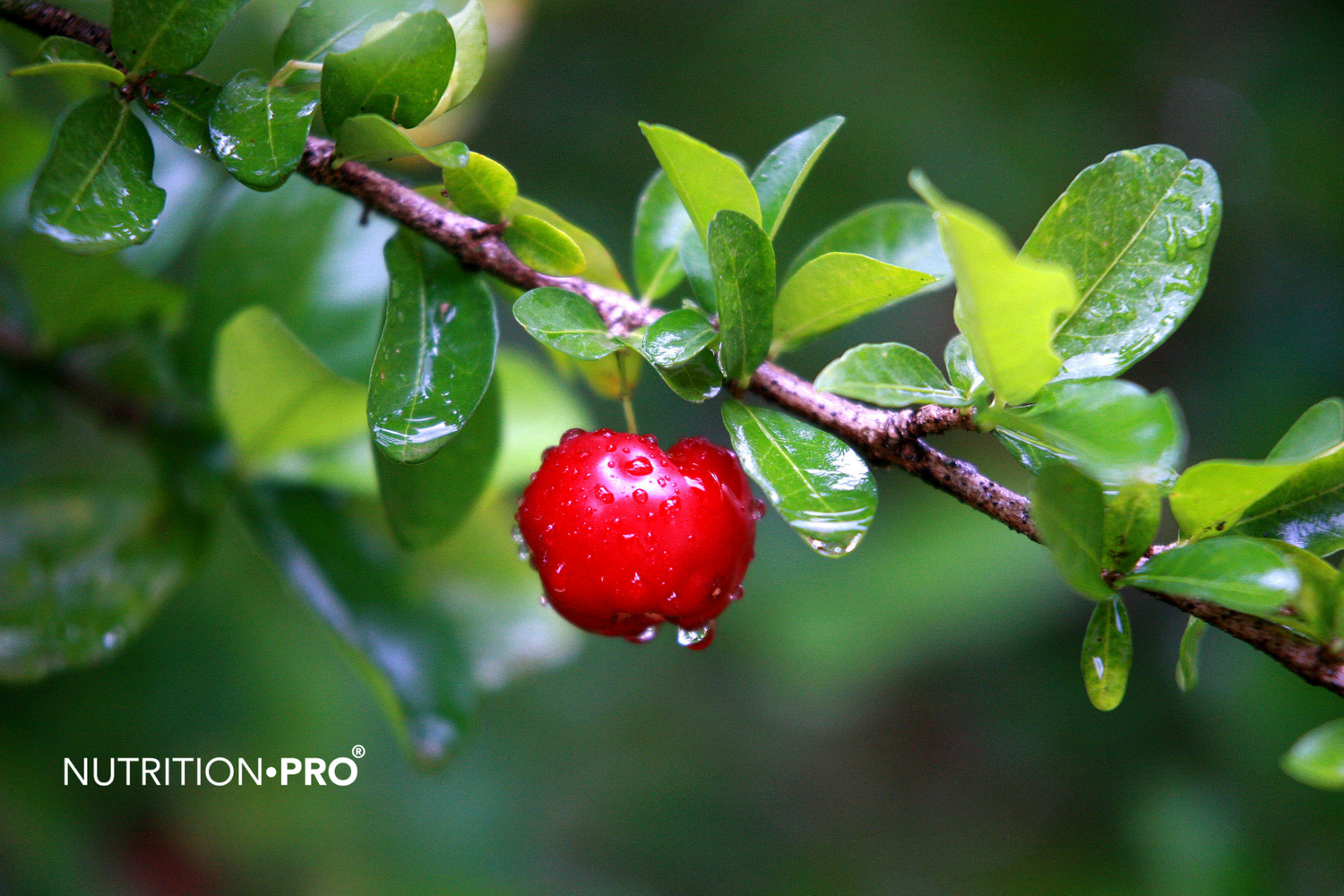
Acerola is a small tropical cherry from South America, and it is one of the most concentrated natural sources of vitamin C known to mankind. On this point alone, it surpasses the orange by proportions that surprise most people.
But acerola has a particularity that few ingredients share, and this is what makes this guide different from others: because it provides vitamin C, it benefits from a set ofrecognized and validated effects at the European level. Where most plants cannot claim any benefit, vitamin C counts ten, across six body systems. This guide details which ones, what research says about the common cold, the question of natural versus synthetic, and how to choose between powder and tablets.

What makes acerola unique. Its vitamin C content is among the highest in the plant kingdom, far superior to that of the orange. And because vitamin C benefits fromrecognized effects at the European level, acerola can claim specific benefits, which is rare: reduction of fatigue, immune system function, collagen formation for skin, bones, cartilage, gums, teeth and blood vessels, protection of cells against oxidative stress, energy metabolism, nervous system, psychological functions, iron absorption.
What research says about the common cold. A Cochrane review covering 11,306 participants concludes that vitamin C does not reduce the number of colds in the general population. On the other hand, in 598 marathon runners, skiers and soldiers subject to intense exercise, the risk was divided by two. And the duration of colds decreased by 8% in adults and 14% in children. The nuance regarding the matrix: human data suggest that the bioavailability of vitamin C depends on the matrix that accompanies it, but remain limited.
What acerola is
Acerola, Malpighia emarginata, sometimes referred to as Malpighia punicifolia, is the fruit of a shrub from the Malpighiaceae family. It is also called Barbados cherry or West Indian cherry, but it has no botanical connection to the European cherry: the resemblance is limited to size and bright red color.
It grows in the tropical zones of Central and South America, and Brazil is now the world's leading producer. That is where our raw material comes from.
Fresh acerola is extremely fragile : it degrades within a few days of harvest, and its vitamin C, sensitive to heat, light, and oxygen, declines quickly. This is why you will never find it in the fruit section in Europe, and why it is almost always marketed in processed form, as juice, frozen pulp, powder, or extract.
This fragility also explains why the processing method matters so much for this ingredient: between one well-treated raw material and another, the final vitamin C content can vary considerably. This is the main criterion to look at, well before origin or price.
Beyond vitamin C, a review published in Molecules describes acerola as an important source of phenolic compounds, of carotenoids and of bioactive polysaccharides. We return to what this entails in the section dedicated to the plant matrix.
Its vitamin C content, and the figure that matters
This is the characteristic that made acerola's reputation: a review published in Molecules describes it as one of the richest natural sources of vitamin C there is. Comparisons with oranges circulate everywhere, with ratios of twenty to forty times depending on the sources, fruit maturity, and analysis method.
These comparisons are spectacular, and they are useless to you for choosing a product. What matters is what your daily dose actually delivers, and this figure appears on the label, not in marketing descriptions.
A concrete example with our powder: the daily dose of 10 g contains 1,000 mg of acerola extract standardized to 17%, which delivers 170 mg of vitamin C, or 212.5% of the reference intake. That's the useful information. A product that boasts its ratio compared to an orange without displaying its content in milligrams is hiding the essentials from you.
Why the concept of standardization changes everything
There is an important difference between a dried fruit powder and a standardized extract. The first is ground fruit, whose vitamin C content varies from one batch to another depending on the harvest and drying. The second is a concentrated fraction whose content is guaranteed, here at 17%, which makes it possible to know precisely what each dose contains.
This is a point where standardization has a genuine practical benefit: with a nutrient as sensitive to degradation, knowing what you're taking is better than hoping.
The ten recognized effects, one by one
Here is what makes this guide different from our other reports. On most plants, we must explain that no benefit can be claimed. With acerola, it's the opposite: because it provides vitamin C, it benefits from a list of effects scientifically evaluated and recognized at the European level.
| System concerned | Recognized effect of vitamin C |
|---|---|
| Energy and fatigue | Contributes to reducing fatigue and to normal energy metabolism |
| Immunity | Contributes to normal immune system function, including during and after intense physical exercise |
| Skin, bones, cartilage | Contributes to normal collagen formation to ensure the normal functioning of skin, bones, cartilage, gums, teeth and blood vessels |
| Cells | Contributes to protection of cells against oxidative stress |
| Nervous system | Contributes to normal nervous system function and to normal psychological functions |
| Iron and vitamin E | Increases iron absorption and contributes to the regeneration of the reduced form of vitamin E |
These effects belong to vitamin C, not to acerola as a fruit. In other words, they apply only when the product provides sufficient amounts. This is precisely why dosage is the decisive criterion: a product that is too weakly concentrated cannot make any claims, regardless of how beautiful its origin.
The threshold is clearly exceeded. À 170 mg per dose, or more than twice the reference intake values, we are well above the minimum required for all of these effects. The same is true for the last one on the list, the one about immunity during intense exercise, which requires a higher intake than the others.
The special case of iron absorption
This deserves a word, because it is the most practically applicable to daily life. Vitamin C increases iron absorption, in particular non-heme iron, that is, iron of plant origin, which is less well absorbed than that from meat.
The practical consequence is simple: combine a source of vitamin C with a meal rich in plant-based iron—lentils, spinach, chickpeas—to improve what your body gets from it. This is a particularly useful lever for vegetarian or vegan individuals, and for women with increased needs. Our article on iron and fatigue develops this point.
Vitamin C and colds: what Cochrane says
This is the question everyone asks, and it has been the subject of controversy for seventy years. A Cochrane review settled it with solid data, and its conclusion deserves to be read carefully.
| Question | What the Cochrane review found |
|---|---|
|
Do we catch fewer colds? General population |
No. Out of 29 comparisons and 11,306 participants, the relative risk is 0.97 with an interval of 0.94 to 1.00. In other words, no effect in the general population |
| And in people subjected to intense physical effort? | Yes, markedly. Out of 5 trials and 598 marathon runners, skiers, and soldiers in subarctic exercise, the relative risk drops to 0.48, interval of 0.35 to 0.64: the risk is cut in half |
| Do colds last shorter? | Yes, modestly. Out of 31 comparisons and 9,745 episodes, the duration decreases by 8% in adults and 14% in children. Severity is also reduced |
| What if we start by catching a cold? | No consistent effect. Out of 7 comparisons and 3,249 episodes, supplementation started at the onset of symptoms shows no reproducible effect |
What is false: the idea that regular vitamin C intake prevents catching a cold. The authors are explicit—systematic supplementation in the general population is not justified on this criterion. And the widespread habit of rushing to it at the first sign of symptoms finds no support in the trials either.
What is true, and remarkable: in people exposed to intense physical exertion, marathon runners, skiers, soldiers in extreme conditions, the risk of a cold was cut in half. This is a strong effect, on a specific population. And the duration of episodes decreases consistently from one study to another, modestly but genuinely.
The authors conclude, moreover, that given this consistent effect on duration and severity, the low cost and good tolerability, it may be worth each person individually testing what it does for them.
This result on sport overlaps with one of the recognized effects mentioned above, the one specifically concerning immune system function during and after intense physical exercise. This is an interesting convergence between regulatory evaluation and clinical literature, and it identifies a population for whom acerola makes particular sense: those who train hard. Our guides hyrox and marathon address the question from a training perspective.
Natural or synthetic: the question of the matrix
This is the question that determines the purchase, and it deserves better than the two caricatured answers you read everywhere.
Let's start with what is not debatable: the molecule is identical. The ascorbic acid from acerola and that produced by synthesis are chemically the same thing. Claiming otherwise would be false.
The real question is therefore not the molecule, it's what accompanies it. And there, there is a real difference.
| Synthetic Vitamin C | Acerola | |
|---|---|---|
| The molecule | Isolated ascorbic acid | Ascorbic acid, chemically identical |
| What accompanies it | Nothing, except excipients | Phenolic compounds, carotenoids, bioactive polysaccharides |
| Dosage | Very high possible, at low cost | Depends on the extract's standardization |
| What research says | Human data suggest matrix effects on bioavailability | But they remain limited and heterogeneous |
The review published in Molecules is cautious and we will be equally so: human data suggest effects dependent on the matrix on vitamin C bioavailability, while emphasizing that clinical evidence remains limited, with significant methodological heterogeneity and insufficient characterization of active fractions.
In other words: the hypothesis that the fruit matrix contributes something is plausible and supported, it is not demonstrated with the level of evidence from a large-scale clinical trial. We prefer to state it this way rather than claim a superiority that the data do not yet support.
What is certain, on the other hand, is that acerola provides additional compounds that isolated ascorbic acid does not provide. A review published in theInternational Journal of Molecular Sciences highlights this combined richness in vitamin C and polyphenols, associated with strong antioxidant activity. This is a matter of composition, independent of the absorption debate.
Our article natural vitamin C, which one to choose compares the different available sources.
Powder or tablets: how to choose
| Criterion | Powder | Tablets |
|---|---|---|
| Use | To be mixed in a beverage, yogurt, smoothie or bowl | Taken as-is, without preparation |
| Dosage flexibility | Adjustable by the spoonful, easy to divide | Fixed dose per unit, precise and reproducible |
| On the go | Less practical, requires a liquid base | Ideal, slips into a bag |
| Taste | Tangy, red berries, appreciated as a beverage | Not an issue if the tablet is swallowed |
| Who is it for | Those who already have a morning routine, smoothie or prepared breakfast | Those who want simplicity and consistency |
Our two references come from the same raw material, an extract of acerola cultivated in Brazil under organic farming. You can compare theorganic acerola powder and theorganic acerola tablets and look at the vitamin C content per dose on each—that's the figure to compare.
Safety, dosage and precautions
Vitamin C is water-soluble, which means the body eliminates through urine what it doesn't need, unlike fat-soluble vitamins such as D or A which can accumulate. This is the main reason for its good tolerance.
| Situation | What you should know |
|---|---|
| Very high doses | Beyond several grams per day, digestive upset is possible: bloating, diarrhea. These cease when the dose is reduced |
| History of kidney stones | Vitamin C is metabolized in part into oxalate. In case of a history of stones, particularly oxalic stones, seek medical advice before prolonged supplementation |
| Hemochromatosis or iron overload | Since vitamin C increases iron absorption, this effect becomes a disadvantage in these situations: medical advice required |
| Current medication | As with any supplement, inform your doctor or pharmacist |
| Pregnancy and breastfeeding | Needs are slightly increased, but any supplementation should be discussed with your healthcare provider |
| In the evening | Some people find it stimulating. If that's the case for you, take it in the morning, without affecting its effectiveness |
Acerola is one of the rare ingredients in this category where benefits are not based on promise but on evidence: ten recognized effects, across six body systems. The selection criterion is therefore not whether it works, but verifying that the content is sufficient and that you'll take it regularly. Look at the milligrams, choose a standardized extract, and keep in mind that consistency matters more than intensity.
Frequently asked questions
Understanding acerola
What is acerola?
It is the fruit of a tropical shrub, Malpighia emarginata, also called West Indian cherry or Barbados cherry, with no botanical relation to the European cherry. It grows in Central and South America, with Brazil being the world's leading producer. A review published in Molecules describes it as one of the richest known natural sources of vitamin C.
Why is it never found as fresh fruit?
Because it is extremely fragile: it degrades within days of harvest, and its vitamin C, sensitive to heat, light, and oxygen, declines rapidly. This is why it is almost always marketed in processed form—as juice, frozen pulp, powder, or extract. This is also why the processing method matters so much for this ingredient.
How many times more vitamin C than an orange?
The cited ratios range from twenty to forty times depending on sources, fruit maturity, and analysis method. But this comparison is useless for choosing a product: what matters is the vitamin C content of your daily dose, in milligrams, stated on the label. A product that touts its ratio without displaying its milligrams is hiding what matters most.
What does acerola contain besides vitamin C?
A review published in Molecules describes acerola as an important source of phenolic compounds, carotenoids, and bioactive polysaccharides. Another review, in the International Journal of Molecular Sciences, emphasizes its combined richness in vitamin C and polyphenols, associated with strong antioxidant activity.
Recognized effects
What are the recognized effects of acerola?
They stem from its vitamin C content, which has ten recognized effects at the European level: contribution to reducing fatigue, to energy metabolism, to immune system functioning including during and after intense exercise, to normal collagen formation for skin, bones, cartilage, gums, teeth, and blood vessels, to protection of cells against oxidative stress, to nervous system functioning, to psychological functions, to iron absorption, and to vitamin E regeneration.
Is a minimum dose required for these effects to apply?
Yes, and this is the decisive point. These effects belong to vitamin C, not to the fruit itself: they apply as long as the product provides enough of it. A product that is insufficiently concentrated cannot make any claims, regardless of its origin. With 170 mg per dose, representing 212.5% of reference intakes, our powder is well above the required threshold, including for the immunity effect during intense exercise which requires a higher intake.
Does acerola really help against fatigue?
Vitamin C helps reduce fatigue, this is a recognized effect. That said, persistent fatigue has identifiable causes that a supplement doesn't address: insufficient sleep, iron deficiency, thyroid disorder, among others. If your fatigue persists, a medical evaluation is the useful course of action, and iron testing is often part of it.
What is the most concretely useful application?
Probably iron absorption. Vitamin C increases iron absorption, particularly non-hemic iron from plant sources, which is less well assimilated than that from meat. Combining a source of vitamin C with a meal of lentils, chickpeas, or spinach thus directly improves what your body gets from it. This is a particularly relevant lever for vegetarian or vegan individuals.
Vitamin C and the common cold
Does vitamin C prevent catching a cold?
No, not in the general population. The Cochrane review, covering 29 comparisons and 11,306 participants, results in a relative risk of 0.97 with an interval of 0.94 to 1.00, that is, no effect. The authors explicitly conclude that systematic supplementation is not justified on this criterion alone.
Why then is an effect mentioned in athletes?
Because the result is spectacularly different. In five trials totaling 598 marathon runners, skiers, and soldiers subjected to exercise in subarctic conditions, the relative risk drops to 0.48, with an interval of 0.35 to 0.64: the risk of a cold is halved. This is a strong effect, in a population subjected to intense physical stress.
Do colds last shorter?
Yes, modestly but consistently. Over 31 comparisons and 9,745 episodes, duration decreases by 8% in adults and 14% in children, and severity is also reduced. It is this consistency that leads the authors to suggest that each person can individually test what it delivers, given the low cost and good tolerability.
Should you take it at the first symptoms?
The data do not support this. Over seven comparisons and 3,249 episodes, supplementation started at symptom onset shows no consistent effect on duration or severity. The logic that emerges from the trials is that of regular ongoing intake, not emergency treatment at the first sneeze.
Natural or synthetic
Is acerola vitamin C different from synthetic vitamin C?
The molecule is identical: ascorbic acid from acerola and that produced by synthesis are chemically the same thing, and claiming otherwise would be false. The real difference lies in what accompanies it: acerola additionally provides phenolic compounds, carotenoids, and bioactive polysaccharides that isolated ascorbic acid does not bring.
Does the fruit matrix improve absorption?
It is plausible and supported, though not proven. The review published in Molecules indicates that human data suggest effects dependent on the matrix on vitamin C bioavailability, while emphasizing that this evidence remains limited, with significant methodological heterogeneity. We prefer to state it this way rather than claim a superiority that the data do not yet support.
Fruit powder or standardized extract?
A dried fruit powder is ground fruit, whose vitamin C content varies from batch to batch depending on harvest and drying. A standardized extract is a concentrated fraction whose content is guaranteed, here at 17%, which allows you to know precisely what each dose contains. With a nutrient as sensitive to degradation as this, this guarantee has real practical value.
Form, dosage, and safety
Powder or tablets, which to choose?
Neither is superior at equal content. The deciding factor is regularity: the best form is the one you'll take every day without thinking about it. Powder integrates well if you already have a morning ritual, smoothie, or prepared breakfast. Tablets are better suited if you're looking for simplicity, particularly when traveling.
Can you take too much?
Vitamin C is water-soluble: the body eliminates through urine what it doesn't need, unlike fat-soluble vitamins like D or A. This is what explains its good tolerability. Beyond several grams per day, digestive disturbances are possible, bloating or diarrhea, which stop with dose reduction.
Are there situations where caution is needed?
Three mainly. In case of history of kidney stones, particularly oxalic ones, since vitamin C is metabolized partly into oxalate. In case of hemochromatosis or iron overload, since vitamin C increases iron absorption. And in case of ongoing treatment, as with any supplement. During pregnancy and breastfeeding, any supplementation should be discussed with your healthcare provider.
What to remember about acerola?
That it's one of the most concentrated natural sources of vitamin C, and especially one of the rare ingredients whose benefits are recognized at the European level, with ten effects on six systems. That the question is therefore not whether it works, but to verify the content in milligrams and choose a standardized extract. That regarding the common cold, the preventive effect concerns people subjected to intense effort, not the general population, while episode duration decreases modestly but consistently.
Glossary
- Malpighia emarginata
- Botanical name for acerola, also called West Indian cherry or Barbados cherry.
- Ascorbic acid
- Chemical name for vitamin C, identical whether it comes from a fruit or from synthesis.
- Standardized extract
- Concentrated fraction whose content of active compound is guaranteed, here 17% vitamin C.
- Reference intakes
- Value serving as a benchmark for expressing nutrient content as a percentage on labeling.
- Water-soluble
- Refers to a water-soluble vitamin, the excess of which is eliminated through urine.
- Non-heme iron
- Iron from plant origin, less well absorbed than heme iron from animal sources.
- Plant matrix
- All the compounds in the fruit that accompany the main nutrient.
- Relative risk
- The ratio between the risk in the treated group and that of the control group; a value of 1 means no effect.
Sources
The studies cited below were identified via PubMed.
- Hemilä H, Chalker E. Vitamin C for preventing and treating the common cold. Cochrane Database of Systematic Reviews, 2013;(1):CD000980. DOI
- Aquino JS, et al. Acerola and its by-products as sources of bioactive compounds: phytochemical profile and biological effects in experimental and clinical studies. Molecules, 2026;31(11):1792. DOI
- Olędzki R, Harasym J. Anti-inflammatory activity of acerola: a review. International Journal of Molecular Sciences, 2024;25(4):2089. DOI
- Ran L, et al. Vitamin C as complementary therapy to relieve cold symptoms: meta-analysis of 10 randomized controlled trials. BioMed Research International, 2020;2020:8573742. DOI
- European Commission. Register of authorized nutritional and health claims, entries relating to vitamin C. ec.europa.eu


