

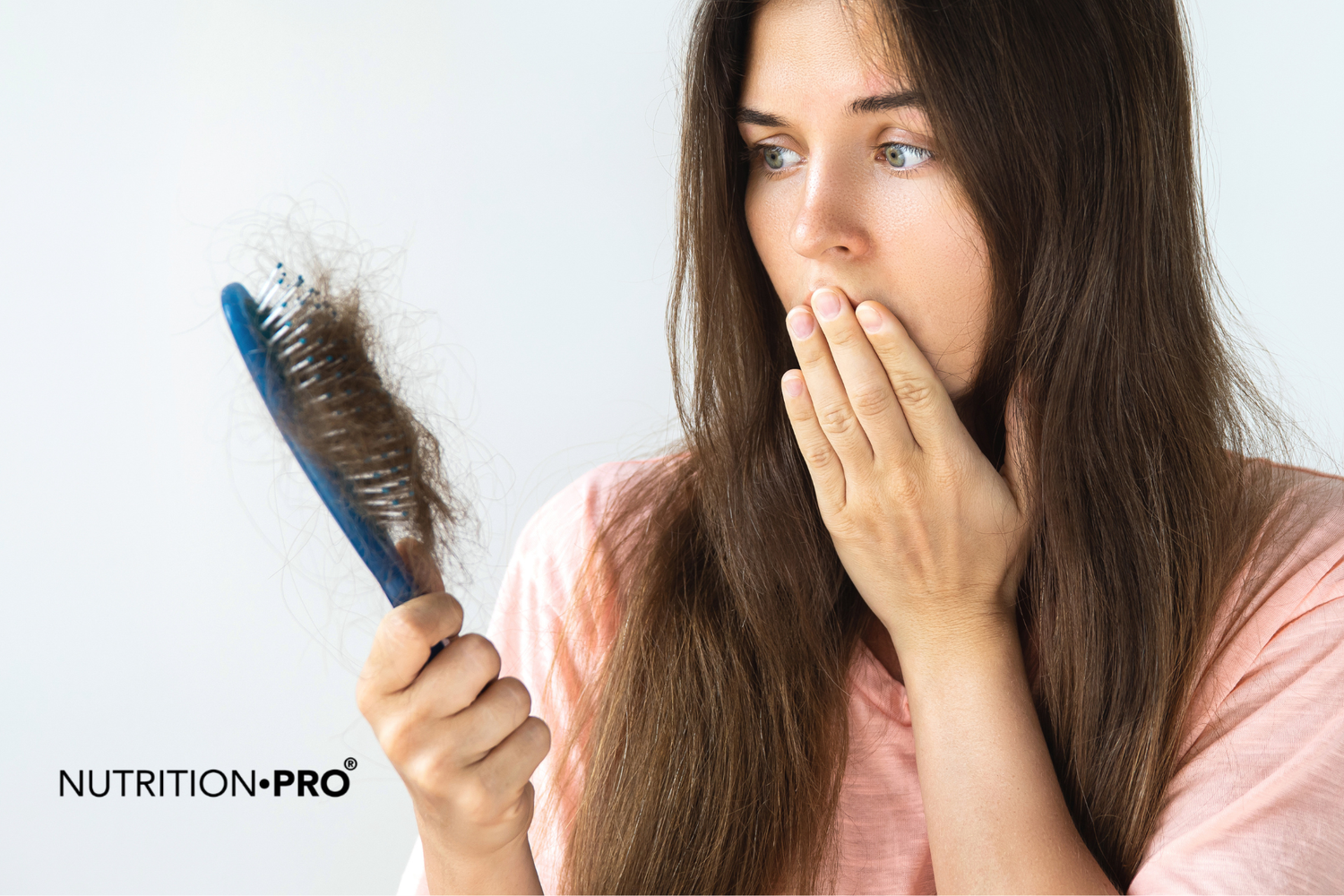
Every year, at the same time, the brush fills up, the shower clogs, and the question returns: am I losing my hair? The answer, for the vast majority of people, is no. You are losing the hair that your body had programmed to fall in summer, and which is falling now. It's measured, it's cyclical, and it grows back.
This article explains the mechanism as a six-year study on 823 women established it, provides benchmarks for duration and intensity, teaches you to distinguish seasonal shedding from another problem, then reviews what studies show to support the cycle: the bioavailable keratin, with a 90-day randomized trial, the zinc, the biotin and the iron. And it tells you when to start, because autumn shedding has an advantage over the others: it is predictable.

The mechanism. In 823 women followed for six years, the proportion of hair in resting phase is maximum in summer and minimum in late winter. A hair in rest falls two to three months later: the summer peak becomes shedding in September to November. The duration. Four to eight weeks, diffuse, with no bald patches, then return to normal. Hair regrows: the follicle is intact.
What helps. A bioavailable keratin at 500 mg, tested over 90 days in 50 women in double-blind: shedding, growth, resistance and shine significantly improved compared to placebo. The zinc, lower in 312 patients experiencing hair loss, across all types. The biotin, cofactor in keratin synthesis. The iron, to check if shedding persists. When: from early September, for three months. When to consult: more than three months, patches, localized recession, irritated scalp.
Why autumn: the cycle measured in 823 women
A hair lives in three phases: a growth phase, theanagen, which lasts from two to six years; a short transition; then a resting phase, the telogen, lasting two to three months, after which it falls out, pushed by the new hair forming underneath. At any given time, 10 to 15% of hairs are at rest. The autumn question is simple: does this proportion vary with the seasons?
The dermatology team at Zurich University Hospital answered it in the most rigorous way possible: by analyzing for six years the trichograms of women who came in for a hair loss consultation, after excluding all those with a disease or treatment explaining the shedding. This left 823 healthy women, the largest series ever studied on this topic.
| Season | Proportion of hair at rest | What follows from this |
|---|---|---|
| Summer | Maximum | These hairs fall two to three months later: September to November |
| Spring | Second peak, less pronounced | Slight shedding in early summer |
| Late winter | Minimum | Density is at its highest: regrowth has done its work |
The authors conclude that there is an annual periodicity in hair growth and shedding, and note that this confirms older observations, but for the first time on a representative number of women. The underlying mechanism is probably linked to light: the long days of summer cause more follicles to enter the resting phase, an adaptation inherited from ancestors who molted.
What falls in October was already dead in July. Resting hair no longer grows, no longer nourishes itself, awaits being replaced. Nothing you do in October can prevent it, and nothing needs to prevent it: beneath every hair that falls, a new one grows. Autumn hair loss is not a loss, it's a visible renewal.
And because it stems from a measurable summer peak, it is predictable. It's the only hair loss whose date you know in advance, and that changes how you prepare for it.
How much, how long, and does it grow back
| Benchmark | Value |
|---|---|
| Normal hair loss year-round | 50 to 100 hairs per day, out of approximately 100,000 |
| Hair loss in autumn | Noticeably more, for a few weeks, concentrated during shampooing and brushing |
| Duration | Four to eight weeks, peak in late September and October |
| Appearance | Diffuse, across the entire scalp, with no bald patches |
| Regrowth | Immediate beneath each fallen hair; visible in two to three months; maximum density by late winter |
| Recurrence | Every year, at the same time |
The sensation is always stronger than reality, for a mechanical reason: you don't count the hairs that fall during the day, you discover them in bunches in the shower and brush, where several days accumulate. A simple test: run your fingers through clean, dry hair, from root to tips, over three areas. A few hairs in your hand is normal; around ten with each pass, for more than two months, warrants professional advice.
Seasonal or something else: the signs that distinguish
| Seasonal hair loss | Something else | |
|---|---|---|
| Distribution | Diffuse, everywhere | Patches, temples, crown, widening part line |
| Duration | Four to eight weeks | More than three months, or worsening |
| Scalp | Normal | Itching, redness, flaking, tenderness |
| Trigger | The season, every year | Childbirth, strict diet, surgery, fever, new medication, shock |
| Other signs | None | Fatigue, brittle nails, heavy periods, sensitivity to cold, weight gain |
| What to do | Support the cycle, wait for regrowth | Doctor or dermatologist, blood test |
Hair loss that lasts more than three months. Patches of hair loss , even small ones. Receding hairline or hair thinning at the crown that progresses, in both men and women. A scalp that itches, reddens or flakes. Sudden hair loss after an event, childbirth, diet, surgery, fever, medication. Changes in nails or skin at the same time. Unusual fatigue or heavy periods, which point to iron or thyroid issues. In these cases, see a doctor and get a blood test including ferritin and thyroid levels.
Bioavailable keratin: the 90-day trial
Hair is made up of 95% keratin, a protein rich in sulfur-containing amino acids, with cysteine at the forefront, which give it its strength. The follicle that produces new hair needs these building blocks. The problem with ordinary keratin, from feathers or wool, is that it is indigestible : its amino acids are locked in place by bonds that the intestine cannot break. Solubilized keratins are treated to make these amino acids absorbable, and this is the form that was tested.
A randomized, double-blind, placebo-controlled trial included 50 women : 25 received for 90 days two capsules per day of Cynatine HNS, a solubilized keratin at 500 mg combined with vitamins and minerals, 25 identical placebo capsules.
| What was measured | Result, keratin versus placebo |
|---|---|
| Hair loss | Statistically significant improvement |
| Growth | Statistically significant improvement |
| Fiber strength | Statistically significant improvement |
| Amino acid composition, shine | Improved |
| Nail strength and appearance | Significantly improved |
| Registration | Trial registered, public EudraCT number |
The authors conclude that Cynatine HNS is an effective supplement for improving hair and nails in 90 days or less. The fact that hair loss, growth, and strength improve together is consistent with the mechanism: delivering the raw material to the follicle that produces new hair, at the time it produces it.
One of the authors is affiliated with the ingredient manufacturer, which we note, as we do for most trials on patented ingredients. The trial is randomized, double-blind, registered, and its criteria are objective; this does not invalidate it. The sample size, 50 women, is that of a modest-sized trial, and it was not conducted specifically on seasonal hair loss: it concerns women with fragile hair and nails, which is the condition in which autumn hair loss is most apparent.
Zinc, biotin, iron: the cofactors
Zinc: 312 patients, 30 controls
Zinc plays a role in the division of follicle cells, among the fastest-dividing in the body, and in the enzymes that assemble keratin. A Korean dermatology team measured blood zinc levels in 312 patients suffering from four types of hair loss and 30 controls.
| Group | Blood zinc | Result |
|---|---|---|
| Controls without hair loss | 97.9 µg/dl | Reference |
| All patients with hair loss | 84.3 µg/dl | Significantly lower, p = 0.002 |
| Each type of hair loss, separately | Lower in the four | Zinc is low regardless of hair loss type |
| Diffuse telogen hair loss, the closest to seasonal | Zinc below 70 µg/dl more frequent | Significant |
The authors conclude that a disruption in zinc metabolism plays a key role in hair loss, particularly diffuse telogen hair loss. Copper, on the other hand, showed no difference. This is an association study, not a supplementation trial; it shows that zinc is deficient in those experiencing hair loss, and that the follicle needs it.
Biotin: the cofactor of keratin
The biotin, vitamin B8, is the cofactor of enzymes that produce keratin. The reference review on vitamins and hair loss, published in Dermatology and Therapy by a team including Antonella Tosti, one of the world's leading hair specialists, notes that its deficiency results in fine hair and hair loss, that the benefit of supplementation is most evident when intake is insufficient, and that larger trials are expected in the general population. Its place in a formula is logical: it is the cofactor of the active ingredient. Our biotin guide details dosages and limitations.
Iron: the number to watch if it persists
The same review identifies iron as the nutrient whose deficiency is most often associated with diffuse hair loss, especially in women, and ferritin, its storage form, as the first number to check. An autumn hair loss that doesn't settle down may hide reserves that are too low, particularly with heavy periods or a diet low in meat. Our article on ferritin and hair loss gives the target level.
When to start, and the routine for weeks of hair loss
Because it stems from a measured summer peak, autumn hair loss can be anticipated. The follicle that restarts in September needs its materials in September, not in November when hair loss is already visible. The keratin trial lasted 90 days : a course from September to November Covers the shedding window and the start of regrowth. Starting in October remains useful, as regrowth extends throughout the winter.
| When | What happens | What to do |
|---|---|---|
| Early September | Hair that went into rest during summer begins to shed | Start the treatment : keratin, zinc, biotin, one capsule per day |
| Late September, October | Peak shedding, brush and shower full of hair | Continue, mechanical gentleness, don't panic: this is expected |
| November | Shedding calms down, new hair is under the scalp | Finish the three months; first signs appear in the brush |
| December to February | Visible regrowth, density increasing, minimal rest period by late winter | Check ferritin levels if shedding hasn't stopped |
The routine for shedding weeks
- Don't space out shampooing : washing doesn't pull out a living hair, it only removes those already detached. Spacing them out concentrates the loss, which appears more dramatic for the same number.
- Mechanical gentleness : less hot blow-drying, no tight hairstyles, color treatments spaced out by a few weeks. Shedding is inevitable; breakage can be prevented.
- Massage the scalp : risk-free, pleasant, and mechanical stimulation of the follicle is the oldest gesture in hair care routine.
- Sleep and eat protein : hair is a protein, and the follicle is one of the tissues most sensitive to lack of sleep and back-to-school stress, which can prolong shedding.
What to do concretely
Frequently asked questions
Understanding
Why do we lose more hair in autumn?
Because hair has a cycle and this cycle follows the seasons. A study by Zurich University Hospital analyzed trichograms from 823 healthy women over six years and found a clear annual pattern: the proportion of hair in the telogen phase, the resting phase that precedes hair loss, is highest in summer and lowest in late winter. Hair in telogen falls out two to three months later. The summer peak of rest thus becomes a peak of hair loss from September to November.
How much hair do we normally lose per day?
Between 50 and 100 per day, which corresponds to the natural renewal of approximately 100,000 hairs of which 10 to 15% are resting at any time. In autumn, this number can increase noticeably for a few weeks, and the sensation is amplified because hair loss is most noticeable during shampooing and brushing, when several days' worth of hair falls out at once.
How long does seasonal hair loss last?
Four to eight weeks in most cases, with a peak toward the end of September and the month of October, then a gradual return to normal. Hair loss that extends beyond three months, that worsens, or that reveals the scalp in places is no longer seasonal hair loss and warrants medical attention.
Is it serious? Will the hair grow back?
No, it's not serious, and yes, it will grow back. Seasonal hair loss is telogen hair loss: the hair falls out at the end of its cycle, but the follicle remains intact and begins a new cycle. Hair that falls out in October is replaced by hair that grows starting in winter. Hair density restores itself naturally, which is confirmed by the telogen trough observed in late winter in the Zurich study.
How do you know if it's seasonal or something else?
Seasonal hair loss is diffuse, across the entire scalp, with no bald patches, no itching or pain, and it calms down in a few weeks. It returns every year at the same time. Conversely, bald patches, receding temples or crown, an itchy or flaking scalp, hair loss lasting more than three months or following a specific event—childbirth, severe diet, illness, medication—suggest another cause and warrant consultation.
Are men affected?
Yes, the seasonal cycle exists in men as well, even though the Zurich study only included women. In men, the difficulty is not confusing seasonal hair loss with the beginning of androgenetic hair loss, which affects the temples and crown and does not resolve. Diffuse hair loss that returns every autumn and resolves is seasonal; localized and progressive recession is not.
What helps
What does keratin show regarding hair loss?
A randomized, double-blind, placebo-controlled trial in 50 women tested a bioavailable keratin, Cynatine HNS at 500 mg, combined with vitamins and minerals over 90 days. Measured criteria included hair loss, growth, resistance, amino acid composition and shine, as well as nail strength and appearance. Women taking keratin showed statistically significant improvements compared to placebo for hair and nails. One author is affiliated with the ingredient manufacturer.
Why a bioavailable keratin?
Because ordinary keratin, from feathers or wool, is indigestible: its sulfur amino acids are locked by disulfide bonds that the intestine cannot break. Solubilized keratins like Cynatine HNS are treated so that these amino acids, cysteine foremost, are absorbable and available for the follicle that produces hair. This is the form that was tested in the clinical trial, and this is what distinguishes it from raw keratin.
What does zinc show?
A Korean study compared blood zinc in 312 patients suffering from four types of hair loss to that of 30 controls. All hair loss groups had significantly lower zinc, 84 versus 98 micrograms per deciliter. In diffuse telogen hair loss, which resembles seasonal hair loss, the proportion of patients below 70 was significantly higher. The authors conclude that a disruption in zinc metabolism plays a key role in these types of hair loss. Zinc is involved in the division of follicle cells and keratin synthesis.
Does biotin really help?
Biotin, vitamin B8, is the cofactor for enzymes that produce keratin, and the reference review on vitamins and hair loss recalls that its deficiency causes fine hair and hair loss. The benefit of supplementation is most evident when intake is insufficient, and the authors call for larger trials. Its place in a formula is logical: it is the cofactor of the main active ingredient, keratin. Our article dedicated to biotin details dosages and limitations.
What about iron?
Iron is the nutrient whose deficiency is most often associated with diffuse hair loss in women, and ferritin, its storage form, is the first marker to check if hair loss persists. Seasonal hair loss that doesn't subside may conceal iron reserves that are too low, especially in women with heavy periods or a diet low in meat. Our article on ferritin and hair loss details the target level.
In practice
When should you start a fall treatment course?
Early September, before the peak. Fall hair loss is predictable, since it stems from the peak rest period in summer, and the hair follicle restarting needs its building materials when it restarts. The keratin trial lasted 90 days; a course from September to November covers exactly the hair loss window and the beginning of regrowth. Starting in October remains beneficial, as regrowth continues throughout the winter.
How long does a treatment course last?
Three months, the duration of the clinical trial on keratin and the time it takes for new hair to become visible. The first signs, less hair in the brush, often appear within three to four weeks; density and shine require two to three months. A course from September to November or October to December aligns with the cycle.
Should you change your hair care routine in fall?
Gently. Hair that falls would fall anyway; shampoo doesn't pull it out; spacing out washes doesn't change hair loss, it concentrates it. On the other hand, limiting very hot blow-drying, tight hairstyles, and harsh coloring during weeks of hair loss prevents adding breakage to the loss. The scalp, meanwhile, responds well to massage: mechanical stimulation is risk-free and pleasant.
Does stress worsen fall hair loss?
Stress is one of the classic causes of telogen effluvium, and the back-to-school season often combines several factors: return to work, increased pace, shorter sleep. It doesn't create seasonal hair loss, but it can add to it and prolong it. Fall hair loss that drags on and coincides with a difficult period is a signal worth listening to, regarding sleep and workload as much as hair health.
When to see a doctor
What signs warrant a consultation?
Hair loss lasting more than three months. Bald patches, even small ones. Receding temples or thinning at the crown that progresses. A scalp that itches, reddens, or flakes. Sudden hair loss following an event—childbirth, severe diet, surgery, fever, new medication. Nails or skin changing at the same time. Unusual fatigue or heavy periods, which point toward iron or thyroid issues. In these cases, consult a doctor or dermatologist and get blood work done.
What to remember about fall hair loss?
That it is normal, measured in 823 women, and stems from the peak rest period of hair in summer. That it lasts four to eight weeks and hair regrows. That a randomized 90-day trial shows the effect of bioavailable keratin on hair loss, growth, strength, and shine, that zinc is lower in people losing hair, and that biotin is the cofactor of keratin. That treatment should begin in early September for three months. And that hair loss lasting longer, forming patches, or following an event warrants consultation.
Glossary
- Anagen
- The growth phase of hair, lasting two to six years, during which it grows approximately one centimeter per month.
- Telogen
- The rest phase lasting two to three months, at the end of which the hair falls out, pushed by the new hair forming beneath it.
- Telogen effluvium
- Diffuse and temporary hair loss caused by the simultaneous entry of many hairs into the resting phase; seasonal hair loss is its mildest form.
- Trichogram
- Microscopic examination of approximately one hundred hair samples, allowing the proportion in growth and rest phases to be counted.
- Follicle
- A structure in the scalp that produces hair; intact in seasonal hair loss, it begins a new cycle.
- Keratin
- Protein rich in sulfur-containing amino acids that makes up 95% of hair and most of the nail.
- Bioavailable keratin, solubilized
- Keratin treated so its sulfur-containing amino acids are absorbable by the intestine; the form tested in the clinical trial.
- Cysteine
- Sulfur-containing amino acid whose bonds give hair its strength; the most abundant in keratin.
- Ferritin
- Iron storage protein, whose blood level is the first marker to check in case of persisting hair loss.
- Androgenetic alopecia
- Progressive and localized hair loss, at the temples and crown, of hormonal and genetic origin; does not improve with the seasons.
Sources
The studies cited below were identified via PubMed.
- Kunz M, Seifert B, Trüeb RM. Seasonality of hair loss in healthy women complaining of hair loss. Dermatology, 2009;219(2):105-110. DOI
- Beer C, Wood S, Veghte RH. Clinical trial evaluating the effect of Cynatine HNS on hair and nail parameters. The Scientific World Journal, 2014;2014:641723. One author affiliated with the ingredient manufacturer. DOI
- Kil MS, Kim CW, Kim SS. Analysis of serum zinc and copper concentrations in hair loss. Annals of Dermatology, 2013;25(4):405-409. DOI
- Almohanna HM, Ahmed AA, Tsatalis JP, Tosti A. The role of vitamins and minerals in hair loss: a review. Dermatology and Therapy, 2019;9(1):51-70. DOI


