

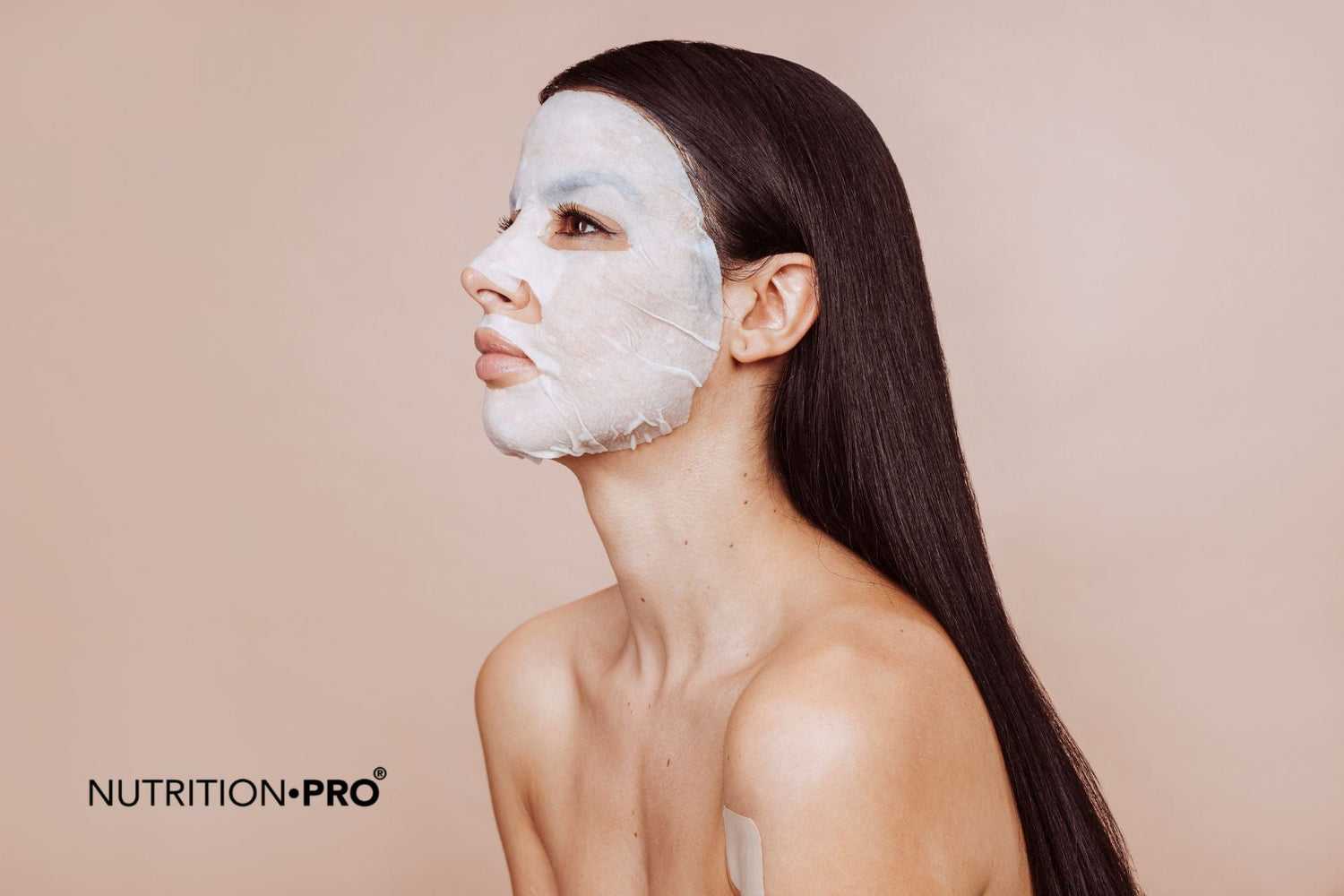
Collagen masks promise plumper, smoother, rejuvenated-looking skin. The image is appealing: you would apply collagen where it's missing, and the skin would reabsorb it. Except that skin biology tells a different story.
Here's the honest take on collagen masks: what it actually does (and it is real), what it doesn't do (despite the promises), and why the best-documented way to act on skin collagen isn't the mask, but the oral supplement.
A collagen mask hydrates and smooths the surface of the skin: a real but temporary radiance effect. What it doesn't do : rebuild dermal collagen. The molecule is too large to penetrate the skin. According to Bos and Meinardi 2000, a substance must weigh less than 500 daltons to cross the skin barrier, while collagen weighs several thousand. The route that actually works on skin collagen isingestion (de Miranda 2021). Mask for immediate radiance, oral supplement for lasting results.
The promise of collagen masks
On the packaging, the reasoning seems airtight: skin loses collagen with age, so applying it directly would make up for the loss. Collagen masks, whether sheet or gel, capitalize on this intuitive idea of collagen being "redeposited" in the skin.
The problem is that this logic clashes with the skin's primary function: being a barrier. Skin is designed to prevent external substances from entering, not to let them through. And collagen is precisely the type of molecule it blocks most effectively.
Why Collagen Doesn't Penetrate the Skin
This is the heart of the matter, and it comes down to molecular size. The outermost layer of skin, the stratum corneum, only allows very small molecules to pass through.
According to Bos and Meinardi 2000 in Experimental Dermatology, a molecule must weigh less than 500 daltons to cross the stratum corneum and be absorbed by the skin. Larger molecules cannot pass the skin barrier. This is the famous "500 dalton rule," well-established in dermatology. See the study.
Now collagen is a very large molecule. Native collagen weighs hundreds of thousands of daltons. Even hydrolyzed collagen, broken down into peptides for supplements, still weighs in the range of several thousand daltons, well beyond the 500 limit. Logical and unambiguous conclusion: collagen applied to the skin remains on the surface. It does not reach the dermis, where the true structural collagen lives.
Key Takeaway: this is not a matter of mask quality or brand. It is a physical limitation: the collagen molecule is too large to penetrate the skin, regardless of the product.
What a Collagen Mask Actually Does
Should we conclude that a collagen mask is useless? No, and it's important to be fair. It has a real effect, but you need to understand what it is.
By remaining on the surface, collagen forms a hydrating film on the skin. This film has a film-forming effect: it retains water, temporarily smooths skin texture, and gives a more supple appearance and fresher complexion. This is the famous "instant glow" effect after a mask.
This effect is cosmetic, superficial, and temporary. It lasts for the duration of the mask application and a few hours after, sometimes until the next day. It's pleasant and useful, for example before an event, but it should not be confused with deep-acting results: the mask does not modify the skin's deep structure and does not boost collagen production in the dermis.
| What a Collagen Mask Does | What It Doesn't Do |
|---|---|
| Hydrates the skin's surface | Rebuild dermal collagen |
| Temporarily smooths skin texture | Penetrate the skin barrier |
| Provides an immediate radiant effect | Work deeply over the long term |
| Offers cosmetic comfort | Replace an ingested collagen regimen |
The Method That Really Works: Ingestion
Here is the paradox that marketing prefers to hide: collagen works on the skin, but when you ingest it, not when you apply it. When ingested, hydrolyzed collagen is broken down into small peptides and amino acids, absorbed by the intestines, which enter the bloodstream and reach the dermis, where they stimulate collagen-producing cells.
According to de Miranda et al. 2021 in the International Journal of Dermatology, a meta-analysis of 19 randomized placebo-controlled trials (1,125 participants) shows that oral collagen supplementation for approximately 90 days significantly improves skin hydration and elasticity and reduces wrinkles. View the meta-analysis.
According to Bolke et al. 2019 in Nutrients, a randomized placebo-controlled trial showed that 2.5 g of collagen peptides per day simultaneously improved skin hydration, elasticity, roughness, and density after 12 weeks. View the study.
In other words, what a mask cannot do (reach the dermis), the oral route does, indirectly but genuinely, by providing the skin with the raw material and the signal to maintain its collagen. This is why, for lasting results, the collagen cure to drink or in powder form is the documented solution.

And the DIY collagen powder mask?
An idea circulates: using your drinkable collagen powder to prepare a DIY mask. It's tempting, but it makes no sense, for two simple reasons.
First, as we just saw, collagen applied to the skin does not penetrate. Mixing food-grade powder into a DIY mask would not change this physical limitation: the powder would remain on the surface, with no deep benefit. At best, you'd get a slight surface moisturizing effect, like with any mask, but not the action attributed to collagen.
Furthermore, our collagen powder is a dietary supplement designed to be drunk, not a cosmetic formulated for the skin. Its proper place is in a glass of water, coffee, or a smoothie, where it truly delivers its effects. Repurposing a drinkable product as a mask is wasting an active ingredient that only asks to be ingested to work.
To avoid: do not use your drinkable collagen powder as a mask. It will not penetrate the skin and you will lose the real benefit of the product, which is obtained orally. Reserve the powder for consumption.
The right strategy: mask AND cure, each has its role
Rather than opposing the two, the fairest approach is to give each its own role, without being mistaken about what to expect from it.
| Approach | Role | Timeline |
|---|---|---|
| Collagen mask | Radiance boost, surface hydration | Immediate and occasional |
| Drinkable collagen or powder | Support for dermal collagen | Over time (cure) |
| Active topical treatments (retinol, etc.) | Stimulate the skin on the surface and beyond | Over time |
A mask remains perfect for immediate radiance before an evening out. For real deep work on firmness and wrinkles, the ingested collagen cure is what has the evidence. And if you're looking for a topical active ingredient that truly works on the skin, turn to molecules designed for that purpose, like retinol, which we detail in our dedicated article.
Frequently asked questions
Is a collagen mask effective?
It hydrates and temporarily smooths the skin's surface (real radiance-boosting effect), but it does not rebuild dermal collagen: the molecule is too large to penetrate the skin. According to Bos and Meinardi 2000, a molecule must weigh less than 500 daltons to penetrate, whereas collagen weighs several thousand. Real but superficial and temporary effect.
Does collagen in cream or mask form penetrate the skin?
No. It remains on the surface. The stratum corneum only allows small molecules to pass through, approximately 500 daltons or less (Bos and Meinardi 2000). Collagen, even when hydrolyzed, weighs from several thousand to several hundred thousand daltons. It acts as a surface hydrator, not as an active ingredient that reaches the dermis.
Does a collagen mask provide a radiance-boosting effect?
Yes, that's its true benefit. By forming a hydrating film on the surface, it temporarily smooths skin texture and gives a refreshed complexion, useful before an event. This effect is cosmetic and temporary, and does not replace deep-acting treatment.
So collagen is useless for the skin?
On the contrary, but through another route. It works when ingested. According to the meta-analysis by de Miranda 2021 (19 trials, 1,125 subjects), oral supplementation improves hydration and elasticity and reduces wrinkles. Ingested peptides enter the bloodstream and stimulate dermal cells, which a surface mask cannot do.
What's the difference between a mask and drinkable collagen?
The mask acts on the surface: temporary hydration and smoothing. Drinkable or powdered collagen acts from within: peptides are absorbed by the intestine, enter circulation, and support dermal collagen production over time. For lasting results, ingestion is the documented route.
What really works when applied topically to the skin?
Effective topical actives are small molecules capable of penetrating or stimulating the skin, such as retinol, vitamin C, or hydrators. Collagen, on the other hand, is better as an ingested active. Mask for immediate radiance, oral course for deep results: both are complementary.
Can you make a homemade mask with the drinking powder?
It is not recommended. Our collagen powder is a dietary supplement designed to be consumed orally, not a cosmetic product. Applied to the skin, it would remain on the surface with no proven benefit, since it does not penetrate. To truly benefit from collagen, it's better to consume it.
Learn more
- Stratum corneum
- The most superficial layer of the epidermis, the main barrier of the skin against the external environment.
- Dalton
- Unit of mass of molecules. The more daltons a molecule has, the larger it is and the more difficult it is to penetrate.
- The 500 Dalton Rule
- Principle whereby a molecule must weigh less than 500 daltons to cross the skin.
- Film-forming
- That forms a film on the surface, retaining water and temporarily smoothing the skin.
- Hydrolyzed collagen
- Collagen broken down into small peptides to be absorbed by the intestine when ingested.
- Dermis
- Deep layer of the skin where supportive collagen is found, beneath the epidermis.
Important note: this article is for informational purposes and does not replace individual dermatological advice. To understand how collagen works on the skin, consult our article collagen and skin: wrinkles and firmness.
- Bos JD, Meinardi MM. The 500 Dalton rule for the skin penetration of chemical compounds and drugs. Exp Dermatol. 2000;9(3):165-169. doi:10.1034/j.1600-0625.2000.009003165.x
- de Miranda RB, Weimer P, Rossi RC. Effects of hydrolyzed collagen supplementation on skin aging: a systematic review and meta-analysis. Int J Dermatol. 2021;60(12):1449-1461. doi:10.1111/ijd.15518
- Bolke L, Schlippe G, Gerß J, Voss W. A Collagen Supplement Improves Skin Hydration, Elasticity, Roughness, and Density: Results of a Randomized, Placebo-Controlled, Blind Study. Nutrients. 2019;11(10):2494. doi:10.3390/nu11102494


