

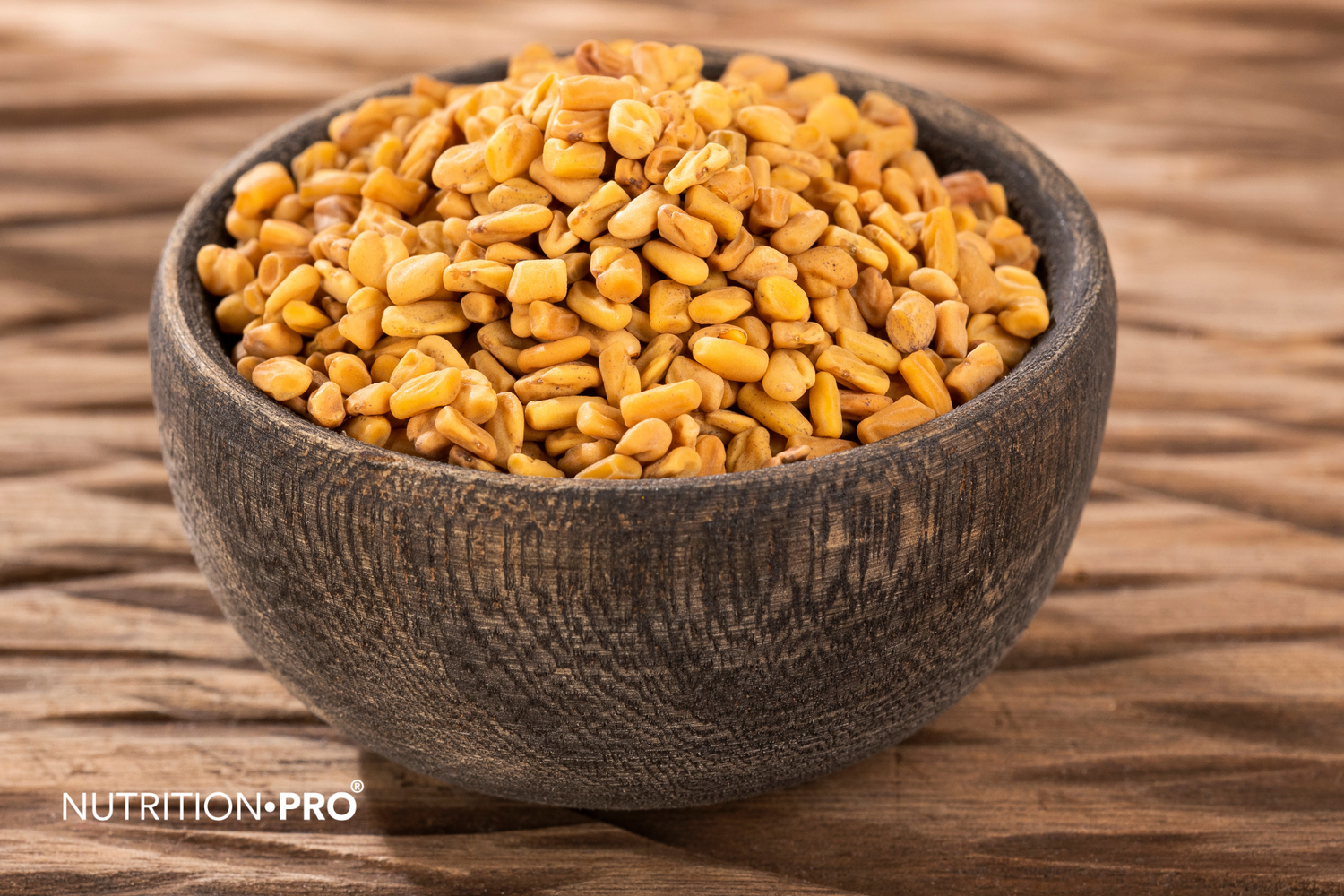
Fenugreek is one of the plants most systematically associated with testosterone, and yet one of the least well understood. You read everything and its opposite, generally without a single figure to back it up.
This article provides the figures. A meta-analysis of 7 trials totaling 449 participants, themost recent dose-response trial conducted in 95 men, and three other randomized trials. What they show is more nuanced than either camp claims: there is a real but modest effect on total testosterone, and nothing statistically significant on free testosterone, lean mass, or strength. This guide complements our general fenugreek guide by focusing on this single question.

Individual trials. A randomized double-blind trial in 49 trained men, over 8 weeks of supervised strength training, reports compared to placebo a leg press gain of 84.6 kg versus 48 kg (p < 0.001), a bench press gain of 9.1 kg versus 4.3 kg (p = 0.01) and a decrease in body fat of 2.3 points versus 0.39 (p < 0.001). Another trial finds effects on body fat, total testosterone and bioavailable testosterone. A third shows that fenugreek combined with 3.5 g of creatine equals 5 g of creatine plus 70 g of dextrose.
The meta-analysis. Seven trials, 449 participants. Significant but small effect on total testosterone (0.32; from 0.09 to 0.55). On free testosterone (0.24; from -0.04 to 0.52), lean mass, fat mass and leg press (0.22; from -0.02 to 0.47), the confidence intervals approach the threshold without crossing it. The point of caution: in the most recent dose-response trial, the 13% plasma increase did not beat placebo. And a major practical point: all these trials involved standardized extracts at 500 to 1800 mg per day.
- Strength and body composition: the most notable trials
- The combination with creatine, the overlooked angle
- Testosterone: the favorable trials
- The meta-analysis, figure by figure
- The dose-response trial and the lesson from the placebo control
- The counter-example that sheds light on the issue
- Standardized extract or powder, and how to go about it
- Frequently asked questions
Strength and body composition: the most striking findings
Let's start with the most robust trial in the performance file, published in the Journal of the International Society of Sports Nutrition. Its protocol is rigorous: 49 trained resistance-exercise men, matched by body weight, randomized double-blind, receiving 500 mg of a fenugreek extract or placebo, with a periodized resistance training program supervised at four weekly sessions for 8 weeks. Body composition measured by hydrostatic weighing, maximal strength, muscular endurance and anaerobic capacity evaluated at 0, 4 and 8 weeks.
| Criterion | Fenugreek group | Placebo group | Significance |
|---|---|---|---|
| Fat mass | -2.3 points | -0.39 point | p < 0.001 |
| Leg press, 1 RM | +84.6 kg | +48 kg | p < 0.001 |
| Bench press, 1 RM | +9.1 kg | +4.3 kg | p = 0.01 |
| Anaerobic power (Wingate) | No difference between groups | p = 0.95 | |
| Muscular endurance | No difference between groups | p > 0.05 | |
Training volume was comparable between groups, which rules out the simplest explanation. The authors also note that no changes were observed in safety parameters, lipid panel, liver function, kidney function and complete blood count.
A gain in leg press nearly doubled versus placebo, over eight weeks and in a double-blind trial with supervised training, this is not a trivial result. And it is not a marginal difference squeezed out of statistics: the gap is clear and the significance threshold well exceeded.
Also note what did not change : anaerobic power and muscular endurance. The effect bears on maximum strength and body composition, not on all physical qualities. This is a coherent profile, and this selectivity is rather a mark of credibility: a product that improved everything indiscriminately would be more suspect.
A second trial pointing in the same direction
Published in theInternational Journal of Sport Nutrition and Exercise Metabolism, another double-blind trial followed 30 trained men receiving 500 mg per day for 8 weeks, with a four-session-per-week program. It reports significant effects between groups on body fat percentage (p = 0.048), total testosterone (p = 0.018) and bioavailable testosterone (p = 0.049).
Again, selectivity is instructive: no difference between groups on anaerobic power, total weight, dihydrotestosterone or hemodynamic parameters, and no abnormalities in clinical safety data.
The combination with creatine, the overlooked angle
This one is rarely cited, and that's a shame, because it addresses a very concrete problem that practitioners encounter.
The classical creatine loading protocol combines creatine with a large quantity of simple carbohydrates, typically dextrose, to promote its absorption. It's effective, but it means swallowing several dozen grams of sugar with each dose.
A trial published in the Journal of Sports Science & Medicine compared three groups in 47 trained men, over 8 weeks with a periodized program of four sessions per week:
| Group | Daily protocol |
|---|---|
| Placebo | 70 g of dextrose |
| Standard creatine | 5 g of creatine + 70 g of dextrose |
| Creatine + fenugreek | 3.5 g of creatine + 900 mg of fenugreek extract, without dextrose |
Result: the creatine plus fenugreek group achieved gains in bench press strength and body composition comparable to those of the standard creatine plus dextrose protocol, with significant increases in lean mass at 4 and 8 weeks. The authors conclude that the fenugreek and creatine combination could be an effective means of improving creatine uptake while eliminating the need for excessive amounts of simple carbohydrates.
If you use creatine, our Creapure® creatine is directly suited for this combination.
Testosterone: favorable trials
The Testofen trial in aging men
Published in The Aging Male, this randomized double-blind placebo-controlled trial followed 120 men aged 43 to 70 receiving 600 mg per day of standardized seed extract for 12 weeks. Three consistent results:
- Significant reduction in the score on the aging male symptoms questionnaire, compared to placebo.
- Improvement in sexual function, notably the number ofmorning erections and frequency of sexual activity.
- Increase in total and free testosterone compared to placebo after 12 weeks.
The authors conclude that this extract is a safe and effective treatment for reducing symptoms of possible androgenic deficiency, improving sexual function, and increasing serum testosterone in healthy middle-aged and older men. It's the most comprehensive trial in the file, because it links a hormonal change to perceived effects. Useful contextual note: one of the authors declares an affiliation with a commercial company in the sector.
The Furosap trial on free testosterone and sperm
Published in theInternational Journal of Medical Sciences, this trial followed 50 men aged 35 to 65 years receiving 500 mg per day of an extract enriched with 20% protodioscin for 12 weeks. Its figures are the highest in the file:
| Parameter | Reported result |
|---|---|
| Free testosterone | Improved up to 46% in 90% of participants |
| Sperm count | Improved in 85.4% of participants |
| Sperm morphology | Improved in 14.6% of participants |
| Mood and mental alertness | Improvements reported by the majority of subjects |
| Libido and cardiovascular health | Significant improvements reported |
| Safety | No changes in lipid panel, blood count, liver and kidney markers |
An improvement in free testosterone of up to 46% in 90% of participants is the strongest result in the entire file. However, its protocol was single-arm and open-label : no placebo group, no blinding. In practical terms, it is impossible to know what portion is attributable to the product and what portion is attributable to other factors, including study participation. The authors are also affiliated with the research center that developed this extract.
This is not a reason to dismiss it: it provides real data, particularly on sperm profile, which no one else has measured, and an extended safety dataset. It is a reason to read it for what it is, an encouraging exploratory study, and not as proof that its figures suggest.
Regarding male fertility, this parameter requires specific management: our formula Male fertility was built for this purpose.
The meta-analysis, figure by figure
After individual trials, here's what their aggregation shows. Published in theInternational Journal of Sports Medicine, this systematic review with meta-analysis followed PRISMA recommendations and included 7 studies totaling 449 participants, including 378 men and 71 women. It evaluated the effect of fenugreek on strength, body composition, and hormonal concentrations.
A reading note before the figures. The standardized mean difference expresses the size of an effect. Around 0.2 we speak of a small effect, around 0.5 of a medium effect. And most importantly: if the95% confidence interval crosses zero, the effect is not statistically significant, regardless of the reported average.
| Measured Criterion | Effect | 95% Confidence Interval | Significant? |
|---|---|---|---|
| Total Testosterone | 0.32 | 0.09 to 0.55 | Yes, small effect |
| Free Testosterone | 0.24 | -0.04 to 0.52 | No |
| Lean Mass | 0.19 | -0.10 to 0.49 | No |
| Fat Mass | -0.19 | -0.44 to 0.05 | No |
| Leg Press | 0.22 | -0.02 to 0.47 | No |
Only one criterion out of five reached statistical significance, total testosterone, with an effect qualified as small. The other four have confidence intervals that cross zero, which means that the hypothesis of no effect is not ruled out by the data.
Two of them, free testosterone and leg press, are very close to the threshold, at -0.04 and -0.02. This means that one additional trial could tip the result one way or the other. It's neither "it doesn't work" nor "it's proven": it's a weak signal that requires more data.
The authors conclude that chronic fenugreek application has anabolic effects and performance benefits in male athletes, and thatno conclusion is possible for women.
How do we reconcile this statistical caution with the clear results from the 49-man trial? In the most straightforward way possible: trials don't all point in the same direction, and averaging aggregates the disparities. Some protocols, some populations, and some extracts produce clear effects, others don't. This is precisely what an interval that approaches the threshold without crossing it tells us: the signal exists, its consistency is not yet established.
The most recent trial, and the lesson of the active control
A randomized, double-blind trial published in PLoS One tested a fenugreek extract in 95 men aged 40 to 80 for 12 weeks, with a valuable feature: four doses compared, placebo, 600, 1200, and 1800 mg per day. A dose-response design, which is rare for this type of product.
| Measurement | Versus baseline | Versus placebo |
|---|---|---|
| Total plasma testosterone | +13.0% (significant) | +9.0%, not significant |
| Free testosterone index | +16.3% (significant) | +11.3%, not significant |
| Salivary testosterone | +31.1% (significant) | +37.2%, significant |
| Perceived effects and adverse effects | None reported | None reported |
At the highest dose, 1800 mg per day, the free testosterone index increased by 12.2% and salivary testosterone by 19.6%, both results being significant.
Look at the first column, then the second. An increase of 13% in testosterone compared to the starting point: that's exactly the kind of figure an advertisement would highlight. And it's true. But it proves nothing, because the placebo group also improved, and the difference between the two did not reach statistical significance.
This is why trials include a placebo group: hormone concentrations vary with season, sleep, weight, stress, and the simple fact of participating in a study, which often encourages healthier living. The only question that matters is: how much better than placebo? On the plasma testosterone in this trial, the answer is: not enough to conclude.
This reading reflex applies far beyond fenugreek. Every time a product announces a percentage improvement, that's the question to ask.
Two other elements of this trial deserve to be highlighted. The salivary testosteronedid beat placebo, and the authors suggest that saliva could be a preferable measure for the free fraction, since it doesn't contain protein-bound testosterone. And most importantly: no subjective effects were observed. The participants felt nothing, neither benefit nor adverse effects. A measurable biological variation is not necessarily a perceptible variation.
The counter-example that clarifies the entire picture
Here is the most instructive element, and it is rarely cited. The same lead researcher who conducted the Testofen trial published three years later, in Phytotherapy Research, a trial involving 100 men aged 45 to 80 years presenting with symptoms of benign prostatic hyperplasia, receiving 600 mg per day of standardized extract for 12 weeks.
Same plant, same dose, same duration, comparable age range. Result: fenugreek did not improve prostate symptoms, and hormone concentrations remained unchanged, as did prostate-specific antigen and safety markers, all remaining within normal limits.
This is not an embarrassing contradiction, it's valuable information. It indicates that the effect observed elsewhere is neither universal nor robust: it likely depends on the population, baseline hormonal profile, and other poorly identified factors. A truly powerful effect would appear in both trials.
This trial also provides a useful element of safety : after 12 weeks, prostate-specific antigen and safety markers were unchanged and within normal limits, which the authors note as adding to the safety profile of this extract.
Standardized extract or powder, and how to go about it
All the trials presented above have one thing in common: they test standardized extracts, often patented, at doses of 500 to 1800 mg per day. Not fenugreek seed powder.
| Standardized extract | Seed powder | |
|---|---|---|
| What it is | A concentrated fraction, obtained through an extraction process, standardized to one or more compounds | The whole seed, simply ground |
| Composition | Enriched in certain compounds, depleted in others | All the constituents of the seed, including fibers |
| Reproducibility | Guaranteed standardization from batch to batch | Natural variability linked to origin and harvest |
| What the studies test | Yes, it's the form that was studied | No, to our knowledge |
We sell fenugreek powder, that is, the whole seed ground. It would be convenient for us to claim the results obtained with patented extracts: that would be inaccurate. Seed powder and a standardized extract are not interchangeable products, and nothing allows us to assert that they produce the same effects.
Our powder has other qualities, which are those of a food: the whole seed, its fibers, its traditional culinary use and its versatility. Those are the ones we highlight, not results obtained on something else.
Concretely, if your goal is to reproduce the protocols described here, you should turn to a standardized titrated extract at the doses used in the studies, namely 500 to 600 mg per day in most of them. If your approach is dietary, seed powder has a rightful place, and is equally suited to savory preparations and beverages.
Fenugreek is neither a useless plant nor a serious hormonal lever. The data shows a real but small effect on total testosterone, and nothing statistically established on free testosterone, lean mass, fat mass, or strength. It's a possible supplement, in fifth position, far behind a medical assessment and sleep. And if you're presented with a spectacular figure, the first question to ask remains: compared to placebo, or compared to baseline?
Frequently Asked Questions
The Effect on Testosterone
Does Fenugreek Really Increase Testosterone?
Slightly, on one measure only. A meta-analysis of 7 trials and 449 participants finds a significant but small effect on total testosterone, with a standardized mean difference of 0.32 and a confidence interval of 0.09 to 0.55. On free testosterone, lean mass, fat mass, and leg press, the intervals all cross zero: these effects are not statistically significant.
Why is Free Testosterone Not Affected?
The data do not permit conclusions about it: the measured effect is 0.24 but with a confidence interval ranging from -0.04 to 0.52, which crosses zero just barely. This is an important point physiologically, since the free fraction is the one that is biologically available. An increase in total testosterone without a demonstrated increase in the free fraction has uncertain significance.
What About Strength and Muscle Mass?
This is where individual trials are most straightforward. A double-blind trial in 49 trained men over 8 weeks of supervised resistance training reports a leg press gain of 84.6 kg versus 48 kg under placebo (p < 0.001), a bench press gain of 9.1 kg versus 4.3 kg (p = 0.01), and a fat mass reduction of 2.3 percentage points versus 0.39 (p < 0.001). However, the meta-analysis aggregating all trials yields a more modest pooled effect, at the threshold of significance.
Does Fenugreek Work on All Physical Qualities?
No, and this selectivity is rather reassuring. In available trials, effects focus on maximal strength and body composition, while anaerobic power measured by the Wingate test and muscular endurance show no difference between groups. A product that improved everything indiscriminately would be more suspect than a product with a coherent effect profile.
Can Fenugreek and Creatine Be Combined?
This is the most directly actionable angle of the evidence. One trial in 47 trained men compared 5 g of creatine with 70 g of dextrose against 3.5 g of creatine with 900 mg of fenugreek extract, without dextrose, over 8 weeks. Both protocols produced comparable gains in bench press strength and body composition. The authors conclude that this combination could enhance creatine uptake while eliminating the need for excessive amounts of simple carbohydrates.
Do the Results Apply to Women?
No. The meta-analysis included 71 women out of 449 participants, and its authors explicitly state that no conclusions can be drawn for female athletes. The results presented here therefore concern men.
Reading Studies Correctly
What Does "versus Placebo" Mean Rather Than "versus Baseline"?
This is the most useful distinction in this evidence. In the most recent trial, plasma testosterone increased by 13% from baseline, an impressive and precise figure. But the placebo group also improved, and the gap between the two did not reach significance. Hormone concentrations vary with season, sleep, weight, and the simple fact of participating in a study. Only comparison versus placebo allows firm conclusions.
What Exactly Did the Dose-Response Trial Show?
In 95 men aged 40 to 80 over 12 weeks, with four compared doses from 0 to 1800 mg per day: total plasma testosterone and free testosterone index increased significantly from baseline, but not significantly versus placebo. Salivary testosterone, however, beat placebo. At 1800 mg, the free testosterone index improved by 12.2% and salivary testosterone by 19.6%.
Why Measure Testosterone in Saliva?
The trial authors suggest that saliva might be preferable for assessing the free fraction, as it contains no protein-bound testosterone. Indeed, it was on this measure that the result versus placebo was significant, whereas it was not on plasma. This divergence between two measures of the same parameter well illustrates the fragility of the signal.
Did Participants Feel Anything?
No, and this is an important point. In the dose-response trial, no subjective effects were observed, neither benefits nor adverse effects. A measurable biological variation in the laboratory is not necessarily a perceptible variation in daily life. This is a nuance that commercial communications systematically omit.
How to Explain That Some Trials Are Positive and Others Are Not?
This is the most striking counter-example of the evidence. The same lead researcher, with the same dose of 600 mg per day and the same 12-week duration, found hormonal increase in aging men, and no hormonal change in men with benign prostatic hyperplasia. The effect thus probably depends on the population, the baseline hormonal profile, and the extract used. This also explains why a meta-analysis yields a more cautious pooled effect than the most favorable trials taken individually.
The Favorable Trials
What Did the Testofen Trial Show?
This is the most favorable trial of the evidence. In 120 men aged 43 to 70 receiving 600 mg per day of standardized extract for 12 weeks, it reports a significant reduction in male aging symptom score, improved sexual function including morning erections and frequency of sexual activity, and increased total and free testosterone versus placebo. Two clarifications: it concerns a specific patented extract, and one of the authors declares a commercial affiliation in the sector.
What Did the Furosap Trial Show?
These are the highest figures of the evidence: in 50 men aged 35 to 65 receiving 500 mg per day of an extract enriched to 20% protodioscin for 12 weeks, free testosterone was improved up to 46% in 90% of participants, and sperm count in 85.4%. Essential point to know: the protocol was single-arm and open-label, without placebo group or blinding, and the authors are affiliated with the center that developed this extract. This is an encouraging exploratory study, not a demonstration.
Does Fenugreek Improve Libido?
One trial suggests so: the one on Testofen extract in aging men, which reports improved sexual function including morning erections and frequency of sexual activity. The more recent dose-response trial, however, observed no subjective effects reported by participants. A signal therefore exists, on a single trial, with a specific extract. Persistent decreased libido warrants medical evaluation.
Form, Safety, and Priorities
Seed Powder or Standardized Extract?
These are not interchangeable products. All cited trials test standardized extracts, often patented, at doses of 500 to 1800 mg per day. An extract is a concentrated fraction titrated on certain compounds; a powder is the whole seed ground with its fiber. Nothing permits affirming that results obtained on one apply to the other, and we do not do so for our own product.
Is Fenugreek Safe?
The presented trials reported no notable adverse effects. The trial in men with benign prostatic hyperplasia provides a useful element: after 12 weeks, prostate-specific antigen and safety markers remained unchanged and within normal limits. Nevertheless, precautions exist, particularly during pregnancy and with antidiabetic or anticoagulant treatment: these are detailed in our general fenugreek guide.
What Should I Start With If I'm Concerned About My Testosterone?
With a consultation and a blood test. Fatigue, decreased libido, and erectile dysfunction have identifiable medical causes, some of them serious, and an evaluation guides everything else. Next comes sleep, closely linked to hormone production, then body composition and physical activity, then micronutrient status verified by testing. Plants come in fifth place.
Can Fenugreek Replace Medical Treatment?
No, and it should not delay appropriate medical care. A confirmed androgenic deficit is a medical diagnosis that requires specialized follow-up, with therapeutic options far beyond what a supplement can offer. If your symptoms are concerning you, a blood test is the first useful step.
Key takeaways on fenugreek and testosterone?
That several randomized, double-blind trials report, against placebo, gains in maximum strength, a decrease in fat mass, and increases in total and bioavailable testosterone, with sometimes significant differences. That the meta-analysis aggregating all studies shows a more modest effect, significant for total testosterone and borderline for other outcomes, as not all trials converge. That combining it with creatine allows for a reduced creatine dose and the elimination of dextrose. And that all these results are based on standardized extracts at 500 to 1800 mg per day.
Sources
The studies cited below were identified via PubMed.
- Isenmann E, et al. The anabolic effect of fenugreek: systematic review with meta-analysis. International Journal of Sports Medicine, 2023;44(10):692-703. DOI
- Lee-Ødegård S, et al. Effect of a fenugreek plant extract on plasma and salivary testosterone in a randomized, double-blind intervention study. PLoS One, 2024;19(9):e0310170. DOI
- Rao A, et al. Testofen, a specialized seed extract of Trigonella foenum-graecum, reduces age-related symptoms of androgen decline, increases testosterone and improves sexual function. The Aging Male, 2016;19(2):134-142. DOI
- Rao A, Grant R. Effect of a Trigonella foenum-graecum extract on prostate-specific antigen and prostate function in men with benign prostatic hyperplasia. Phytotherapy Research, 2020;34(3):634-639. DOI
- Poole C, et al. Effects of a commercially available botanical supplement on strength, body composition, power, and hormonal profiles in resistance-trained men. Journal of the International Society of Sports Nutrition, 2010;7:34. DOI
- Taylor L, et al. Effects of combined creatine plus fenugreek extract versus creatine plus carbohydrates on adaptations to resistance training. Journal of Sports Science & Medicine, 2011;10(2):254-260.
- Maheshwari A, et al. Efficacy of Furosap, a novel seed extract, in increasing testosterone levels and improving semen profile in male volunteers. International Journal of Medical Sciences, 2017;14(1):58-66. DOI
- Wilborn C, et al. Effects of a purported aromatase and 5-alpha-reductase inhibitor on hormonal profiles in young men. International Journal of Sport Nutrition and Exercise Metabolism, 2010;20(6):457-465. DOI
- European Parliament and Council. Regulation (EC) 1924/2006 on nutrition and health claims made on foods. eur-lex.europa.eu


