

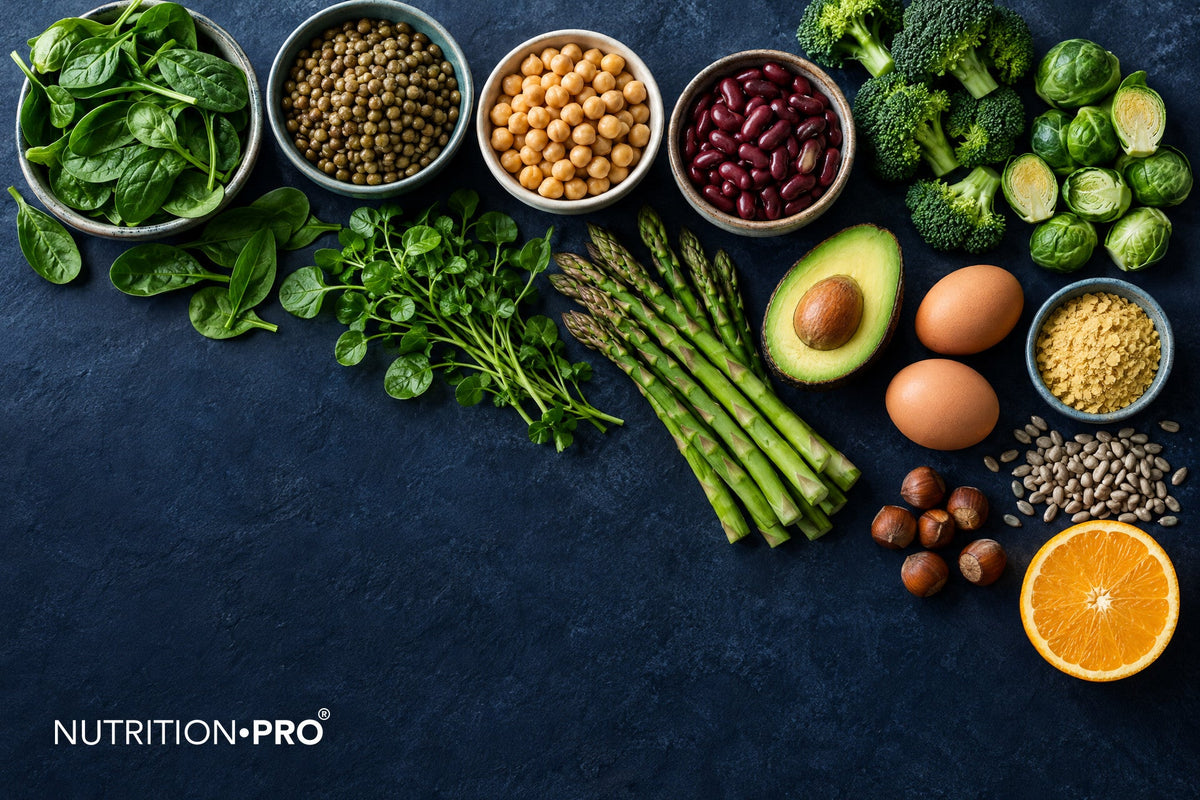
We often look for vitamin B9 in fruits, and find it mainly elsewhere: in liver, yeast, lentils, chickpeas, and leafy green vegetables. But you need to know how much a real serving provides, what the cooking pot loses, and what the body actually absorbs.
This ranking gives the nutrient content per 100 g and per serving, in ranges, because reference tables don't all say the same thing. It reports the study that measured cooking losses, trials that measured the absorption of dietary folates, and the Cochrane review that explains why, before pregnancy, diet alone isn't enough.

per 100 g: poultry liver, from 580 to 1,440 µg depending on tables, then veal or beef liver, and yeast, highly concentrated but consumed by the spoonful. Per real serving , legumes come first: 200 g of cooked lentils, chickpeas or red beans provide 100 to 360 µg, up to the entire330 µg recommended per day. Followed by spinach, broccoli, Brussels sprouts, avocado and sunflower seeds. Cooking matters
: boiled, spinach and broccoli lose about half their folates; steamed, almost none. Absorption of dietary folates reaches approximately 80% of that of folic acid. Before pregnancy , 400 µg of folic acid per day as a supplement, from the moment you plan to conceive: it's this supplementation that reduces neural tube defects by 69% in trials, not diet alone.Medical information.
- The ranking, per 100 g and per serving
- The best sources, by category
- Les meilleures sources, famille par famille
- Cooking: up to half less
- What the body actually absorbs
- Two typical days above 330 µg
- Pregnancy: why diet alone isn't enough
- When a supplement makes sense, and which one
- Frequently asked questions
Folates, folic acid, B9: what are we talking about
Vitamin B9 refers to a family of molecules. Folates are the natural forms found in foods, fragile when exposed to heat, light, and cooking water.Folic acid is the synthetic form in supplements and fortified foods, stable and very well absorbed, which the body must convert. 5-methyltetrahydrofolate, or methylfolate, is the form that circulates in the blood and that cells use directly. All of them serve the same purpose: to manufacture DNA and allow cells to divide. This is why they are important for red blood cells and, especially, for the embryo in the first weeks, when the neural tube closes—the foundation of the brain and spinal cord.
French and European nutritional standards set the adequate intake at 330 µg per day in adults and at 600 µg during pregnancy. These values are expressed in dietary folate equivalents, a unit that accounts for the better absorption of folic acid: this is why some tables show two figures for the same food.
The ranking, per 100 g and per serving
| Food | Per 100 g | Portion | Per portion |
|---|---|---|---|
| Cooked poultry liver | 580 to 1 440 µg | 100 g | 580 to 1 440 µg |
| Cooked veal or beef liver | 250 to 590 µg | 100 g | 250 to 590 µg |
| Cooked lentils | 50 to 180 µg | 200 g | 100 to 360 µg |
| Cooked chickpeas | 85 to 170 µg | 200 g | 170 to 340 µg |
| Spinach, boiled | 95 to 145 µg | 200 g | 190 to 290 µg |
| Cooked red beans | 80 to 130 µg | 200 g | 160 to 260 µg |
| Cooked broccoli | 75 to 110 µg | 150 g | 110 to 165 µg |
| Raw spinach | 175 to 195 µg | 80 g as salad | 140 to 155 µg |
| Cooked Brussels sprouts | 60 to 110 µg | 150 g | 90 to 165 µg |
| Eggs | 45 to 105 µg | 2 eggs, 100 g | 45 to 105 µg |
| Brewer's yeast flakes | 700 to 2,000 µg | 1 tablespoon, 5 g | 35 to 100 µg |
| Avocado | 70 to 90 µg | half, 80 g | 55 to 70 µg |
| Sunflower seeds | 180 to 230 µg | 30 g | 55 to 70 µg |
| Peanuts | 120 to 240 µg | 30 g | 35 to 70 µg |
| Hazelnuts | 110 to 200 µg | 30 g | 35 to 60 µg |
| Orange | 25 to 30 µg | 1 fruit, 150 g | 40 to 45 µg |
| Camembert, Brie | 60 to 100 µg | 30 g | 20 to 30 µg |
Rounded ranges based on the 2013 and 2025 editions of the Ciqual table (Anses) and the USDA FoodData Central database. These are orders of magnitude, not laboratory values: folate content varies with variety, season, storage, and analytical method.
Folates are difficult to measure: they exist in multiple forms, degrade during analysis, and methods have evolved. Tables therefore diverge. For strawberries, the American database gives 24 µg per 100 g, the 2013 edition of the Ciqual table gives 43 µg, and the 2025 edition gives 99 µg. For raw broccoli, the University of Ulster team measured 177 µg per 100 g using enzymatic extraction, when tables show 60 to 110 µg.
What doesn't change from one table to another is the ranking: liver and yeasts at the top, then legumes and leafy green vegetables, then oil seeds, eggs and cheeses, then fruits. It is this ranking that should guide menu planning, rather than fixating on a figure precise to the microgram.
The best sources, family by family
Liver is the champion in all categories: 580 to 1,440 µg per 100 g of poultry liver, two to four times the recommended daily intake in a single serving. It is also the leading source of preformed vitamin A, which rules it out during pregnancy (section 7). Outside this period, an occasional serving provides a complete boost.
Yeasts, brewer's yeast flakes, malted yeast, yeast spreads, display 700 to 2,500 µg per 100 g, but we eat a spoonful, or 35 to 100 µg. A useful supplement on a salad, soup or pasta, not a staple.
Legumes, lentils, chickpeas, red and white beans, split peas, flageolets, have an average content per 100 g, but a generous serving: 200 g cooked provide 100 to 360 µg, along with fiber, iron and proteins. Two to three legume dishes per week change the weekly balance.
Green leafy vegetables and cruciferous vegetables, spinach, lamb's lettuce, watercress, romaine lettuce, asparagus, broccoli, Brussels sprouts, are the family that gave its name to the vitamin: folate comes from the Latin folium, the leaf. Raw or steamed, they retain most of their B9.
Seeds and nuts, sunflower seeds, peanuts, hazelnuts, walnuts, provide 35 to 70 µg per handful of 30 g: a snack that counts in the day.
Eggs and aged cheeses provide some. The yolk concentrates the folates in the egg, 130 to 245 µg per 100 g of yolk; two eggs provide 45 to 105 µg. Soft-ripened cheeses, camembert and brie, give 20 to 30 µg per serving.
Fruits, oranges, mandarins, kiwis, strawberries, avocados, are less rich per 100 g than green vegetables, but we eat them raw, without cooking losses. One fresh fruit per meal adds 30 to 50 µg.
What contains little of it : meat and poultry excluding offal, fish, white rice, pasta and white bread, dairy products. In France, flours are not enriched with folic acid, unlike the United States or Canada, where mandatory fortification has reduced neural tube defects. Some breakfast cereals are, 170 to 250 µg per 100 g according to the Ciqual 2025 table: the label specifies this.
Cooking: up to half less
Boiling for usual durations left only 49% of folates in spinach, from 191.8 to 94.4 µg per 100 g, and 44% in broccoli, from 177.1 to 77.0 µg per 100 g. Steaming spinach or broccoli, on the other hand, resulted in no significant decrease, even at maximum durations of 4.5 minutes for spinach and 15 minutes for broccoli. Prolonged grilling of beef did not reduce its content, and boiling whole potatoes, with or without skin, did not significantly alter theirs. Folate retention depends on both the food and cooking method; advice to improve folate status should include practical cooking recommendations.
McKillop DJ, Pentieva K, Daly D, et al. Br J Nutr 2002;88(6):681-688. DOI: 10.1079/BJN2002733
| Cooking method | What remains | In practice |
|---|---|---|
| Raw | Everything | Baby spinach leaves, lamb's lettuce, watercress, avocado, fruits |
| Steamed | The essentials, no measurable decrease | Broccoli, spinach, asparagus, Brussels sprouts |
| Boiling water | About half | B9 passes into the water: keep it for a soup or sauce |
| Whole food, grilled | The essentials | Whole cooked potatoes, grilled beef |
The principle is easy to remember: folates dissolve in water. The longer a green vegetable spends in a large pot of water, the more it loses. Three steps are enough: raw vegetables every day, green vegetables steamed or in very little water, and cooking water recovered when boiling. Legumes, meanwhile, are eaten with their cooking liquid in soups and stews, which limits losses.
What the body actually absorbs
Seventy-two healthy adults were divided into four groups for four weeks: a diet rich in dietary folates, 369 µg per day, with placebo, or a diet low in folates, 73 µg per day, with 92, 191 or 289 µg of folic acid in capsule form. All also received a small dose of folic acid labeled with carbon 13. The bioavailability of dietary folates compared to folic acid was 78% based on isotopic labeling and 85% based on serum folate changes. The overall bioavailability of folates from fruits, vegetables and liver is approximately 80% of that of folic acid. A diet rich in folates can improve population status more effectively than is generally assumed.
Winkels RM, Brouwer IA, Siebelink E, Katan MB, Verhoef P. Am J Clin Nutr 2007;85(2):465-473. DOI: 10.1093/ajcn/85.2.465
Sixty-six adults aged 18 to 45 years followed one of three controlled diets for four weeks: rich in vegetables and citrus fruits, approximately 560 µg of folates per day, with placebo; low in folates with 250 µg folic acid per day; or low in folates with placebo. Folate status improved and plasma homocysteine decreased in the first two groups. The relative bioavailability of dietary folates compared to folic acid was estimated at 60 to 98% depending on the criterion used. Increasing consumption of vegetables and citrus fruits improves folate status and lowers homocysteine.
Brouwer IA, van Dusseldorp M, West CE, et al. J Nutr 1999;129(6):1135-1139. DOI: 10.1093/jn/129.6.1135
Folates from food are therefore slightly less well absorbed than folic acid from supplements, approximately four fifths, but a plate rich in vegetables, legumes and fruits truly improves B9 status and lowershomocysteine, a blood marker that rises when folates are lacking. This is the good news from these trials: in adults, diet does the job. The limitation appears with pregnancy (section 7).
Two typical days above 330 µg
Both days far exceed 330 µg, using the lower ranges and without liver, under one condition: that legumes and green vegetables are on the menu. A day made up of white bread, pasta, meat and dairy products remains well below, regardless of quantity. During pregnancy, the 600 µg target is also achievable through diet, but this does not eliminate the need for supplementation, for the reason that follows.
Pregnancy: why diet alone isn't enough
Five trials involving 7,391 women were included, of which 2,033 had previously had a pregnancy affected by a neural tube defect. Out of 6,708 births, daily folic acid supplementation, alone or combined with other vitamins and minerals, protected against neural tube defects, relative risk 0.31, high-quality evidence, and against their recurrence, relative risk 0.34. The effect did not depend on the dose explored, 400 µg per day or more, nor on combination with other micronutrients. No net effect was shown on cleft lip and palate, heart malformations, or miscarriages. Folic acid, alone or combined with vitamins and minerals, prevents neural tube defects.
De-Regil LM, Peña-Rosas JP, Fernández-Gaxiola AC, Rayco-Solon P. Cochrane Database Syst Rev 2015;(12):CD007950. DOI : 10.1002/14651858.CD007950.pub3
What the trials tested was the supplement, not diet. And timing works against diet alone: the neural tube closes in the first four weeks of pregnancy, often before the pregnancy is known. Folic acid therefore begins from conception planning, at least one month before conception, and continues until twelve weeks. A German trial in 144 women actually showed that red blood cell folates had still not reached their plateau after 24 weeks of supplementation, and its authors argue for starting more than four weeks before conception. Countries that fortify their flours have seen these defects decline; France does not, hence the importance of supplementation.
The liver is the best dietary source of B9, and a poor choice during pregnancy: it is also the primary source of preformed vitamin A, several thousand micrograms per 100 g. A prospective study of 22,748 pregnant women associated an intake of preformed vitamin A greater than 15,000 IU per day with a risk of neural crest-related malformations multiplied by 3.5, the excess being especially harmful before the seventh week.
During pregnancy planning and pregnancy, liver and liver-based products should be avoided, and B9 comes from vegetables, legumes, and folic acid supplementation. Our article on retinol and pregnancy details this point.
When a supplement makes sense, and which one
Outside of pregnancy, a diet that includes legumes and green vegetables covers the needs. A supplement makes sense in a few situations: the pregnancy planning and first trimester, without question; a diet poor in plant foods that cannot be changed immediately; a documented deficiency by a blood test, whose cause the doctor will investigate, malabsorption, alcohol consumption, certain medications such as methotrexate or anticonvulsants. In these latter cases, the dose and duration are decided with the doctor.
One hundred forty-four healthy women aged 19 to 33 years received each day for 24 weeks 400 µg of folic acid, the equimolar quantity of [6S]-5-methyltetrahydrofolate, 416 µg, half this dose, 208 µg, or placebo. The increase in red blood cell folates was significantly greater with 416 µg of [6S]-5-methyltetrahydrofolate than with 400 µg of folic acid or 208 µg of methylfolate. No plateau of erythrocyte folates was reached in 24 weeks, while plasma folates plateaued after 12 weeks. [6S]-5-methyltetrahydrofolate is more effective than folic acid for improving folate status and could be an effective and safe alternative.
Lamers Y, Prinz-Langenohl R, Brämswig S, Pietrzik K. Am J Clin Nutr 2006;84(1):156-161. DOI : 10.1093/ajcn/84.1.156
Old observations in patients deficient in vitamin B12 showed that high-dose folic acid could correct their anemia and delay diagnosis, while nerve damage progressed. An analysis of the U.S. national survey in 1,459 seniors points in the same direction: when B12 was low, high serum folates were associated with more anemia, odds ratio 3.1, and cognitive impairment, odds ratio 2.6; when B12 was normal, high folates were conversely associated with cognitive protection.
Hence two reflexes: have B12 checked in case of fatigue or anemia, and prefer a supplement that combines both vitamins. Our article on vitamin B12 details its sources and deficiencies.
Vitamin B9 as Quatrefolic® (5-methyltetrahydrofolate) 400 µg, B12 as methylcobalamine 2.5 µg, B6 as pyridoxal-5-phosphate 5 mg, with B1, B2, B3, B5 and B8, in one capsule per day at breakfast. The form of B9 that performed better than folic acid on red blood cell folates in the German trial, and the B12 that must accompany it. During pregnancy, the choice of supplement is made with the midwife or doctor.
See B VitaminsOur complete guide to folic acid details deficiency, pregnancy, and dosages.
Frequently Asked Questions
What foods are richest in folic acid?
Per 100 g, liver takes the lead: 580 to 1,440 µg for poultry liver according to food composition tables, 250 to 590 µg for veal or beef liver. Yeasts, brewer's yeast in flakes or yeast extracts, are even more concentrated, but we consume only a spoonful. Per actual serving, cooked legumes—lentils, chickpeas, red beans—provide 100 to 360 µg per 200 g, followed by spinach, broccoli, Brussels sprouts, avocado, and sunflower seeds.
Which vegetables contain the most vitamin B9?
Leafy green vegetables and cruciferous vegetables: spinach, 175 to 195 µg per 100 g raw, lamb's lettuce, watercress, romaine lettuce, asparagus, broccoli, and Brussels sprouts, 60 to 110 µg per 100 g cooked. The word folate actually comes from the Latin folium, meaning leaf. A 200 g serving of cooked spinach provides 190 to 290 µg, a 150 g serving of broccoli provides 110 to 165 µg. Steamed or raw, they retain most of their B9; boiled, they lose approximately half.
Which fruits are rich in folic acid?
Fruits contain less than leafy greens and legumes: orange 25 to 30 µg per 100 g, or 40 to 45 µg per fruit, avocado 70 to 90 µg per 100 g, strawberry 24 to 99 µg depending on the tables, kiwi and clementine in the same range as orange. Their advantage is that they are eaten raw, with no loss from cooking. One fresh fruit at each meal adds 30 to 50 µg, helpful but not sufficient alone.
Does cooking destroy folic acid?
Natural folates do, especially in boiling water. A study from Ulster University measured that boiling retained 49% of spinach folates and 44% of broccoli folates, whereas steaming, even prolonged, caused no significant decrease. Grilled beef and whole cooked potatoes retained most of their folates. To preserve B9: raw vegetables daily, steamed leafy greens, and cooking water reused in soup. Synthetic folic acid from supplements is stable.
Can you meet your B9 needs through diet alone?
Yes in adults, provided legumes and leafy greens are on the menu. With the low end of food composition table ranges, an omnivorous day with whole grain bread, orange, spinach salad, eggs, sunflower seeds, lentils, and steamed broccoli exceeds 500 µg, above the recommended 330 µg. Folates from foods are absorbed at approximately 80% of folic acid according to a Dutch trial, and a diet rich in vegetables and citrus fruits genuinely improves folate status. Pregnancy is the exception: there, a supplement is added.
Why take a folic acid supplement during pregnancy if you eat well?
Because supplementation is what has been tested and shown to protect. The 2015 Cochrane review, five trials and 7,391 women, shows that daily folic acid at 400 µg or more reduces neural tube defects by 69%, high-quality evidence. The neural tube closes in the first four weeks of pregnancy, often before it is known, and red blood cell folates take months to increase: the supplement begins at conception planning, at least one month before conception, and continues through twelve weeks, with your midwife or doctor.
Do you need to eat liver for vitamin B9?
It's not necessary, and should be avoided during pregnancy. Liver is the most concentrated source, 580 to 1,440 µg per 100 g of poultry liver, but also the primary source of preformed vitamin A, several thousand micrograms per 100 g. A prospective study of 22,748 pregnant women associated preformed vitamin A intake above 15,000 IU per day with a 3.5-fold increased risk of birth defects. Outside of pregnancy, an occasional portion is a good source; the rest of the time, legumes and leafy greens are sufficient.
Folic acid or methylfolate: which form to choose?
Both work. Folic acid is the form used in neural tube defect prevention trials; the body must convert it. Methylfolate, or 5-methyltetrahydrofolate, is the form that circulates in the blood. In a randomized trial with 144 women aged 19 to 33, 416 µg of methylfolate raised red blood cell folates more than 400 µg of folic acid over 24 weeks. During pregnancy, the choice is made with your midwife or doctor. In all cases, B9 benefits from being combined with B12.
What should you remember about foods rich in vitamin B9?
That liver and yeasts are the most concentrated, but legumes and leafy green vegetables provide most of the intake per actual serving. That food composition tables differ, hence ranges rather than single figures. That boiling water removes half the folates from leafy greens, and steaming almost none. That folates from foods are absorbed at approximately 80% of folic acid. And that before pregnancy, 400 µg of folic acid as a supplement is added to meals, excluding liver.
Sources
The studies cited below were identified via PubMed ; nutrient content comes from food composition tables indicated at the end of the list.
- Winkels RM, Brouwer IA, Siebelink E, Katan MB, Verhoef P. Bioavailability of dietary folates is 80% that of folic acid. American Journal of Clinical Nutrition, 2007;85(2):465-473. DOI
- Brouwer IA, van Dusseldorp M, West CE, et al. Dietary folates from vegetables and citrus lower plasma homocysteine: controlled dietary trial. Journal of Nutrition, 1999;129(6):1135-1139. DOI
- McKillop DJ, Pentieva K, Daly D, et al. Effect of different cooking methods on folate retention in foods that are major sources of folates in the United Kingdom. British Journal of Nutrition, 2002;88(6):681-688. DOI
- De-Regil LM, Peña-Rosas JP, Fernández-Gaxiola AC, Rayco-Solon P. Effects and safety of periconceptional oral folate supplementation to prevent congenital malformations. Cochrane Database of Systematic Reviews, 2015;(12):CD007950. DOI
- Lamers Y, Prinz-Langenohl R, Brämswig S, Pietrzik K. Erythrocyte folate levels increase more after supplementation with [6S]-5-methyltetrahydrofolate than with folic acid in women of childbearing age. American Journal of Clinical Nutrition, 2006;84(1):156-161. DOI
- Rothman KJ, Moore LL, Singer MR, Nguyen US, Mannino S, Milunsky A. Teratogenicity of high vitamin A intake. New England Journal of Medicine, 1995;333(21):1369-1373. DOI
- Morris MS, Jacques PF, Rosenberg IH, Selhub J. Folate and vitamin B12 status, anemia, macrocytosis and cognitive disorders in American seniors in the era of folic acid fortification. American Journal of Clinical Nutrition, 2007;85(1):193-200. DOI
- Crider KS, Bailey LB, Berry RJ. Food fortification with folic acid: history, effects, issues and perspectives. Nutrients, 2011;3(3):370-384. DOI
- Anses. Nutritional composition table of foods Ciqual, 2013 and 2025 editions. ciqual.anses.fr
- USDA Agricultural Research Service. FoodData Central, SR Legacy database. fdc.nal.usda.gov


