

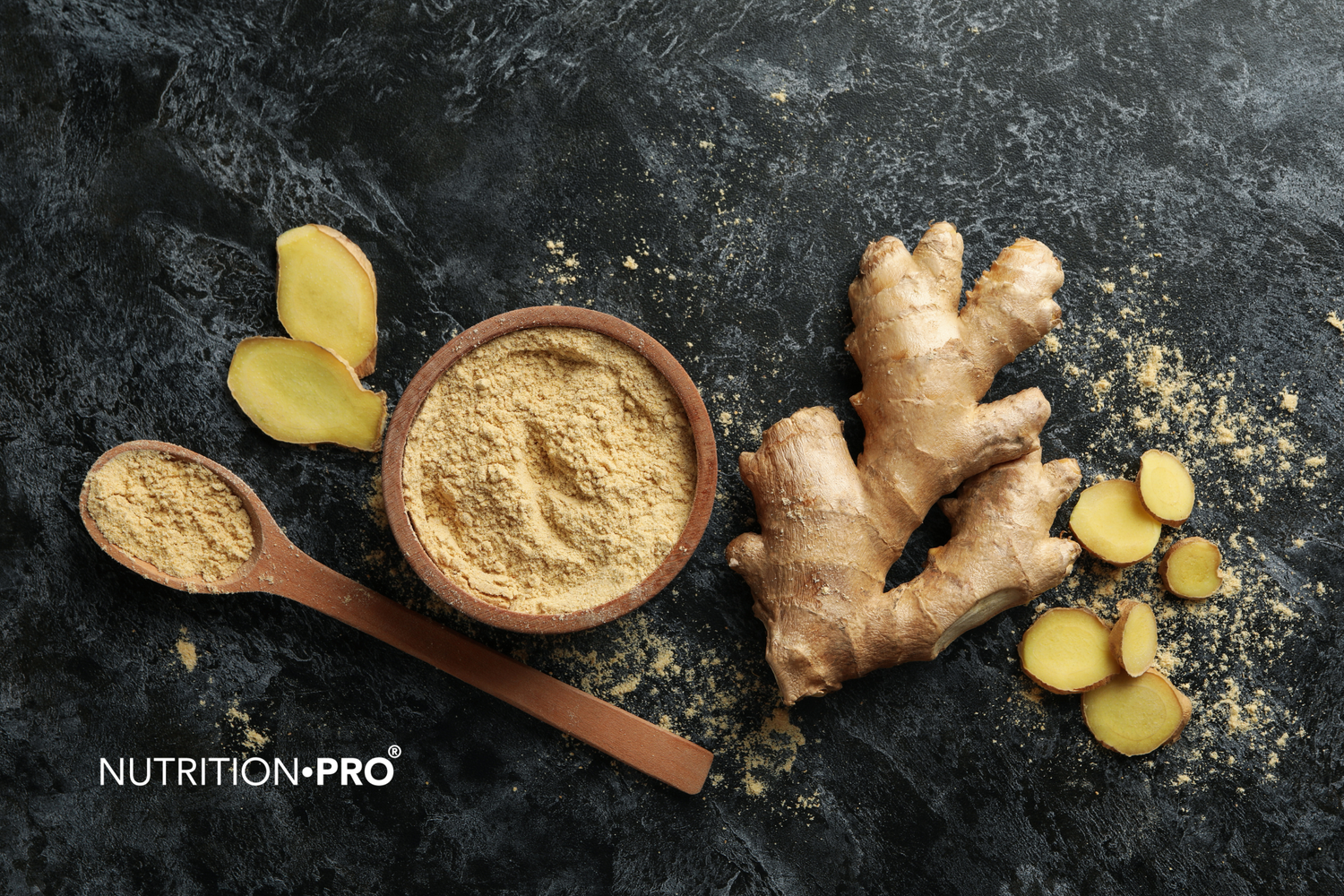
Fresh grated rhizome, culinary powder, infusion, capsules, standardized extract: ginger comes in half a dozen forms, and the question "which is the best" comes up constantly. It's the wrong question. Fresh ginger and dried ginger do not contain the same molecules, and two capsules bearing the same name may contain amounts of active ingredients with no relationship to one another.
This article follows the molecule rather than the form. What drying does to gingerols. What your body actually absorbs from it, and for how long. What an analysis of ten commercial supplements found in the capsules. And what the clinical trials, those that produced the results of our articles on pregnancy nausea and painful periods, actually used.

Fresh and dried are not the same product. The fresh rhizome is rich in gingerols. Drying and heat dehydrate them into shogaols : up to seven times more 6-shogaol between cold drying and drying at 80 °C. An analysis of commercial dried ginger identified 115 compounds, of which 31 were formed by heat.
What the body does with it. In 27 volunteers, no free gingerol or shogaol was found in the blood: everything is conjugated by the liver, peak around 65 to 75 minutes, half-life less than two hours. What the capsules contain. Ten commercial supplements analyzed: 6-gingerol from 0.0 to 9.43 mg per gram, suggested daily doses of 250 mg to 4.77 g. The conclusion: The form tells us nothing, the content tells us everything, and only a dosed and analyzed powder allows us to know it.
What's in a rhizome
The rhizome of Zingiber officinale contains hundreds of compounds, but three groups carry most of what interests us here.
| Family | What it is | Where it's found |
|---|---|---|
| Gingerols | The major pungent compounds in fresh ginger; 6-gingerol dominates, along with 8- and 10-gingerols | Fresh rhizome, especially |
| Shogaols | The dehydrated forms of gingerols: same skeleton, one water molecule fewer Minor in fresh ginger, major after drying or cooking | Essential oil |
| Zingiberene and other terpenes, responsible for the aroma | Fresh and dried, volatile, lost during drying and storage | The key point that organizes everything else: gingerols are |
thermally unstable . Heat them, dry them, store them for long periods, and they lose a water molecule to become shogaols. Fresh ginger and dried ginger are therefore not two concentrations of the same thing. They aretwo chemically different products What drying does: from gingerols to shogaols.
Two analyses, one same pattern.
commercial dried ginger , the kind you buy in powder form, comparing it to fresh ginger they had previously characterized. They identified115 compounds . Among them,31 were new , never described in fresh ginger, and the authors attribute most of the short-chain compounds tothermal degradation that occurred during commercial drying, or during the analysis itself which mimics cooking. The overall result: gingerols, predominant in fresh ginger, were slightly reduced in the dried form, and shogaols increased A Korean team subsequently quantified the phenomenon by controlling it. Fresh ginger was dried in four ways: by freeze-drying, at room temperature, in an oven at 60°C and 80°C, then extracted at three temperatures..
Process
| Effect on 6-shogaol | Freeze-drying followed by extraction at room temperature |
|---|---|
| Lowest content: the profile remains close to fresh | Drying at 80°C followed by extraction at 80°C |
| Highest content, approximately | seven times that of the cold process Acidic medium |
| Milieu acide | Further increases conversion to shogaol |
The same rhizome can yield a powder rich in gingerols or a powder rich in shogaols, depending on how it has been dried. The manufacturer who dries gently and the one who dries at high temperature do not sell the same product under the same name. And the infusion you prepare with boiling water also converts some of the gingerols while it steeps.
Korean authors note that 6-shogaol has been reported to have an activity more potent than 6-gingerol in laboratory studies, which explains the industrial interest in shogaol-rich extracts. This superiority is established in vitro and in animal models. In humans, no trial compares a gingerol-rich profile to a shogaol-rich profile on a clinical endpoint. It is therefore not a marketing argument, it is a research avenue.
What your body does with it
A team from the University of Michigan gave ginger to 27 volunteers, at increasing doses of 100 mg to 2 g, and drew their blood from 15 minutes to 72 hours after ingestion. They were looking for gingerols and 6-shogaol.
| What was measured | Result |
|---|---|
| Free gingerols and shogaol | Undetectable in all participants, at all doses |
| Conjugated forms | Present: glucuronides of each compound, 6-gingerol sulfate above 1 g |
| Blood peak | Around 65 to 75 minutes after ingestion |
| Elimination half-life | Less than two hours for all compounds |
Two practical takeaways.
The first: gingerols and shogaols are absorbed, the question of their bioavailability is not one of a molecule that doesn't enter. But they are immediately conjugated, that is bound to a glucuronide or sulfate that makes them soluble and prepares them for elimination. What your body "sees" are not the molecules from the rhizome, but their conjugates.
The second: with a peak in just over an hour and a half-life of less than two hours, a single dose taken in the morning leaves nothing measurable in the blood by afternoon. This is precisely why clinical trials distribute the dose in three or four doses, and why a single large capsule has no pharmacokinetic logic.
What commercial capsules really contain
Here is the section we wanted to write. A team from a Texas medical center purchased ten ginger root supplements, randomly, from pharmacies and health food stores, and analyzed them using liquid chromatography.
| Compound | Minimum | Maximum | Average |
|---|---|---|---|
| 6-gingerol | 0.0 mg/g | 9.43 mg/g | 2.56 mg/g |
| 6-shogaol | 0.16 mg/g | 2.18 mg/g | 1.27 mg/g |
| 8-gingerol | 0.00 mg/g | 1.10 mg/g | 0.47 mg/g |
| 10-gingerol | 0.00 mg/g | 1.40 mg/g | 0.36 mg/g |
| Suggested daily dose | 250 mg | 4.77 g | 19-fold difference between the two |
Some supplements sold as "ginger" contained no detectable 6-gingerol. Others contained 9.43 mg per gram. Between two capsules bearing the same word on the label, the quantity of the main active compound thus varied from zero to everything. And manufacturers recommended doses ranging from 250 mg to nearly 5 g per day, a 19-fold difference, without the active ingredient content justifying it.
The authors, who were writing in an obstetrics journal because these supplements are often taken for pregnancy-related nausea, concluded on a wide variation in composition and suggested doses from one manufacturer to another. In plain terms: the pregnant woman who buys ginger at a pharmacy doesn't know what she's taking, unless the manufacturer has measured it and told her.
How can ginger powder contain no gingerol? Through everything described in section 2: poor raw material, drying that was too hot or too long, which converted gingerols to shogaols and then degraded these, prolonged storage, dilution. The word "ginger" on a label designates a plant, not a content level.
Fresh, powder, infusion, capsules: the comparison
| Form | Chemical profile | Known dose? | Fidelity to clinical trials |
|---|---|---|---|
| Fresh grated rhizome | Rich in gingerols, essential oil intact | No: variable content depending on variety, maturity, storage | Low: almost no trial used it |
| Fresh infusion | Gingerols poorly soluble in water, partial conversion to shogaols with heat | No: depends on quantity, time, temperature | Low: doses generally much lower |
| Kitchen powder | Rich in shogaols, essential oil partially lost | Partially: known weight, unknown content | Medium: same material, but rarely analyzed |
| Rhizome powder capsules | Same as powder, depending on manufacturer's drying process | Yes for weight ; content depends on batch analysis | High : this is the form used in most trials |
| Standardized extract | Gingerol and shogaol content guaranteed | Yes for content ; powder equivalence unknown | Medium: most trials used powder, not extracts |
The table says one simple thing: no form is intrinsically superior, because no human trial has compared the profiles. What distinguishes the forms is knowing what you're taking. Fresh and infusion don't allow this. Powder in capsules allows it for weight, and for content if the batch is analyzed. Extract allows it for content, at the cost of distance from the reference doses of trials, expressed in powder.
What clinical trials used
The clinical results for ginger, those from our articles on pregnancy nausea and painful periods, were obtained with a specific form, and it makes sense to want to reproduce it.
- Painful periods, compared to ibuprofen: 250 mg of rhizome powder in capsules, four times daily, for three days.
- Pregnancy nausea, compared to vitamin B6: 650 mg of ginger, three times daily, for four days.
- Meta-analyses: ranges of 500 to 2,000 mg of powder per day, in multiple doses, some trials with syrups or biscuits.
- Fresh rhizome and infusion: practically absent from trials.
The trials distributed the dose into three or four doses. Pharmacokinetics explains why: peak around 70 minutes, half-life under two hours. A protocol with a single dose would match neither the trials nor what the body does with the molecule. When a product recommends a single large capsule per day, it deviates from both.
What to do in practice
Frequently asked questions
The molecules
Fresh or powdered ginger: which is more active?
The question is poorly framed, because the two do not contain the same molecules. Fresh ginger is rich in gingerols. Drying and heat transform some of these gingerols into shogaols, through the loss of a water molecule. An analysis of commercial dried ginger found slightly reduced gingerols and increased shogaols compared to fresh. Both families are active, with different profiles. What matters is not fresh or dry, it's how much of each, and this cannot be seen with the naked eye.
What is a gingerol?
Gingerols are the predominant pungent compounds of the fresh rhizome, with 6-gingerol being the most abundant, along with 8- and 10-gingerols. These are what give fresh ginger its sharp pungency and carry much of its activity studied in the laboratory. They are thermally unstable: heat dehydrates them into shogaols.
What is a shogaol?
Shogaol is the dehydrated form of gingerol. It is a minor component in the fresh rhizome and increases with drying, storage, and cooking. It gives dried ginger its warmer and more persistent pungency. Several laboratory studies attribute to it a more powerful activity than that of the corresponding gingerol, which explains why manufacturers are interested in shogaol-rich extracts. This superiority is established in vitro and in animals, but not demonstrated in humans.
Why does dried ginger taste differently pungent than fresh?
Because they are not the same molecules creating the pungency. The gingerol in fresh ginger gives a sharp, fresh pungency. The shogaol in dried ginger gives a warmer, deeper, and more persistent pungency. The change in taste that everyone knows between a grated rhizome and a cooking powder is the sensory translation of a real chemical change.
Drying and cooking
What exactly does drying do to ginger?
It modifies its composition. One study dried fresh ginger by freeze-drying, at room temperature, or in an oven at 60 and 80 degrees, then extracted at different temperatures. The 6-shogaol content increased with drying and extraction temperature, up to seven times more between the coldest and hottest process. Another analysis of commercial dried ginger identified 115 compounds, including 31 new ones formed by thermal degradation. Drying does not concentrate ginger, it transforms it.
Is dried ginger therefore better than fresh?
It is different. Dried ginger has more shogaols, fresh has more gingerols, and clinical trials on nausea or painful menstruation used dried rhizome powder, which supports this form if one wants to reproduce what has been studied. But nothing demonstrates in humans that one profile is superior to the other for a given use. The decisive advantage of powder lies elsewhere: it can be dosed.
Does cooked ginger retain its properties?
It transforms them. Cooking, like drying, dehydrates gingerols into shogaols, and an analysis of commercial dried ginger attributes some of its compounds to thermal degradation that mimics cooking. Cooked ginger is therefore not inactive, it has a different profile from fresh, richer in shogaols. What is lacking are clinical data comparing one to the other.
How long does ginger powder keep?
Its composition evolves over time, light, and heat: gingerols continue to convert to shogaols, then the shogaols themselves degrade. Powder stored for a long time in a warm cupboard no longer has the profile of fresh powder from the batch. An opaque, closed container, kept cool and dry, and a recent manufacturing date are the useful benchmarks.
In the body
What happens to ginger once swallowed?
A trial in 27 volunteers who took 100 mg to 2 g of ginger tracked gingerols and 6-shogaol in the blood for 72 hours. No participant had detectable free gingerol or shogaol. Only their conjugated forms, bound to a glucuronide or sulfate by the liver and intestine, were present. The peak occurred around 65 to 75 minutes, and the elimination half-life was less than two hours. The body therefore transforms everything very quickly.
Should doses be split?
The pharmacokinetic data suggest so: with a peak in just over an hour and a half-life of less than two hours, a single morning dose leaves nothing measurable in the blood by afternoon. This is consistent with clinical trial protocols, which divide the dose into three or four doses throughout the day. One capsule in the morning and one in the evening follows this logic; a large single dose does not.
The products
Are all ginger capsules equal?
No, and it is measurable. Ten ginger root supplements bought at random in pharmacies and stores were analyzed. The 6-gingerol content ranged from 0.0 to 9.43 mg per gram of powder. Some contained none at all. The 6-shogaol ranged from 0.16 to 2.18 mg per gram. And the suggested daily doses on labels ranged from 250 mg to 4.77 g. Two capsules labeled ginger can therefore contain unrelated quantities of active ingredients.
How can a ginger powder contain no gingerol?
Through a combination of several factors: poor raw material, a variety or harvest with low concentration, drying that was too long or too hot, which converted gingerols to shogaols then degraded these, prolonged storage, or dilution. The word ginger on the label refers to a plant, not a content. Without analysis, nothing guarantees what is in the capsule.
How do you know what a product contains?
Through the batch certificate of analysis, which indicates the gingerol and shogaol content measured by chromatography. A serious manufacturer provides it on request. In its absence, indirect indicators are the mention of the plant part—rhizome—the form, rhizome powder rather than a blend, the origin, and the presence of a batch number. A product that specifies none of this does not allow for any verification.
Does a fresh ginger infusion provide many active ingredients?
Little, and especially an unknown quantity. Gingerols are poorly soluble in water, some remains in the rhizome, and the dose depends on the amount grated, the infusion time, and the temperature, which actually converts some of the gingerols to shogaols during preparation. The infusion is pleasant and may suffice for mild discomfort. It does not correspond to the doses of clinical trials and does not allow you to know what you are taking.
Are standardized extracts preferable to powder?
A standardized extract guarantees a gingerol and shogaol content, which crude powder does not guarantee without analysis. But most clinical trials used rhizome powder, not extracts, and reference doses are expressed in milligrams of powder. A concentrated extract has an unknown equivalent powder dose. Both approaches have their logic; powder analyzed batch by batch combines fidelity to trials and verification of content.
A 500 mg ginger capsule, how much fresh ginger is that?
Fresh rhizome contains approximately 80 to 90% water, so one gram of dry powder corresponds roughly to 5 to 10 grams of fresh. But the comparison is misleading: drying has changed the composition, converted gingerols to shogaols, and degraded some compounds. A capsule of powder is not concentrated fresh ginger, it is a different product, richer in shogaols and above all dosable.
Is organic ginger richer in active ingredients?
The cultivation method does not determine the gingerol content, which depends on the variety, maturity at harvest, terroir, and especially post-harvest processing. Organic certification guarantees the absence of synthetic pesticides, which is a real quality criterion, but distinct from content level. The two are verified separately: certification for one, analysis for the other.
The trials
What did the clinical trials use?
Essentially dried rhizome powder in capsules, at defined doses: 250 mg four times daily in the trial on painful periods versus ibuprofen, 650 mg three times daily in the trial on pregnancy nausea versus vitamin B6, and ranges of 500 to 2,000 mg per day in meta-analyses. A few trials used syrups or biscuits. Almost none used fresh rhizome or infusion.
What to know about ginger form?
That fresh and dried do not contain the same molecules, drying converting gingerols to shogaols. That the body conjugates everything in less than an hour and eliminates it in less than two, which argues for divided doses. That commercial supplements range from zero to 9.43 mg/g of 6-gingerol, so the word ginger guarantees nothing. That clinical trials used dried rhizome powder in capsules at defined doses. And that the only useful question is: how many active compounds, and how verified.
Glossary
- Gingerols
- Pungent compounds predominant in the fresh rhizome, of which 6-gingerol is the most abundant; thermally unstable.
- Shogaols
- Dehydrated forms of gingerols, minor in the fresh product, increased by drying, cooking, and storage.
- Dehydration
- Chemical reaction by which a molecule loses a water molecule; here, the one that transforms a gingerol into a shogaol.
- Freeze-drying
- Cold drying under vacuum, which preserves the chemical profile of the fresh product.
- Conjugation
- Attachment by the liver or intestine of a glucuronide or sulfate to a molecule, making it more soluble and faster to eliminate.
- Half-life
- Time required for the blood concentration of a substance to decrease by half.
- Liquid chromatography
- Analysis technique allowing separation and quantification of compounds in a mixture, used to measure gingerols and shogaols.
- Certificate of analysis
- Laboratory document indicating, for a given batch, the measured content levels and product compliance.
- Standardized extract
- Concentrated preparation whose content of marker compounds is guaranteed at a defined value.
Sources
The studies cited below were identified via PubMed.
- Jolad SD, Lantz RC, Chen GJ, Bates RB, Timmermann BN. Commercial dried ginger (Zingiber officinale): composition and effects on LPS-stimulated PGE2 production. Phytochemistry, 2005;66(13):1614-1635. DOI
- Ok S, Jeong WS. Optimization of extraction conditions for a 6-shogaol-rich ginger extract. Preventive Nutrition and Food Science, 2012;17(2):166-171. DOI
- Zick SM, et al. Pharmacokinetics of 6-gingerol, 8-gingerol, 10-gingerol and 6-shogaol and their conjugated metabolites in healthy human subjects. Cancer Epidemiology, Biomarkers & Prevention, 2008;17(8):1930-1936. DOI
- Schwertner HA, Rios DC, Pascoe JE. Variation in concentration and labeling of ginger root dietary supplements. Obstetrics & Gynecology, 2006;107(6):1337-1343. DOI


