

You're searching for "homemade weight gainer" because you don't feel like buying a powder, and you're right to question it: a gainer has no active ingredients, it's calories and protein, and oats, a banana and milk provide those too. We sell a gainer, and this article starts by telling you that.
It then gives three recipes calibrated by calorie level, compares homemade versus ready-made on what matters, recalls what studies say about surplus and protein, and ends with the three situations, and only those, where a powder has a real advantage.

Homemade is worth buying on what matters, calories and protein, and provides fiber and micronutrients on top. The basic recipe : 250 ml of milk, 50 g of oats, one banana, 25 g of protein powder, approximately 550 kcal and 35 g of protein. What studies say : a large surplus creates mostly fat, so homemade calories count like those in a powder; protein caps out around 1.6 g per kilogram, spread roughly three hours apart.
When store-bought makes sense : when volume is the problem, a powder serving makes 300 ml and 189 kcal where homemade makes 500 ml, fills you up and blocks progress; when consistency matters for adjusting on the scale; when logistics require it. In other cases, make it yourself.
What a gainer really is
A gainer is a mixture of carbohydrates and proteins whose only function is to add calories and protein in an easy format. It contains no active ingredient that builds muscle: it's resistance training that builds, and the gainer provides some of the energy. The body makes no difference between 60 g of carbohydrates from a powder and 60 g from oats and banana. This is what makes homemade gainer not only possible, but equivalent.
Two data points frame what follows, detailed in our gainer guide. The only randomized trial on surplus size, Helms', shows that a 15% surplus mostly makes fat compared to 5%: the calories from a homemade gainer therefore count as seriously as those from a powder. And Morton's meta-analysis of 49 trials sets the useful ceiling for protein at around 1.6 g per kilo: the gainer, homemade or bought, counts toward it, it doesn't add to it.
Three calibrated recipes
The base is always the same: a liquid, a carbohydrate source, a protein source, and depending on the level, a fat source. The values are orders of magnitude; a banana weighs 90 to 130 g and a spoonful of peanut butter varies twofold. Weigh the ingredients at least the first few times, to know what you're drinking.
250 ml of water or unsweetened plant-based beverage, 30 g of oat flakes, one small banana, 25 g of protein powder, whey or plant-based. Blend for 30 seconds.
For whom: the snack that complements protein without inflating the surplus. Close to a dose of whey with some carbs.
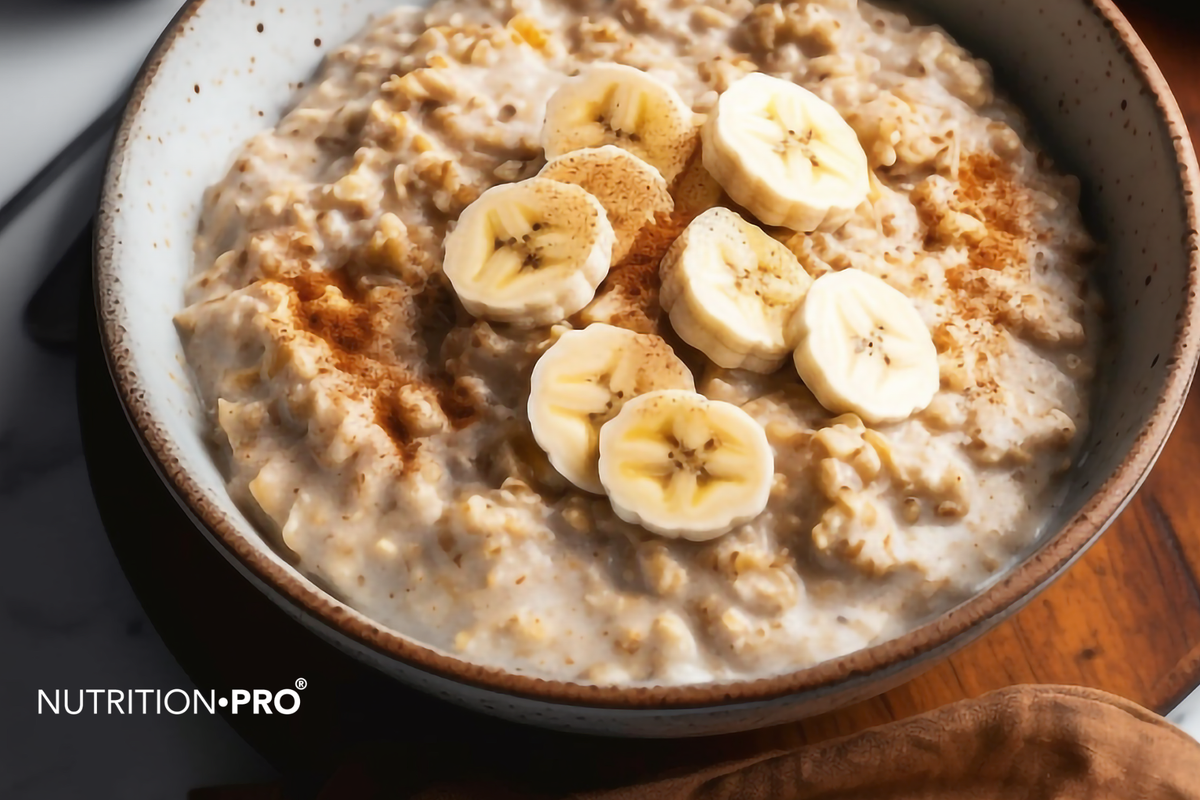
250 ml of semi-skimmed milk, 50 g of oat flakes, one banana, 25 g of protein powder, a pinch of cinnamon. Blend, drink within the hour.
For whom: the meal that replaces a skipped meal, around training or mid-day. The equivalent of two to three servings of powder gainer.
250 ml of whole milk, 60 g of oat flakes, one banana, one tablespoon of peanut butter, 25 g of protein powder. Blend thoroughly.
For whom: the hardgainer whose weight doesn't go up despite recipe 2. Not to be taken on top of already sufficient nutrition: it's the surplus that Helms' trial advises against.
Replace the 25 g of protein powder with 150 to 200 g of cottage cheese, skyr or Greek yogurt, which provide 15 to 20 g of protein, or with two whole cooked eggs blended. Without any added protein source, an oat-banana-milk gainer caps out at 12 to 15 g, which is low for a meal targeting 20 to 40 g according to ISSN positioning.
Homemade or bought: the honest comparison
| Criterion | Homemade gainer, recipe 2 | Lean Gainer, one serving | Who wins |
|---|---|---|---|
| Calories | Approximately 550 kcal | 189 kcal | Tie: the powder serving multiplies |
| Protein | Approximately 35 g with whey | 12.6 g | Homemade, thanks to the whey added to it |
| Fiber, micronutrients | Oats, banana, milk | 1 g of fiber | Homemade, clearly |
| Volume to consume | 400 to 500 ml, thick, filling | 300 ml, fluid | The powder, for those without appetite |
| Dose consistency | Varies with the banana and the spoon | Identical every time | The powder, to adjust on the scale |
| Time, equipment | Blender, five minutes, dishwashing | Shaker, thirty seconds | The powder |
| Cost per serving | Approximately 1 to 1.50 euros | Approximately 1.75 euros per serving | Homemade, slightly |
The table says what it says: nutritionally, homemade performs better or equally well. The powder wins on three practical criteria, and these three criteria are exactly those that matter for the profile a gainer is designed for.
The three cases where powder makes sense
Volume is the problem. Those who struggle to gain weight, the hardgainer, have a stomach that reaches its limit. A homemade gainer with 550 kcal makes a thick half-liter with fiber: it's filling, which is its strength, and it's its weakness here. A powder serving delivers 189 kcal in 300 ml of fluid liquid, without fiber, and passes through where the smoothie gets stuck. For this profile, powder isn't a luxury—it's what enables the caloric threshold that solid and thick foods refuse.
Consistency matters. Adjusting a surplus on the scale requires knowing what you're adding. A powder serving delivers 189 kcal, every time. A homemade recipe delivers 500 or 620 kcal depending on the banana and how generous with the spoon, and the variation clouds your scale reading. Those managing their muscle gain in 200 kcal increments need a stable unit.
Logistics demands it. At work, while traveling, in a locker room, without a blender or fridge, powder and a shaker are the only option. It's not a nutritional reason, it's a real-life reason, and it's valid.
The most common approach among those who train seriously: homemade gainer on weekends and work-from-home days, powder on office and travel days. It's not a compromise, it's an organization. In both cases, the total daily calories and protein is what matters, and training is what builds muscle.
189 kcal and 12.6 g of protein per 50 g dose in 300 ml of water, identical with each serving. A 2.5 to 1 ratio, fluid, fiber-free, that goes down when your stomach is full, and that can be halved to adjust the surplus based on the scale. The complement to homemade gainer, not its replacement.
View the Lean GainerIf you have the time, blender and appetite, recipe 2 works just as well. Our gainer guide details who it makes sense for.
Frequently Asked Questions
Does a homemade gainer match a store-bought gainer?
On what matters, yes. A gainer has no active ingredient: it provides calories and protein, and the body doesn't distinguish between 60 g of carbs from oats and banana versus 60 g from powder. What studies show about muscle gain—a moderate surplus and protein around 1.6 g per kilo—is achieved equally well with either. Homemade gainer also provides fiber and micronutrients that powder doesn't have. Its only disadvantages are practical: time, equipment, volume, and variability in quantities.
What is the basic recipe for a homemade gainer?
A liquid, a carb source, a protein source, a fat source. The foundation: 250 ml of milk or plant-based drink, 50 g of oat flakes, a banana, and a serving of whey or plant-based protein, about 25 g of protein. This gives around 550 kcal and 35 g of protein. To increase calories, add a tablespoon of peanut butter, about 100 kcal, or a handful of nuts. To decrease, replace the milk with water and reduce the oats. Blend, drink within the hour.
How many calories in a homemade gainer?
Whatever you put in it, and that's both the benefit and the pitfall. The basic recipe runs around 550 kcal; with peanut butter and whole milk, you exceed 700; with water and less oats, you drop to around 350. The only randomized trial on surplus size shows that a large surplus mostly builds fat: a 700 kcal homemade gainer taken on top of already sufficient nutrition is exactly what the trial advises against. Weigh the ingredients at least the first few times, to know what you're drinking.
Do you need whey in a homemade gainer?
You need a protein source; whey is the most convenient, not the only one. Without it, an oat-banana-milk gainer provides 12 to 15 g of protein, which is low for a serving targeting 20 to 40 g according to ISSN guidelines. Cottage cheese, skyr, or Greek yogurt, 150 to 200 g, provide 15 to 20 g; plant-based protein powders work too. The key is that your total daily intake reaches about 1.6 g per kilo, spread throughout the day.
When does a store-bought gainer make more sense than a homemade gainer?
In three situations. When volume is the issue: a 550 kcal homemade gainer makes 400 to 500 ml and contains fiber, it's filling, whereas a dose of gainer powder provides 189 kcal in 300 ml and goes down easier for someone without appetite. When consistency matters: powder delivers the same dose every time, making scale-based adjustments clear, while the homemade recipe varies depending on the banana and the spoon. And when logistics demands it: at work, while traveling, without a blender. Beyond these three cases, homemade works just as well.
When should you drink your homemade gainer?
Instead of the meal you'd skip, according to ISSN guidelines which prioritize total intake spread roughly every three hours. Around training if you haven't eaten before or after; as a mid-day snack if lunch and dinner are far apart. Never in place of a full meal you could eat: gainer, homemade or store-bought, adds to your intake, it doesn't replace it.
What should you remember about homemade gainer?
That it matches store-bought gainer on calories and protein, with added fiber and micronutrients. That its basic recipe is simple—milk, oats, banana, protein—around 550 kcal. That its calories must be counted like powder calories, because a large surplus builds fat. That store-bought gainer retains three advantages: volume, consistency, and logistics. And that in both cases, it's training and total daily intake that build muscle.
Sources
The studies cited below were identified via PubMed.
- Helms ER, Spence AJ, Sousa C, et al. Effect of small and large energy surpluses on strength, muscle, and skinfolds in resistance-trained individuals. Sports Medicine - Open, 2023;9(1):102. DOI
- Morton RW, Murphy KT, McKellar SR, et al. Systematic review, meta-analysis, and meta-regression of the effect of protein supplementation on muscle mass and strength gains. British Journal of Sports Medicine, 2018;52(6):376-384. DOI
- Kerksick CM, Arent S, Schoenfeld BJ, et al. International Society of Sports Nutrition position stand: nutrient timing. Journal of the International Society of Sports Nutrition, 2017;14:33. DOI


