

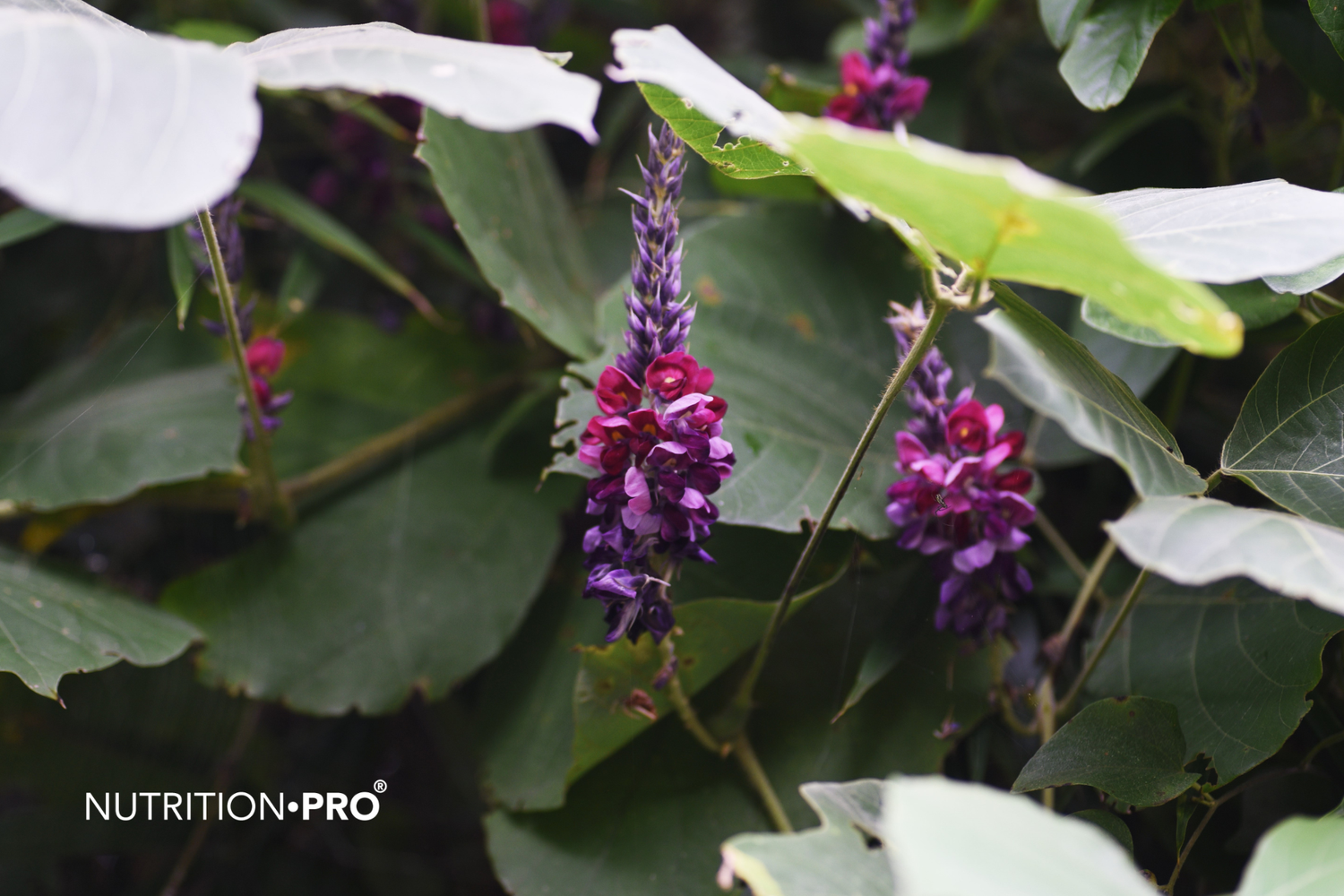
Kudzu is one of the rare medicinal plants whose traditional use has been tested inrandomized double-blind trials, by a Harvard team, over more than ten years. It is also a plant that is credited with far more benefits than what these trials actually show: alcohol withdrawal, sugar cravings, tobacco, hot flashes.
This page sorts through the facts. What the trials measured, in whom, over what timeframe, at what dose, and what they did not find. Then the question that product sheets avoid: the doses used in trials compared to what's in the capsules on the market, including ours.

What the trials show: in heavy drinkers not seeking treatment, kudzu reduces the number of drinks consumed by 30 to 57%, in four randomized double-blind trials. It works quickly: a single dose two and a half hours before, seven days of use, or four weeks in the longest trial. It acts on drinking pattern (smaller sips, slower pace), not on cravings.
What they do not show: no effect on craving in any trial, no effect in alcohol-dependent individuals in treatment, no demonstrated general benefit at menopause, and no clinical trials on tobacco or sugar. The dose that matters is in milligrams of isoflavones, and most capsules on the market, including ours, fall far short of the trial dosages.
- Alcohol: what four randomized trials show
- How quickly kudzu works
- What the trials do not show: cravings, dependence, menopause, tobacco, sugar
- How it works, based on what is observed
- Doses from trials versus doses sold, including ours
- Safety: the liver, hormones, interactions
- Frequently asked questions
Alcohol: what four randomized trials show
The setup is the same in all these trials: regular drinkers, a recreated living room with television and refrigerator, up to six beers of their preferred brand available, and a scale hidden in the coffee table that records each sip. No one knows whether they received kudzu or placebo.
Heavy drinkers treated for 7 days with kudzu or placebo: significant reduction in the number of beers consumed, with more sips per beer, smaller sips and more time to finish each glass. No effect on the urge to drink. No adverse effects reported.
Lukas SE et al., Alcoholism: Clinical and Experimental Research, 2005. DOI 10.1097/01.alc.0000163499.64347.92
Ten volunteers, 1,200 mg of puerarin per day for one week: 2.4 beers consumed versus 3.5 under placebo. Under placebo, four participants drank five or six beers; under puerarin, none. Smaller sips, slower glasses, longer delay before opening the next one.
Penetar DM et al., Drug and Alcohol Dependence, 2012. DOI 10.1016/j.drugalcdep.2012.04.012
17 men aged 21 to 33 drinking 27.6 drinks per week, with a diagnosis of abuse or dependence: extract standardized to 250 mg of isoflavones three times daily. Reduction of 34 to 57% in weekly drinks, fewer days of heavy consumption, more consecutive days of abstinence. No effect on craving. No adverse effects, liver and kidney function unchanged.
Lukas SE et al., Psychopharmacology, 2013. DOI 10.1007/s00213-012-2884-9
20 men, 2 g of extract (520 mg of isoflavones) or placebo taken 2 hours 30 minutes before a 90-minute session: the kudzu group went from 3.0 to 1.9 beers, the placebo group from 2.7 to 3.4. The kudzu group opened 21 beers after treatment versus 32 before; the placebo group 38 versus 33. Slower consumption.
Penetar DM et al., Drug and Alcohol Dependence, 2015. DOI 10.1016/j.drugalcdep.2015.05.025
Four trials, four results in the same direction, a single research team. This is both the strength and the limitation of this data: the consistency is remarkable, but no independent team has reproduced them, and sample sizes are small, 10 to 20 participants per trial. The authors themselves describe the effect as modest and call for studies in people seeking treatment.
How long it takes for kudzu to work
| Timeframe | What the trial observed | Dose and form |
|---|---|---|
| 2 hours 30 minutes | A single dose is sufficient to reduce consumption during the session that follows: 3.0 to 1.9 beers | 2 g of extract, 520 mg of isoflavones, in a single dose |
| 7 days | Reduced consumption during the test session, slowed pace, in two separate trials | Daily standardized extract, or 1,200 mg of puerarin per day |
| 4 weeks | Weekly glasses reduced by 34 to 57%, more consecutive alcohol-free days, in real life | 250 mg of isoflavones three times per day, or 750 mg per day |
| Beyond | No data. There is no trial lasting longer than one month | Unknown |
Kudzu is therefore a plant with rapid action, which distinguishes it from most adaptogenic plants that require several weeks. This is explained by the supposed mechanism, detailed below: it does not modify the terrain, it modifies the way alcohol is perceived at the moment it is consumed. This also means that there is no reason to accumulate it for months while waiting for an effect: if it changes nothing in four weeks, the trials give no reason to think it will change anything in four months.
What the trials do not show
The urge to drink: no effect, in any trial
This is the most consistent result of all the literature, and the most contrary to what the packaging says. In the four positive trials, kudzu reduces what people drink, not what they want to drink. Craving scales are unchanged across the board. A product presented as an "appetite suppressant" is not supported by any of this data.
Established dependence: one negative trial
38 veterans in a care program, 1.2 g of root extract twice per day: no significant difference with placebo on craving or sobriety after one month, or at subsequent stages. Kudzu did no better than placebo.
Shebek J, Rindone JP, Journal of Alternative and Complementary Medicine, 2000. DOI 10.1089/acm.2000.6.45
The population makes all the difference. The positive trials involve people who drink excessively without being dependent and without seeking treatment. The only trial in dependent individuals in treatment is negative. Kudzu is neither a withdrawal treatment nor a substitute for proper care, and presenting the plant this way wastes time for people who need it.
Menopause: the reference trial proved nothing
127 postmenopausal women aged 50 to 65, divided between hormone therapy, Pueraria lobata (equivalent to 100 mg of isoflavones) and no treatment: no significant change in lipids, FSH or LH in the kudzu group. Only cognitive indices improved. The authors conclude they were unable to demonstrate a scientific basis for the use of kudzu for the health of postmenopausal women in general.
Woo J et al., Menopause, 2003. DOI 10.1097/01.GME.0000054764.94658.33
A confusion sustains kudzu's reputation on this ground: Pueraria mirifica, a different Thai species, very rich in specific phytoestrogens, has more substantial data on hot flashes. This is not the kudzu sold in Europe, which is Pueraria lobata. Our article on kudzu and menopause details this distinction.
Tobacco and sugar: no clinical trials
We searched for a randomized trial in humans on kudzu and tobacco cessation, and on kudzu and sugar cravings. None exists indexed on PubMed. These two uses, omnipresent on sales pages, are extrapolations of the supposed mechanism on alcohol, supported at best by animal models. They are not documented clinically, and we do not claim them.
How it works, based on what we observe
The historical hypothesis comes from Chinese medicine and biochemistry: the daidzin, an isoflavone from kudzu, inhibits the ALDH2 enzyme which breaks down acetaldehyde, an unpleasant metabolite of alcohol. This is the mechanism of disulfiram, and that of genetic alcohol intolerance common in East Asia, which protects against alcoholism. The problem: in the trials, participants report no discomfort, and the study on puerarin alone, which does not inhibit this enzyme, achieves the same effect.
The hypothesis that fits the observations is different. Under kudzu, participants drink in smaller sips, take longer to finish each glass, and wait longer before opening the next one. The Harvard team proposes that isoflavones accelerate alcohol's arrival to the brain, likely by increasing cerebral blood flow: the desired sensation comes sooner, with fewer drinks, and the need to keep going diminishes. This would explain both the speed of action, the lack of effect on cravings, and the lack of effect in dependent individuals, for whom consumption is no longer driven by sensation.
This hypothesis has a practical consequence that we prefer to state: if alcohol reaches the brain faster, each drink may be felt more intensely. Exercise caution with driving and any risky activity.
Trial doses versus sold doses, including ours
All positive trials use either a standardized extract whose isoflavone content is known, or pure puerarin. Raw kudzu root contains isoflavones, but in variable proportion depending on origin, harvest, and drying, generally a few percent. Comparing 750 mg of root to 750 mg of isoflavones is like comparing an orange to a vitamin C tablet.
| Source | Dose per day | Isoflavones per day | Result |
|---|---|---|---|
| 4-week trial (Lukas 2013) | Standardized extract, 3 doses | 750 mg | Weekly drinks reduced by 34 to 57% |
| Single dose trial (Penetar 2015) | 2 g extract, single dose | 520 mg | 3.0 to 1.9 beers |
| Puerarin trial (Penetar 2012) | Pure puerarin | 1,200 mg | 3.5 to 2.4 beers |
| Negative trial (Shebek 2000) | 2.4 g of root, non-standardized | Unknown | No effect in dependent individuals |
| Menopause trial (Woo 2003) | Pueraria lobata | 100 mg | No general benefit |
| Our Kudzu | 750 mg of root, non-standardized | Not dosed, presumably a few dozen mg | Well below the positive trials |
The conclusion is uncomfortable and we draw it anyway: our Kudzu, like nearly all kudzu sold in France in root form as capsules, does not provide the isoflavone dose from the trials. It provides the traditional plant, in its traditional form, which is one thing; it does not reproduce the Harvard protocol, which is another. A reader seeking the effect from the trials should look for an extract displaying its isoflavone content, ideally 500 mg per day or more, and verify that it is indeed Pueraria lobata.
The table above shows that our product is far from the isoflavone doses in the trials, that kudzu does not act on cravings and does nothing in dependent individuals. We prefer a customer who buys a traditional root knowing what it is, or who doesn't buy it, to a customer hoping for a withdrawal effect that the plant has never demonstrated. If your alcohol consumption concerns you, the useful page is not this one, it's your doctor's.
See KudzuSafety: the liver, hormones, interactions
In the four randomized trials, no adverse effects were reported, and the four-week trial, the only one to monitor biology, observed no changes in liver enzymes, renal function, or vital signs. This is reassuring for one month of use at standardized dose. Beyond that, it is unknown.
55-year-old man with no medical history, taking mistletoe extract for one month and kudzu root extract for ten days: transaminases over 1,000 IU/L, bilirubin at 9.4 mg/dL, hepatitis seronegative. Progressive normalization after discontinuing both extracts. Causality assessment designates mistletoe as probable, kudzu cannot be ruled out.
Kim HJ et al., Journal of Alternative and Complementary Medicine, 2015. DOI 10.1089/acm.2014.0228
Kudzu contains isoflavones with weak oestrogenic activity : not recommended during pregnancy and breastfeeding, and without medical advice in case of history of hormone-dependent cancer. Theoretical interactions with anticoagulants and diabetes treatments. Liver signs to watch for: unusual fatigue, dark urine, pain under the right rib cage, jaundice: stop immediately and consult a doctor. And if you take kudzu before drinking, remember that each drink may be felt more strongly: no driving.
Frequently asked questions
Kudzu and alcohol
What is kudzu?
A climbing legume from East Asia, Pueraria montana var. lobata, whose root has been used for centuries in China, particularly for the effects of alcohol. Its root is rich in isoflavones, particularly puerarin, daidzin, and daidzein, which are the compounds studied in clinical trials. It is the isoflavone content, not the weight of root, that defines the dose.
Is kudzu effective against alcohol?
On one specific point, yes: four randomized double-blind trials conducted in heavy drinkers not seeking treatment show that kudzu or its main isoflavone reduce the number of drinks consumed during a session by 30 to 57% depending on the trial. On the urge to drink, no: no trial observes an effect on craving. And in alcohol-dependent individuals in a treatment program, one trial finds no difference from placebo.
How quickly does kudzu work?
Faster than most plants. In one trial, a single dose of 2 g of extract taken two and a half hours before a session was enough to reduce consumption from 3 to 1.9 beers. In two others, seven days of taking it produced the effect. The longest trial lasts four weeks and shows a weekly reduction of 34 to 57% of drinks. There is no data beyond one month.
How does kudzu work?
The most supported mechanism is a change in pace: under kudzu, participants drink in smaller sips, take longer to finish a drink, and wait longer before opening another one. The hypothesis is that isoflavones accelerate the arrival of alcohol in the brain, which gives the desired sensation sooner and reduces the need to keep drinking. Another lead, the inhibition of the ALDH2 enzyme by daidzin, causes an accumulation of unpleasant acetaldehyde, but it doesn't explain everything that is observed.
Does kudzu help stop drinking?
No, according to the data. The only trial conducted in alcohol-dependent patients in treatment, at 1.2 g twice daily for one month, finds no difference from placebo on craving or sobriety. Kudzu reduces the amount drunk by people who drink too much without being dependent. It is neither a withdrawal treatment nor a substitute for addiction management.
Does kudzu suppress the urge to drink?
No. This is the most consistent point across all trials: none observe an effect on the urge or craving. The effect is on the amount consumed and the pace, not on the desire. Pages that present kudzu as an urge suppressant are not based on any of these studies.
Can you take kudzu while drinking alcohol?
That is precisely the setting of the trials: participants took kudzu and then drank. No severe disulfiram-like reaction was reported at the doses studied. However, if the mechanism involves faster arrival of alcohol in the brain, the effect felt per drink may be stronger: use caution with driving and high-risk activities.
Doses and other uses
What dose of kudzu should you take?
Positive trials use standardized extracts providing 520 mg of isoflavones in a single dose, 750 mg of isoflavones per day over four weeks, or 1,200 mg of pure puerarin per day over one week. The correct unit is milligrams of isoflavones, not milligrams of root. A non-standardized root powder contains only a fraction of these amounts.
Is kudzu effective against hot flashes?
The reference trial does not show this. In 127 menopausal women followed for three months, the equivalent of 100 mg of kudzu isoflavones modified neither lipids nor hormones, and the authors conclude they could not demonstrate a scientific basis for its use for menopausal women's health in general. Only some cognitive indices improved. Also be aware of the frequent confusion with Pueraria mirifica, a different Thai species, more studied in this area.
Does kudzu help quit smoking or reduce sugar cravings?
We found no randomized clinical trial in humans on kudzu and tobacco, nor on kudzu and sugar cravings. These uses, very common on sales pages, are based on an extrapolation of the supposed mechanism for alcohol and on animal studies. They are not clinically documented.
Safety
Is kudzu dangerous for the liver?
In the trials, four weeks of standardized kudzu modified neither liver enzymes nor kidney function. However, one case of severe liver damage was published in a 55-year-old man who combined mistletoe extract for one month and kudzu extract for ten days, with normalization upon stopping. Mistletoe is the main suspect; kudzu cannot be ruled out. Unusual fatigue, dark urine, pain under the right rib cage: stop and consult a doctor.
What are the side effects of kudzu?
In randomized trials, no adverse effects were reported, and the four-week trial showed no changes in vital signs or laboratory values. Kudzu contains isoflavones with weak oestrogenic activity: it is not recommended during pregnancy and breastfeeding, and in case of a history of hormone-dependent cancer without medical advice. It could theoretically interact with anticoagulants and diabetes treatments.
When should you consult a doctor rather than take kudzu?
Whenever alcohol is causing a problem: inability to stop once started, daily consumption, tremors or anxiety upon waking, consequences for work or relationships, failed attempts to quit. These are signs of dependence, and the trial conducted in this population shows that kudzu does nothing. A general practitioner or addiction specialist has effective treatments and support available.
Glossary
- Isoflavones
- A family of plant compounds with weak oestrogenic activity. In kudzu: puerarin, daidzin, daidzein. Their content defines the dose of a product.
- Puerarin
- The major and specific isoflavone of kudzu, tested alone in a trial at 1,200 mg per day with a result comparable to the complete extract.
- Craving
- Irresistible urge to consume. Measured by scale in all kudzu trials, and never modified.
- ALDH2
- Enzyme that breaks down acetaldehyde, a toxic metabolite of alcohol. Its inhibition causes flushing and discomfort; this is the mechanism of disulfiram, and the historical hypothesis for kudzu, not confirmed by trials.
- Standardized extract
- Preparation whose active compound content is measured and guaranteed, as opposed to raw plant powder whose content varies.
- Pueraria mirifica
- Thai species different from kudzu, rich in specific phyto-estrogens, often confused with Pueraria lobata in discussions about menopause.
Sources
- Lukas SE, Penetar D, Berko J et al. An extract of the Chinese herbal root kudzu reduces alcohol drinking by heavy drinkers in a naturalistic setting. Alcohol Clin Exp Res. 2005;29(5):756-762. doi.org/10.1097/01.alc.0000163499.64347.92
- Penetar DM, Toto LH, Farmer SL et al. The isoflavone puerarin reduces alcohol intake in heavy drinkers: a pilot study. Drug Alcohol Depend. 2012;126(1-2):251-256. doi.org/10.1016/j.drugalcdep.2012.04.012
- Lukas SE, Penetar D, Su Z et al. A standardized kudzu extract (NPI-031) reduces alcohol consumption in nontreatment-seeking male heavy drinkers. Psychopharmacology. 2013;226(1):65-73. doi.org/10.1007/s00213-012-2884-9
- Penetar DM, Toto LH, Lee DY, Lukas SE. A single dose of kudzu extract reduces alcohol consumption in a binge drinking paradigm. Drug Alcohol Depend. 2015;153:194-200. doi.org/10.1016/j.drugalcdep.2015.05.025
- Shebek J, Rindone JP. A pilot study exploring the effect of kudzu root on the drinking habits of patients with chronic alcoholism. J Altern Complement Med. 2000;6(1):45-48. doi.org/10.1089/acm.2000.6.45
- Woo J, Lau E, Ho SC et al. Comparison of Pueraria lobata with hormone replacement therapy in treating the adverse health consequences of menopause. Menopause. 2003;10(4):352-361. doi.org/10.1097/01.GME.0000054764.94658.33
- Kim HJ, Kim H, Ahn JH, Suk HJ. Liver injury induced by herbal extracts containing mistletoe and kudzu. J Altern Complement Med. 2015;21(3):180-185. doi.org/10.1089/acm.2014.0228


