

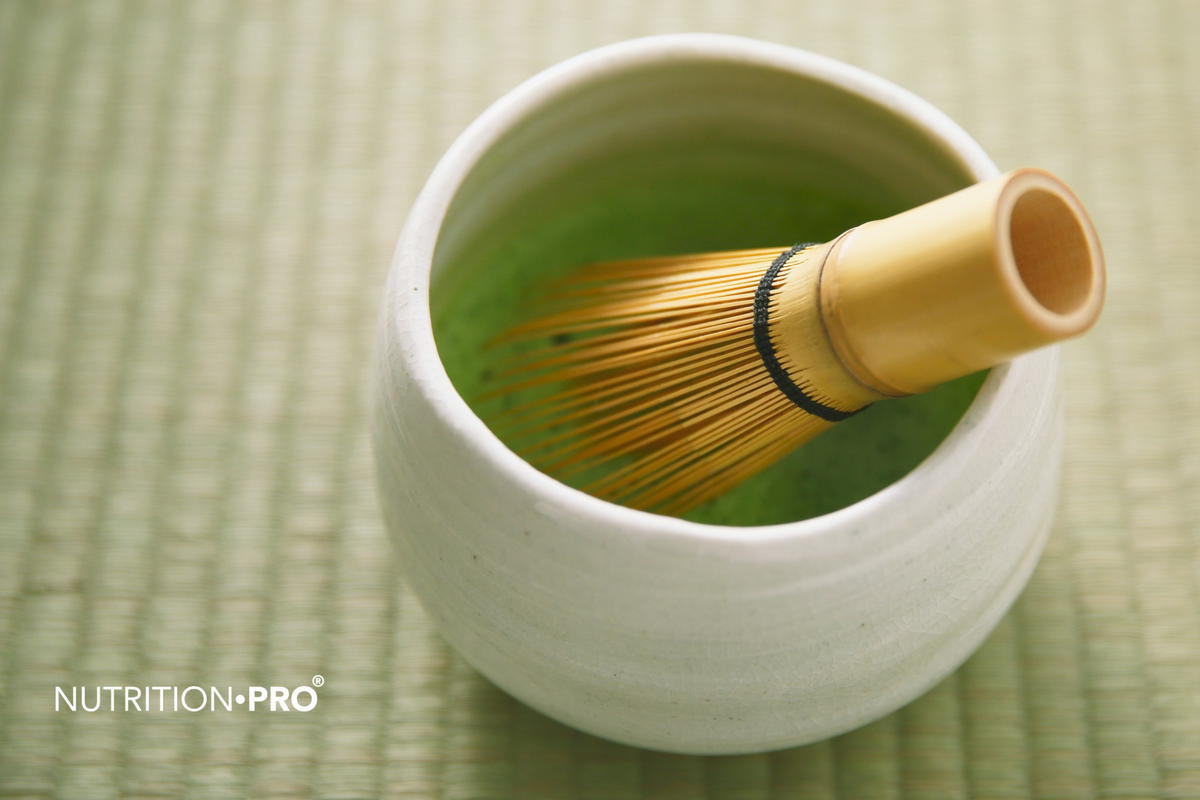
All matchas are green, and many promise the same thing: energy without jitters. A team from Shizuoka University wanted to verify whether this was true for any powder. They compared matchas sold in Japan and abroad, measured their composition, then tested their actual effect. Their conclusion is clear, and it changes the way you choose: the anti-stress effect only appears if a precise ratio is respected between caffeine and catechins on one side, theanine and arginine on the other.
This guide starts there. Why the shading of tea plants determines this ratio, what the trials on attention and stress show, what matcha itself has actually demonstrated as opposed to its isolated components, how to prepare it without destroying what you paid for, and what you shouldn't expect from it.

The deciding criterion. A Japanese trial published in Nutrients showed that the stress-reducing effect of a matcha does not depend solely on its theanine content, but on a molar ratio below two between caffeine and EGCG on one hand, theanine and arginine on the other. In the associated clinical trial, anxiety was significantly lower under selected matcha than under placebo matcha. Shading and first harvest are what push this ratio in the right direction.
Attention. A systematic review of 21 studies concludes that the cognitive benefits of green tea are observed under the combined influence of caffeine and theanine, either one alone having a lesser impact. Stress. 200 to 400 mg of theanine per day help people exposed to stress, but theanine performs no better than placebo in diagnosed anxiety disorder. The honest limitation. A critical review from 2022 judges the data on matcha itself to still be limited.
What matcha is, and why shading changes everything
Matcha comes from the same plant as black tea, white tea, and classical green tea: Camellia sinensis. Two things distinguish it, and both have measurable consequences.
The first is shading. Three to four weeks before harvest, tea plants are covered. Deprived of direct light, the plant slows its growth and modifies its chemistry: it produces more chlorophyll, which gives the jade green color, and most importantly it retains more L-theanine. Under full sun, some of this amino acid is converted into catechins, which are more bitter. Shading is therefore literally what directs the leaf toward a profile rich in L-theanine and low in bitterness. It's not a detail of tradition, it's an agronomic decision that changes the composition.
The second is the method of consumption. Classical green tea is steeped: you drink what has passed into the water, and discard the leaf. Matcha is ground on a stone mill and put into suspension: you swallow the entire leaf. You therefore also recover what does not dissolve, notably the fibers, chlorophyll, and carotenoids.
In Japan, the first picking of the year is called ichibancha. During winter, the plant slows down and the leaves accumulate their reserves. Subsequent harvests, faster and more exposed, yield leaves that are more bitter and less rich in L-theanine. The harvest rank is therefore, like shading, a direct determinant of the ratio discussed in the next section. This is why a ceremonial grade matcha and a culinary matcha are not the same product at two different prices, but two different compositions.
The ratio that determines the effect
L-theanine, the primary amino acid in green tea, exerts a stress-reducing effect in mice and humans. Matcha, which is essentially a powdered green tea rich in L-theanine, is also abundant in caffeine, which exerts a strong antagonistic effect against L-theanine. Commercial matchas sold in Japan and abroad were evaluated according to their composition. In mice, high L-theanine and arginine content resulted in a significant stress-reducing effect. However, this effect was only obtained when the molar ratio of caffeine and EGCG to L-theanine and arginine was below two. Thirty-nine participants then consumed either a test matcha, from which an effect was expected, or a placebo matcha, from which no effect was expected. Anxiety, a stress response, was significantly lower in the test group than in the placebo group. To predict the mental effect of a matcha, it is necessary to verify both its L-theanine quantity and the ratios of caffeine, EGCG, and arginine relative to it.
Unno K, Furushima D, Hamamoto S, et al. Nutrients 2018;10(10):1468. DOI : 10.3390/nu10101468
This result deserves careful consideration, because it contradicts the way matcha is usually marketed. It is generally promoted based on content: this much theanine, this much antioxidants. This trial says something different: what matters is balance, not quantity. Caffeine acts as an antagonist to theanine, and EGCG contributes to the same imbalance. A matcha highly concentrated in everything is not necessarily a calming matcha; it can even behave like a simple caffeinated beverage.
The practical consequence is that two powders that look identical can produce opposite effects, and the factors that shift this ratio in the right direction are exactly those that Japanese tradition has established: shading, which preserves theanine, and the first harvest, which concentrates it. A displayed origin and harvest grade are therefore not arguments of terroir but indicators of composition.
| Culture Parameter | Effect on the Leaf | Effect on the Ratio |
|---|---|---|
| Shading 3 to 4 weeks | Theanine preserved, chlorophyll increased, catechins less converted | Lowers it, therefore favorable |
| First harvest | Young leaves that have accumulated their reserves over winter | Lowers it, therefore favorable |
| Late harvests | Older leaves, more bitter, less theanine | Raises it |
| Full sun cultivation | Theanine converted to catechins, duller color | Raises it |
Note: the caffeine and theanine synergy
Twenty-one studies were examined, including four randomized controlled trials and twelve crossover studies, with average methodological quality judged to be good. The combined work provides evidence that green tea influences psychopathological symptoms, with for example a reduction in anxiety, cognition, with benefits for memory and attention, and brain function, with activation of working memory visible on functional MRI. The effects of green tea cannot be attributed to a single constituent of the beverage: cognitive benefits are observed under the combined influence of caffeine and L-theanine, whereas separate administration of one or the other substance has a lesser impact.
Mancini E, Beglinger C, Drewe J, Zanchi D, Lang UE, Borgwardt S. Phytomedicine 2017;34:26-37. DOI : 10.1016/j.phymed.2017.07.008
A crossover trial conducted in 20 volunteers provides the finest demonstration of this synergy. Five conditions were compared: theanine alone at 200 mg, caffeine alone at 160 mg, the combination of the two, a cup of black tea, and a placebo. Reaction time in visual recognition improved under theanine, under caffeine, and under the combination, but not under black tea or placebo. Most importantly, when measuring brain activity associated with selective attention, the combination produced a significantly greater amplitude not only compared to placebo, but also compared to theanine alone and caffeine alone.
This is the mechanistic reason why matcha behaves differently from coffee, and why the ratio from the previous section matters so much: caffeine and theanine do not cancel each other out, they complement each other, but only in a certain proportion. We detail this comparison in our article on daily coffee amounts.
Stress, sleep, and an important nuance
Thirty healthy adults with no major psychiatric disorder received 200 mg of L-theanine per day or a placebo for four weeks, in a crossover design. Depression scores, trait anxiety scores, and Pittsburgh sleep quality scores decreased after theanine administration. Pittsburgh subscores for sleep onset latency, sleep disturbances, and use of sleep medication decreased compared to placebo. On the cognitive level, verbal fluency and executive function scores improved.
Hidese S, Ogawa S, Ota M, et al. Nutrients 2019;11(10):2362. DOI : 10.3390/nu11102362
A systematic review of nine randomized trials concludes in the same direction: an intake of 200 to 400 mg of L-theanine per day may help reduce stress and anxiety in people exposed to stressful conditions. Its authors immediately clarify that longer studies and larger sample sizes remain necessary before clinically justifying its use as a therapeutic agent.
These results concern everyday stress in healthy individuals. They do not apply to characterized anxiety disorder. A network meta-analysis published in 2022, which compared twelve medicinal plants across 29 trials in adults with diagnosed or subclinical anxiety disorder, found no statistical superiority of L-theanine over placebo for this indication.
In other words: a bowl of matcha may help you get through a busy day. Anxiety that sets in, that disrupts sleep or work, requires a healthcare professional.
A clarification on sleep, because confusion is common: the trials above concern isolated theanine, without caffeine. Matcha, on the other hand, contains it. It is not an evening beverage, and our article on sleep actives details what is appropriate at that time of day.
What matcha itself has demonstrated
In seniors
A randomized, double-blind, placebo-controlled trial followed 61 elderly people living at home for 12 weeks, receiving 3 g of fresh matcha powder daily or placebo. In the sex-stratified analysis, significant cognitive improvement in the MoCA score was observed in women in the active group. The authors conclude a possible protective effect against cognitive decline in elderly women living at home, without extending the conclusion beyond this subgroup.
During training
Healthy, untrained men consumed a beverage containing 1.5 g of matcha powder or placebo twice daily while following a resistance training program for 8 then 12 weeks. In the first trial, maximum leg strength after training tended to progress more in the matcha group, and subjective fatigue after exercise was lower from the first week. Microbiota analysis showed a change in the abundance of five bacterial genera, three of which showed variation positively correlated with strength gains. In the second trial, the increase in muscle mass in response to training was greater in the matcha group, and salivary cortisol was lower.
Shigeta M, Aoi W, Morita C, et al. Nutr J 2023;22(1):32. DOI : 10.1186/s12937-023-00859-4
And the critical assessment
A critical review published in 2022 takes stock without bias, and it is honest to cite it as is. To date, randomized trials show that matcha reduces stress, improves slightly attention and memory, and has no effect on mood. Results concerning cognitive function are contradictory and more trials are needed. Cardio-metabolic effects have only been studied in animals, with more consistent results. Data on an antitumor role are very limited and fall within cell culture studies. The authors conclude that evidence remains limited and firm conclusions cannot be drawn.
What not to expect from it
It is not a weight-loss product. The effects of matcha on metabolism and body composition have only been observed in animals, with a high-fat diet. Human data do not exist for matcha specifically. Our article on green tea and weight loss details what catechins do and do not do.
It's not a caffeine bomb. A bowl prepared with 1.5 g of powder generally provides between 40 and 70 mg of caffeine, compared to 80 to 100 mg for a cup of filtered coffee. The matcha content relative to dry weight is certainly high, but we consume only a small quantity. The difference felt comes from the theanine that accompanies the caffeine, not from a higher dose.
It's not neutral for iron. This is the least mentioned and yet most concrete precaution. The polyphenols in green tea reduce the absorption of non-hemic iron, that of plant origin. If your ferritin is low, it's better to drink matcha away from meals rather than with them.
Choosing, dosing, preparing
The color. A vibrant jade green signals controlled shading and high chlorophyll content. A dull, olive, or yellowish green indicates the opposite.
The taste. In a first harvest matcha, umami sweetness dominates and bitterness remains subtle. Pronounced bitterness betrays later leaves or those less shaded.
The label. The origin and harvest grade must be displayed. A matcha that doesn't indicate where it comes from or when it was picked makes it impossible to assess the ratio on which its effect depends.
Leaves from the first harvest from theUjiregion, near Kyoto, the historical birthplace of matcha, cultivated under shade and then ground on a stone mill. Shading and harvest grade are exactly the two parameters that determine the leaf's composition. Organic, additive-free, a single ingredient.
View the organic matcha teaContains caffeine. To be moderated in cases of sensitivity, heart rhythm disorders, anxiety or insomnia.
Choose what resonates most with you: the answer appears just below.
Caffeine accompanied by theanine is precisely what distinguishes matcha from coffee, and the systematic review shows that the combination works better than each separately. One bowl in the morning, water at 80°C. If you are very sensitive, start with half the dose: caffeine is still caffeine.
The crossover trial on selective attention is the most convincing, with a superior brain response under the combination than with each component alone. But the 2022 critical review speaks of a slight improvement in attention and memory, not a leap. To be integrated as a support, not as a solution.
Matcha contains caffeine and is not an evening beverage. Positive trials on sleep involve isolated theanine, without caffeine. And for diagnosed anxiety disorder, the network meta-analysis finds no superiority over placebo. Anxiety and sleep degradation lasting several weeks warrant medical advice.
Green tea polyphenols reduce non-heme iron absorption. It's not a contraindication, but a matter of timing: drink matcha between meals rather than with them. Our article on low ferritin details the other factors that affect absorption.
This test provides guidance; it does not replace the advice of a healthcare professional.
Frequently asked questions
Understand
What exactly is matcha?
A powder of ground green tea leaves on a stone mill, from the same plant as all teas, Camellia sinensis. Its distinctive feature lies in two things: the tea plants are covered for several weeks before harvest, and the entire leaf is consumed in suspension in water rather than being steeped and then discarded. So you consume everything the leaf contains, not just what passes into the water.
Why is matcha cultivated in the shade?
Because shading modifies the chemistry of the leaf. Deprived of direct light for three to four weeks, the tea plant slows its growth, produces more chlorophyll, which gives it a jade green color, and above all retains more theanine, the amino acid responsible for umami taste and the calming effect. In sunlight, some of this theanine is converted into catechins, which are more bitter. Shading is therefore what directs the leaf toward a profile rich in theanine.
Do all matchas have the same effect?
No, and a Japanese trial published in Nutrients demonstrated this quite spectacularly. Researchers compared commercial matchas and found that the anti-stress effect only appears if the molar ratio between caffeine and EGCG on one side, and theanine and arginine on the other, remains below two. In other words, it's not just the quantity of theanine alone that matters but its balance with caffeine and catechins. Two green powders can have opposite effects.
What does the clinical trial on stress show?
Thirty-nine participants received either a matcha selected for its favorable ratio, or a placebo matcha from which no effect was expected. Anxiety, measured as a stress response, was significantly lower in the group receiving the test matcha than in the placebo group. The authors conclude that to predict the mental effect of a matcha, you must verify both its theanine quantity and the ratios of caffeine, EGCG, and arginine in relation to it.
The effects
Does matcha improve concentration?
A systematic review of 21 studies on green tea concludes that cognitive benefits are observed under the combined influence of caffeine and theanine, whereas separate administration of one or the other has a lesser impact. A crossover trial in 20 volunteers measured brain response to an attention task: the theanine and caffeine combination produced significantly greater amplitude than placebo, but also than theanine alone and caffeine alone. It's the synergy that works, not one of the two ingredients.
Does matcha reduce anxiety?
Two situations must be distinguished. In healthy people exposed to stress, a systematic review of nine trials concludes that an intake of 200 to 400 mg of theanine per day can help reduce stress and anxiety. However, in patients with a diagnosed anxiety disorder, a network meta-analysis of 29 trials involving twelve plants found no statistical superiority of theanine over placebo. Everyday stress and anxiety disorder are not the same target.
Does matcha help you sleep better?
Matcha itself contains caffeine and is not an evening beverage. However, its characteristic amino acid has been studied in isolation: a double-blind crossover trial in 30 adults receiving 200 mg of L-theanine per day for four weeks measured improvements in sleep quality scores, particularly in sleep onset latency and sleep disturbances, as well as a decrease in anxiety scores. This concerns theanine taken alone, not a bowl of matcha consumed in the evening.
What is known about matcha itself, and not just its components?
Less than one might think, and a critical review from 2022 states it clearly: randomized trials show that matcha reduces stress, slightly improves attention and memory, and has no effect on mood. Results on cognition are contradictory. Cardio-metabolic effects have only been studied in animals. Anticancer data are very limited and cellular. The authors conclude that evidence remains limited and firm conclusions cannot be drawn.
Has matcha been studied in seniors?
Yes. A double-blind randomized trial against placebo followed 61 elderly people living at home for 12 weeks, with 3 g of fresh matcha powder per day. In the sex-stratified analysis, a significant improvement in MoCA cognitive score was observed in women in the active group. The authors suggest a protective effect against cognitive decline in elderly women living at home, without generalizing beyond this.
Is matcha useful for sports?
A randomized trial had untrained men consume a drink containing 1.5 g of matcha twice daily for eight then twelve weeks of strength training. Maximum leg strength tended to progress more in the matcha group, subjective fatigue after exercise was lower from the first week, muscle mass increased more in the second trial, and salivary cortisol was lower. Changes in gut microbiota were also observed and correlated with strength progression.
In practice
How much caffeine does a bowl of matcha contain?
A bowl prepared with approximately 1.5 g of powder generally provides between 40 and 70 mg of caffeine, compared to 80 to 100 mg for a cup of filtered coffee. A bowl of matcha thus practically contains less caffeine than coffee, even though the matcha content per dry weight is high: you simply consume a small amount. The difference felt is mainly due to the presence of theanine, which accompanies the caffeine.
How do you prepare a bowl of matcha?
Half a teaspoon, or approximately 1.5 g, in a wide bowl. One hundred milliliters of water at 80 degrees, never boiling. Pour the water over the powder, then whisk with a chasen bamboo whisk using a rapid M-shaped wrist motion, not circular, for about twenty seconds, until a fine foam forms. The matcha is consumed within minutes after preparation, as the powder is in suspension and will settle.
Why not use boiling water?
Because water that is too hot brings out the bitterness of the catechins and degrades the aromatic finesse linked to theanine. A matcha prepared at 100 degrees becomes astringent and loses what the shading took weeks to build. Eighty degrees is the usual benchmark, which corresponds to water that has cooled one to two minutes after boiling.
What time of day should you drink matcha?
In the morning or early afternoon, like any caffeinated beverage. Caffeine has a half-life of approximately five hours in adults, which means a bowl consumed at 4 p.m. still has half its active caffeine at 9 p.m. Sensitive individuals do better by setting a time limit rather than counting bowls.
How do you recognize quality matcha?
First, the color: a bright jade green signals controlled shading and high chlorophyll content, a dull or yellowish green signals the opposite. Then the taste: umami sweetness dominates over bitterness in a first-harvest matcha, while frank bitterness betrays later leaves or less shaded leaves. Origin and harvest grade must be displayed. These visible criteria are indicators of the theanine-to-caffeine ratio highlighted in trials.
What precautions should be taken with matcha?
It contains caffeine: people who are sensitive, those suffering from heart rhythm disorders, anxiety, or insomnia should moderate their consumption. Pregnant or breastfeeding women should seek advice, as caffeine intakes are limited during pregnancy. Green tea can also reduce the absorption of non-heme iron: it's better to drink it away from meals if your ferritin is low. In case of regular treatment, the question should be discussed with your pharmacist.
Glossary
- Matcha
- Powder of shaded green tea leaves, ground on a stone mill, consumed as a suspension and not steeped.
- L-theanine
- Amino acid characteristic of tea, responsible for umami taste; associated with a state of calm alertness.
- Shading
- Coverage of tea plants three to four weeks before harvest; preserves theanine and increases chlorophyll.
- Ichibancha
- First harvest of the year in Japan, the richest in theanine and the least bitter.
- EGCG
- Epigallocatechin gallate, main catechin of green tea; antioxidant, but also contributor to bitterness.
- Arginine
- Amino acid that enters, along with theanine, into the ratio associated with the stress-reducing effect.
- Chasen
- Traditional bamboo whisk, whose fine strips allow the powder to be put into suspension.
- MoCA
- Montreal Cognitive Assessment, screening test for cognitive disorders used in the trial with seniors.
Sources
The studies cited below were identified via PubMed.
- Unno K, Furushima D, Hamamoto S, et al. Stress-reducing function of matcha green tea in animal experiments and clinical trials. Nutrients, 2018;10(10):1468. DOI
- Mancini E, Beglinger C, Drewe J, Zanchi D, Lang UE, Borgwardt S. Effects of green tea on cognition, mood and human brain function: systematic review. Phytomedicine, 2017;34:26-37. DOI
- Kahathuduwa CN, Dassanayake TL, Amarakoon AMT, Weerasinghe VS. Acute effects of theanine, caffeine and their combination on attention. Nutritional Neuroscience, 2016;20(6):369-377. DOI
- Sokary S, Al-Asmakh M, Zakaria Z, Bawadi H. The therapeutic potential of matcha tea: critical review of human and animal studies. Current Research in Food Science, 2022;6:100396. DOI
- Hidese S, Ogawa S, Ota M, et al. Effects of L-theanine administration on stress-related symptoms and cognitive functions in healthy adults: randomized controlled trial. Nutrients, 2019;11(10):2362. DOI
- Williams JL, Everett JM, D'Cunha NM, et al. Effects of L-theanine consumption on stress management capacity and anxiety levels: a systematic review. Plant Foods for Human Nutrition, 2020;75(1):12-23. DOI
- Sakurai K, Shen C, Ezaki Y, et al. Effects of matcha green tea powder on cognitive functions in older adults living at home. Nutrients, 2020;12(12):3639. DOI
- Shigeta M, Aoi W, Morita C, et al. A matcha green tea beverage moderates fatigue and supports adaptation to resistance training. Nutrition Journal, 2023;22(1):32. DOI
- Zhang W, Yan Y, Wu Y, et al. Medicinal plants in the treatment of anxiety: a systematic review and network meta-analysis. Pharmacological Research, 2022;179:106204. DOI
- Baba Y, Inagaki S, Nakagawa S, Kaneko T, Kobayashi M, Takihara T. Effects of L-theanine on cognitive function in middle-aged and older subjects: a randomized placebo-controlled trial. Journal of Medicinal Food, 2021;24(4):333-341. DOI
- Karunaratne UW, Dassanayake TL. Effect of L-theanine on selective attention in a traffic-related reaction task in sleep-deprived young adults. Nutritional Neuroscience, 2025;28(4):471-480. DOI


