

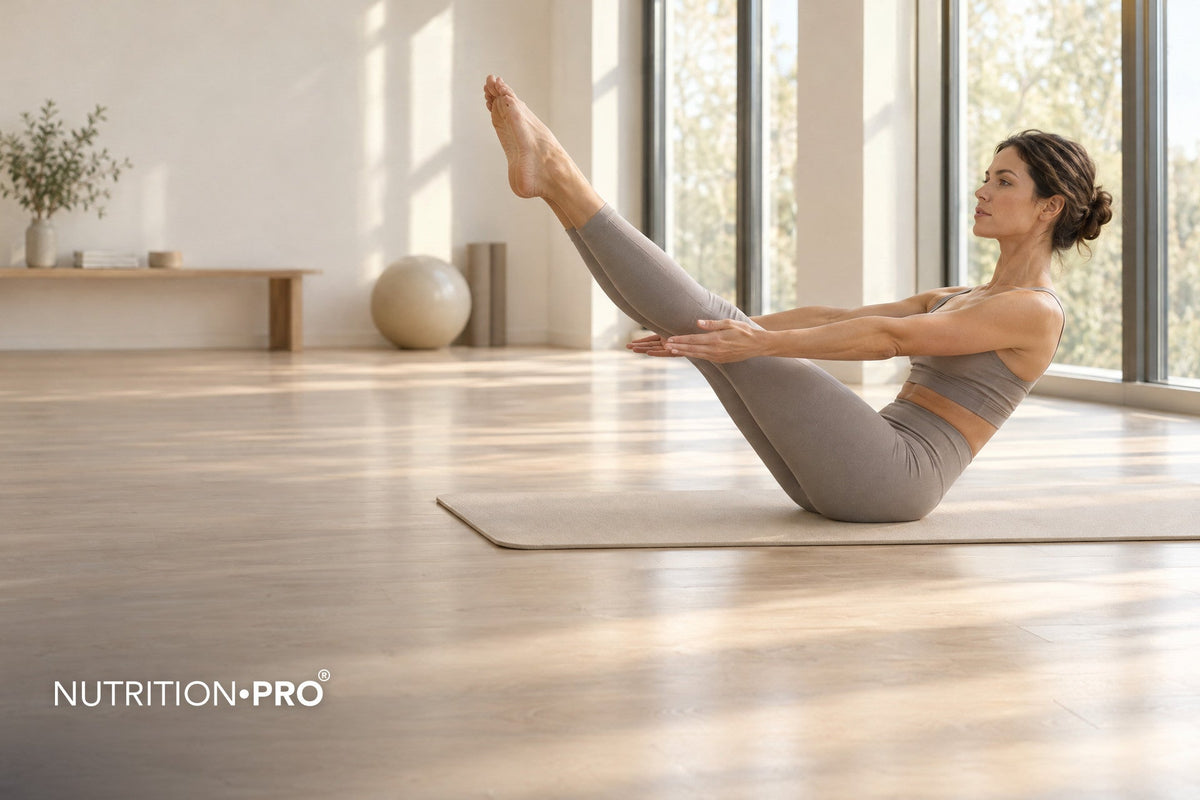
Springs attached to hospital bed frames in an internment camp on the Isle of Man during World War I: this is where Joseph Pilates designed the ancestors of the apparatus for the method he called Contrology. A century later, Pilates ranks among the best-rated exercises against back pain: in a network meta-analysis of 118 trials and 9,710 participants, it had the highest probability of being most effective for pain (93%) and disability (98%) related to chronic lower back pain.
This guide gathers what studies identified via PubMed show: definition, origin and principles of the method, measured benefits from core to back and from balance to sleep, with their limitations, number of useful sessions and timeline for effects, floor or machine, then proteins and collagen associated with training.

Method and benefits : born from Joseph Pilates' Contrology, the method is built on six principles, from centering to breathing. Studies show gains in core endurance and flexibility and, after age 60, effects on balance, strength and fall risk. Against chronic lower back pain, Pilates ranks among the best-rated exercises. Sleep, quality of life and breathing also improve, based on often small-scale trials.
Frequency, limitations, nutrition : most programs include 2 to 3 sessions per week; against back pain, two weekly sessions outperformed one. Pilates burns little, 1.93 kcal per minute on the floor in a study of 18 young women, and has minimal impact on weight. On the nutrition side, total protein intake is paramount, and collagen combined with training increased lean mass in a meta-analysis of 19 trials.
- What is Pilates? Definition and origin
- The 6 principles of the Pilates method
- Benefits of Pilates: what studies measure
- Core and abdominal muscles: endurance before strength
- Flexibility, balance and falls: seniors take center stage
- Pilates and back pain: chronic lower back pain
- Mood, sleep and quality of life
- Heart, blood pressure and weight: more modest effects
- After menopause: sleep, mood and bones
- How many times per week, and for how long?
- Floor or machine, for whom, with what precautions
- Proteins and collagen: the nutrition that supports training
- Frequently Asked Questions
What is Pilates? Definition and Origins
A systematic review of 119 scientific articles drew out a consensual definition: Pilates is a "mind-body" exercise that works strength, core stability, flexibility, muscular control, posture and breathing, on the floor or using equipment. A Sports Health review clarifies what it is not: neither yoga, nor dance, nor physical therapy, even though it is increasingly being incorporated into rehabilitation programs.
Its creator, Joseph Hubertus Pilates, was born in 1880 near Düsseldorf, according to a historical review. A fragile and asthmatic child, he trained himself in anatomy, gymnastics, boxing, yoga and martial arts. Settled in England in 1912, he was interned as a German national at the beginning of World War I. At Lancaster camp, he trained his fellow detainees and developed Contrology; on the Isle of Man, responsible for injured internees, he attached springs to hospital bed frames, the first models of the reformer and the trapeze table, the "Cadillac."
Returning to Germany in 1918, he settled in the United States in 1925 and opened a studio in Manhattan. In 1945, his book Return to Life Through Contrology describes 34 exercises without equipment, all performed seated or lying down, intended to make the body "as flexible as a cat's." His students would bring the method to the general public in the 1980s, under the name Pilates.
The method includes 12 original pieces of equipment, from the reformer to the circle passing through the mat, but Joseph Pilates viewed them as learning aids: according to the Sports Health review, mastery of the floor program was the goal of his method. It is also its most accessible form, on a thin non-slip mat like our NP Pilates Mat.
The 6 Principles of the Pilates Method
At the heart of the method is a guiding idea: the mind guides the body. The Sports Health review breaks this down into six principles.
| Principle | What it Means | Practical Reference |
|---|---|---|
| Centering | The center of the body, the "powerhouse," from which energy radiates to the limbs | Gently draw the navel toward the spine |
| Concentration | Attention given to the entire body with each exercise | Think about alignment before moving |
| Control | A movement led from the center, with concentration | Slow down, especially on the return of the movement |
| Precision | "It's not how much, but how" | Few repetitions, all properly aligned |
| Breathing | For Joseph Pilates, the most important principle, with complete exhalation | Breathe fully, without holding your breath |
| Fluidity | Exercises linked together with minimal movements, no isolated movement | Pay attention to transitions |
His "center" goes beyond the abdominal muscles: Joseph Pilates described it as a box extending from one shoulder to the other and from one hip to the other, including the girdles, and associated the work of the arms and legs with it. Drawing the navel toward the spine primarily recruits the transverse abdominis, the internal obliques, and the multifidus—deep muscles that contribute to the stability of the lower back.
These principles remain secondary in research: a review of 119 articles found them on average in only 23% of publications and, breathing aside, never in those devoted to lower back pain, where posture was mentioned more often. When questioned using the Delphi method, 30 Australian physiotherapists identified body awareness, breathing, movement control, posture, and education as key for lower back pain.
Benefits of Pilates: what studies measure
Pilates has been the subject of numerous trials of varying quality. A review of reviews published in 2023 identified 27 meta-analyses: one of high quality, one of moderate quality, 15 of low quality, and 10 of very low quality. It found benefits for body mass index, body fat, pain, disability, sleep, and balance, with certainty ranging from very low to moderate.
Programs are similar: in adult women, a meta-analysis of 12 studies describes interventions lasting 5 to 12 weeks, at a rate of one to four sessions per week, most often two or three, lasting about an hour. Many trials test adapted versions of the method: in the Sports Health review, only 3 of the 9 trials analyzed involved classical Pilates.
| Benefit studied | Main result | Level of evidence |
|---|---|---|
| Chronic lower back pain | −14 points of pain out of 100 compared to minimal management | Low to moderate (Cochrane, 10 trials) |
| Seniors | 0.90 on fall risk, 0.63 on strength, 0.36 on balance (meta-analysis of 39 trials) | Moderate to low |
| Flexibility | 0.69 on the sit-and-reach test (7 studies in women) | Moderate |
| Sleep | −1.65 on sleep quality; 5 Pilates trials among 86 | Moderate to low |
| Cardiorespiratory fitness | 0.96 over 12 trials, from 1,440 cumulative minutes | Very low to low |
| Blood pressure | −4.76 mmHg systolic in hypertensive patients | 4 trials and 7 comparative studies |
| Mood and quality of life | Quality of life and self-esteem improved; anxiety and depression, limited results (32 trials) | Limited |
| Weight | −2.4 kg in case of overweight, with no significant effect on waist circumference (11 trials) | Discordant results |
An effect size compares the difference between two groups to the dispersion of measurements: 0.2 corresponds to a small effect, 0.5 to a medium effect, 0.8 to a large effect. Network meta-analyses also rank exercises by probability of being the best: 93% does not mean 93% less pain.
Core and abdominal muscles: endurance before strength
In 50 active middle-aged adults, 12 weeks of mat Pilates at two one-hour sessions per week with approximately 25 exercises per session improved abdominal endurance, hamstring flexibility, and upper body muscular endurance compared to the control group, with no measurable effect on posture or balance.
Kloubec JA. J Strength Cond Res 2010;24(3):661-667. DOI : 10.1519/JSC.0b013e3181c277a6
The trial considers these exercises low-intensity, equipment-free, and easy to integrate into a personal routine. The finding also applies to already trained practitioners: in 19 already trained women, 10 weeks of Pilates on reformer and Cadillac, at least twice a week, further increased trunk endurance, measured by McGill tests, and flexibility.
Maximum strength improves much less: in the meta-analysis of 12 studies in women, neither grip strength nor vertical jump improved significantly, which the authors link to the low external load of the programs. According to Sports Health review, its moderate, long and slow contractions correspond to the ideal stimulus for trunk muscle endurance. For strength and muscle mass, weight training remains the reference, as detailed in our guide for building muscle ; the two practices complement each other well throughout the week.
Flexibility, balance and falls: seniors in the front line
Flexibility also progresses steadily: medium effect (0.69) on the sit-and-reach test in the meta-analysis of 12 studies in women, and hamstring flexibility gain in the 12-week trial.
However, the most abundant evidence concerns seniors. In a meta-analysis of 39 randomized trials conducted in people aged 60 and older, Pilates improves balance (0.36), strength (0.63), flexibility (0.41) and functional autonomy (0.51), with a large effect on fall risk (0.90); certainty is judged moderate for strength and falls, low for the rest. Limited to mat Pilates, a meta-analysis of 9 trials finds large effects on dynamic balance (1.10), lower limb strength (1.13), flexibility (1.22) and cardiorespiratory endurance (1.48).
In 53 people aged 61 to 84 years living at home, a one-hour Pilates class twice a week for 12 weeks improved standing balance, leg strength and flexibility. At 24 weeks, the rate of fall-related injuries was 42% lower and that of injurious falls was 64% lower, differences that were not statistically significant: according to the authors, 804 participants would be needed to conclude.
Barker AL, Talevski J, Bohensky MA, et al. Clin Rehabil 2016;30(10):984-996. DOI : 10.1177/0269215515606197
Pilates therefore improves several fall risk factors, but the reduction in falls themselves remains to be demonstrated. In younger, more active adults, the 12-week trial also found no balance gain.
Pilates and back pain: chronic low back pain
The Cochrane review dedicated to Pilates brought together 10 trials and 510 participants suffering from nonspecific low back pain. Against minimal intervention, Pilates reduced pain by 14 points out of 100 in the short term (low-quality evidence) and by 10.5 points in the medium term (moderate quality), and disability by approximately 8 then 11 points. Against other exercises, the authors conclude to no clear superiority: choice may depend on preferences and cost.
Network meta-analyses, which compare exercises with each other, place it nonetheless in the top tier. The largest, 217 trials and 20,969 participants, ranks it with the McKenzie method and functional restoration among the most effective, with 15 to 19 fewer pain points out of 100 against minimal treatment, and advises above all to practice the exercise you enjoy, a guarantee of consistency.
Over 118 trials and 9,710 adults aged 18 to 65 years suffering from chronic low back pain, all types of exercise except stretching reduced pain. Pilates had the highest probability of being most effective, 93% for pain and 98% for disability; the most beneficial programs included at least one to two sessions per week, over 3 to 9 weeks for Pilates.
Fernández-Rodríguez R, Álvarez-Bueno C, Cavero-Redondo I, et al. J Orthop Sports Phys Ther 2022;52(8):505-521. DOI : 10.2519/jospt.2022.10671
Frequency matters. In 296 people suffering from chronic low back pain, six weeks of Pilates at one, two or three sessions per week, in addition to advice, all performed better than a simple booklet: 1.2, 2.3 and 2.1 fewer pain points out of 10. Two sessions performed significantly better than one, and cost-effectiveness analysis retained three sessions as the most cost-effective option; the authors do not rule out that some of the effect may be due to the attention received and the expectations of participants.
Mood, sleep and quality of life
On mood, a recent meta-analysis, published in 2026 on 32 trials and 1,264 participants, finds a significant overall effect only after adjustment for the type of outcome measured (0.39, a small to medium effect): clear on quality of life and self-esteem, limited or not significant on depression and anxiety. A few single-session-per-week trials also reported improvements, and online classes seemed as beneficial as in-person for adults. Stress is also determined elsewhere, as shown in our article on cortisol and stress.
Sleep is the other strong point. In a network meta-analysis of 86 trials and 7,276 participants, Pilates, evaluated in 5 of these trials, clearly improved sleep quality (−1.65) and achieved the best ranking, without statistically significant difference with endurance exercise, weight training, yoga or Chinese gymnastics: all helped. A significant benefit appeared from as little as 390 MET-minutes of Pilates per week, or about 140 minutes, for example three 45-minute sessions.
Heart, blood pressure and weight: more modest effects
Pilates is low-intensity. In 18 young women, a 15-exercise session burned 1.93 kcal per minute on the mat and 2.59 kcal per minute on a reformer, with no significant increase in heart rate, blood pressure or lactate compared to rest. At this rate, one hour would represent approximately 116 kcal on the mat and 155 kcal on a reformer, according to our calculation.
Cardiorespiratory fitness does progress with duration, however. Over 12 trials and 569 healthy adults, the effect is large (0.96), on the mat as well as on equipment, but appears only from 1,440 cumulative minutes of practice, or two sessions per week for three months or three for two months. Pilates performs neither better nor worse than other exercises, on very weak to weak evidence.
In people with high blood pressure, a meta-analysis of 4 randomized trials and 7 comparative studies measures a decrease of 4.76 mmHg in systolic pressure and 3.43 mmHg in diastolic pressure compared to comparison groups; Pilates is judged safe, without demonstrated superiority over other activities (see our guide on blood pressure after age 60).
On weight, effects are modest and inconsistent. In 393 overweight or obese adults distributed across 11 trials, Pilates resulted in 2.4 kg weight loss, 1.17 point body mass index reduction and 4.2 percentage points fat mass loss, with no significant effect on waist circumference or lean mass. In women, the meta-analysis of 12 studies found weight loss of 3.99 kg, with very low certainty, with no significant effect on fat mass percentage or waist circumference; a meta-analysis of 10 studies finds mat Pilates no more effective than other exercises, or than no intervention, on body composition.
Pilates is therefore not, by itself, a weight loss method: our guides on flat stomach and on walking for weight loss detail what works. Asian Pilates and wall Pilates, which are highly sought after, have not been the subject of any studies we could identify in PubMed.
After menopause: sleep, mood and bones
In 110 postmenopausal women averaging 69 years old, 12 weeks of Pilates improved sleep duration (0.69) and reduced sleep disturbances (0.78), anxiety (1.27) and depressive symptoms (0.86) compared to the control group; perceived fatigue also decreased in the Pilates group (0.32).
Aibar-Almazán A, Hita-Contreras F, Cruz-Díaz D, et al. Maturitas 2019;124:62-67. DOI: 10.1016/j.maturitas.2019.03.019
On quality of life, a meta-analysis of 11 trials in postmenopausal women found effects on five of the nine dimensions measured, including physical pain (0.96) and physical functioning (0.85). Programs of at least 48 sessions improved eight dimensions, versus three below that threshold, and those conducted on equipment seven, versus three on the floor; certainty ranged from very low to moderate.
For bones, results diverge. In a small trial of 51 postmenopausal women, six months of Pilates at three sessions per week increased lumbar bone mineral density and trochanteric density compared to the control group. In the MEDEX-OP trial, in 115 women aged 63.6 years with low bone mass, eight months of heavy resistance training and impact exercises increased lumbar density by 1.9%, versus 0.1% with a gentle program inspired by Pilates; both programs improved functional performance, more so at high intensity.
In case of osteoporosis, the international consensus Too Fit To Fracture recommends to everyone daily balance work, endurance of the back extensor muscles and movements that spare the spine, such as the hip hinge. Our guide on menopause reviews other solutions.
How many times per week, and for how long?
The programs studied converge: two to three sessions per week, typically one hour each. Against lower back pain, the panel of Australian physiotherapists recommends supervised sessions of 30 to 60 minutes, twice per week, for 3 to 6 months. A single weekly session is not without merit either: in the meta-analysis of 32 trials on psychological well-being, some trials with one session per week also reported improvements.
| Objective | Program studied | Result |
|---|---|---|
| Back pain | 2 sessions per week, 6 weeks | −2.3 points pain reduction on 10 versus booklet, compared to −1.2 with a single session |
| Trunk endurance, flexibility | 2 sessions of one hour, 12 weeks | Improved in 50 active adults |
| Cardiorespiratory fitness | 1,440 cumulative minutes, i.e., 2 sessions per week for 3 months | Effectiveness threshold; overall effect of 0.96 |
| Quality of life after menopause | At least 48 sessions | 8 out of 9 dimensions improved, versus 3 below that |
Before, after: the most effective programs against back pain lasted 3 to 9 weeks, trunk endurance and flexibility progressed in 10 to 12 weeks in the cited trials, cardiorespiratory fitness requires approximately three months at two sessions per week, and bone effects observed occurred after six months. The program below combines these parameters: these are practical benchmarks for a healthy adult, not a protocol tested as such.
On the floor or on machines, for whom, with what precautions
Floor or machines, both work. In 98 people suffering from chronic low back pain, 12 weeks on the floor or on machines improved pain, disability, fear of movement, and transversus abdominis activation, faster on machines. In 86 low back pain patients, 12 sessions on machines performed better at six months for disability and fear of movement, but not for pain. Cardiorespiratory fitness improves regardless of modality, and the reformer burns slightly more energy.
The floor has accessibility on its side: at home, in group classes, or online. Practical advice: a thin and stable mat helps maintain balance and precision on the knees or on one foot, a non-slip surface secures support points, and a folded towel relieves sensitive bony contact points. Our NUTRITION•PRO Pilates Mat combines a microsuede surface with a non-slip rubber base, measuring 61 x 173 cm and 3 mm thick, weighing 1.75 kg.
For whom? The trials included sedentary or active adults, experienced practitioners, people with low back pain, seniors, and menopausal women. During pregnancy, practice is decided with a doctor or midwife, and a dedicated guide in our series details the precautions.
Back pain : fever, loss of strength or sensation in a leg, urinary problems, or pain following a fall require medical advice before any session. Osteoporosis : after vertebral fracture, especially with pain, multiple fractures, or marked kyphosis, the Too Fit To Fracture consensus recommends consulting a physiotherapist. Pregnancy : approval from a doctor or midwife and adapted exercises. Recent surgery, cardiovascular disease, uncontrolled hypertension : prior medical advice. Beginners : a few guided sessions help find proper positioning; effectiveness depends on instructor training, notes the Sports Health journal.
Exercises for beginners : basic movements step by step, from the hundred to the roll-up. The reformer : trials on machines. Weight loss and flat belly : actual energy expenditure and trends such as Asian Pilates. Back pain : adapted exercises and an eight-week program. Pregnancy and postpartum : precautions, pelvic floor and diastasis. Pilates or yoga : which to choose based on your goal. Mats and accessories : thickness, grip, ball, circle and resistance bands.
Proteins and collagen: nutrition to support your training
In 19 women already trained in Pilates, 10 weeks of reformer and Cadillac sessions improved core endurance, flexibility and certain aspects of body composition. Adding 0.6 g of whey per kilogram of body weight daily made no difference to these gains: their diet already provided 1.3 g of protein per kilogram per day.
Karpouzi C, Kypraiou A, Mougios V, Petridou A. J Int Soc Sports Nutr 2025;22(1):2472891. DOI: 10.1080/15502783.2025.2472891
This result aligns with a reference meta-analysis on protein and strength training, 49 trials and 1,863 participants: a supplement added 0.30 kg of lean mass and 2.49 kg of maximum strength, but no further lean mass gains beyond a total intake of approximately 1.6 g per kilogram per day. A supplement therefore mainly serves to reach this intake when diet alone is insufficient: a dose of 30 g of our 100% Whey Isolate provides 22.9 g of protein, and our article on whey details its effects.
Collagen has mainly been studied with strength training. In 77 non-menopausal women, 12 weeks of strength training at three sessions per week, with 15 g daily of specific collagen peptides, resulted in 1.0 kg of lean mass gain compared to 0.4 kg under placebo, 1.5 kg of fat loss compared to 0.7 kg and a 2.7 kg improvement in grip strength compared to 1.3 kg, with no significant difference in leg strength. A meta-analysis of 19 trials and 768 participants found a collagen effect associated with training on lean mass (0.48, moderate certainty), on tendon morphology (0.67, very low certainty) and, smaller, on maximum strength (0.19, low certainty).
In athletes, it was tested against knee pain during exercise: in 180 active adults aged 18 to 30, 5 g daily of specific collagen peptides for 12 weeks reduced this pain by 21.9 mm on a 100-point scale, compared to 15.6 mm under placebo. Our Drinkable Marine Collagen provides 5 g of Naticol® marine collagen per shot, and Novagen 5,000 mg of marine collagen per dose: the dose is the same, not the product. The peptides in the trial were of porcine origin, approximately 3,000 daltons, and the authors clarify that their results do not transfer to other collagens.

collagen tripeptides and our guide collagen and joints Our mat.
that anchors every posture, from core work to stretching. Thin and stable at 3 mm, designed for Pilates, yoga, mobility and meditation, it rolls up in one gesture to move from your living room to the studio. See the Pilates Mat
To support your training, also discoverNovagen, our premium marine collagen Novagen, notre collagène marin premium.
Frequently Asked Questions
What is Pilates?
An exercise method created by Joseph Pilates in the early twentieth century under the name Contrology. Practiced on the floor or on equipment such as the reformer, it works the core, flexibility, movement control, posture, and breathing.
Who invented the Pilates method?
Joseph Hubertus Pilates, born in 1880 near Düsseldorf. Interned during World War I in Lancaster and then on the Isle of Man, he developed his method there and attached springs to the beds of injured internees, the ancestors of the reformer. Settling in New York in 1925, he published a book of 34 floor exercises in 1945.
What are the 6 principles of Pilates?
Centering, or working from the body's center, concentration, control, precision, breathing, and fluidity of movements. Joseph Pilates considered breathing to be the most important principle.
What are the benefits of Pilates?
Greater core endurance and flexibility, better balance, more strength and reduced risk of falls in seniors, less pain in cases of chronic lower back pain, better sleep, and improved quality of life. Effects on weight remain modest.
Pilates: how many times per week?
Two to three sessions per week, as in most trials. Against lower back pain, two weekly sessions performed better than one in six weeks. One session per week is not useless: a few trials with one weekly session reported improvements in well-being, according to a meta-analysis of 32 trials.
After how long do you see the effects of Pilates?
The most effective programs against back pain lasted 3 to 9 weeks. Abdominal endurance and flexibility improved in 10 to 12 weeks in the trials, and cardiorespiratory fitness requires approximately 1,440 cumulative minutes, or two sessions per week for three months.
Does Pilates make you lose weight?
Barely: in a study of 18 young women, a floor session burned approximately 1.9 kcal per minute. In overweight adults, it resulted in an average weight loss of 2.4 kg across 11 trials, with no significant effect on waist circumference, and another meta-analysis found it no more effective than other exercises on body composition.
Is Pilates good for back pain?
Yes, for non-specific chronic lower back pain: according to the Cochrane review, it reduces pain by approximately 14 points out of 100 compared to minimal management, and it ranks among the best-rated exercises, with no demonstrated superiority over all others.
Does Pilates improve sleep?
Yes: in a network meta-analysis of 86 trials, Pilates, tested in 5 of them, significantly improved sleep quality, with no significant difference from other exercises, starting at approximately 140 minutes per week. In postmenopausal women, 12 weeks reduced sleep disorders.
Do you need to take protein when doing Pilates?
Not necessarily: in practitioners who already consumed 1.3 g of protein per kilogram of body weight per day, adding whey made no difference. According to a meta-analysis of 49 strength training trials, a supplement provides no additional lean mass gain beyond approximately 1.6 g per kilogram of body weight per day in total.
Sources
The studies cited below were identified via PubMed.
- Hoffman J, Gabel CP. The origins of Western mind-body exercise methods. Physical Therapy Reviews, 2015;20(5-6):315-324. DOI
- Fernández-Rodríguez R, Álvarez-Bueno C, Cavero-Redondo I, et al. Best exercise options for reducing pain and disability in adults with chronic lower back pain: Pilates, strengthening, core stabilization, and mind-body exercises. A network meta-analysis. Journal of Orthopaedic and Sports Physical Therapy, 2022;52(8):505-521. DOI
- Miyamoto GC, Franco KFM, van Dongen JM, et al. Different doses of Pilates-based exercises in chronic lower back pain: randomized controlled trial with economic evaluation. British Journal of Sports Medicine, 2018;52(13):859-868. DOI
- de Souza Andrade L, da Silva Almeida I, Mochizuki L, et al. What is the intensity of Pilates? Analysis of energy expenditure, lactate levels, and intensity of equipment-based and floor sessions. Journal of Bodywork and Movement Therapies, 2021;26:36-42. DOI
- Bischof K, Moitzi AM, Stafilidis S, König D. Impact of collagen peptide supplementation combined with prolonged physical training on strength, musculotendinous remodeling, functional recovery, and body composition in healthy adults: systematic review with meta-analysis. Sports Medicine, 2024;54(11):2865-2888. DOI
- Fernández-Rodríguez R, Álvarez-Bueno C, Ferri-Morales A, et al. Pilates improves physical performance and decreases fall risk in older adults: systematic review and meta-analysis. Physiotherapy, 2021;112:163-177. DOI
- Pessôa RAG, de Oliveira LC, Vitor GBB, de Oliveira RG. Effects of Pilates exercises on cardiorespiratory fitness: systematic review and meta-analysis. Complementary Therapies in Clinical Practice, 2023;52:101772. DOI
- Wells C, Kolt GS, Bialocerkowski A. Defining Pilates exercise: a systematic review. Complementary Therapies in Medicine, 2012;20(4):253-262. DOI
- Di Lorenzo CE. Pilates: what is it? Should it be used in rehabilitation? Sports Health, 2011;3(4):352-361. DOI
- Wells C, Kolt GS, Marshall P, Bialocerkowski A. Definition and application of Pilates exercise in the treatment of chronic low back pain: Delphi survey of Australian physiotherapists. Physical Therapy, 2014;94(6):792-805. DOI
- Xu M, Tian C, Wang Y, et al. Pilates and multiple health outcomes: an umbrella review. Journal of Science and Medicine in Sport, 2023;26(4-5):232-240. DOI
- Bajčetić Č, Rudović V, Novaković M, et al. Effects of Pilates programs on body composition, flexibility, muscle strength, balance, functional performance, and respiratory function in adult women: systematic review and meta-analysis. Sports, 2026;14(9):407. DOI
- Yamato TP, Maher CG, Saragiotto BT, et al. Pilates for low back pain. Cochrane Database of Systematic Reviews, 2015;2015(7):CD010265. DOI
- Wang H, Xin X, Pan Y. Best approaches and doses of exercise to improve sleep quality: network meta-analysis and dose-response relationship study. BMC Public Health, 2025;25(1):1371. DOI
- González-Devesa D, Varela S, Diz-Gómez JC, Ayán-Pérez C. Efficacy of the Pilates method in hypertensive patients: systematic review and meta-analysis. Journal of Human Hypertension, 2024;38(3):200-211. DOI
- Tsartsapakis I, Zafeiroudi A, Kouthouris C. Effects of Pilates-based exercise on mental health, psychological well-being, and quality of life: systematic review and meta-analysis. Sports, 2026;14(5):171. DOI
- Wang Y, Chen Z, Wu Z, et al. Pilates in overweight or obese individuals: a meta-analysis. Frontiers in Physiology, 2021;12:643455. DOI
- Kloubec JA. Pilates for improving muscular endurance, flexibility, balance, and posture. Journal of Strength and Conditioning Research, 2010;24(3):661-667. DOI
- Karpouzi C, Kypraiou A, Mougios V, Petridou A. Effects of protein supplementation during Pilates training on body composition, core muscle endurance, and joint flexibility in trained women: a randomized controlled trial. Journal of the International Society of Sports Nutrition, 2025;22(1):2472891. DOI
- Bueno de Souza RO, Marcon LF, Arruda ASF, et al. Effects of mat Pilates on functional physical performance in older adults: meta-analysis of randomized controlled trials. American Journal of Physical Medicine and Rehabilitation, 2018;97(6):414-425. DOI
- Barker AL, Talevski J, Bohensky MA, et al. Feasibility of Pilates for reducing fall risk: a randomized controlled pilot trial in community-dwelling older adults. Clinical Rehabilitation, 2016;30(10):984-996. DOI
- Hayden JA, Ellis J, Ogilvie R, et al. Some types of exercise are more effective than others in people with chronic low back pain: a network meta-analysis. Journal of Physiotherapy, 2021;67(4):252-262. DOI
- Cavina APS, Pizzo Junior E, Machado AF, et al. Effects of the mat Pilates method on body composition: systematic review with meta-analysis. Journal of Physical Activity and Health, 2020;17(6):673-681. DOI
- Aibar-Almazán A, Hita-Contreras F, Cruz-Díaz D, et al. Effects of Pilates training on sleep quality, anxiety, depression, and fatigue in menopausal women: a randomized controlled trial. Maturitas, 2019;124:62-67. DOI
- de Almeida PP, de Oliveira RG, de Almeida LIM, de Oliveira LC. Effects of Pilates exercises on health-related quality of life in menopausal women: systematic review and meta-analysis. Quality of Life Research, 2024;33(8):2067-2079. DOI
- de Oliveira LC, de Oliveira RG, de Almeida Pires-Oliveira DA. Effects of whole body vibration compared to Pilates on bone mineral density in menopausal women: randomized controlled clinical trial. Journal of Geriatric Physical Therapy, 2019;42(2):E23-E31. DOI
- Kistler-Fischbacher M, Yong JS, Weeks BK, Beck BR. Bone-targeted exercise, with or without antiresorptive treatment, to reduce fracture risk indices in menopausal women with low bone mass: the MEDEX-OP randomized controlled trial. Journal of Bone and Mineral Research, 2021;36(9):1680-1693. DOI
- Giangregorio LM, McGill S, Wark JD, et al. Too Fit To Fracture: results of a Delphi consensus on physical activity and exercise recommendations for adults with osteoporosis, with or without vertebral fracture. Osteoporosis International, 2015;26(3):891-910. DOI
- Cruz-Díaz D, Bergamin M, Gobbo S, et al. Comparative effects of 12 weeks of apparatus-based and mat Pilates on pain, function, and transverse abdominis activation in chronic low back pain: randomized controlled trial. Complementary Therapies in Medicine, 2017;33:72-77. DOI
- da Luz MA, Costa LO, Fuhro FF, et al. Effectiveness of mat or apparatus Pilates in patients with chronic non-specific low back pain: randomized controlled trial. Physical Therapy, 2014;94(5):623-631. DOI
- Morton RW, Murphy KT, McKellar SR, et al. Systematic review, meta-analysis, and meta-regression of the effect of protein supplementation on muscle mass and strength gains induced by resistance training in healthy adults. British Journal of Sports Medicine, 2018;52(6):376-384. DOI
- Jendricke P, Centner C, Zdzieblik D, et al. Specific collagen peptides associated with resistance training improve body composition and regional muscle strength in non-menopausal women: randomized controlled trial. Nutrients, 2019;11(4):892. DOI
- Zdzieblik D, Brame J, Oesser S, et al. Influence of specific bioactive collagen peptides on knee discomfort in physically active young adults: randomized controlled trial. Nutrients, 2021;13(2):523. DOI


