

The retinol is everywhere: in serums, creams, and increasingly as a dietary supplement. Behind this trendy name hides the reality of vitamin A, an essential nutrient that the body cannot do without, for both skin and vision. But between cosmetic promises and physiological reality, it's easy to get lost.
This guide clarifies things, based on health claims truly authorized by EFSA and scientific data: what retinol really does for your skin, vision and immunity, the difference with a cream, at what dosage, and especially the precautions, because vitamin A is a nutrient where overdosage is not inconsequential. Without exaggerated promises.

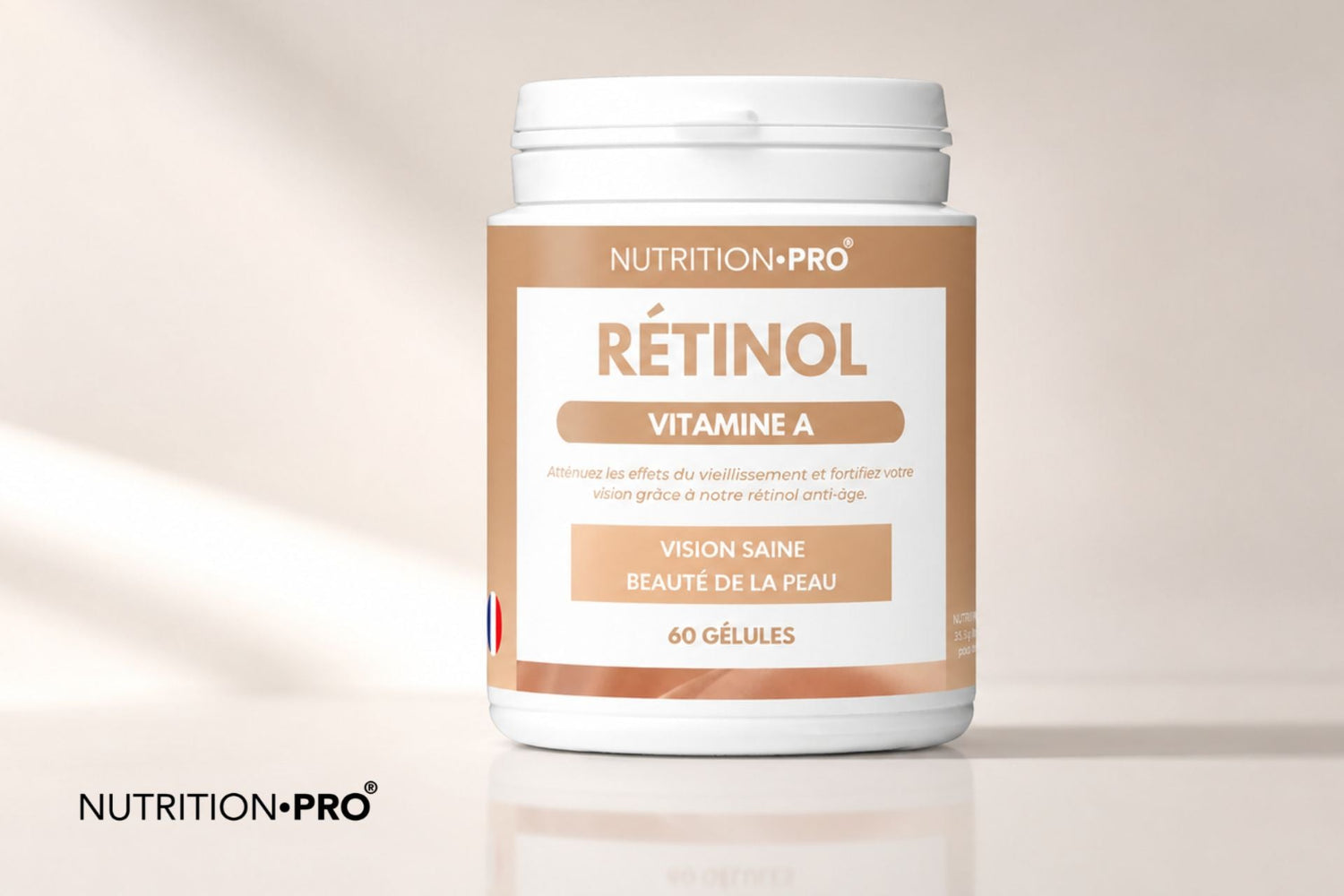
One capsule provides 1000 µg of vitamin A (125% of NRV), in the form of retinol acetate, in a vegetable capsule. To help maintain normal skin, vision and immunity.
Retinol is the active form of vitamin A, an essential fat-soluble nutrient. EFSA recognizes that it contributes to the maintenance of normal skin, normal vision, normal mucous membranes, to normal functioning of the immune system, to iron metabolism and to cell specialization. Deficiency remains a major cause of visual disorders worldwide (Sommer, J Nutr, 2008). However, be aware: vitamin A accumulates in the body, overdosage can be toxic (adult safety limit around 3000 µg per day), and supplementation is not recommended during pregnancy. A supplement in capsule form does not replace a retinol cream: these are two different uses.
- Retinol and vitamin A: what are we talking about?
- The benefits recognized by EFSA
- Retinol and skin: what science says
- Retinol and vision
- Retinol and immunity
- Supplement in capsules or retinol cream?
- Dosage and safety limit
- How to take a course
- Precautions and contraindications
- Frequently asked questions
1. Retinol and vitamin A: what are we talking about?
Behind the word "retinol" there are actually several different realities that must be distinguished:
- Retinol (preformed vitamin A) : the active form, present in animal-origin products (liver, eggs, dairy products) and in our supplement, in the form ofretinol acetate.
- Carotenoids (provitamin A) : such as the beta-carotene from plants (carrots, sweet potatoes), which the body converts to vitamin A according to its needs.
- Topical retinoids : retinol derivatives used in creams and serums, which act on the skin surface, a separate topic that we address further below.
Vitamin A is fat-soluble : unlike water-soluble vitamins, it is stored in the body, mainly in the liver. This explains both its benefits and the need to avoid excessive consumption, which we will return to.
2. The benefits recognized by EFSA
Not all promises are equal. Rather than relay marketing, here are the officially authorized health claims for vitamin A in Europe, that is, those based on validated scientific evidence:
Normal skin
The "beauty" benefit in the regulatory sense.
Vitamin A contributes to the maintenance of normal skin, in connection with the renewal of skin cells.
Normal vision
Its oldest and most well-established role.
It contributes to the maintenance of normal vision, via retinal pigments, particularly in low light conditions.
Immune system
A foundational function.
It contributes to the normal functioning of the immune system and the maintenance of normal mucous membranes.
Iron metabolism and cells
Less well-known roles.
It contributes to normal iron metabolism and plays a role in normal cell specialization process.
These claims speak of "normal" functions: the role of a supplement is to support and meet nutritional needs, not to treat or transform. This is precisely the honest framework we follow throughout.
3. Retinol and skin: what science says
This is the most publicized use of retinol. Physiologically, vitamin A is involved in the renewal and differentiation of skin cells, which explains why it is associated with healthy skin. Reviews on antioxidants and skin health emphasize this role of retinol in epidermal cell regeneration (Kumar, Recent Adv Food Nutr Agric, 2025).
Let us remain precise and honest: in the regulatory sense, vitamin A contributes to the maintenance of normal skin, which is not the same as a promise to "erase wrinkles." A supplement acts as overall support, from within; it integrates into good lifestyle habits (hydration, sun protection, sleep), it does not replace them. For a complete beauty approach, see our skin collection and our article on the most powerful natural antioxidants.
One capsule per day to contribute to the maintenance of normal skin, vision, and immunity. Retinyl acetate in vegetable capsule, controlled dose.
Discover retinol →4. Retinol and vision
This is the historical role and the best documented function of vitamin A. It is an essential component of rhodopsin, the pigment of retinal cells that enables vision, especially in dim light. Without sufficient intake, it is low-light vision that deteriorates first.
Vitamin A deficiency is among the major causes of preventable visual disorders worldwide, with its first signs affecting night vision before more severe impairment occurs.
Sommer A. Vitamin A deficiency and clinical disease: an historical overview. J Nutr 2008;138(10):1835-1839. DOI : 10.1093/jn/138.10.1835
In a person with insufficient intake, meeting vitamin A requirements contributes to maintaining normal vision (EFSA claim). However, beyond covering nutritional needs, taking more does not improve eyesight: more is not better, and it can even be counterproductive, as we will see below.
5. Retinol and immunity
Less known than its effects on skin and vision, the immune role of vitamin A is nonetheless well established. It participates in theintegrity of mucous membranes (respiratory, digestive), which form a physical barrier against external threats, and in the normal functioning of the immune system (EFSA claims).
This role appears most clearly in deficiency contexts, as vitamin A deficiency is associated with greater susceptibility to infections (Sommer, J Nutr, 2008). Meeting your requirements thus supports the proper functioning of your body's natural defenses, complementing other key nutrients. See our immunity.
collection
These are two different, complementary, and non-interchangeable uses. The supplement meets the body's needs via oral intake; the cream acts locally, on the skin's surface. One does not replace the other.
| This is the most common confusion. The word "retinol" refers to both a nutrient (the supplement) and a cosmetic active ingredient (the cream), but their mechanisms differ: | Criterion | Capsule supplement |
|---|---|---|
| Retinol cream | Route | Oral, systemic action |
| Topical, localized action | Objective | Meet vitamin A requirements |
| Act on the epidermis at the surface | Scope | Skin, vision, immunity |
| Comfort | No skin irritation | Possible redness at first |
In short: the capsule supplement nourishes the body from within and supports multiple functions at once; the cream works on the skin's surface. The two can complement each other in a routine, but the supplement does not replace a topical treatment, and vice versa. Our retinol in capsules is designed for those who want to support their vitamin A intake simply, without application constraints.
7. Dosage and safety limit
This is the most important point, and the one commercial pages often forget. Because it is fat-soluble and stored in the liver, vitamin A must be dosed carefully :
- Adult reference intake : approximately 650 to 750 µg of retinol equivalents per day according to ANSES.
- Our supplement : 1000 µg per capsule, or 125% of nutritional reference values, in a single daily dose.
- Safety limit : around 3000 µg per day for adults (total intake, including food).
One capsule per day is sufficient, and you must never exceed the recommended dose. Excessive and prolonged vitamin A intake can lead to toxic accumulation (liver damage, headaches, bone disorders).
Beware of cumulative sources : if you are already taking a multivitamin, cod liver oil, or another supplement containing vitamin A, check the total to avoid adding up your intakes.
8. How to take a course
To learn more about usage, our article why retinol is so prized complements this guide, and the combination with marine collagen is often of interest to those targeting skin health.
9. Precautions and contraindications
When used properly, retinol in capsule form is a safe supplement. The precautions relate to the very nature of vitamin A, which is stored in the body:
Pregnancy and breastfeeding : an excess of vitamin A can be harmful to the fetus. Supplementation is not recommended; always seek medical advice.
Do not exceed the recommended dose or combine multiple sources of vitamin A. Menopausal woman, ongoing treatment, liver disease : medical advice is recommended before starting. Keep out of reach of children, and remember that a supplement accompanies a varied diet, it does not replace it.
With these simple precautions, retinol naturally finds its place in a well-thought-out routine.
Select what applies to you best: your pathway will display immediately. This is a guide, not medical advice.
Vitamin A contributes to the maintenance of normal skin. The retinol in capsules, ideally combined with good lifestyle habits and, if desired, with marine collagen.
Vitamin A contributes to the maintenance of normal vision and the normal functioning of the immune system. The retinol, one capsule per day, to meet your needs.
Vitamin A supplementation is not recommended during pregnancy and breastfeeding, and requires medical advice in case of treatment. Do not start a course of treatment without professional advice.
Frequently Asked Questions
What are the proven benefits of retinol (vitamin A)?
EFSA recognizes several roles for vitamin A: it contributes to the maintenance of normal skin, normal vision, normal mucous membranes, normal immune system function, normal iron metabolism, and normal cell specialization process. These claims describe a physiological role, not a medicinal effect: retinol supports these functions, it does not treat them.
What is the difference between retinol supplement and retinol cream?
These are two distinct approaches. The capsule supplement provides vitamin A orally to meet the body's needs (skin, vision, immunity). Retinol cream works on the surface, locally, on the renewal of the epidermis. The supplement does not replace a topical treatment and vice versa: they address different objectives.
What is the daily dose of vitamin A?
The nutritional reference for adults is around 650 to 750 µg of retinol equivalents per day. Our supplement provides 1000 µg per capsule, or 125% of the reference nutritional values. Do not exceed the recommended dose or combine multiple sources of vitamin A, as this vitamin accumulates in the body.
Is retinol dangerous? Is there a risk of overdose?
Vitamin A is fat-soluble: it is stored in the liver and excessive and prolonged intake can become toxic. The safety limit for adults is approximately 3000 µg per day (total intake). This is why you must respect the dose, not combine sources, and avoid supplementation during pregnancy, where excess vitamin A poses a risk to the fetus.
Can retinol be taken during pregnancy?
No. Vitamin A (retinol) supplementation is not recommended during pregnancy and breastfeeding, as excessive vitamin A can be harmful to the fetus. A pregnant or breastfeeding woman should seek her doctor's advice before taking any supplement, and should prioritize intake through a balanced diet.
Does retinol really work for vision?
Vitamin A is essential for vision: it is a component of the pigments in the retina involved in vision, particularly in low light. Deficiency is a major cause of visual disorders worldwide (Sommer, J Nutr, 2008). In a person whose vitamin A intake is insufficient, meeting vitamin A needs thus contributes to the maintenance of normal vision.
Is retinol good for the skin?
Yes, vitamin A contributes to the maintenance of normal skin (EFSA claim) and plays a role in the renewal of skin cells. Reviews on antioxidants and skin emphasize this role of retinol in cell regeneration (Kumar, Recent Adv Food Nutr Agric, 2025). This is physiological support, to be integrated into good lifestyle habits, not an anti-wrinkle treatment.
When and how to take retinol capsules?
One capsule per day, preferably with a meal containing some fat, with a large glass of water: since vitamin A is fat-soluble, it is absorbed better this way. Respect the indicated dose and do not combine with other supplements rich in vitamin A.
Can retinol be combined with marine collagen?
Yes, this is a coherent combination in a skin beauty approach: vitamin A contributes to the maintenance of normal skin, while marine collagen provides peptides used by the body. The two complement each other within a routine, without substituting for one another or for a balanced diet.
- Retinol
- Active form of vitamin A, found in animal products and supplements, as opposed to plant carotenoids.
- Vitamin A
- Fat-soluble nutrient essential for skin, vision, and immunity, which the body does not produce.
- Retinyl acetate
- Stable form of vitamin A used in dietary supplements.
- Fat-soluble
- Said of a vitamin that dissolves in fats and is stored in the body, particularly in the liver.
- Rhodopsin
- Light-sensitive pigment of the retina, derived from vitamin A, essential for vision in low light.
- Carotenoids
- Plant pigments (such as beta-carotene) that the body converts to vitamin A according to its needs.
- NRV
- Nutrient Reference Values: regulatory benchmark for recommended daily intakes.
- EFSA Panel on Dietetic Products, Nutrition and Allergies. Authorized health claims for vitamin A (skin, vision, immune system, iron metabolism, mucous membranes, cell specialization). European Register of Authorized Health Claims, EFSA.
- ANSES. Nutritional references and upper safety limits for vitamin A. National Food Safety Agency.
- Sommer A. Vitamin A deficiency and clinical disease: an historical overview. J Nutr 2008;138(10):1835-1839. DOI : 10.1093/jn/138.10.1835
- Kumar V, Tanwar N, Goel M, et al. Antioxidants for Skin Health. Recent Adv Food Nutr Agric 2025;16(3):250-265. DOI : 10.2174/012772574X311177240710100118


