

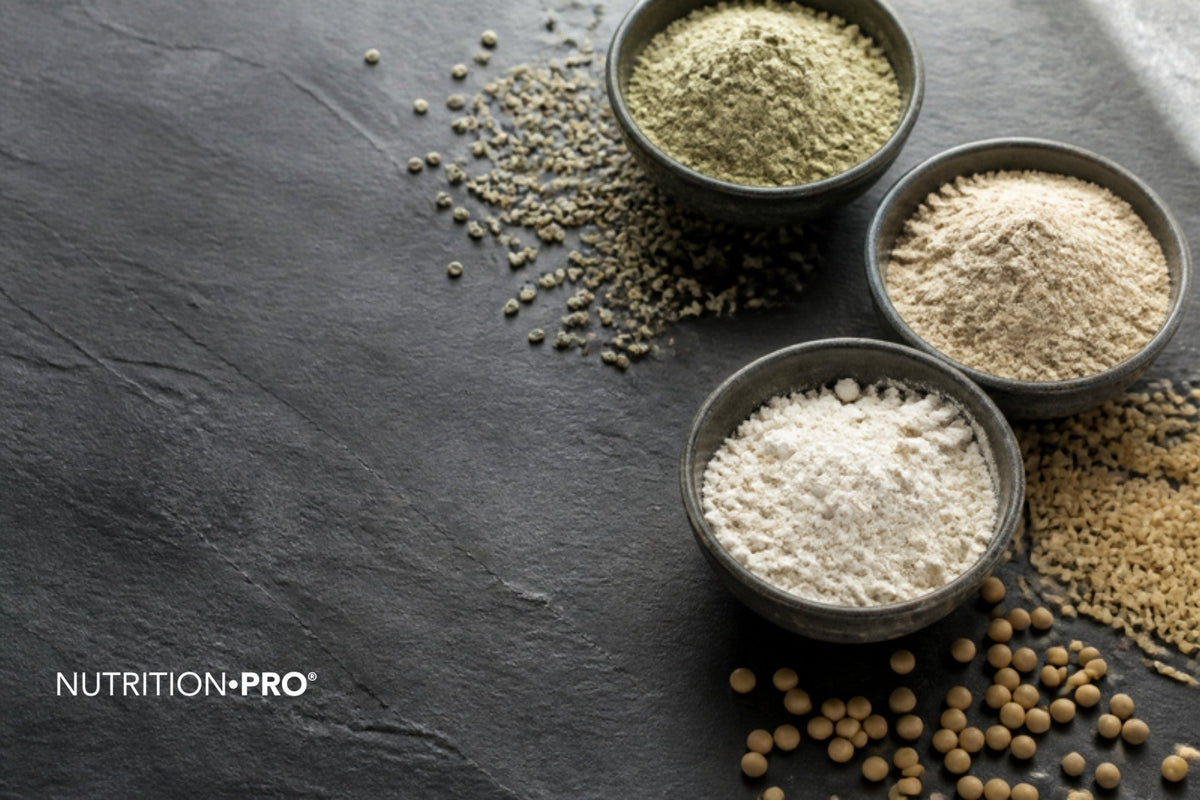
Forty-eight grams of rice protein after each session, for eight weeks: in a trial conducted in 24 trained young men, this protocol resulted in 2.5 kg of lean mass gain, compared to 3.2 kg with the same dose of whey isolate—a difference the researchers did not find significant. Rice, hemp, and soy are the three major plant-based alternatives to whey, each with its own questions: amino acids, hormones, arsenic, or THC.
This guide brings together what studies identified via PubMed show, from composition to muscle-building trials, from hormones to heavy metals, and concludes with a comparison to whey.

Quality and muscle : soy is the most complete of the three, with an average DIAAS of 91 and a PDCAAS close to 1.00; rice (DIAAS of 47) and hemp (54) lack lysine, and hemp is low in leucine (5.1%). In muscle building, a meta-analysis of 9 trials finds no difference between soy and animal proteins on strength and lean mass, and two 8-week trials give comparable results between rice and whey, at 48 g after each session then 24 g per day. Older studies favor milk or whey over soy, and most studies are small.
Safety : a meta-analysis of 41 human studies finds no effect of soy or its isoflavones on testosterone or estrogen; TSH increases very slightly (+0.248 mIU/L) with no effect on thyroid hormones. In 22 powders tested in Hungary, including one brown rice powder, arsenic, lead, cadmium, and mercury remained below the detection threshold. THC is measurable in commercial hemp seeds and oils, but no identified study measured it in hemp protein powders.
- Rice, hemp, soy: where these powders come from
- Amino acids: the weak link in each
- PDCAAS and DIAAS: quality scores
- Protein synthesis: leucine and dosage
- Brown rice protein and muscle building: the match against whey
- Soy protein and muscle building
- Hemp protein: muscle and omega-3s
- Rice and pea blends, creatine: building muscle without whey
- Soy: male hormones, estrogen, and thyroid
- Digestion, tolerance, and allergies
- Arsenic, heavy metals, and THC: what studies measure
- The comparison: rice, hemp, soy and whey
- Frequently Asked Questions
Rice, hemp, soy: where do these powders come from
A protein powder is the protein fraction of a seed, separated from starch, oil or fiber, more or less concentrated depending on the process.
A team from Maastricht University analyzed 35 commercial proteins intended for human or animal consumption using the same method. The brown rice powder contained 79% protein, the hemp powder 51%, and the seven soy samples between 61 and 91% depending on the supplier, compared to 72 to 84% for whey. Rice and hemp each had only one sample: an order of magnitude, not a standard.
The hemp case is explained by its origin. A Canadian analysis of 30 hemp seed-based products measured 24.0% protein and 30.4% fat in the whole seed, 35.9% protein and 46.7% fat in the decorticated seed, and 40.7% protein for 10.2% fat in the meal obtained after cold-pressing the oil. Hemp protein powders are generally derived from this meal. Soy isolates, meanwhile, have existed since 1959, according to a review by nutritionists employed by a nutrition products manufacturer.
The lacto-ovo vegetarian consumes eggs and dairy products: whey, a milk protein, remains an option for them. The vegan excludes all animal products: this guide never proposes whey to them.
Amino acids: the weak link of each
Nine essential amino acids must come from food; the one a protein provides least relative to requirements is its limiting amino acid. For muscle, leucine is particularly important: it triggers muscle protein synthesis.
In the Maastricht analysis, essential amino acids represented 28% of brown rice proteins, 27% of soy, and 23% of hemp, compared to 43% for whey. Hemp, with 5.1% leucine, remained below the reference requirement of 5.9%, while soy and brown rice clearly exceeded it, without reaching whey's 11.0%. For lysine, with a reference requirement of 4.5%, brown rice (2.4%) and hemp (2.8%) were below it, soy just above (4.6%). For methionine (requirement of 1.6%), it's the opposite: 2.5% for brown rice, 2.0% for hemp, only 0.4% for soy.
| Protein | Essential amino acids | Leucine | Lysine | Methionine |
|---|---|---|---|---|
| Brown rice | 28% | Above requirement | 2.4%, limiting | 2.5% |
| Hemp | 23% | 5.1%, below requirement | 2.8%, limiting | 2.0% |
| Soy | 27% | Above requirement | 4.6% | 0.4%, limiting |
| Whey | 43% | 11.0% | Above requirement | Above requirement |
| Reference requirement | Met by rice and soy | 5.9% | 4.5% | 1.6% |
In the study by Joy and colleagues, isolated rice protein contained 80 mg of leucine and 31 mg of lysine per gram of protein, compared to 115 mg and 101 mg for the comparison whey isolate. For hemp, Canadian analysis confirms lysine as the first limiting amino acid.
PDCAAS and DIAAS: quality scores
The PDCAAS, created in 1989, compares the limiting amino acid of a protein to a reference profile, then corrects it by its digestibility measured in rats; it is capped at 1.00. The DIAAS, proposed in 2011, is based on the digestibility of each amino acid measured at the end of the small intestine, most often in pigs, and is not capped. DIAAS strongly depends on the sample and reference profile chosen: infant, child, or adult.
Soy : its PDCAAS is close to 1.00, like that of milk and whey. In a compilation of 43 datasets in pigs, its average DIAAS reaches 91 with the reference profile for children aged 6 months to 3 years, limited by methionine and cysteine. In a 2025 Korean study conducted in pigs, soy isolate achieved 61, 74, or 87 depending on the infant, child, or adult profile.
Rice : Average DIAAS of 47, limited by lysine, across 3 datasets.
Hemp : DIAAS of 54, limited by lysine, but calculated from a single dataset. Its PDCAAS, measured in Canada, ranges from 46 to 51% for the meal to 63 to 66% for the decorticated seed.
| Protein | Average DIAAS (6-month to 3-year profile) | Limiting amino acid | Other data |
|---|---|---|---|
| Rice | 47 (3 datasets) | Lysine | Limited data |
| Hemp | 54 (1 dataset) | Lysine | PDCAAS of 46 to 66% depending on the form |
| Soy | 91 (43 datasets) | Methionine and cysteine | PDCAAS close to 1.00; isolate: 87 with the adult profile |
| Pea | 70 | Methionine and cysteine | Complements rice: 84 for a mixture at 41% rice |
| Whey | 85 (78 to 88 depending on the products) | Histidine | PDCAAS close to 1.00 |
The 2020 compilation is based mainly on raw materials for animal feed, often unprocessed, and its authors are employees of a potato protein manufacturer. The child's profile, more demanding, lowers the scores. These ratings compare sources; they do not predict muscle gain.
Protein synthesis: leucine and dosage
Muscle protein synthesis is measured over a few hours, using labeled amino acids and biopsies. Direct data on plant proteins focus mainly on soy: according to the Maastricht team, anabolic properties had only been studied for a few sources, essentially soy, wheat, and rice.
Three groups of 6 young men drank, after a leg resistance training session, a beverage providing 10 g of essential amino acids in the form of hydrolyzed whey, casein, or soy isolate. After exercise, muscle protein synthesis was 31% higher with whey than with soy, and 69% higher with soy than with casein. At rest, the difference between whey and soy (18%) was not significant.
Tang JE, Moore DR, Kujbida GW, et al. J Appl Physiol 2009;107(3):987-992. DOI : 10.1152/japplphysiol.00076.2009
The authors mention digestion speed and leucine, hence the idea of compensating with quantity: according to the Maastricht team's calculations, 37 g of brown rice protein, 40 g of soy protein, and 54 g of hemp protein are needed to provide the 2.7 g of leucine contained in 25 g of whey, a dose that notably stimulates protein synthesis in humans. For hemp, this represents 105 g of powder.
A 2025 systematic review covering 24 studies on recovery after resistance training in young adults points in the same direction: plant proteins taken alone generally provide limited benefit compared to whey in the hours following exercise, but well-formulated blends, for example pea, rice, and canola, stimulated protein synthesis like whey from 30 g with approximately 2.5 g of leucine. The authors emphasize small sample sizes and a notable risk of bias.
Brown rice protein and resistance training: the match against whey
In 24 trained men aged 21 years with at least one year of training experience, 48 g of isolated rice protein or whey isolate after each of 3 weekly sessions, for 8 weeks, with a diet containing 25% protein: lean mass increased from 58.5 to 61.0 kg with rice and from 59.6 to 62.8 kg with whey, bench press strength from 85.9 to 95.5 kg and from 89.5 to 98.5 kg, leg press from 220.0 to 286.8 kg and from 209.5 to 289.7 kg, with no significant difference between groups.
Joy JM, Lowery RP, Wilson JM, et al. Nutr J 2013;12:86. DOI : 10.1186/1475-2891-12-86
At 48 g, rice provided approximately 3.8 g of leucine and whey 5.5 g, two doses above the threshold considered sufficient. Recognized limitations: only 8 weeks and no unsupplemented control group.
The second trial tested a dose twice as low. In 24 trained men averaging 33 years old, 24 g daily of rice protein or concentrated whey for 8 weeks of standardized resistance training produced comparable changes in lean mass, bench press and leg press strength, endurance, and power. Participants were already consuming 1.87 g of protein per kilogram per day, beyond the 1.62 g per kilogram plateau above which a meta-analysis of 49 trials finds no further lean mass gains. The trial was registered retrospectively and two co-authors are affiliated with a private company.
In young, trained men already well-nourished with protein, rice performed equally to whey over 8 weeks. With 24 participants per trial, nothing is said about women, seniors, or beginners, and an absence of difference does not prove equivalence.
For those consuming dairy products, whey remains the reference for these comparisons. Our 100% Whey Isolate provides 22.9 g of protein per 30 g serving; for reference, the 2013 trial used 48 g of whey isolate and the 2020 trial used 24 g of whey concentrate, another form. Our whey analysis details its measured effects.
Soy protein and muscle building
Soy is the most studied plant protein in resistance training. A 2018 meta-analysis combined 9 studies of 6 weeks or longer, involving 266 participants: five compared soy and whey, four compared soy and another animal protein (beef, milk, or dairy products). Bench press and squat strength improved with both, with no difference between groups, and there was also no difference in lean mass. Its first author is affiliated with a private company.
Earlier trials nuance this picture. In 56 young male beginners, 12 weeks of resistance training 5 days per week with skim milk after each session increased type II fiber area and lean mass more than a soy beverage of identical protein and energy content, with no difference in strength. In a trial of approximately 9 months in untrained men and women, lean mass increased by 3.3 kg with whey, compared to 1.8 kg with soy and 2.3 kg with carbohydrates, for a protein intake of 1.4 g per kilogram per day in both protein groups.
Nineteen young vegan men and nineteen untrained omnivorous men followed 12 weeks of resistance training, two sessions per week, with protein intake increased to 1.6 g per kilogram per day through soy isolate for vegans or whey for omnivores. Lean mass in the legs increased by 1.2 kg in both groups, leg press load increased by 97 kg in vegans and 117 kg in omnivores, with no significant difference between them.
Hevia-Larraín V, Gualano B, Longobardi I, et al. Sports Med 2021;51(6):1317-1330. DOI : 10.1007/s40279-021-01434-9
Participants were not randomly assigned to diets, which they already followed. When total protein intake is sufficient, around 1.6 g per kilogram, the source appears to matter little; below that, quality matters more. Our guide to building muscle details the calculation of requirements, and our comparison of plant and animal proteins expands the question.
Hemp protein: muscle and omega-3
Only one resistance training trial identified, comparing hemp to soy and not to whey.
Twenty-two trained men and twelve trained women, approximately 30 years old, received during 8 weeks of resistance training, approximately 4 sessions per week, either 60 g daily of hemp providing 40 g of protein and 9 g of oil, or soy of identical protein and energy content. Hemp increased elbow flexor thickness in women (from 2.6 to 3.1 cm), soy in men (from 3.7 to 4.0 cm); in men taking hemp, contraction strength was better preserved after a fatigue test.
Kaviani M, Shaw KA, Candow DG, et al. Eur J Appl Physiol 2024;124(4):1097-1107. DOI : 10.1007/s00421-023-05337-7
With 34 participants divided into four subgroups, these effects specific to each sex remain preliminary.
Regarding fatty acids, in an Italian analysis of hemp oils and meals, linoleic acid, an omega-6, represented 50 to 55% of fatty acids, thealpha-linolenic acid (ALA), an omega-3, approximately 12 to 14%, and gamma-linolenic acid more than 1.70%, plant-based ALA being distinct from EPA and DHA. But a protein powder comes from defatted meal, which contained only 10.2% fat in the Canadian analysis: the amount of ALA provided by a serving is therefore modest. These studies do not quantify the fiber content of hemp protein powders.
Rice and pea blends, creatine: building muscle without whey
Rice and peas complement each other: rice lacks lysine but provides methionine, peas the opposite. According to the 2020 compilation, a blend containing 41% rice and 59% peas achieves a DIAAS of 84, compared to 47 for rice alone and 70 for peas alone. According to a 2020 review, blends of 40 to 90% peas achieve a PDCAAS of 1.00 with the adult profile. According to the Maastricht team, a 50/50 blend of rice or hemp with soy or peas requires only 10 to 90% additional protein to meet needs, compared to 2 to 4 times more with a single source. These calculations remain theoretical: we have not identified a multi-week trial measuring muscle mass or strength with a rice and pea blend compared to whey; a 12-week trial with a soy and pea blend (45 g daily) produced gains comparable to whey in 44 young male beginners.
The creatine is the other lever. The body must renew approximately 1 to 3 g of creatine daily: diet, especially meat and fish, covers roughly half of this, and the liver and kidneys produce the rest. According to the International Society of Sports Nutrition position, vegetarians have lower muscle reserves, of 90 to 110 mmol per kilogram of dry muscle, and can see their muscle creatine increase more with supplementation.
In 18 vegetarians and 24 non-vegetarians aged 19 to 55 following 8 weeks of resistance training, creatine (0.25 g per kilogram of lean mass for 7 days, then 0.0625 g per kilogram for 49 days) increased phosphocreatine, bench press strength, type II fiber area, and lean mass more than placebo. Vegetarians taking creatine, starting from lower reserves (117 compared to 130 mmol per kilogram), gained more muscle creatine, lean mass, and total work than non-vegetarians taking creatine.
Burke DG, Chilibeck PD, Parise G, et al. Med Sci Sports Exerc 2003;35(11):1946-1955. DOI : 10.1249/01.MSS.0000093614.17517.79
This trial used a loading phase and a dose calculated based on lean mass. The International Society of Sports Nutrition position also describes a simpler approach: 3 g per day for 28 days, then 3 to 5 g per day to maintain filled reserves. Our Creatine Creapure provides 3 g of creatine monohydrate per 3 vegetable capsules, our creatine monohydrate powder 5 g per day; neither is intended for children, adolescents, or pregnant or nursing women.

The quantities below are practical advice drawn from the cited studies, not trial results.
Our creatine guide and our article when to take creatine detail doses and timing.
Soy: male hormones, estrogens, and thyroid
The concern comes from isoflavones, soy compounds whose structure resembles that of estrogens and which bind weakly to their receptors. Soy protein isolates contain them: 88 to 164 mg per 100 g according to measurements reported by a 2020 review, or approximately 26 to 49 mg per a 30 g serving (our calculation).
In adult men consuming soy foods, soy protein, or isoflavone extracts, no significant effect was found on total testosterone (measured in 1,753 men), free testosterone (752), estradiol (1,000), estrone (239), or sex hormone-binding protein (967), regardless of isoflavone dose and study duration. One of its authors is affiliated with a private company.
Reed KE, Camargo J, Hamilton-Reeves J, et al. Reprod Toxicol 2021;100:60-67. DOI: 10.1016/j.reprotox.2020.12.019
An earlier meta-analysis of 15 placebo-controlled groups reached the same conclusion, with intakes reaching, according to the 2020 review, up to 60 g of soy protein per day. The two share authors. In women, a meta-analysis of 47 studies, 11 of which were premenopausal, found no effect on estradiol before menopause, but a decrease of approximately 20% in FSH and LH hormones.
For thyroid, a meta-analysis of 18 randomized trials shows no change in free thyroid hormones T3 and T4, but a very modest increase in TSH of 0.248 mIU/L, at the threshold of significance and whose clinical relevance is uncertain. The 2020 review adds two nuances: an adverse effect cannot be excluded in people with borderline iodine status or subclinical hypothyroidism, and, according to a few reported cases, soy may interfere with the absorption of levothyroxine, which can be managed by adjusting the dose or spacing out doses.
People treated with levothyroxine, those with subclinical hypothyroidism or low iodine intake, and people allergic to soy. For other adults, available clinical trials show no notable hormonal effect of soy protein at the studied intake levels.
Digestion, tolerance and allergies
Plant proteins are generally slightly less digestible than those from milk, partly because of their structure, which resists digestive enzymes, and seed compounds that slow down these enzymes, according to the 2020 compilation; cooking, fermentation or enzymatic treatment reduce this effect. For hemp, removing the hull improves digestibility.
Allergies. According to a European meta-analysis of 93 studies, 0.5% of people report a soy allergy during their lifetime, and 0.3% have an allergy confirmed by a provocation test. For cow's milk, these figures are 5.7% and 0.3%. Digestive discomfort is not an allergy. Rice and hemp are not among the major allergens studied in this meta-analysis, but any protein can trigger a reaction in a sensitized person.
Arsenic, heavy metals and THC: what studies measure
Rice retains arsenic from soil and water: an analysis of several varieties detected it in all of them, from 0.02 to 0.15 µg of arsenite equivalent per gram, mostly in inorganic form. Analyses of powders remain rare.
Twenty-two powders purchased online in Hungary, including six plant-based (one of brown rice alone, several blends of pea and rice), were analyzed by mass spectrometry for 16 elements. Arsenic, cadmium, mercury and lead remained below the detection threshold in all powders; plant-based powders contained more aluminum and manganese. The authors describe this as a reassuring snapshot, but not a guarantee of quality.
Horváth IL, Kajner G, Galbács G, Csupor D. J Nutr Sci 2025;14:e49. DOI: 10.1017/jns.2025.10024
An American risk assessment based on published data from 15 and then 133 powders notes that the risk index depended mainly on arsenic and cadmium, and that plant-based powders may contain more of them. Even at 3 servings per day, exposure remained below values associated with risk, except for one product highly loaded with cadmium. The average arsenic intake from 3 servings was estimated at 5.9 µg per day, compared to 9.9 µg per day for the usual dietary intake of an adult man. None of these analyses allow judgment of a specific product.
THC. In hemp seeds, THC is concentrated mainly in the shell: in one analysis, the shell contained 300 mg of THC per kilo, compared to 2 mg per kilo for the kernel. In 12 batches of seeds sold in Turkey, THC ranged from 0.11 to 2.08 µg per gram, and from 0.11 to 31.08 µg per mL in 20 oils; only one oil was free of it. None of the studies identified measured THC in hemp protein powders: these figures cannot therefore be extrapolated.
These traces may matter for tested athletes. In a trial with 15 volunteers divided into three groups of 5, hemp oil taken orally made THC metabolites detectable in 72 of 77 urine samples (93.5%), up to 4.52 ng per mL; seed consumption produced repeated but weaker traces.
The comparison: rice, hemp, soy and whey
| Criterion | Brown rice | Hemp | Soy | Whey |
|---|---|---|---|---|
| Protein in the powder | 79% (1 sample) | 51% (1 sample) | 61 to 91% | 72 to 84% |
| Limiting amino acid | Lysine | Lysine, low leucine | Methionine | Histidine (child profile) |
| Average DIAAS | 47 | 54 | 91 | 85 |
| Protein for 2.7 g of leucine | 37 g | 54 g | 40 g | 25 g |
| Muscle-building trials | 2 trials, comparable to whey | 1 trial against soy | Meta-analysis of 9 studies, mixed results trial by trial | Comparison reference |
| Point of attention | Rice arsenic, not detected in the tested powder | Possible traces of THC | Milk allergy, levothyroxine | Milk allergy |
| Suitable for vegans | Yes | Yes | Yes | No, milk protein |
If you are vegan, soy offers the most complete profile and the most data; a rice and pea blend is the best alternative if you avoid soy; hemp, low in concentration and poor in leucine, is rather complementary. A vegan diet also requires attention to vitamin B12, which should be supplemented, vitamin D, available in plant-based form derived from lichen like our plant-based Vitamin D3 at 1,000 IU per drop, and iron, to be checked with a blood test, as explained in our article on iron deficiency.
If you are vegetarian and consume dairy products, whey remains the protein richest in leucine, and plant-based proteins can complement or replace it based on your preferences. Omnivore, the choice mainly comes down to taste and tolerance: our comparison of protein powders reviews the criteria, and our protein-rich foods help meet your needs without powder.
An isolate whey protein: 22.9 g of protein per 30 g serving. For omnivores and vegetarians who consume dairy products, the reference protein from trials comparing rice and soy to whey.
View the Whey isolateTo complement creatine intake, our Creapure Creatine in plant-based capsules provides 3 g of creatine monohydrate per day.
Frequently Asked Questions
What is the best plant protein between rice, hemp, and soy?
Soy has the most complete amino acid profile, with an average DIAAS of 91 compared to 47 for rice and 54 for hemp, and the most numerous strength training trials. Brown rice protein produced results comparable to whey in two 8-week trials.
Is brown rice protein effective for muscle building?
In two 8-week trials in 24 trained men each, 48 g after each session, then 24 g per day, of rice protein produced lean mass and strength gains comparable to whey, with no significant difference. These trials are small.
Is soy protein dangerous for men?
Clinical trials do not show this: a meta-analysis of 41 studies found no effect of soy or its isoflavones on total or free testosterone, estradiol, or estrone in men, regardless of dose and duration.
Is soy bad for the thyroid?
A meta-analysis of 18 trials shows no effect on thyroid hormones T3 and T4, with a very modest increase in TSH of 0.248 mIU/L. According to a few reported cases, soy can interfere with levothyroxine absorption: should be spaced apart, with medical advice.
Does rice protein contain arsenic?
Rice can accumulate arsenic, but in an analysis of 22 commercial powders in Hungary, including one brown rice and several pea-rice blends, arsenic remained below the detection threshold. Data remains limited.
Does hemp protein contain THC?
Traces of THC have been measured in commercial hemp seeds, from 0.11 to 2.08 micrograms per gram in a Turkish study, mainly in the seed hull. No identified study has measured THC in hemp protein powders.
What is the limiting amino acid in rice protein?
Lysine: 2.4% of brown rice proteins in a 2018 analysis, below the reference requirement of 4.5%. Hemp is also limited by lysine, soy by methionine and cysteine.
Why mix rice protein and pea protein?
Because they complement each other: rice lacks lysine, peas lack methionine. A 41% rice blend reaches a DIAAS of 84, compared to 47 for rice alone and 70 for peas alone, and blends of 40 to 90% peas reach a PDCAAS of 1.00 with the adult profile.
How much plant protein should you take after a workout?
To provide the 2.7 g of leucine from 25 g of whey, approximately 37 g of brown rice protein, 40 g of soy protein, or 54 g of hemp protein is needed.
Can a vegan take creatine?
Yes, in a form with no animal-derived ingredients. Vegetarians, with lower baseline levels, benefited more than non-vegetarians in an 8-week trial. The usual dose is 3 to 5 g per day.
Sources
The studies cited below were identified via PubMed.
- Joy JM, Lowery RP, Wilson JM, et al. Effects of 8 weeks of whey or rice protein supplementation on body composition and performance. Nutrition Journal, 2013;12:86. DOI
- Herreman L, Nommensen P, Pennings B, Laus MC. Overview of plant and animal protein quality according to the DIAAS score. Food Science & Nutrition, 2020;8(10):5379-5391. DOI
- Hertzler SR, Lieblein-Boff JC, Weiler M, Allgeier C. Plant proteins: assessing their nutritional quality and effects on health and physical function. Nutrients, 2020;12(12):3704. DOI
- Gorissen SHM, Crombag JJR, Senden JMG, et al. Protein content and amino acid composition of commercial plant protein isolates. Amino Acids, 2018;50(12):1685-1695. DOI
- Messina M, Lynch H, Dickinson JM, Reed KE. No difference between soy protein and animal protein on muscle mass and strength gains in resistance training. International Journal of Sport Nutrition and Exercise Metabolism, 2018;28(6):674-685. DOI
- Moon JM, Ratliff KM, Blumkaitis JC, et al. Effects of daily doses of 24 grams of rice protein or whey on adaptations to resistance training in trained men. Journal of the International Society of Sports Nutrition, 2020;17(1):60. DOI
- Hartman JW, Tang JE, Wilkinson SB, et al. Skim milk after resistance training promotes more lean mass than soy or carbohydrates in young beginners. The American Journal of Clinical Nutrition, 2007;86(2):373-381. DOI
- Volek JS, Volk BM, Gómez AL, et al. Whey supplementation during resistance training increases lean mass. Journal of the American College of Nutrition, 2013;32(2):122-135. DOI
- Reed KE, Camargo J, Hamilton-Reeves J, et al. Neither soy nor isoflavones modify male reproductive hormones: expanded and updated meta-analysis. Reproductive Toxicology, 2021;100:60-67. DOI
- Otun J, Sahebkar A, Östlundh L, et al. Systematic review and meta-analysis of the effect of soy on thyroid function. Scientific Reports, 2019;9(1):3964. DOI
- Horváth IL, Kajner G, Galbács G, Csupor D. Heavy metal content of powdered proteins on the Hungarian market: a reassuring snapshot, but not a quality guarantee. Journal of Nutritional Science, 2025;14:e49. DOI
- Spolidoro GCI, Ali MM, Amera YT, et al. Prevalence of the eight major food allergens in Europe: updated systematic review and meta-analysis. Allergy, 2023;78(9):2361-2417. DOI
- Soyturk H, Goren IE, Atasoy Aydin A, Daglioglu N. Low urinary cannabinoid levels after controlled administration of hemp seed-based products in Turkey. Forensic Science International, 2026;387:113053. DOI
- House JD, Neufeld J, Leson G. Evaluating the protein quality of hemp seed-based products using the PDCAAS score. Journal of Agricultural and Food Chemistry, 2010;58(22):11801-11807. DOI
- Oh J, Park N, Kim BG. Determination of DIAAS score of plant proteins and skim milk powder in pigs. Animals, 2025;15(5):650. DOI
- Tang JE, Moore DR, Kujbida GW, et al. Whey hydrolysate, casein, or soy isolate: effects on muscle protein synthesis at rest and after resistance training in young men. Journal of Applied Physiology, 2009;107(3):987-992. DOI
- Govindasamy K, Parpa K, Katanic B, et al. Effect of plant proteins on recovery after resistance training-induced muscle damage in young adults: a systematic review. Nutrients, 2025;17(15):2571. DOI
- Morton RW, Murphy KT, McKellar SR, et al. A systematic review, meta-analysis, and meta-regression of the effect of protein supplementation on muscle mass and strength gains in resistance training. British Journal of Sports Medicine, 2018;52(6):376-384. DOI
- Hevia-Larraín V, Gualano B, Longobardi I, et al. High-protein plant-based diet versus omnivorous diet with equal protein intake to support resistance training: vegans and omnivores compared. Sports Medicine, 2021;51(6):1317-1330. DOI
- Kaviani M, Shaw KA, Candow DG, et al. Effects of hemp protein supplementation during resistance training in trained young adults. European Journal of Applied Physiology, 2024;124(4):1097-1107. DOI
- Arena P, Rigano F, Guarnaccia P, et al. Lipid composition of hemp-based products by chromatography coupled with mass spectrometry. Molecules, 2022;27(10):3358. DOI
- Santini MH, Erwig Leitão A, Mazzolani BC, et al. Similar effects of a blend of animal or plant proteins as dietary supplementation on muscle adaptations to resistance training: results from a randomized clinical trial. Journal of the International Society of Sports Nutrition, 2025;22(1):2568047. DOI
- Kreider RB, Kalman DS, Antonio J, et al. International Society of Sports Nutrition position stand: safety and efficacy of creatine supplementation in exercise, sport, and medicine. Journal of the International Society of Sports Nutrition, 2017;14:18. DOI
- Burke DG, Chilibeck PD, Parise G, et al. Effect of creatine and resistance training on muscle creatine and performance in vegetarians. Medicine and Science in Sports and Exercise, 2003;35(11):1946-1955. DOI
- Hamilton-Reeves JM, Vazquez G, Duval SJ, et al. Clinical studies show no effect of soy protein or isoflavones on reproductive hormones in men: meta-analysis. Fertility and Sterility, 2010;94(3):997-1007. DOI
- Hooper L, Ryder JJ, Kurzer MS, et al. Effects of soy protein and isoflavones on circulating hormones before and after menopause: systematic review and meta-analysis. Human Reproduction Update, 2009;15(4):423-440. DOI
- Baumann B, van der Meer JR. Analysis of bioavailable arsenic in rice using live reporter bacteria. Journal of Agricultural and Food Chemistry, 2007;55(6):2115-2120. DOI
- Bandara SB, Towle KM, Monnot AD. Health risk assessment related to heavy metal ingestion in powder protein consumers. Toxicology Reports, 2020;7:1255-1262. DOI
- Kim NP, Aditiya A, Min TJ. A mathematical model and selective extraction to remove delta-9-THC from hemp seed hulls. Journal of Cannabis Research, 2025;7(1):91. DOI
- Kacargil CU, Soyturk H, Aydin AA, et al. Quantification of cannabinoids in commercial hemp seeds and oils in Turkey by LC-MS/MS. Forensic Science International, 2026;381:112836. DOI


