

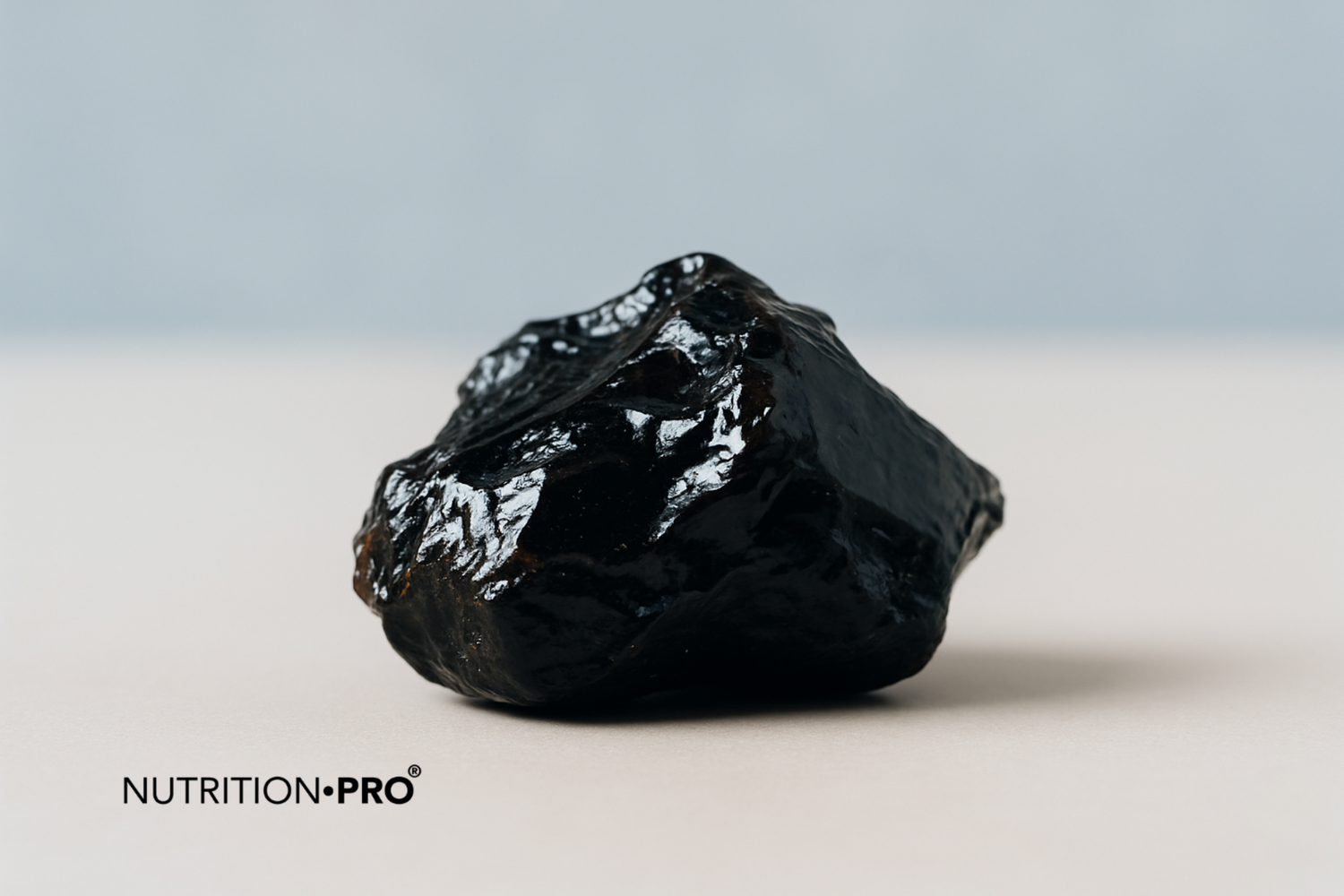
Shilajit, the black resin from the Himalayan mountains, has been used in Ayurvedic medicine for centuries. Today it is attracting genuine scientific interest, along with its fair share of exaggeration. Between real, documented benefits and far-fetched promises, some sorting out is needed.
Here is the complete guide to Himalayan black gold: what shilajit really is (often spelled chilagite or shilagite), where it comes from, what science actually says about its benefits, how to take it, and which claims to set aside. No overselling, but no playing down what is seriously documented either.

Important information. Shilajit is a dietary supplement, not a medicine. It does not treat, prevent or cure any disease. The benefits described here are limited to what studies suggest, with their level of evidence, and several still need to be confirmed by larger human trials. If you have a medical condition, are taking medication or are pregnant, ask your doctor for advice.
Shilajit (or chilagite) is a Himalayan resin formed over thousands of years and a pillar of Ayurveda, which calls it the “destroyer of weakness.” Its real, documented benefits: support for energy and reduced fatigue (through ATP production), antioxidant properties and, in men aged 45 to 55, a rise in testosterone (randomized trial). It is also being studied for male fertility and immunity. In practice: 250 to 500 mg in the morning, as a 2- to 3-month course. Claims about Alzheimer's, diabetes, the heart or “detox,” on the other hand, have not been established in humans. Product quality (purification, absence of heavy metals) is essential.
- What shilajit (or chilagite) is
- Where it comes from: history and formation
- 1. Energy and reduced fatigue
- 2. Antioxidant action
- 3. Testosterone in men
- 4. Male fertility
- 5. Immunity and adaptogenic action
- 6. Recovery and physical performance
- How to take shilajit
- Claims to set aside
- Quality and precautions
- Frequently asked questions
What is shilajit?
Shilajit (also called mumie or moomiyo, and often spelled chilagite, shilagite or shilajite: it is exactly the same product) is a natural resin that seeps from rocks in the Himalayas and other mountain ranges, formed by the slow decomposition of plant matter over centuries. Its color ranges from dark brown to black, hence its nickname, “black gold.”
Its richness comes from two main components: fulvic acid and dibenzo-alpha-pyrones, along with numerous minerals and trace elements. Research attributes most of its effects to these compounds. According to Stohs 2013 in Phytotherapy Research, a landmark review, shilajit has antioxidant, anti-inflammatory, adaptogenic and immunomodulatory properties, and its safety is well documented for a purified product. See the review.
Where shilajit comes from: history and formation
Shilajit forms in high-altitude mountain ranges, first and foremost the Himalayas, but also the Altai and the Caucasus. Over thousands of years, plant matter trapped in rock crevices slowly decomposes, blends with minerals and oozes out under the effect of pressure and temperature swings: the dark resin that beads on the rocks in summer is shilajit. It is then harvested by hand at altitude and purified before consumption.
Its history is as old as medicine itself: the Ayurvedic tradition has used it for more than two thousand years and calls it the “destroyer of weakness”; Russian medicine, for its part, has studied it under the name mumie. Legend has it that people discovered it by observing the vigor of the monkeys that came to lick the resin off the rock faces. One last useful point: shilajit is classified into grades (Gold, Silver, Bronze, Iron), and the Gold grade, harvested at the highest altitudes, is the richest in active compounds.
Energy and reduced fatigue
This is the benefit most firmly associated with shilajit, and its main traditional use. According to Stohs 2013, animal and human data support its role as a “revitalizer” that improves physical performance and eases fatigue, with increased production of ATP (the molecule that supplies cells with energy). See the review.
The proposed mechanism: fulvic acid and dibenzo-alpha-pyrones are thought to support the functioning of mitochondria, the “powerhouses” of the cells. In practical terms, this explains why shilajit is traditionally taken to support day-to-day vitality and endurance. It is a real, documented benefit, even though larger human trials would still be welcome.
Whether you prefer the convenience of PrimaVie® capsules (a standardized, purified extract) or the authenticity of traditional pure shilajit resin, what matters most is quality: a purified shilajit, rich in fulvic acid and free from heavy metals. A supplement to support energy and vitality as part of a healthy lifestyle.
Antioxidant action
Shilajit is rich in antioxidant compounds, fulvic acid in particular. According to Stohs 2013, its antioxidant properties are among its best-described effects. See the review. Antioxidants help protect cells against oxidative stress, a process involved in cellular aging.
This is a documented property of the compound, and it should not be overinterpreted: “antioxidant” does not mean “anti-aging miracle” or “protection against disease.” It is a worthwhile form of cellular support, to be seen as part of an overall approach.
Testosterone in men
This is one of the most studied benefits, and it rests on a good-quality study, provided its precise scope is respected. According to Pandit et al. 2015 in Andrologia, a randomized, double-blind, placebo-controlled trial showed that purified shilajit, at 250 mg twice a day for 90 days, significantly increased total and free testosterone as well as DHEAS in healthy men aged 45 to 55, while maintaining levels of the gonadotropic hormones (LH, FSH). See the study.
Let's be precise and honest about what this means: the result applies to men in this age group, taking a purified, standardized shilajit, over 90 days. It is neither a universal promise nor a performance-enhancing drug, and it does not replace medical care in the event of a confirmed hormone deficiency. But within that framework, it is a real and well-documented benefit.
Male fertility
As an extension of its hormonal action, shilajit is being studied for male fertility. According to Stohs 2013, animal and human data indicate that shilajit promotes spermatogenesis (the production of sperm). See the review.
This is an interesting, documented avenue, but it is a matter of support, not of treating infertility: any plan to conceive or any fertility difficulty should be medically supervised. Shilajit is never a substitute for a medical work-up and specialist care.
Immunity and adaptogenic properties
According to Stohs 2013, shilajit has adaptogenic and immunomodulatory properties. See the review. An adaptogen is a substance traditionally reputed to help the body better withstand various kinds of stress. Immunomodulation refers to support for the balance of the body's natural defenses.
These properties are part of shilajit's traditional profile as a general tonic. They are described in the literature, but the level of evidence in humans still needs strengthening: think of it as background support for the body, not as a shield against infections.
Recovery and physical performance
Shilajit's “revitalizing” role, documented by Stohs 2013, ties in with the interest it attracts among athletes: support for energy, physical performance and recovery, linked to its action on ATP and its antioxidant profile. See the review.
This is consistent with its traditional use for endurance but, here again, let's keep things in proportion: shilajit complements well-managed training and recovery (sleep, nutrition, hydration); it does not replace them. To find out more, see our dedicated article on shilajit and sport.
How to take shilajit (dosage)
As a resin: take a portion somewhere between the size of a grain of rice and a pea (around 250 to 500 mg) and dissolve it in warm water, tea, milk or coffee that is not scalding hot. As PrimaVie® capsules: 250 mg twice a day, the exact protocol of the landmark clinical trial. In both cases, opt for the morning or early in the day, as its energizing effect can make it harder for the most sensitive people to fall asleep.
Plan on a 2- to 3-month course: the first effects are often felt within 1 to 3 weeks and settle in over 4 to 8 weeks. Between two courses, take a 2- to 4-week break. Start with the smaller dose for the first week, then adjust: consistency matters more than quantity. For the detailed step-by-step protocol, see our guide on when and how much shilajit to take.
Claims to set aside
In the interest of honesty, here are the claims you often read about shilajit but that have not been established in humans, and that should therefore be set aside. Presenting them as proven benefits would be misleading, even dangerous.
- Prevention of Alzheimer's or neurodegenerative diseases: not demonstrated in humans. Fulvic acid is being explored in laboratory studies, but that does not justify any prevention claim.
- Antidiabetic or blood sugar-lowering effect: not established in humans. Shilajit does not treat diabetes and does not replace any treatment.
- Cardiovascular protection: the favorable data come from animal studies and cannot be translated into a promise for human health.
- Heavy metal detoxification: not demonstrated in humans. Paradoxically, unpurified shilajit can itself contain heavy metals, which is why quality matters so much.
Key takeaway: shilajit has real benefits (energy, antioxidant action, testosterone in middle-aged men, fertility), but it is not a cure-all. Be wary of websites that present it as a remedy for serious diseases: such claims are neither proven nor permitted.
Quality and precautions
With shilajit, quality is not a detail; it is a safety issue. Raw, unpurified shilajit can contain heavy metals or contaminants. According to Stohs 2013, it is purified shilajit whose safety is documented. See the review. Hence the importance of choosing a purified, tested product.
- Choose a purified shilajit that has been lab-tested (no heavy metals), such as a standardized PrimaVie®-type extract or a resin whose purity is verified.
- Follow the doses indicated on the product.
- Seek medical advice if you have a medical condition, are taking medication, or are pregnant or breastfeeding.
- To find out more, see our guides on how to choose a quality shilajit and on the dangers and precautions.
Frequently asked questions
What exactly is shilajit? And chilagite?
Shilajit (often spelled chilagite, shilagite or shilajite: it is the same product) is a natural resin that oozes from high-mountain rocks, formed over thousands of years by the decomposition of plant matter mixed with minerals. Rich in fulvic acid, it is the tonic of choice in Ayurveda, which describes it as the destroyer of weakness.
What are the real benefits of shilajit?
The best documented: support for energy and reduced fatigue (via ATP), antioxidant action and, in men aged 45 to 55, a rise in testosterone (randomized trial, Pandit 2015). It is also being studied for male fertility and immunity (Stohs 2013). Several effects still need to be confirmed by larger human trials.
Does shilajit really increase testosterone?
According to Pandit 2015, purified shilajit (250 mg twice a day for 90 days) increased total and free testosterone in healthy men aged 45 to 55 in a randomized, double-blind trial. It is a solid result for this specific profile, not to be generalized to all ages, and it does not replace medical follow-up in the event of a deficiency.
Does shilajit give you energy?
This is its main traditional use, and the best supported. According to Stohs 2013, the data support its role as a revitalizer that improves physical performance and eases fatigue, with increased ATP production. It supports vitality as part of a healthy lifestyle.
How and when should you take shilajit?
As a resin: a portion somewhere between the size of a grain of rice and a pea (around 250 to 500 mg), dissolved in a warm drink that is not scalding hot, in the morning. As PrimaVie® capsules: 250 mg twice a day. A 2- to 3-month course, with a 2- to 4-week break between courses. Full details are in our guide on when and how much to take.
How long does it take to feel the effects?
The first effects are often felt within 1 to 3 weeks, and they settle in over 4 to 8 weeks of regular use. This is a supplement that works over the long term: the consistency of a 2- to 3-month course matters more than the dose.
Is shilajit good for women?
Yes: it is a deep-acting general tonic, not a product reserved for men. Its density of minerals and fulvic acids makes it an ally during demanding periods, whatever your profile. The only restriction: it is not recommended during pregnancy and breastfeeding. Our dedicated article on shilajit and women's health covers the subject in detail.
What does shilajit taste like?
An earthy, slightly bitter taste with a smoky note, which can be surprising at first. If the flavor puts you off, the resin dissolves completely in tea, milk or juice, and PrimaVie® capsules have no taste at all.
Does shilajit cure diseases (Alzheimer's, diabetes)?
No. Shilajit does not treat, prevent or cure any disease. Claims about Alzheimer's, diabetes or cardiovascular protection have not been established in humans (some are based on animal or laboratory studies). It is a dietary supplement, not a medicine.
Does shilajit detoxify the body?
This claim has not been demonstrated in humans. Paradoxically, unpurified shilajit can itself contain heavy metals. That is why it is essential to choose a purified, tested shilajit rather than counting on a hypothetical detox effect.
How do you choose a safe shilajit?
Choose a purified, lab-tested shilajit that is free from heavy metals: a standardized extract such as PrimaVie® or a resin whose purity is verified. According to Stohs 2013, it is purified shilajit whose safety is documented. Follow the doses and seek medical advice if you have a medical condition, are taking medication or are pregnant.
Capsules or resin: which should you choose?
Both formats are valid. PrimaVie® capsules offer a standardized, purified extract and precise, very convenient dosing. Pure resin is the traditional form, to be dissolved before use, and is valued for its authenticity. In both cases, the overriding criterion remains purity and the absence of heavy metals. To compare the three forms, see our Shilajit range.
Further reading
- Shilajit (chilagite)
- Natural resin from the Himalayas, rich in fulvic acid and minerals, also called mumie; chilagite and shilagite are common spellings of the same product.
- Fulvic acid
- The main active compound in shilajit, with antioxidant properties.
- ATP
- The molecule that supplies cells with energy; shilajit is thought to support its production.
- Adaptogen
- A substance traditionally reputed to help the body withstand stress.
- Gold grade
- Shilajit classification: the Gold grade, harvested at the highest altitudes, is the richest in active compounds, ahead of the Silver, Bronze and Iron grades.
- Spermatogenesis
- The production of sperm, supported by shilajit according to the literature.
- PrimaVie®
- A purified, standardized shilajit extract, used to guarantee purity and dosage.
Important reminder: this article is for information purposes and does not replace individual medical advice. Shilajit is a dietary supplement, not a medicine. If you have a medical condition, are taking medication or are pregnant, seek advice from a healthcare professional.
- Stohs SJ. Safety and efficacy of shilajit (mumie, moomiyo). Phytother Res. 2014;28(4):475-9. doi:10.1002/ptr.5018
- Pandit S, Biswas S, Jana U, et al. Clinical evaluation of purified Shilajit on testosterone levels in healthy volunteers. Andrologia. 2016;48(5):570-5. doi:10.1111/and.12482


