

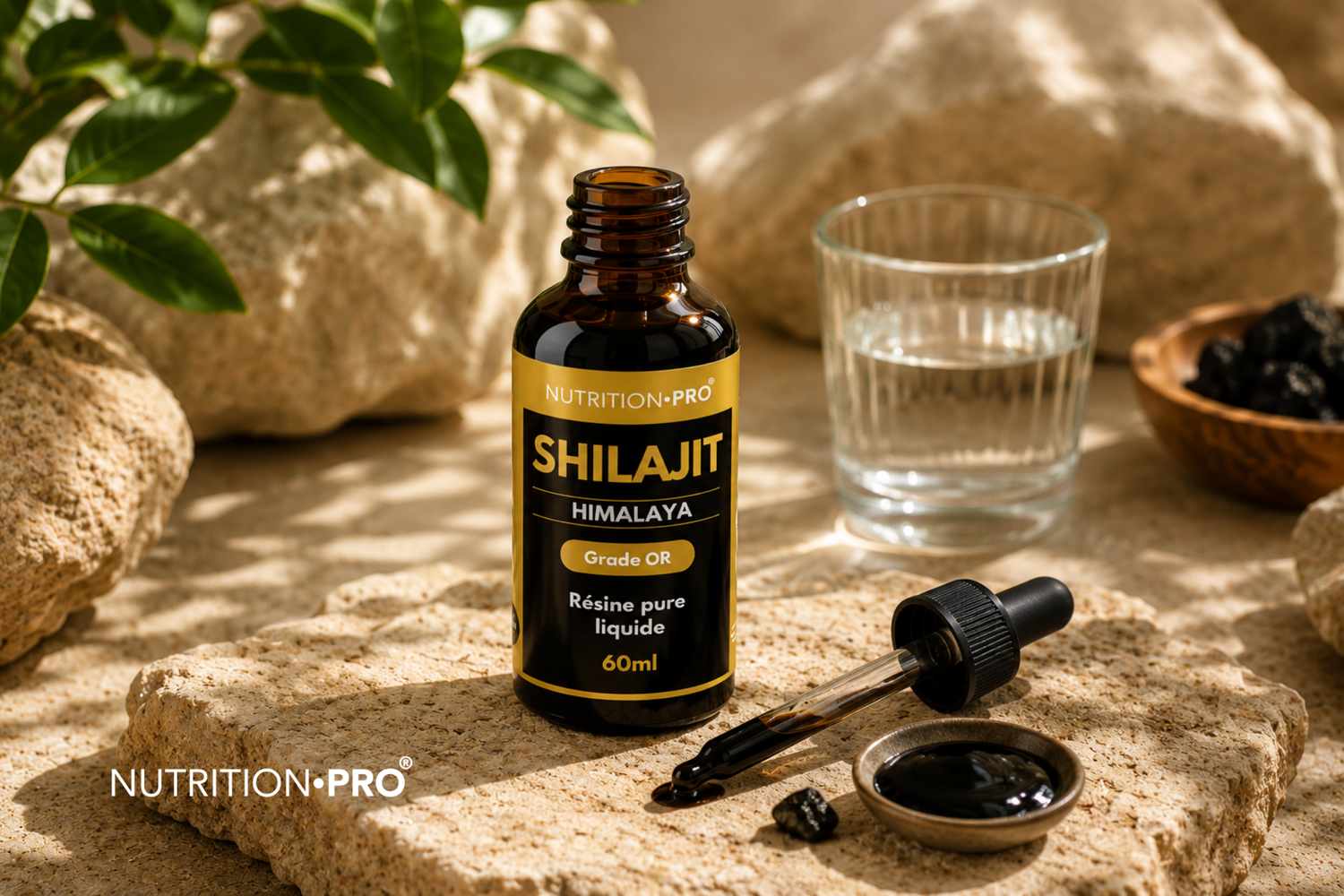
Shilajit, the “black gold of the Himalayas,” has become one of the most sought-after supplements. But its popularity has a downside: the market is flooded with products of wildly varying quality, some diluted, some poorly purified, some even contaminated. Buying shilajit can feel like an obstacle course.
How can you be sure you are not being misled? This guide walks through the real criteria that determine a shilajit's quality: purity and lab analyses, fulvic acid content (and what it is actually worth), the risk of heavy metals, origin, and the choice of form (resin, liquid or capsules). The goal: to give you an honest framework for choosing with confidence.


To choose a quality shilajit, check these points first: the availability of independent laboratory analyses (the only real safeguard against heavy metals), a clearly stated origin (Himalayas, Altai) and transparency from the manufacturer. Fulvic acid content is a useful clue, but one to keep in perspective: there is no official threshold, and the figure depends on the testing method. As for form, resin is the most traditional, liquid the most convenient to dose, and standardized capsules the simplest, with no taste. None is better in absolute terms: what matters is purity.
- What is a quality shilajit?
- The 5 criteria that really matter
- The sensitive issue: heavy metals and purification
- Resin, liquid or capsules: which form should you choose?
- Fulvic acids: what the number does (and doesn't) tell you
- How to spot a fake shilajit
- Where to buy and how to read a label
- Frequently asked questions
1. What is a quality shilajit?
Shilajit is a dark resin that seeps from rocks in high mountain ranges, notably the Himalayas and the Hindu Kush. According to PubMed, it is a complex mixture of humic substances (formed as plant matter decomposes over centuries) and metabolites, the most studied of which are fulvic acids and dibenzo-α-pyrones (Agarwal 2007, DOI: 10.1002/ptr.2100; Stohs 2013, DOI: 10.1002/ptr.5018).
One important point, in the interest of honesty: research on shilajit remains limited. The review by Wilson et al. 2011 in the Journal of Ethnopharmacology points out that, despite a long tradition of use, shilajit still lacks systematic scientific evaluation, and that several of its reputed properties have not been firmly demonstrated (DOI: 10.1016/j.jep.2011.04.033). In other words, a good shilajit is not a miracle product; it is first and foremost a pure, well-made product. That is exactly what this guide helps you identify.
2. The 5 criteria that really matter
Marketing aside, five things truly separate a good shilajit from a bad one. Here is your framework for assessing one.
Laboratory analyses
The number one criterion.
This is the only real guarantee of safety. A reputable manufacturer has every batch tested by an independent laboratory to verify the absence of heavy metals and contaminants. If no analysis is available or even mentioned, walk away.
Geographic origin
Himalayas, Altai, Caucasus.
Quality shilajit comes from recognized high-altitude regions. A specific, traceable origin is a good sign; a vague or missing one is a bad sign.
Purification
Raw does not mean pure.
Raw shilajit must be purified to remove impurities from the rock. Be wary of “raw shilajit” sold unprocessed: it may contain exactly what you are trying to avoid.
Manufacturer transparency
What you are told, and what is kept from you.
Form, origin, analyses, recommended dose, active compounds: a good manufacturer communicates clearly. Vague, spectacular promises with no verifiable data behind them are a red flag.
Fulvic acid content (keep it in perspective)
A clue, not proof.
Often given pride of place, it is a useful criterion but one that marketing overrates. We come back to it in detail below: a high figure with no stated testing method does not prove much.
3. The sensitive issue: heavy metals and purification
This is the topic sales pages tend to avoid, and yet it is the most important one. Because shilajit is a rock exudate, the raw product can naturally contain heavy metals. The safety of shilajit, which is well documented according to Stohs 2013, rests precisely on its being properly purified and standardized (DOI: 10.1002/ptr.5018).
The practical consequence is simple: purification and laboratory analysis are not “premium” extras; they are basic requirements. A shilajit that cannot prove it is safe should not end up in your cup.
4. Resin, liquid or capsules: which form should you choose?
You will often read that “only the resin is worth buying.” That is an oversimplification. Resin is indeed the rawest, most traditional form, but a capsule of purified, standardized shilajit is every bit as credible, and sometimes easier to dose. Here is how to decide between them based on your priorities.
The form closest to the natural state, rich and traditional. Pronounced earthy taste, dosed by eye (a portion anywhere from the size of a grain of rice to that of a pea).
Resin already dissolved, supplied with a dropper. Convenient for adjusting the dose and stirring it into a drink.
Purified extract (such as PrimaVie®) with a fixed, consistent dose and no taste. The simplest, most portable format.
A word about PrimaVie®: it is a purified, standardized shilajit extract, and it is precisely this type of standardized extract that was used in the clinical trial by Pandit et al. 2016 on testosterone (DOI: 10.1111/and.12482). This does not mean the resin is inferior, but that standardization has real value: you know exactly what you are taking. For details on its effects, see our article on the benefits of shilajit according to science.
5. Fulvic acids: what the number does (and doesn't) tell you
Fulvic acids are among shilajit's key compounds, and their content has become the number one marketing argument. Claims of “70% fulvic acids minimum,” sometimes more, are popping up everywhere. Let's be precise: there is no officially recognized threshold that defines the quality of a shilajit and, above all, the percentage measured depends heavily on the analytical method used. Two laboratories can report very different figures for the same product.
As a result, a spectacular percentage printed on a package, with no stated testing method and no analysis to back it up, proves nothing. It can even be a red flag when the figure looks unrealistic. You are better off relying on the full laboratory analysis and the manufacturer's overall consistency than on a single marketing number. An honest manufacturer will tell you about its method, not just its figure.
6. How to spot a fake shilajit
A few physical cues can help you spot a dubious product, as long as you do not read more into them than they can tell you:
Sticky, resinous texture
At room temperature, pure resin is pliable and sticky, and it softens with heat. A hard, crumbly or grainy product is suspect.
Cloudy dissolution
In lukewarm water, pure shilajit dissolves into a cloudy liquid, golden to brown in color. Instant, perfectly clear dissolution is questionable.
Abnormally low price
Genuine shilajit requires high-altitude harvesting, purification and analyses. A rock-bottom price often points to a diluted, poorly purified or contaminated product.
No analysis, vague origin
No laboratory analysis, no stated origin, spectacular promises with no data: the classic trio of a product to avoid.
The key takeaway: these tests are a complement, not a guarantee. Only a laboratory analysis can confirm the absence of heavy metals, which neither the eye nor the nose can detect.
7. Where to buy and how to read a label
Before you check out, run through this checklist. If a product checks these boxes, you are looking at a reputable product.
At Nutrition•pro, our shilajits are lab-tested and come in three forms to suit the way you use them: pure shilajit resin, the liquid format and PrimaVie® capsules. You can compare them below.
Frequently asked questions
Which shilajit should you choose: resin, liquid or capsules?
All three forms are valid as long as the product is pure and tested. Resin is the closest to the natural state and the most traditional. Liquid is convenient for adjusting the dose. Standardized capsules (such as PrimaVie®) offer a precise dose with no taste. The choice comes down to how you prefer to take it: what matters above all is purity and the manufacturer's transparency, not the form.
How can you tell real shilajit from fake?
Authentic shilajit has a sticky, resinous texture, a brown-black color and an earthy smell, and it dissolves into a cloudy liquid (rather than instantly and clearly). But these at-home tests are not enough: the only reliable guarantee is an independent laboratory analysis certifying the absence of heavy metals. Be wary of abnormally low prices.
Is fulvic acid content a good quality criterion?
It is one criterion among others, but one to keep in perspective. There is no universal official threshold, and a high percentage displayed on the packaging depends on the testing method used, which varies from one manufacturer to another. A very high claimed content with no stated method is not proof. You are better off relying on the full laboratory analysis and the manufacturer's overall transparency.
Is cheap shilajit necessarily poor quality?
An abnormally low price is a red flag. Authentic shilajit requires high-altitude harvesting, purification and analyses, all of which come at a cost. A very cheap product may be diluted, poorly purified or contaminated. That does not mean the most expensive is always the best: what matters is the relationship between the price, the analyses provided and the transparency.
Can shilajit contain heavy metals?
Yes, this is the main risk to watch for. Raw, unpurified shilajit can contain heavy metals from the rock. That is precisely why purification and laboratory analyses are essential. Never buy raw, untested shilajit, and favor products whose manufacturer publishes analyses certifying the absence of contaminants.
Glossary
- Fulvic acids
- Compounds derived from humic substances, among the main studied constituents of shilajit. Their content is often highlighted, but it depends on the testing method.
- Humic substances
- Organic matter formed by the slow decomposition of plants over long periods, from which fulvic and humic acids are derived.
- Dibenzo-α-pyrones
- A family of compounds also found in shilajit, studied among its active constituents.
- Standardization
- A process that guarantees a consistent level of active compounds from one batch to the next. A standardized extract (such as PrimaVie®) offers a predictable dose.
- Purification
- The step that removes impurities from raw shilajit, essential for reducing the risk of heavy metals.
Information drawn from PubMed, cited for informational purposes.
- Stohs SJ. Safety and efficacy of shilajit (mumie, moomiyo). Phytother Res 2014;28(4):475-9. DOI: 10.1002/ptr.5018
- Wilson E, Rajamanickam GV, Dubey GP, et al. Review on shilajit used in traditional Indian medicine. J Ethnopharmacol 2011;136(1):1-9. DOI: 10.1016/j.jep.2011.04.033
- Agarwal SP, Khanna R, Karmarkar R, et al. Shilajit: a review. Phytother Res 2007;21(5):401-5. DOI: 10.1002/ptr.2100
- Pandit S, Biswas S, Jana U, et al. Clinical evaluation of purified Shilajit on testosterone levels in healthy volunteers. Andrologia 2016;48(5):570-5. DOI: 10.1111/and.12482


