

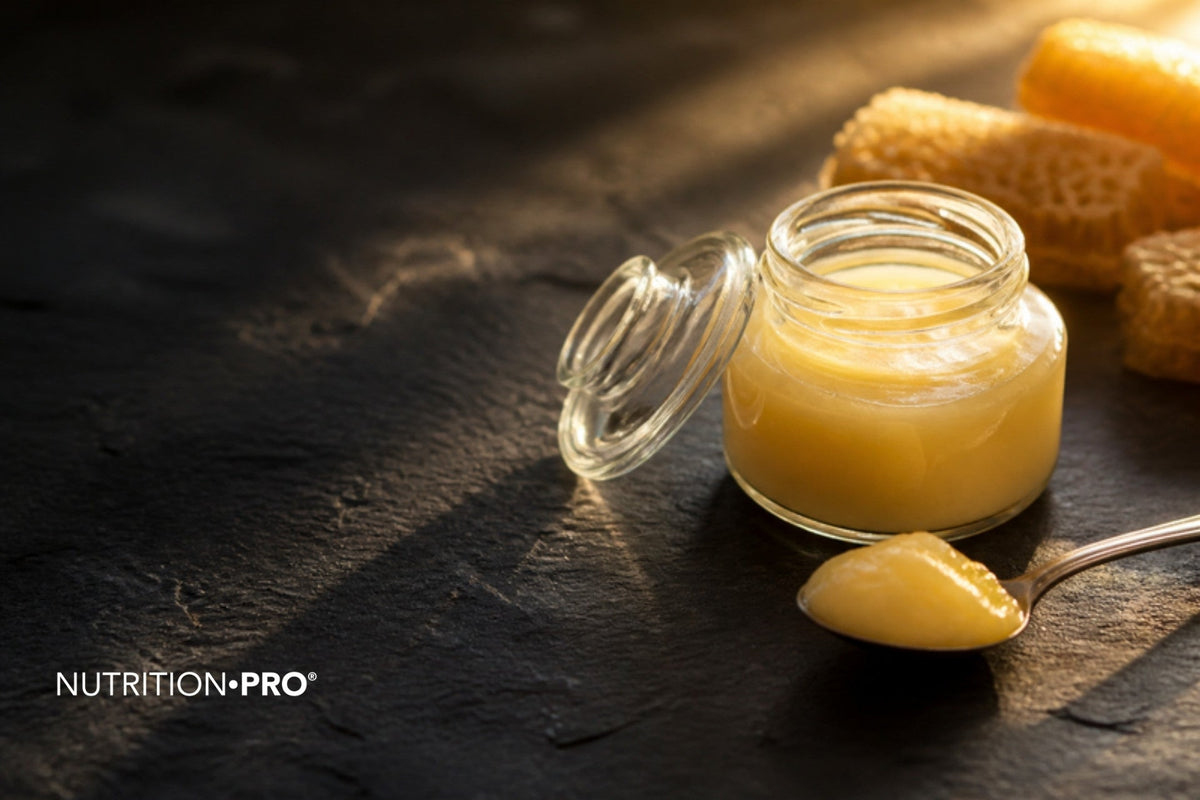
Three grams of royal jelly per day for six months: this is the protocol followed by 31 Japanese adults aged 42 to 83 years in a placebo-controlled trial. In the end, their mental health score had gained 4 points while the placebo group's had lost 7, but their vitality score had not evolved differently. This dual finding summarizes what research knows about royal jelly in the face of fatigue.
This guide brings together trials identified via PubMed on fatigue, vitality, strength in older adults, athlete performance, mood and sleep, with for each one the form of royal jelly, dose, duration and exact result, including when it is null. Animal data are treated separately.

In humans : in good health, no controlled trial has shown an effect of royal jelly on fatigue or vitality distinct from placebo; six months at 3 g per day did however improve a mental health score. In 194 nursing home residents, one year of enzyme-treated royal jelly at most slowed the decline in grip strength. After a stroke, fatigue did not differ from placebo, and in athletes, performance improved with a mixture containing coenzyme Q10 and, in one trial, with freeze-dried royal jelly alone.
Form and precautions : each trial tested a precise form, and in humans, athletic performance was only studied in three small trials. Royal jelly can trigger asthma and severe allergic reactions. Fatigue that lasts should first be discussed with a doctor: sleep disorders, depression and stress are its most frequent causes, and iron, vitamin D or ginseng have measured effects in certain profiles.
- Fatigue, energy, vitality: what do the studies say?
- Where does the energizing reputation of royal jelly come from
- Healthy adults: vitality, mood and fatigue
- After 70 years: muscle strength and autonomy
- Athletes: endurance and recovery
- Fatigue linked to illness
- Mood, stress and sleep
- What animal and cellular studies show
- Fresh, freeze-dried or treated: form matters
- Other approaches studied against fatigue
- Allergy, asthma and warning signs
- In practice: taking stock in four steps
- Frequently Asked Questions
Fatigue, energy, vitality: what do the studies measure?
Fatigue is the primary or secondary reason for 10 to 20% of consultations in general medicine, according to a 2021 review. When it persists, its most common causes are sleep disorders, including respiratory ones, depression, and excessive psychosocial stress. A systematic review of 26 primary care studies clarifies the proportions: anemia in 2.8% of cases, serious organic disease in 4.3%, and depression in 18.5%. Absent any clinical clues, attention should focus on mood and psychosocial difficulties rather than a battery of tests.
To measure fatigue, trials on royal jelly use questionnaires: theFatigue Severity Scale, with 9 questions, theChalder Scale, with 14 questions, or the vitality subscale of the SF-36 quality of life questionnaire, scored from 0 to 100.
Fatigue often improves on its own or under placebo: in a trial of fatigued women, the fatigue score decreased by 28.8% under placebo. Only a placebo group allows an effect to be attributed to the tested product.
Where royal jelly's energizing reputation comes from
Secreted by young worker bees, royal jelly nourishes all larvae for three days, then only the queen for her entire life. A 2019 review recalls the contrast that forged its reputation: the queen can lay up to 3,000 eggs per day and live up to five years, while a worker bee lives only 45 days at most.
Its lipids, which represent 7 to 18% of its composition, are 90% short and rare fatty acids, including 10-hydroxy-2-decenoic acid, often called 10-HDA. Its most abundant vitamin is pantothenic acid, vitamin B5, with 52.8 mg per 100 g. Our complete royal jelly guide details this composition.
In laboratory mice, royal jelly added to the diet increased average survival from 88 weeks to 112 weeks at approximately 6 mg per kilogram and to 110 weeks at approximately 60 mg per kilogram, or about 25% more, without extending maximum lifespan; the lowest dose had no such effect. The authors of the 2019 review found no studies on human lifespan: only human trials can determine if it acts on fatigue.
Healthy adults: vitality, mood and fatigue
The longest trial in healthy adults was conducted in Japan: 61 volunteers aged 42 to 83 years drank daily, for six months, 100 mL of a beverage containing 3,000 mg of royal jelly, or the same beverage without royal jelly.
In 56 analyzed participants, six months at 3,000 mg of royal jelly per day in beverage form increased the SF-36 mental health score by 4 points, compared to a decrease of 7 points under placebo. Red blood cells increased by 0.16 million per µL, compared to −0.01 under placebo. Of the eight dimensions of the SF-36, only mental health evolved differently between groups: vitality showed no significant difference.
Morita H, Ikeda T, Kajita K, et al. Nutr J 2012;11:77. DOI: 10.1186/1475-2891-11-77
Three participants receiving royal jelly and five receiving placebo discontinued the beverage due to bloating, diarrhea, or unpleasant taste, with no difference in adverse effects between groups. The beverage was prepared by a bee product manufacturer.
A second trial, published in 2023, gave 90 healthy adults 1,200 mg per day of royal jelly treated with proteases, enzymes that fragment its proteins, or placebo, for four weeks. The primary endpoint, the number of blood stem cells, did not differ between groups (p = 0.103), except in an analysis excluding participants with colds. Fatigue, measured by the Chalder scale, decreased in both groups, with no difference between them, and sleep quality improved equally under placebo. The authors are, for the most part, employed by a royal jelly producer.
These two trials therefore do not support the claim that royal jelly reduces fatigue in healthy adults; the first suggests an effect on psychological well-being, a signal that warrants confirmation.
After age 70: muscle strength and autonomy
With age, fatigue often becomes confused with loss of strength. A Chinese trial conducted in multiple nursing homes gave 194 residents with an average age of 78.5 years placebo, 1.2 g, or 4.8 g per day of royal jelly treated with proteases, in 400 mg tablets. Individuals with allergies or asthma had been excluded.
In 163 residents analyzed, grip strength changed by −0.98 kg under placebo, by +0.50 kg at 1.2 g per day, and by +1.03 kg at 4.8 g per day: the overall difference was not significant (p = 0.06), but the dose-response trend was (p = 0.02). No effect was observed on six-minute walking, the timed up-and-go test, or single-leg balance.
Meng G, Wang H, Pei Y, et al. Sci Rep 2017;7(1):11416. DOI: 10.1038/s41598-017-11415-6
The authors conclude that this royal jelly could slow the decline in strength rather than improve it, with no benefit on physical performance. No adverse effects related to the product were reported; two authors belong to the research institute of a royal jelly producer. A 2020 review of bee products and muscle loss emphasizes the scarcity of human trials and notes from this trial the absence of effect on strength and physical performance after age 70.
Athletes: endurance and recovery
A team of Russian and Italian researchers tested in athletes a daily mixture of 400 mg of fresh native royal jelly, 60 mg of coenzyme Q10, and 10 g of honey, taken sublingually in the morning, one hour before training, for ten days. The placebo contained honey alone.
In 20 elite swimmers, the performance score on 4 × 50 m swum at maximum speed increased from 594.6 to 623.1 points with the blend, compared to 588.2 to 588.6 points under placebo (p = 0.013). The post-effort increase in lipid oxidation markers and creatine kinase, a marker of muscle damage, was lower with the blend.
Ovchinnikov AN, Paoli A, Seleznev VV, Deryugina AV. J Int Soc Sports Nutr 2022;19(1):239-257. DOI: 10.1080/15502783.2022.2086015
In 30 regional-level runners, the same blend reduced average time over three 100 m sprints from 11.14 to 11.05 seconds, compared to 11.13 to 11.14 seconds under placebo (p = 0.005), with blood lactate after effort of 14.13 mmol/L versus 16.62 mmol/L. No adverse effects were reported.
Royal jelly was never tested alone in these trials: it is impossible to separate its contribution from that of coenzyme Q10. Sample sizes are small, and the same team reports a previous trial in runners where performance improvement was not significant.
An Iranian crossover trial, published in 2025, tested royal jelly alone: in 18 men trained in endurance, 1,000 mg per day of freeze-dried royal jelly in capsules for two weeks prolonged running time to exhaustion by 4.6 minutes more than placebo (p = 0.002), with no effect on perceived exertion or most oxidative stress markers.
Each participant, with an average age of 27 years, took for two weeks two capsules of 500 mg of freeze-dried royal jelly per day, before breakfast and dinner, and for two other weeks a placebo based on cornmeal, in randomly determined order with a two-week washout between the two periods. While running on a treadmill at 80% of their maximum aerobic speed, participants lasted 7.3 minutes longer under royal jelly and 2.7 minutes longer under placebo, a difference of 4.6 minutes. Heart rate and pleasure experienced during exercise also did not differ, and no adverse effects were reported.
Pasdar Y, Tadibi V, Sadeghi E, et al. Food Sci Nutr 2025;13(7):e70497. DOI: 10.1002/fsn3.70497
This is a unique, short-term trial conducted in only 18 men: an encouraging signal for royal jelly alone, which warrants confirmation in larger populations and in other athletes.
Fatigue related to illness
In people with illness, two controlled trials measured fatigue: one after a stroke, the other in multiple sclerosis.
In 64 patients aged 45 to 80 years after ischemic stroke, one tablet daily equivalent to 1,000 mg of fresh royal jelly for 12 weeks improved cognitive score (+4.71 points), stress and appetite, but not fatigue: the difference of −4.32 points was not significant (95% confidence interval −10.28 to 1.63). Depression and anxiety also did not differ from placebo.
Karimi E, Arab A, Sepidarkish M, et al. Front Nutr 2024;10:1227414. DOI: 10.3389/fnut.2023.1227414
In multiple sclerosis, 61 patients received 500 mg of royal jelly daily for 45 days, or placebo. The abstract reports improvements in "certain parameters" of fatigue and quality of life, without specifying which ones, their magnitude or the difference from placebo; the full text is not freely accessible.
In a chronic illness, fatigue is first and foremost the responsibility of the healthcare team: no supplement replaces its management, and any product, royal jelly included, should be discussed with the doctor following your care.
Mood, stress and sleep
In 42 postmenopausal Japanese women, 800 mg daily of freeze-dried royal jelly powder treated with enzymes reduced anxiety score (p = 0.046) and lower back pain (p = 0.040) after 12 weeks, with no difference at 4 weeks; the authors are mostly employed by a producer. In 200 postmenopausal women, 1,000 mg daily in capsules for eight weeks significantly lowered menopause symptom scores, with the decrease under placebo not being significant; the abstract does not directly compare the groups. In 110 female students, 1,000 mg daily for two cycles reduced premenstrual syndrome score from 23.17 to 11.42, compared to 21.48 to 20.27 under placebo.
For sleep, the only controlled trial we identified is the 2023 one in healthy adults: sleep quality improved equally under placebo and royal jelly. We found no trial in humans showing a distinct effect on sleep.
In mice, royal jelly and an extract of its fatty acids reduced depressive-like behaviors induced by chronic stress, in a study conducted by researchers from a beehive product manufacturer. Another study qualifies these findings: 10-HDA injected protected mice from stress, but royal jelly given orally proved less effective than when injected.
Nearly one in five cases of fatigue seen in general practice is linked to depression. Lasting sadness, loss of interest, or persistent sleep disorders warrant medical management, not a supplement.
What animal and cell studies show
The image of royal jelly as "anti-fatigue" owes much to a 2001 study in mice, conducted by researchers from an industrial company.
In mice subjected to forced swimming, cold-preserved royal jelly increased swimming time until exhaustion compared to a control food, with less lactate and ammonia in the blood and less decrease in muscle glycogen. Royal jelly stored for seven days at 40°C did not have this effect, although its vitamins and 10-HDA were intact: only a 57 kDa protein, a marker of freshness, had been degraded.
Kamakura M, Mitani N, Fukuda T, Fukushima M. J Nutr Sci Vitaminol (Tokyo) 2001;47(6):394-401. DOI: 10.3177/jnsv.47.394
In trained mice, three weeks of royal jelly at 1 g per kilogram allowed training to increase two mitochondrial enzymes in an endurance muscle, which it did not do without it. In aged mice, royal jelly attenuated the decline in muscle mass and strength; in others, given throughout life, it delayed motor decline without extending lifespan; after nerve section, it preserved fiber size but not muscle weight. At least two of these studies involve a royal jelly producer.
| Model | Preparation | Result |
|---|---|---|
| Mice, forced swimming, 2001 | Jelly frozen at harvest, versus jelly stored 7 days at 40°C | Increased endurance with the first only |
| Trained mice, 2018 | 1.0 mg per gram of body weight, 3 weeks | Increased mitochondrial enzymes in one muscle |
| Aged mice, 2013 | Native or enzyme-treated | Reduced loss of mass and strength |
| Genetically varied mice, 2018 | Lifetime, treated or untreated | Delayed motor decline, unchanged lifespan |
| Mice after nerve section, 2020 | Enzyme-treated, daily | Muscle fiber size preserved |
| Muscle cells, 2013 and 2020 | Treated gel, fatty acids | Altered multiplication and differentiation |
The dose of 1 g per kilogram given to trained mice far exceeds human trial doses, ranging from 0.4 to 4.8 g per day total: these studies indicate possible mechanisms, not an expected effect in you.
Fresh, lyophilized or treated: form matters
Human trials used very different preparations, summarized below with the level of evidence as we assess it.
| Trial | Form, dose and duration | Result on fatigue or energy | Level of evidence |
|---|---|---|---|
| 61 healthy adults, 2012 | Beverage, 3,000 mg per day, 6 months | Mental health +4 versus −7; vitality with no difference | Low |
| 90 healthy adults, 2023 | Tablets treated with proteases, 1,200 mg per day, 4 weeks | Fatigue and sleep with no difference from placebo | Low |
| 194 elderly residents, 2017 | Tablets treated with proteases, 1.2 or 4.8 g per day, 1 year | Trend in strength; performance unchanged | Moderate |
| 20 swimmers and 30 runners, 2022 | Fresh jelly 400 mg with coenzyme Q10, 10 days | Improved performance, placebo unchanged | Weak, mixed |
| 18 endurance athletes, 2025 | Freeze-dried capsules, 1,000 mg per day, 2 weeks | Endurance +4.6 min vs placebo | Weak |
| 64 patients after a stroke, 2024 | Tablet equivalent to 1,000 mg fresh jelly, 12 weeks | Fatigue: no significant difference | Weak |
| 61 patients, multiple sclerosis, 2025 | 500 mg per day, 45 days | Some parameters improved, without details | Very weak |
| 42 menopausal women, 2018 | Treated freeze-dried powder, 800 mg per day, 12 weeks | Anxiety reduced at 12 weeks, not at 4 | Weak |
Analysis studies clarify what distinguishes these forms, without ranking them. The freeze-drying preserves the chemical profile, 10-HDA and antibacterial activity of royal jelly, according to researchers from a hive products company. The fresh jelly is heat-sensitive: at 40 °C, its main protein degrades by 37.3% in 7 days and by 73.1% in 49 days, hence the importance of cold storage. The enzyme treatment reduces binding to allergy antibodies, with three out of four sensitized individuals showing no reaction to the skin test, and increases in 12 volunteers the fatty acid metabolites found in the blood; these two studies involve treated royal jelly producers.
Our Organic Royal Jelly belongs to the fresh royal jelly family: not freeze-dried and untransformed, from organic farming, produced in France, certified French Royal Jelly for controlled origin and traceability, harvested without overproduction and kept refrigerated, between 2 and 6 °C. None of the trials presented here used it: we attribute none of their results to it and do not relate it to any of their doses.
Other approaches studied against fatigue
Iron, when reserves are low. In 198 women aged 18 to 53 who were fatigued, without anemia but with ferritin below 50 µg/L, 80 mg of elemental iron per day for 12 weeks reduced the fatigue score by 47.7%, versus 28.8% under placebo, with no effect on quality of life, depression or anxiety.
Vitamin D, in case of deficiency. In 120 adults averaging 29 years old, fatigued and with blood levels below 20 µg/L, a single dose of 100,000 units reduced the fatigue score by 3.3 points, versus 0.8 under placebo; 72% reported improvement, versus 50%.
Ginseng. A meta-analysis of 12 trials found a small effect on fatigue (effect size of 0.34 across four trials), no effect on physical performance, and judged the evidence insufficient. In 90 people suffering from unexplained chronic fatigue, 1 or 2 g per day of an ethanolic extract of Panax ginseng for four weeks did not reduce overall fatigue scores more than placebo, but did improve mental fatigue. A more recent meta-analysis of 19 trials found no significant overall effect (−0.36), but an effect on general fatigue (−0.48), with no more adverse effects than placebo.

Our Red Ginseng provides 200 mg of root extract per day: a formulation different from the ethanolic extract used in the Korean trial, at 1 or 2 g per day, with which it cannot be compared. It is reserved for adults and not recommended during pregnancy, breastfeeding, or with antidiabetic treatment; if taking medication, please seek medical advice. See our article on ginseng and fatigue.
Physical activity and psychological support. The general medicine review cited above recommends discussing, regardless of the cause, an adapted exercise program and a psychoeducational or psychotherapeutic approach.
Allergy, asthma and warning signs
The main known risk of royal jelly is allergic. An Australian case series from 1996 describes seven people who experienced an asthma attack, sometimes with anaphylaxis, after ingesting it; these were true allergies. In 75 people allergic to other substances, 52% had antibodies reacting to royal jelly, of unknown clinical significance.
In Hong Kong, a survey of 1,472 hospital employees showed that 31.3% had previously consumed royal jelly; nine had experienced a total of 14 reactions, ranging from hives to asthma attacks. Skin testing was positive in 7.3% of 300 asthmatic patients, and almost all positive individuals had an allergic predisposition. In China, a 56-year-old woman experienced two anaphylactic reactions within a month, each time less than an hour after ingestion. In Japan, among 30 patients with atopic dermatitis who had never consumed royal jelly, 10 already had antibodies against it, and cross-reactions were demonstrated with dust mites, crab, cockroach, and bee venom.
Our Organic Royal Jelly is therefore not recommended for people allergic to hive products, a precaution that also applies to our Organic Propolis. During pregnancy or breastfeeding, please consult a healthcare professional. Our article on dangers and side effects of royal jelly details all the risks and published cases.
Emergency : breathing difficulty, wheezing, swelling of the face or throat, extensive hives or discomfort after taking royal jelly. Without delay : fatigue persisting for several weeks without explanation, or accompanied by weight loss, fever, night sweats, shortness of breath, snoring with breathing pauses, or persistent sadness. Before starting : in case of asthma, atopic eczema, known allergy, chronic illness, current medical treatment, pregnancy or breastfeeding.
In practice: assess your situation in four steps
This plan, not tested as such, organizes the lessons from the cited studies and some practical advice for a healthy adult without allergy to hive products.
Fresh, non-freeze-dried and unprocessed royal jelly, from organic farming and produced in France. Certified French Royal Jelly for controlled origin and traceability, harvested without overproduction, it keeps fresh between 2 and 6 °C and is enjoyed in the morning, under the tongue, with its measuring spoon included in the 10 g jar.
View the organic royal jellyOur complete royal jelly guide details its composition, 10-HDA and the French Royal Jelly label.
Frequently asked questions
Is royal jelly effective against fatigue?
In healthy adults, the two controlled trials that measured fatigue or vitality found no difference with placebo. After a stroke, fatigue did not differ from placebo. Evidence remains weak.
Does royal jelly give energy?
No trial showed reduced fatigue in healthy adults. In 18 endurance athletes, 1,000 mg daily of freeze-dried royal jelly for two weeks extended running time to exhaustion compared to placebo. In 20 swimmers and 30 runners, a mixture with coenzyme Q10 improved performance, without being able to isolate royal jelly's contribution.
What are the effects of royal jelly on mood?
After six months at 3 g daily, a mental health score gained 4 points, versus a loss of 7 under placebo, and 800 mg daily reduced anxiety in menopausal women after 12 weeks. After a stroke, depression and anxiety did not differ from placebo.
How long does it take to take royal jelly to see an effect?
Trials lasted from 10 days to one year, most often 4 to 12 weeks, and the effect on anxiety observed in menopausal women appeared at 12 weeks, not 4. Recording your fatigue each week and assessing after 4 then 12 weeks allows for an honest evaluation.
What dose of royal jelly was used in the studies?
From 400 mg daily of fresh royal jelly, combined with coenzyme Q10, in athletes to 3 g daily in beverage form in healthy adults, and up to 4.8 g daily of enzyme-treated royal jelly in elderly people; one trial in endurance athletes used 1,000 mg daily of freeze-dried royal jelly. Since the forms differ, these doses are not interchangeable.
Fresh or freeze-dried royal jelly: which was studied?
Both, as well as forms in beverage, capsule or enzyme-treated: fresh jelly in athletes, combined with coenzyme Q10, freeze-dried powder alone in endurance athletes, enzyme-treated freeze-dried powder in menopausal women. Freeze-drying preserves the chemical profile of royal jelly, and fresh jelly keeps refrigerated.
Does royal jelly help maintain strength after age 70?
In a one-year trial in 194 nursing home residents, enzyme-treated royal jelly at most slowed the decline in grip strength, with a dose-dependent trend, without improving walking or balance.
Does royal jelly improve sleep?
The only controlled trial identified, in 90 healthy adults for four weeks, showed no difference: sleep quality improved equally under placebo and under royal jelly.
What are the side effects of royal jelly?
The main risk is allergic, with asthma attacks and anaphylactic reactions described, especially in allergic individuals. In trials, a few participants reported bloating, diarrhea or unpleasant taste, with no difference from placebo. It is not recommended in case of allergy to hive products.
What causes of fatigue should be ruled out before taking a supplement?
Sleep disorders, depression and stress are the most common causes of persistent fatigue; anemia or another organic disease explains fewer than 5%.
Sources
The studies cited below were identified via PubMed.
- Morita H, Ikeda T, Kajita K, et al. Effect of six months of royal jelly consumption in healthy volunteers. Nutrition Journal, 2012;11:77. DOI
- Okamoto H, Ohkuma A, Kawaguchi M, et al. Royal jelly increases blood hematopoietic stem cells: a randomized placebo-controlled trial in healthy subjects. Evidence-Based Complementary and Alternative Medicine, 2023;2023:7665515. DOI
- Meng G, Wang H, Pei Y, et al. Protease-treated royal jelly and muscle strength in elderly nursing home residents: a randomized dose-response placebo-controlled trial. Scientific Reports, 2017;7(1):11416. DOI
- Karimi E, Arab A, Sepidarkish M, et al. Effects of royal jelly consumption on complications of ischemic stroke: results from a randomized controlled trial. Frontiers in Nutrition, 2024;10:1227414. DOI
- Ovchinnikov AN, Paoli A, Seleznev VV, Deryugina AV. Royal jelly and coenzyme Q10: performance in intense intermittent exercise and oxidative stress markers in swimmers, a randomized pilot trial. Journal of the International Society of Sports Nutrition, 2022;19(1):239-257. DOI
- Ovchinnikov AN, Deryugina AV, Paoli A. Royal jelly and coenzyme Q10: performance in intense intermittent exercise, cardiac regulation and lactate in runners. Frontiers in Nutrition, 2022;9:893515. DOI
- Pasdar Y, Tadibi V, Sadeghi E, et al. Royal jelly supplementation improves endurance and mitochondrial biogenesis in athletes: a crossover trial. Food Science and Nutrition, 2025;13(7):e70497. DOI
- Stadje R, Dornieden K, Baum E, et al. The differential diagnosis of fatigue: a systematic review. BMC Family Practice, 2016;17(1):147. DOI
- Hata T, Furusawa-Horie T, Arai Y, et al. Studies of royal jelly and cross-reactive allergens in patients with atopic dermatitis. PLoS One, 2020;15(6):e0233707. DOI
- Maisel P, Baum E, Donner-Banzhoff N. Fatigue as the chief complaint: epidemiology, causes, diagnosis and treatment. Deutsches Ärzteblatt International, 2021;118(33-34):566-576. DOI
- Vaucher P, Druais PL, Waldvogel S, Favrat B. Effect of iron supplementation on fatigue in non-anemic menstruating women with low ferritin: a randomized controlled trial. Canadian Medical Association Journal, 2012;184(11):1247-1254. DOI
- Kunugi H, Mohammed Ali A. Royal jelly and its components promote healthy aging and longevity: from animal models to humans. International Journal of Molecular Sciences, 2019;20(19):4662. DOI
- Inoue S, Koya-Miyata S, Ushio S, et al. Royal jelly prolongs the lifespan of C3H/HeJ mice: correlation with reduced DNA damage. Experimental Gerontology, 2003;38(9):965-969. DOI
- Ali AM, Kunugi H. Apitherapy and age-related muscle dysfunction (sarcopenia): review of the effects of royal jelly, propolis and pollen. Foods, 2020;9(10):1362. DOI
- Eslamifar Z, Manucheri F, Ghanbari S, et al. Royal jelly, oxidative stress and physical activities in multiple sclerosis: a randomized double-blind placebo-controlled trial. Irish Journal of Medical Science, 2025;194(6):2307-2318. DOI
- Asama T, Matsuzaki H, Fukushima S, et al. Royal jelly improves menopausal symptoms, including back pain and anxiety, in Japanese postmenopausal women. Evidence-Based Complementary and Alternative Medicine, 2018;2018:4868412. DOI
- Sharif SN, Darsareh F. Effect of royal jelly on menopausal symptoms: a randomized placebo-controlled clinical trial. Complementary Therapies in Clinical Practice, 2019;37:47-50. DOI
- Taavoni S, Barkhordari F, Goushegir A, Haghani H. Effect of royal jelly on premenstrual syndrome in Iranian female students: a triple-blind randomized study. Complementary Therapies in Medicine, 2014;22(4):601-606. DOI
- Iegaki N, Narita Y, Hattori N, et al. Royal jelly reduces depressive-like behavior in a murine model of chronic stress. Bioscience, Biotechnology, and Biochemistry, 2020;84(3):606-612. DOI
- Ito S, Nitta Y, Fukumitsu H, et al. Antidepressant-like activity of 10-HDA, a fatty acid unique to royal jelly, in a murine model of depression. Evidence-Based Complementary and Alternative Medicine, 2012;2012:139140. DOI
- Kamakura M, Mitani N, Fukuda T, Fukushima M. Antifatigue effect of fresh royal jelly in mice. Journal of Nutritional Science and Vitaminology, 2001;47(6):394-401. DOI
- Takahashi Y, Hijikata K, Seike K, et al. Effects of royal jelly administration on mitochondrial adaptations of skeletal muscle induced by endurance training. Nutrients, 2018;10(11):1735. DOI
- Niu K, Guo H, Guo Y, et al. Royal jelly prevents progression of sarcopenia in aged mice, in vivo and in vitro. The Journals of Gerontology. Series A, Biological Sciences and Medical Sciences, 2013;68(12):1482-1492. DOI
- Okumura N, Toda T, Ozawa Y, et al. Royal jelly delays impairment of motor functions during aging in genetically heterogeneous male mice. Nutrients, 2018;10(9):1191. DOI
- Shirakawa T, Miyawaki A, Matsubara T, et al. Daily oral administration of protease-treated royal jelly protects against denervation-induced muscle atrophy. Nutrients, 2020;12(10):3089. DOI
- Nascimento AP, Moraes LA, Ferreira NU, et al. Lyophilization preserves the chemical and biological characteristics of royal jelly. Evidence-Based Complementary and Alternative Medicine, 2015;2015:825068. DOI
- Shen LR, Wang YR, Zhai L, et al. Freshness of royal jelly determined by ELISA with an antibody specific to MRJP1 protein. Journal of Zhejiang University. Science. B, 2015;16(2):155-166. DOI
- Moriyama T, Yanagihara M, Yano E, et al. Hypoallergenicity and immunological characterization of enzyme-treated royal jelly. Bioscience, Biotechnology, and Biochemistry, 2013;77(4):789-795. DOI
- Yamaga M, Tani H, Yamaki A, et al. Metabolism and pharmacokinetics of medium-chain fatty acids from royal jelly in healthy subjects. RSC Advances, 2019;9(27):15392-15401. DOI
- Nowak A, Boesch L, Andres E, et al. Effect of vitamin D3 on perceived fatigue: a randomized double-blind placebo-controlled trial. Medicine, 2016;95(52):e5353. DOI
- Bach HV, Kim J, Myung SK, Cho YA. Efficacy of ginseng supplements on fatigue and physical performance: meta-analysis. Journal of Korean Medical Science, 2016;31(12):1879-1886. DOI
- Kim HG, Cho JH, Yoo SR, et al. Antifatigue effects of Panax ginseng C.A. Meyer: a randomized, double-blind, placebo-controlled trial. PLoS One, 2013;8(4):e61271. DOI
- Li X, Yang M, Zhang YL, et al. Ginseng and ginseng-based formulas for symptomatic management of fatigue: systematic review and meta-analysis. Journal of Integrative and Complementary Medicine, 2023;29(8):468-482. DOI
- Thien FC, Leung R, Baldo BA, et al. Asthma and anaphylaxis induced by royal jelly. Clinical and Experimental Allergy, 1996;26(2):216-222. DOI
- Li JD, Cui L, Xu YY, Guan K. A case of anaphylaxis caused by royal jelly major protein 3 and its cross-reactivity with honeycomb. Journal of Asthma and Allergy, 2021;14:1555-1557. DOI


