

"Eat your carrots, they're good for your eyes!" Behind this grandmother's advice lies a scientific truth: vitamin A is one of the most important vitamins for vision. Without it, it's impossible to see well, especially in dim light.
But what exactly is the role of vitamin A for the eyes ? What happens when you don't get enough? And where can you find it? This guide provides a complete overview, without exaggerating its benefits or neglecting its precautions, because this powerful vitamin must be consumed in moderation.

<<<24>>> vitamin A vitamine A (retinol) contributes to the maintenance of normal vision (EFSA claim). It is essential for the production of rhodopsin, the retinal pigment that allows you to see in dim light: its first sign of deficiency is night blindness. It is found in the form of retinol in liver, eggs and dairy products, and in the form of beta-carotene (precursor) in colored vegetables (carrot, sweet potato, spinach). Warning: vitamin A is fat-soluble, it accumulates in the body and excess is toxic. Never exceed the recommended doses, and supplementation is not recommended during pregnancy without medical advice.
The role of vitamin A in vision
Vitamin A, also called retinol, bears the first letter of the alphabet because it was the first vitamin ever discovered. And it is no coincidence that its name evokes the retina : its role in vision is fundamental.
The retina, the tissue that lines the back of the eye, contains photoreceptor cells, the cones (color and detail vision) and the rods (vision in low light). These cells contain visual pigments that transform light into a nerve signal transmitted to the brain. Now, these pigments are manufactured from vitamin A.
According to PubMed, a 2020 review by Dowling published in the Journal of Comparative Physiology A recalls that the role of vitamin A as a precursor to visual pigment molecules in photoreceptors was established in the first half of the 20th century, and remains one of its best-demonstrated functions (DOI: 10.1007/s00359-020-01403-z).
Beyond the retina, vitamin A also contributes to corneal health (the transparent surface of the eye) and to tear production, which lubricate and protect the eye. This is why a deficiency can also result in dry eyes.
Vitamin A and night vision
This is the most spectacular role of vitamin A. In the rods of the retina is found a purple pigment, rhodopsin, which is extremely sensitive to light and allows us to see in dim light. Now, rhodopsin is manufactured from vitamin A.
When the light dims, the eye consumes rhodopsin to adapt to darkness. If vitamin A intake is insufficient, the eye can no longer produce enough of it: this is night blindness (or hemeralopia), a difficulty seeing in dim light or adapting to the transition from light to darkness (for example when driving at night). It is often the very first sign of vitamin A deficiency.
Signs of vitamin A deficiency
Since vitamin A is central to vision, its deficiency first manifests in the eyes.
Severe vitamin A deficiency is today rare in developed countries, where diet is varied. But globally, it remains a major public health concern. According to PubMed, a 2022 Cochrane meta-analysis by Imdad and colleagues showed that vitamin A supplementation significantly reduces the incidence of night blindness in children in at-risk regions (risk reduced by approximately two-thirds), confirming its protective role for vision (DOI: 10.1002/14651858.CD008524.pub4).
Foods rich in vitamin A
To meet your needs, you need to know the two forms of vitamin A present in food.
Retinol (preformed vitamin A, of animal origin)
It is vitamin A directly usable by the body. Main sources: the liver (the richest source), the egg yolk, the butter and dairy products, the fatty fish (and the famous cod liver oil).
Beta-carotene (precursor, of plant origin)
It is a pigment from the family of carotenoids that the body converts to vitamin A according to its needs. It is found in colored vegetables: carrot, sweet potato, pumpkin, bell pepper, spinach, apricot, mango, melon. Advantage: beta-carotene does not pose a risk of overdosage, as the conversion is regulated.
A varied diet combining both sources normally covers requirements. Carrot is therefore not a myth: its richness in beta-carotene makes it a true ally for vitamin A intake. To support vision beyond vitamin A, other nutrients matter: vitamin C and zinc (which also contributes to maintaining normal vision), or a complete eye complex such as Visioptine (lutein, zeaxanthin, zinc).
Ointment or supplement: what's the difference?
Many searches for "vitamin A eyes" mix two very different things, let's clarify.
The ophthalmic ointment (or eye drops) with vitamin A is a product applied directly to the eye. It acts on the surface to protect and lubricate the cornea and relieve eye irritation or dryness. It is a local device, to be used according to the guidance of a pharmacist or doctor.
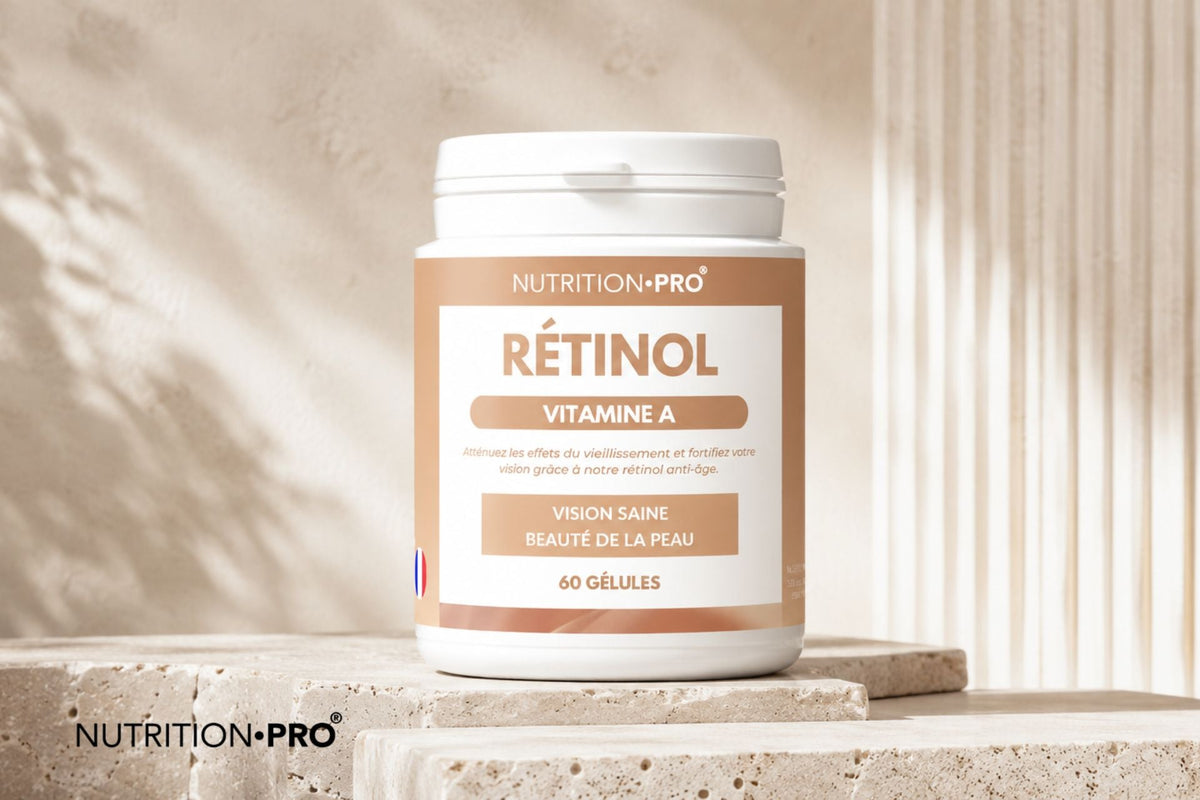
The dietary supplement of vitamin A (such as retinol in capsules) is taken orally. It provides vitamin A to the entire body through digestion, to contribute to sufficient nutritional intake, useful for the functioning of the retina, skin, immune system. The two are not opposed: they meet different needs (eye surface vs. overall nutritional intake).
Requirements, supplementation and precautions
Vitamin A is precious, but it is also the one where caution is most necessary, as it behaves differently from water-soluble vitamins.
The requirements for an adult are approximately 650 to 750 µg of retinol equivalent per day (slightly more in men than in women). A varied diet generally covers these needs, which explains why deficiency is rare in developed countries.
Caution with vitamin A. Unlike water-soluble vitamins (C, B) whose excess is eliminated in urine, vitamin A is fat-soluble : it is stored in the liver and an excess is toxic (headaches, liver damage, long-term bone disorders). Most importantly, excess vitamin A is teratogenic : supplementation is not recommended during pregnancy without medical advice. Never exceed the recommended dose and do not combine multiple sources.
Good news: beta-carotene from plants does not pose this risk, because the body only converts what it needs. This is why diet remains the first approach. Retinol supplementation may be justified in case of insufficient intake, but always at controlled doses and, if in doubt, after consulting a healthcare professional.
Frequently Asked Questions
What is vitamin A for the eyes?
Vitamin A contributes to maintaining normal vision (claim recognized by EFSA). It is essential for the production of rhodopsin, the pigment of retinal photoreceptors that enables vision in low light. It also supports corneal health and tear production. Adequate intake is therefore essential for good vision, especially night vision.
What are the signs of vitamin A deficiency for the eyes?
The first sign of vitamin A deficiency is difficulty seeing in low light, called night blindness or hemeralopia. This may be followed by dry eyes, increased sensitivity, and in cases of prolonged severe deficiency (rare in developed countries), corneal damage. Severe vitamin A deficiency remains a major cause of preventable blindness in children worldwide.
Which foods are rich in vitamin A for the eyes?
Preformed vitamin A (retinol) is found in liver, eggs, dairy products, and fatty fish. Colored vegetables (carrot, sweet potato, butternut squash, bell pepper, apricot, mango, spinach) provide beta-carotene, a precursor that the body converts to vitamin A. A varied diet combining both sources normally covers nutritional needs.
Does vitamin A improve vision?
Vitamin A is essential for proper vision function, but it does not correct a visual defect the way glasses would. Adequate intake prevents disorders related to deficiency (night blindness, dryness), without improving already normal vision or correcting myopia or presbyopia. Beyond nutritional needs, excess vitamin A is useless and potentially harmful.
Should you take a vitamin A supplement for the eyes?
In developed countries, a varied diet generally covers vitamin A requirements, and deficiency is rare. Supplementation may be justified in cases of insufficient intake or specific needs, but since vitamin A is fat-soluble, it accumulates and excess is toxic. Never exceed recommended doses, and supplementation is not recommended during pregnancy without medical advice.
Learn more
- Vitamin A (retinol)
- Fat-soluble vitamin essential for vision, skin, and immune system function. Stored in the liver.
- Rhodopsin
- Purple pigment in retinal rods, made from vitamin A, responsible for vision in low light conditions.
- Beta-carotene
- Plant pigment (carotenoid) that the body converts to vitamin A as needed, with no risk of overdose.
- Night blindness (nyctalopia)
- Difficulty seeing in dim light, the first sign of vitamin A deficiency.
- Cornea
- Transparent surface at the front of the eye, whose health partly depends on vitamin A.
- Fat-soluble
- Soluble in fats: a fat-soluble vitamin (A, D, E, K) is stored in the body, which poses a risk in case of excess.
- Dowling JE. Vitamin A: its many roles-from vision and synaptic plasticity to infant mortality. J Comp Physiol A. 2020;206(3):389-399. doi:10.1007/s00359-020-01403-z
- Imdad A, Mayo-Wilson E, Haykal MR, et al. Vitamin A supplementation for preventing morbidity and mortality in children from six months to five years of age. Cochrane Database Syst Rev. 2022;3(3):CD008524. doi:10.1002/14651858.CD008524.pub4
- EFSA Panel on Dietetic Products, Nutrition and Allergies. Authorized health claim: vitamin A contributes to the maintenance of normal vision. EFSA Journal.
- ANSES. Nutritional references for vitamin A (retinol equivalent).
About this article. Written by the Nutrition•pro team based on references from ANSES and EFSA and publications indexed on PubMed. This article is for informational purposes and does not replace medical advice. Since vitamin A is fat-soluble, never exceed the recommended dose and consult a healthcare professional if in doubt, particularly during pregnancy. Discover our editorial methodology.


