

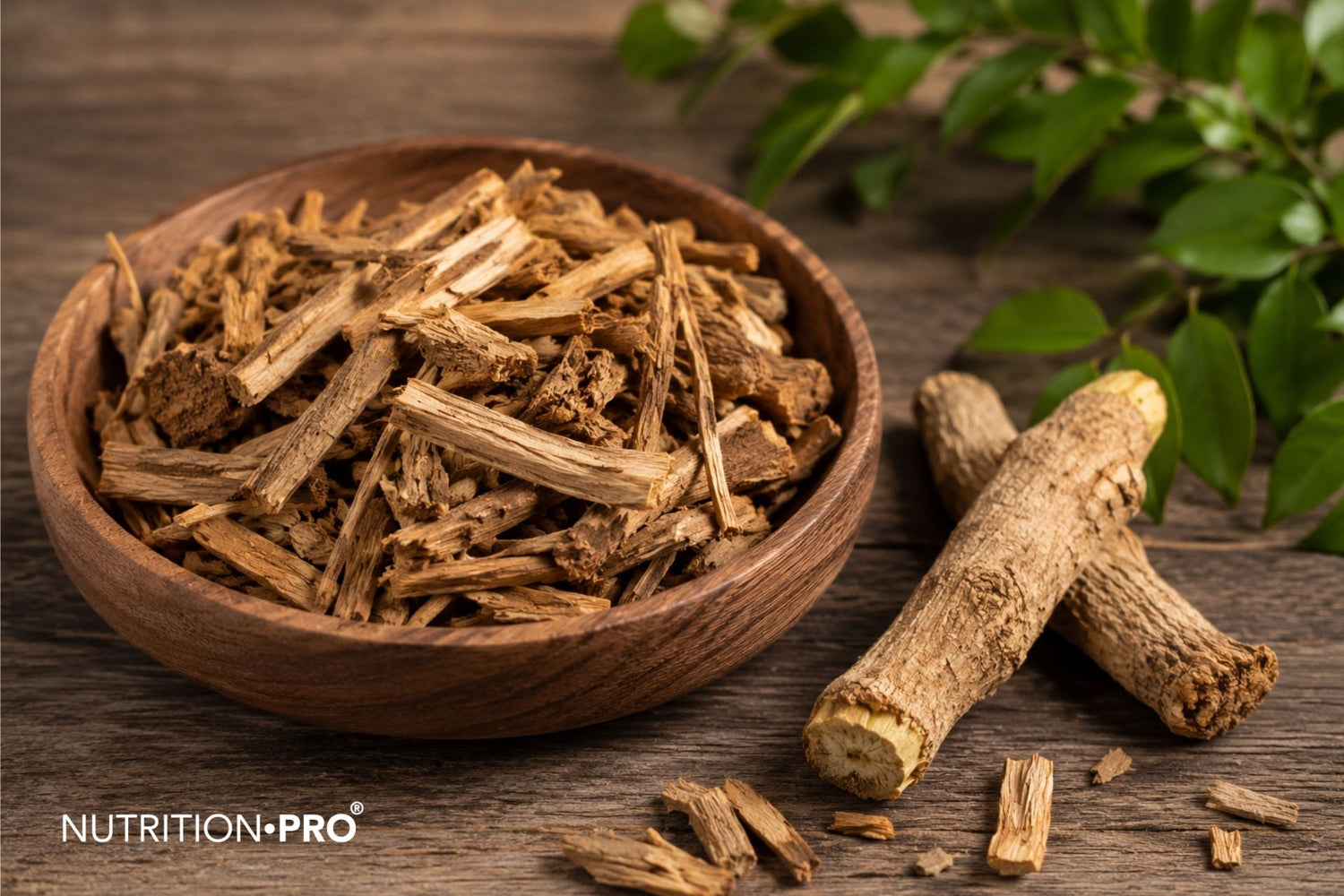
The muira puama wood is one of those plants whose reputation far precedes the evidence. Evocative nickname, spectacular promises on certain websites: difficult to separate fact from marketing. Behind this name lies a very real Amazonian plant, the muira puama, used for generations as a tonic.
So what is it really worth? Rather than relay promises, this article takes an honest look: what muira puama is, what science does (and doesn't) say about it, why it is traditionally used in combination with other plants, how to use it and precautions to know. Without exaggeration.

Muira puama (muira puama wood) is the main active ingredient at 300 mg per day, combined with tribulus, ginger and ginseng. A synergy of 4 plants to support male vitality.
The muira puama wood is the nickname for muira puama (Ptychopetalum olacoides), a tonic plant from the Amazon, authorized as a supplement in France. Let's be honest about the evidence: there is no solid clinical trial on the plant alone in humans. Available data mainly concerns preclinical work (cells, animal) and formulas combining muira puama with other plants (Ferrini, 2021; Waynberg, 2000). This is why it is traditionally used and in studies in combination, never isolated. At usual dose (approximately 300 mg per day), in a course of treatment, it is not recommended in case of pregnancy, breastfeeding, or anti-hypertensive or antidiabetic treatment.
1. Muira puama, what is it?
Native to the Amazon rainforest, muira puama has long been used by Amazonian peoples as a tonic and vitality plant. Its colorful nickname "bois bandé" (literally "stiff wood") comes from its traditional reputation in the male sphere. The wood and bark are used, which are rich in compounds such as sterols, coumarins, and alkaloids.
An important point for France: unlike certain plants in the same category, such as tongkat ali which is not authorized, muira puama is indeed authorized as a dietary supplement and sold freely, within the French and European regulatory framework.
2. Traditional reputation and misconceptions
It's difficult to discuss muira puama without mentioning its notorious reputation. The nickname itself promises a lot, and many sellers capitalize on this image to market it as a "miracle" product for male performance. It's important to distinguish what is documented traditional use from what is purely marketing.
From a traditional perspective, muira puama has indeed long been used as a general tonic and vitality plant, in both men and women. This is an ethnobotanical reality. However, promises of spectacular and immediate effects, worthy of a medication, have no solid foundation. As is often the case with plants, the truth is more modest: support, not a miracle solution.
3. What does science really say?
This is the heart of the matter, and where we distinguish ourselves from pages that oversell. The reputation of muira puama is long-standing and solid, but scientifically, the evidence is far more modest than some sellers suggest. Concretely, we have two types of data, and neither concerns the isolated plant in healthy humans.
On one hand, preclinical studies have explored mechanisms. A study on human muscle cells examined a formula combining muira puama, guarana, ginger, and L-citrulline, observing activation of the nitric oxide biological pathway (the NO-cGMP pathway), involved in circulation.
A formula combining muira puama, guarana, ginger, and L-citrulline activated the nitric oxide pathway (iNOS-NO-cGMP) in human smooth muscle cells, although clinical efficacy in humans was not demonstrated by this study.
According to PubMed, Ferrini MG et al. 2021, Translational Andrology and Urology. DOI: 10.21037/tau-21-11
On the other hand, a few observations on combinations. An old open study, without a placebo group, reported an improvement in libido in women taking a combination of muira puama and ginkgo (Waynberg & Brewer, Adv Ther, 2000), but its limited methodology calls for caution. The common thread in all this data is clear: muira puama is studied in combination, never alone. This is essential information for using it properly.
Nitric oxide pathway
Mechanism explored on cells.
A combined formula activated the NO-cGMP pathway on human cells (Ferrini, 2021). Interesting mechanism, but this is not proof of clinical efficacy.
Libido (in combination)
Old study, without placebo.
Reported improvement in libido with muira puama + ginkgo (Waynberg, 2000), but weak methodology: to be interpreted with caution.
Immediate "miracle effect"
Sales talk.
No data supports the promises of spectacular and immediate effects from muira puama alone. It is a tonic, not a medicine.
4. Why muira puama is used in synergy
If researchers and tradition almost always combine muira puama with other plants, it is no accident. The idea of plant synergy is simple: several plants with complementary profiles can work together, each contributing its own benefit, rather than relying entirely on a single ingredient with limited evidence.
This is exactly the logic of our formula Male Libido, which combines four plants traditionally linked to male vitality. Muira puama holds the central place, accompanied by three plants we know well and which have, for some, better data. Ginseng in particular is the best-studied plant in the group, with real human data on male vitality.
Muira puama (300 mg), tribulus, ginger and ginseng combined in a formula designed to support male vitality, within the French legal framework.
Discover Male Libido →5. The 4 plants in the synergy
Here is how the four plants in the formula are distributed, with their daily dose (for 3 capsules) and their role:
| Plant | Dose/day | Role in the formula |
|---|---|---|
| Muira puama | 300 mg | The central active ingredient, traditional Amazonian tonic plant |
| Ginger | 285 mg | Supports energy and overall body tone |
| Tribulus | 285 mg | Plant for masculine vigor, rich in saponins |
| Ginseng | 150 mg | Most studied for vitality and erectile function |
The value of this combined approach is clear: rather than presenting muira puama alone as a miracle solution, the formula surrounds it with complementary plants, including ginseng which provides the best level of evidence. It's more coherent, and more honest.
6. How to use and dose it
7. Precautions and contraindications
Not recommended during pregnancy and breastfeeding, as well as for people under antihypertensive or antidiabetic treatment. Taken too late in the day, muira puama can disturb sleep: prefer morning or midday.
Respect the recommended dose, do not exceed it, and keep the product out of reach of children. A supplement supports healthy lifestyle habits, it does not replace them. A persistent condition should warrant medical consultation.
To explore other vitality plants, see our collections libido and fertility and vitality and energy, as well as our article on foods that support testosterone.
Select what applies best to you: your path displays immediately. This is a guide, not medical advice.
Muira puama works best when combined with other plants. The formula Men's Libido (muira puama + tribulus + ginger + ginseng), as a course in the morning.
It's the best documented plant in the group. The red ginseng, alone or within the Men's Libido formula which contains it.
Muira puama is not recommended with blood pressure-lowering or antidiabetic treatment. Do not start a course without the advice of a healthcare professional.
Frequently Asked Questions
Is muira puama really effective?
Muira puama (bois bandé) is traditionally reputed for its tonic effects, but let's be honest: there is no solid clinical trial on the plant alone in humans. Available data mainly concern preclinical work (cells, animals) and formulas combining muira puama with other plants. This is why it is traditionally used and studied in synergy, rather than in isolation.
What is muira puama (bois bandé)?
Muira puama (Ptychopetalum olacoides) is an Amazonian shrub whose wood and bark are used. Called bois bandé, it has long been used by Amazonian peoples as a tonic and vitality plant. It is an authorized plant as a dietary supplement in France, unlike other plants in the same category.
Why is muira puama used in synergy?
Because that's how it is most studied and traditionally used. Available scientific research concerns combinations, for example muira puama combined with ginger, guarana and L-citrulline (Ferrini, 2021), or with ginkgo (Waynberg, 2000). The idea is that several complementary plants work better together than one alone.
What dose of muira puama per day?
Uses generally range around 300 to 500 mg of extract per day. In our Men's Libido formula, muira puama is dosed at 300 mg per day, combined with tribulus, ginger and ginseng. It is taken as a course, preferably in the morning or midday, and it is not recommended to take it late to avoid disturbing sleep.
Does muira puama have contraindications?
It is not recommended during pregnancy and breastfeeding, nor for people under blood pressure-lowering or antidiabetic treatment. Taken late in the day, it can disturb sleep. In case of persistent condition or treatment, seek advice from a healthcare professional before starting any course.
Is muira puama banned in France?
No. Unlike certain plants in the same category such as tongkat ali, muira puama (bois bandé) is authorized as a dietary supplement in France and is sold freely there. Supplements containing it are subject to French and European regulatory frameworks.
Muira puama and ginseng, what's the difference?
These are two different plants. Ginseng (Panax ginseng) has much more solid human data, particularly on erectile function and fatigue. Muira puama has a strong traditional reputation but more limited evidence. The two are moreover often combined, as in our Male Libido formula, to combine their profiles.
- Bois bandé
- Traditional nickname for muira puama, linked to its reputation in the male sphere.
- Muira puama
- Common name for Ptychopetalum olacoides, a tonic plant from the Amazon whose wood and bark are used.
- Plant synergy
- Combination of several plants with complementary profiles, considered more beneficial than a single plant in isolation.
- NO-cGMP pathway
- Biological mechanism involving nitric oxide, studied in relation to blood circulation.
- Preclinical study
- Research conducted on cells or animals, before any human trials, which does not prove clinical efficacy.
- Saponins
- Natural plant compounds found notably in tribulus.
Information from PubMed. The studies below focus on plant combinations or preclinical models, not on muira puama alone in humans.
- Ferrini MG, Abraham A, Graciano L, Nguyen S, Mills JN, Rajfer J. Activation of the iNOS/NO/cGMP pathway by Revactin in human corporal smooth muscle cells. Transl Androl Urol 2021;10(7):2889-2898. DOI : 10.21037/tau-21-11
- Ferrini MG, Garcia E, Abraham A, Artaza JN, Nguyen S, Rajfer J. Effect of ginger, Paullinia cupana, muira puama and l-citrulline on the iNOS-NO-cGMP pathway in rat penile smooth muscle cells. Nitric Oxide 2018;76:81-86. DOI : 10.1016/j.niox.2018.03.010
- Waynberg J, Brewer S. Effects of Herbal vX on libido and sexual activity in premenopausal and postmenopausal women. Adv Ther 2000;17(5):255-262. DOI : 10.1007/BF02853164


