

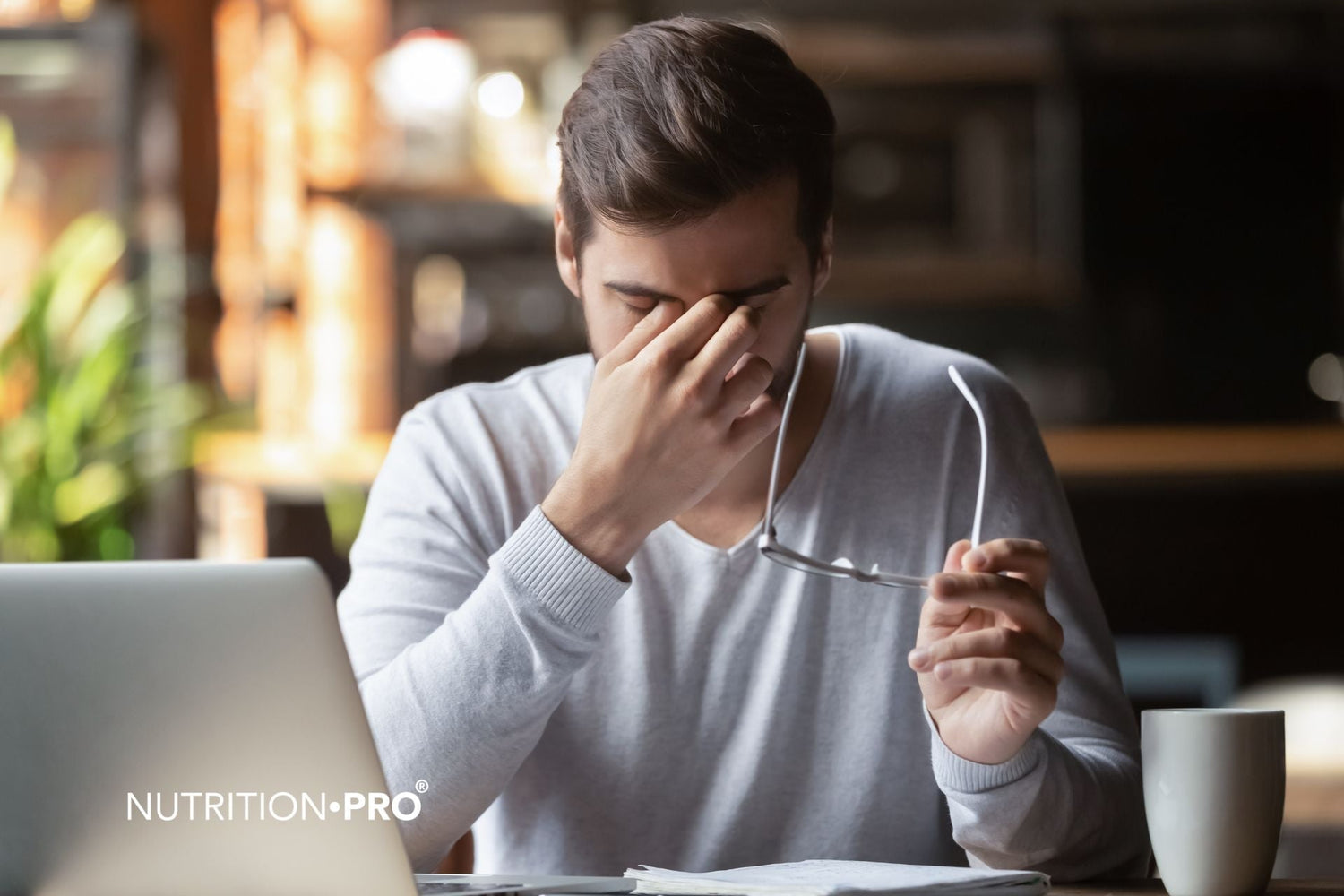
Eyes stinging at the end of the day, blurred vision in front of the screen, headaches after hours of computer work: eye strain has become the curse of the digital age. Between work, smartphones and television, our eyes focus on screens for more than 6 hours per day on average.
This guide explains where screen-related visual fatiguecomes from, how to recognize it, and most importantly how to relieve it: the right daily habits (including the famous 20-20-20 rule), the truth about blue light, and the role of eye nutrition (lutein, zeaxanthin, zinc).

<<<24>>> Eye strain fatigue oculaire (asthenopia) is temporary discomfort caused by overuse of the eyes in front of screens: near focus is continuous and blinking drops by half, which dries out the eye. Symptoms: dry eyes, stinging, blurred vision, headaches. Solutions : the 20-20-20 rule, good lighting and a well-positioned screen, breaks, and remembering to blink. On the nutrition side, lutein and zeaxanthin (present in the macula), zinc and vitamins C and E support eye health. Persistent fatigue should prompt a visit to an ophthalmologist.
What is eye strain?
Eye strain, also called visual fatigue or asthenopia, refers to all the discomfort felt when the eyes are used for too long or under poor conditions. It typically appears after a long screen session, prolonged reading, or night driving.
Important point: this is not a disease, but a functional signal. Your eyes are telling you they're working too hard. The discomfort is real but most often reversible: it eases with rest. This is also why it can be greatly improved by changing a few habits, which we'll see below.
Why screens tire your eyes
Three mechanisms combine to tire your eyes in front of a screen.
1. Sustained accommodation
To see clearly up close, the muscle that deforms the lens (accommodation) must contract and remain contracted. On a screen, this near-focus is maintained for hours without relief. Like any muscle under continuous strain, it becomes fatigued, resulting in blurred vision by day's end and difficulty refocusing on distant objects.
2. Reduced blinking
This is the most underestimated factor. Normally, we blink approximately 15 to 17 times per minute. In front of a screen, concentrated, this drops to 4 to 6 times per minute, or a frequency cut in half or by two-thirds. Now blinking spreads the tear film that protects and hydrates the eye surface. Less blinking means the eyedries out : hence the sensations of itching, burning, and dry eyes.
3. Poor conditions
Aggravating factors add up: glare, inadequate lighting, screen too close inadapté, écran poorly positioned, dry air, and especially a possible uncorrected vision problem (the eye strains to compensate, which causes additional fatigue).
Symptoms to recognize
Eye strain manifests itself through a range of signs, which vary from person to person. The most common:
These symptoms are generally benign and reversible : they ease when you rest your eyes. But if they return each day, it's a sign that you need to adjust your environment and habits, or even have your vision checked.
Good habits and the 20-20-20 rule
Good news: eye strain can be prevented and relieved with simple habits. The most well-known, recommended by ophthalmologists, is the 20-20-20 rule.
The 20-20-20 rule
The anti-fatigue reflex to adopt in front of any screen
Why it works: looking into the distance relaxes the accommodation muscle that remains contracted during near vision. It's a genuine rest for the eye. If you forget, set a reminder every 20 minutes at first, until the reflex becomes automatic.
Other essential practices to combine:
Remember to blink and hydrate
Blink deliberately and regularly to redistribute the tear film. In case of dryness, artificial tears can help, especially after several hours of screen time or when wearing contact lenses.
Position your screen properly
Screen at an arm's length distance (20 to 28 inches), with the top edge at or slightly below eye level (your gaze directed slightly downward, which partially closes the eyelid and limits tear evaporation).
Optimize lighting
Avoid glare (reposition the screen, adjust blinds), balance the screen's brightness with that of the room (neither too dazzling nor a bright screen in darkness), and adjust contrast for comfortable reading.
Take real breaks
Beyond the 20-20-20 rule, step away from the screen for a few minutes every 1 to 2 hours. Use the opportunity to move around: this also relieves tension in the neck and shoulders, often tense with visual fatigue.
Blue light: what we actually know
<<<26>>> Blue light lumière bleue is one of the most discussed and often exaggerated topics. Let's be honest and balanced, because that's what builds trust.
What is established: blue light emitted in the evening by screens disrupts the sleep-wake cycle by delaying melatonin secretion. This is its best-documented effect, and it's a good reason to reduce screen time in the evening.
More uncertain: the idea that it damages the retina. At screen intensities (well below sunlight), the link to damage is not formally established. Eye fatigue in front of a screen comes mainly from accommodation and reduced blinking, not specifically from blue light. As for blue light blocking glasses, they provide relief for some sensitive individuals, but without demonstrated widespread benefits: they do not replace good practices or proper vision correction.
Eye nutrition: lutein, zeaxanthin, zinc
Beyond gestures, <<<2>>> nutrition <<<3>>> plays a fundamental role in eye health, particularly that of the <<<4>>> macula <<<5>>> , the central area of the retina responsible for precise vision. <<<6>>> Lutein and zeaxanthin <<<7>>> These are two <<<8>>> carotenoids <<<9>>> (antioxidant pigments) naturally concentrated in the macula, where they form the macular pigment. Their physiological role: <<<10>>> filter some of the high-energy light <<<11>>> and protect retinal cells from oxidative stress. The body does not produce them: they come from diet (leafy green vegetables, corn, eggs) or from supplementation. <<<12>>> On the specific topic of screens, the data are encouraging. According to PubMed, a randomized double-blind placebo-controlled trial by Lopresti and Smith 2025, published in Frontiers in Nutrition, followed 70 heavy screen users (more than 6 hours per day) supplemented with <<<13>>> 10 mg of lutein and 2 mg of zeaxanthin <<<14>>> for 6 months. Result: compared to placebo, improvements on several objective measures of <<<15>>> dry eye <<<16>>> and visual recovery (Schirmer test, tear film break-up time, photostress recovery), even though subjective questionnaires showed no clear difference (<<<17>>> DOI: 10.3389/fnut.2025.1522302 <<<18>>> ). Promising results, to be confirmed, that justify the interest in these two carotenoids. <<<19>>> Zinc, vitamins C and E, bilberry <<<20>>> Other nutrients complement this approach, with health claims recognized by EFSA: <<<21>>> Zinc <<<22>>> contributes to the maintenance of normal vision <<<23>>> (authorized claim). It participates in the functioning of visual cells and the retina. <<<24>>> Vitamins <<<25>>> C and E contribute to protect cells against oxidative stress <<<26>>> (authorized claims), useful for tissues as exposed to light as those of the eye. <<<27>>> Bilberry <<<28>>> , rich in anthocyanins, is traditionally associated with visual comfort and microcirculation. <<<29>>> This is precisely the logic of our <<<30>>> Visioptine <<<31>>> complex, which brings together <<<32>>> lutein, zeaxanthin, bilberry, vitamins C and E and zinc <<<33>>> in a formula designed for eyes strained by screens. To combine with good habits, not to replace them. For vision and skin, <<<34>>> vitamin A (retinol) <<<35>>> also plays a role in maintaining normal vision. <<<36>>> Ocular nutrition <<<37>>> Support your eyes against screens <<<38>>> Visioptine brings together lutein, zeaxanthin, bilberry, vitamins C and E and zinc: a comprehensive complex to support your eye health daily, in addition to good habits and a diet rich in green vegetables. <<<39>>> Discover Visioptine → <<<40>>> nutrition joue un rôle de fond dans la santé des yeux, en particulier de la macula, la zone centrale de la rétine responsable de la vision précise.
La lutéine et la zéaxanthine
Ce sont deux caroténoïdes (pigments antioxydants) naturellement concentrés dans la macula, où ils forment le pigment maculaire. Leur rôle physiologique : filtrer une partie de la lumière à haute énergie et protéger les cellules de la rétine du stress oxydatif. L'organisme ne les fabrique pas : ils proviennent de l'alimentation (légumes verts à feuilles, maïs, œufs) ou d'une complémentation.
Sur le sujet précis des écrans, les données sont encourageantes. Selon PubMed, un essai randomisé en double aveugle contre placebo de Lopresti et Smith 2025, publié dans Frontiers in Nutrition, a suivi pendant 6 mois 70 gros utilisateurs d'écrans (plus de 6 heures par jour) supplémentés en 10 mg de lutéine et 2 mg de zéaxanthine. Résultat : par rapport au placebo, des améliorations sur plusieurs mesures objectives de la sécheresse oculaire et de la récupération visuelle (test de Schirmer, temps de rupture du film lacrymal, récupération au photo-stress), même si les questionnaires subjectifs n'ont pas montré de différence nette (DOI : 10.3389/fnut.2025.1522302). Des résultats prometteurs, à confirmer, qui justifient l'intérêt porté à ces deux caroténoïdes.
Le zinc, les vitamines C et E, la myrtille
D'autres nutriments complètent l'approche, avec des allégations de santé reconnues par l'EFSA :
- Le zinc contribue au maintien d'une vision normale (allégation autorisée). Il participe au fonctionnement des cellules visuelles et de la rétine.
- Les vitamines C et E contribuent à protéger les cellules contre le stress oxydatif (allégations autorisées), utile pour des tissus aussi exposés à la lumière que ceux de l'œil.
- La myrtille, riche en anthocyanines, est traditionnellement associée au confort visuel et à la microcirculation.
C'est précisément la logique de notre complexe Visioptine, qui réunit lutéine, zéaxanthine, myrtille, vitamines C et E et zinc dans une formule pensée pour les yeux sollicités par les écrans. À associer aux bons gestes, pas à leur place. Pour la vision et la peau, la vitamine A (rétinol) joue aussi un rôle dans le maintien d'une vision normale.
When to see an ophthalmologist
Eye strain is usually benign. But certain signs should prompt you to consult an ophthalmologist, who will provide the correct diagnosis.
Consult without delay if you experience: vision loss, eye pain, double vision (diplopia), appearance of light flashes, spots or a veil, significant and persistent redness, or severe headaches. These signs may indicate something other than simple eye strain.
Most importantly, remember this: a very common cause of eye strain is an uncorrected or poorly corrected vision disorder (myopia, hyperopia, astigmatism, early presbyopia) or outdated eyeglass correction. A simple, up-to-date eye exam often resolves much of the problem. Be sure to tell your eye care professional how many hours per day you spend on screens: they can adjust your correction for intermediate vision (computer distance).
Frequently asked questions
What is eye strain related to screens?
Eye strain, or asthenopia, is temporary visual discomfort that appears after intense eye use, particularly in front of screens. It is not a disease but a functional symptom: the eye muscles work continuously to focus up close, and blinking frequency drops sharply, which dries the eye surface. It manifests as dry eyes, stinging, blurred vision, and headaches.
What are the symptoms of eye strain?
The most common symptoms are: dry or stinging eyes, burning sensation, blurred or fluctuating vision at the end of the day, headaches, light sensitivity, difficulty switching from near to far vision, and sometimes neck and shoulder pain. These signs are generally temporary and ease with rest, but their repetition justifies adapting your habits.
What is the 20-20-20 rule?
The 20-20-20 rule is a simple method recommended to rest your eyes in front of a screen: every 20 minutes, look at an object about 6 meters (20 feet) away for 20 seconds. This distant gaze relaxes the muscle responsible for focusing (accommodation), which remains contracted during near work. It is one of the most effective measures against digital eye strain.
Is blue light from screens dangerous for the eyes?
Blue light from screens contributes to reduced blinking and can increase visual discomfort, but current scientific consensus is nuanced: at the levels emitted by screens, it is not formally established as a cause of eye damage. Its best-documented effect concerns sleep-wake rhythm in the evening. Blue light-blocking glasses can relieve certain sensitive individuals, without being a universal solution.
What nutrients are helpful for eyes exposed to screens?
Several nutrients support eye health: lutein and zeaxanthin, two carotenoids naturally present in the macula that filter light; zinc, which contributes to maintaining normal vision; vitamins C and E, which protect cells against oxidative stress; and anthocyanins from blueberry. A diet rich in green vegetables, supplemented if needed, helps provide these nutrients.
Learn more
- Asthenopia
- Medical term designating eye strain, the set of discomforts related to overuse of the eyes.
- Accommodation
- The eye's ability to focus, thanks to a muscle that reshapes the lens. Continuously solicited during near vision.
- Macula
- Central area of the retina responsible for sharp vision and color perception; rich in lutein and zeaxanthin.
- Lutein and zeaxanthin
- Antioxidant carotenoids concentrated in the macula, which filter part of the light and protect the retina.
- Tear film
- Thin layer of tears that protects and hydrates the eye surface; redistributed with each blink.
- Computer vision syndrome
- Set of ocular and visual symptoms related to prolonged screen use.
- Lopresti AL, Smith SJ. The effects of lutein/zeaxanthin on eye health, eye strain, sleep quality, and attention in high electronic screen users: a randomized, double-blind, placebo-controlled study. Front Nutr. 2025;12:1522302. doi:10.3389/fnut.2025.1522302
- EFSA Panel on Dietetic Products, Nutrition and Allergies. Authorized health claims relating to zinc (maintenance of normal vision) and vitamins C and E (protection of cells against oxidative stress). EFSA Journal.
- Associations of optometrists and ophthalmology. Recommendations on the 20-20-20 rule and visual ergonomics when working at a screen.
About this article. Written by the Nutrition•pro team based on ophthalmological sources, EFSA claims and a clinical trial indexed on PubMed. This article is informative and does not replace medical advice. If you experience persistent eye strain or unusual discomfort, consult an ophthalmologist. Discover our editorial methodology.


