

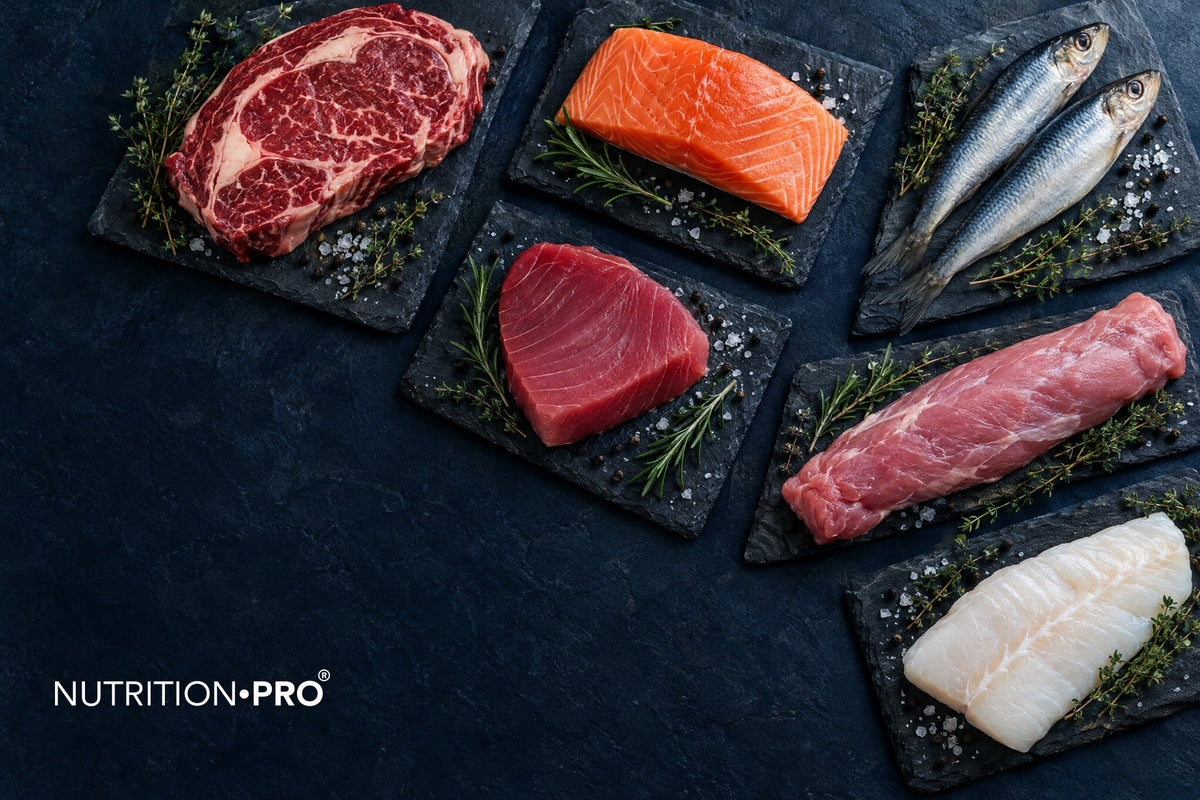
Where is creatine found in food? Almost exclusively in animal flesh, meat and fish. But in what quantity, how much would you need to eat to equal a supplement dose, what happens to it when cooked, and what occurs when you don't eat it?
This guide compiles the actual levels measured in studies, food by food, with the quantity to consume to provide 3 g of creatine. It also clarifies creatine production by the body, the effect of cooking, the case of vegetarians, what supplementation changes and what studies say about kidney health.

Where to find it : in food, creatine exists only in animal flesh. Albacore tuna ranks first in published measurements, with 645 mg per 100 g, ahead of raw beef, chicken or rabbit meat, approximately 390 mg, beef heart and sole. Liver contains ten times less than muscle, milk almost none, vegetables none at all. Cooking transforms some of it into creatinine.
How much to eat : for 3 g of creatine, you would need approximately 465 g of tuna or 765 g of raw beef daily. An omnivore consumes about 1 g per day, enough to compensate for half of their losses, with the body producing the rest; their muscles remain filled at 60 to 80%. Vegetarians, whose intake is nearly zero, have lower reserves. Supplementation of 3 to 5 g per day increases muscle reserves by 20 to 40%.
- What is creatine, and where does it come from?
- Ranking of foods richest in creatine
- How much to eat for 3 g of creatine?
- Cooking reduces creatine in food
- Milk, eggs, vegetables: very little or not at all
- Vegetarians and vegans: lower reserves
- Food or supplement: what changes
- Kidneys, creatinine, water: safety
- The plan according to your profile
- Frequently asked questions
What is creatine, and where does it come from?
<<<11>>> Creatine créatine is a small molecule stored in approximately 95% of muscle tissue, where it forms a rapid energy reserve, phosphocreatine, mobilized during brief and intense efforts. The body produces it itself, especially in the liver and kidneys, from three amino acids: arginine, glycine, and methionine.
Each day, 1 to 2% of this reserve breaks down into creatinine, eliminated in urine: approximately 2 g per day in a 70 kg man, slightly less in women and elderly people. In an omnivore, half of this loss is compensated by diet, the other half by internal production. An expensive production: it consumes approximately 40% of the methyl groups used by the body.
A 70 kg man needs approximately 2 g of creatine per day to replace his losses. An omnivorous diet can cover up to half of this, the rest being produced by the body. In adults, dietary creatine comes exclusively from animal products or supplements: vegans and infants fed soy milk receive none.
Brosnan ME, Brosnan JT. Amino Acids 2016;48(8):1785-1791. DOI : 10.1007/s00726-016-2188-1
<<<20>>> Creatine créatine is the molecule useful to muscle. Creatinine is its breakdown product, eliminated by the kidneys and measured in blood tests to assess their function. Cooking transforms part of the creatine in foods into creatinine, and supplementation slightly raises blood creatinine, without this indicating kidney damage.
The ranking of foods richest in creatine
Published measurements in scientific journals are fewer than one might think, and most often concern raw foods. Here are the verified values, per 100 g, with the amount of food needed to provide 3 g of creatine, before any cooking losses.
| Food | Creatine per 100 g | For 3 g of creatine |
|---|---|---|
| Albacore tuna | 645 mg | Approximately 465 g |
| Raw beef, chicken, rabbit | Approximately 390 mg | Approximately 765 g |
| Raw beef or salmon | 220 to 440 mg, according to a review | 680 g to 1.4 kg |
| Raw beef heart | Approximately 295 mg | Approximately 1 kg |
| Sole | 251 mg | Approximately 1.2 kg |
| Beef liver | Approximately 30 mg | Nearly 10 kg |
| Cow's milk | Approximately 8 mg per 100 mL | Approximately 38 liters |
| Plant-based foods, soy milk | 0 | Impossible |
Muscle is the richest part of the animal. In an analysis of meats and organ meats, raw beef, chicken, and rabbit meats contained approximately 30 mmol of creatine per kilo, or nearly 4 g, beef heart 22.5 mmol, and liver only 2.3 mmol, ten times less. Another study, on five cuts of beef, found the same difference between meat, heart, and tongue on one side, and liver and kidney on the other.
Between species, the differences are small: in ground steaks from nine species, the creatine and creatinine content of raw meat varied little, from 1.36 to 2% of dry matter for veal, beef, pork, lamb, horse, game, and chicken, slightly less for turkey and ostrich. Lamb contains slightly less creatine than beef, and beef cheek approximately one-third less than a thigh muscle.
As for fish, a study conducted in Hawaii measured 645 mg of creatine per 100 g of albacore tuna, and 251 mg for sole. A review estimates that one pound, or 454 g, of raw beef or salmon provides 1 to 2 g of creatine. For herring or cod, no verified values were found in the studies: we therefore do not publish a figure.
How much to eat for 3 g of creatine?
The dose studied in supplementation is 3 to 5 g of creatine per day. An expert review estimates that a 170 g portion of meat provides approximately 0.7 g. To reach 3 g through food, you would need to eat approximately 465 g of albacore tuna or 765 g of raw beef or chicken daily, and more once cooked.
Volunteers took 5 g of creatine monohydrate four to six times a day, for at least two days. A single 5 g dose, the researchers note, corresponds to the creatine contained in 1.1 kg of fresh uncooked steak. Muscle creatine increased by up to 50%, especially in those whose baseline level was low.
Harris RC, Söderlund K, Hultman E. Clin Sci (Lond) 1992;83(3):367-374. DOI: 10.1042/cs0830367
In practice, an omnivore consumes approximately 1 g per day: a Brazilian study measured 1.34 g per day in omnivores, compared to 0.03 g in vegetarians. This is enough to offset half the losses, but not to fill the muscles to maximum capacity: according to the International Society of Sports Nutrition, a diet providing 1 to 2 g per day leaves muscle reserves filled to 60 to 80% of their capacity.
Creatine monohydrate in supplements contains 87.9% creatine: 3 g of monohydrate provides approximately 2.64 g of creatine, equivalent to approximately 660 g of raw steak. To compare a food and a supplement, simply multiply the quantities in the table by 0.88.
Cooking reduces creatine in foods
The table values concern mainly raw foods. During cooking, some of the creatine transforms into creatinine, especially at higher temperatures. In a study on lamb, slow cooking for 90 minutes at 70°C significantly reduced creatine and increased creatinine fourfold. Simply dried meat retains most of its creatine, whereas meat flours obtained by prolonged cooking contain almost none.
Five cuts of beef were pan-fried for 3 minutes at 150 to 200°C. The higher the temperature, the more creatine transformed into creatinine. Above 175°C, extracts from muscle pieces became mutagenic in the laboratory, whereas those from liver and kidney, which are low in creatine, were not significantly mutagenic.
Laser Reuterswärd A, Skog K, Jägerstad M. Food Chem Toxicol 1987;25(10):755-762. DOI: 10.1016/0278-6915(87)90230-4
Creatine and creatinine are indeed precursors of heterocyclic amines, mutagenic compounds that form in meats and fish cooked at high temperatures; a study on fish fried at 199°C found the same link. One simple action limits their formation: microwaving meat for 1 to 3 minutes before pan-frying reduced these precursors by up to 30% and reduced the quantity of heterocyclic amines by 3 to 9 times.
Creatine from supplements does not pose this problem: in humans, supplementation, at low or high doses, did not increase heterocyclic amines in urine; the rare traces detected are explained by diet.
Milk, eggs, plant-based foods: very little or none at all
Pasteurized cow's milk contains approximately 0.08 g of creatine per liter: nearly 38 liters would be needed to provide 3 g. Breast milk contains approximately eight times less, and infant formula based on soy contains none. Eggs and dairy products provide only very small amounts.
Plant-based foods contain none: in adults, dietary creatine comes solely from animal products or supplements. Creatine from supplements is not of animal origin anyway: it is synthesized from sarcosine and cyanamide, without animal by-products, making it compatible with a vegetarian or vegan diet when presented in plant-based capsules.
Vegetarians and vegans: lower reserves
Nine studies compared vegetarians and omnivores. In vegetarians, creatine is approximately 50% lower in plasma, 27 to 50% lower in red blood cells, and 10 to 15% lower in thigh muscle, while the brain appears spared. In one trial, three months of a vegetarian diet reduced muscle creatine by 15%, a decline prevented by a supplement of 1 g of creatine per day.
Kaviani M, Shaw K, Chilibeck PD. Int J Environ Res Public Health 2020;17(9):3041. DOI: 10.3390/ijerph17093041
The brain, on the other hand, appears to depend on its own production: in a spectroscopy study, vegetarians and omnivores had the same brain creatine content, despite dietary intake more than 40 times lower in vegetarians.
Consequence: vegetarians respond better to supplementation. In an 8-week trial combining strength training and creatine, they started with lower muscle creatine, 117 versus 130 mmol per kilogram, and gained more muscle creatine, lean mass, and total work than non-vegetarians. For proteins, our comparison plant-based or animal proteins completes this point.
Diet or supplement: what changes
Supplementation increases muscle creatine reserves by 20 to 40%. Two methods of achieving this produce the same result: a loading phase of 20 g per day for 6 days, or 3 g per day for 28 days, with approximately 20% more muscle creatine in both cases. Upon stopping, reserves return to their baseline level in 4 to 6 weeks.
| Effect | Result | Condition |
|---|---|---|
| Muscle reserves | +20 to 40% | 3 to 5 g per day |
| Intense efforts | Improved performance of 10 to 20% | Brief and repeated efforts |
| Lean mass | +1.10 kg on average | With strength training; no effect without exercise |
| Memory | Moderate improvement | Meta-analysis of 16 trials in adults |
The difference between 1 g per day from food and 3 g per day from supplements is precisely what the trials measure. A meta-analysis of 35 trials thus finds a lean mass gain of 1.10 kg on average when creatine accompanies strength training, but nothing without exercise. Another, on 16 trials, finds a moderate effect on memory. Our guide creatine: dosage, effects and forms details these uses, and our article creatine and brain provides an overview of cognition.
Kidneys, creatinine, water: safety
Twenty randomized trials measured the effect of creatine on kidney markers. Blood creatinine increases slightly, by 0.13 mg/dL on average, but neither urea nor estimated glomerular filtration rate change significantly, whether supplementation lasts less or more than one month.
Tsiaras A, Loufopoulos G, Theodoridis X, et al. J Ren Nutr 2026. DOI: 10.1053/j.jrn.2026.04.010
This increase reflects creatine intake, which breaks down into creatinine, and not kidney damage: creatine skews this marker, which is better to mention to the doctor before a blood test. Data beyond one year remains limited, and medical advice is warranted in case of kidney disease. At the start of supplementation, weight may also increase by 0.5 to 1 kg, due to water retention.
In terms of quality, an expert review reports 99.9% purity for a creatine monohydrate manufactured in Germany, while creatines from other sources contained up to 5.4% dicyandiamide, a manufacturing residue. Beyond 10 g in a single dose, creatine can cause digestive disturbances.
The plan according to your profile
Creapure® creatine monohydrate with certified purity greater than 99.9% and tested for manufacturing impurities such as dicyandiamide, in vegetable capsules manufactured in France. Three capsules per day provide 3 g of creatine monohydrate, the standard recommended dose, with no ingredients of animal origin: a simple solution for athletes and vegetarians alike.
View CreatineOur guide when to take creatine details the best time to take it.
Frequently asked questions
Which foods are richest in creatine?
Animal flesh: albacore tuna reaches 645 mg per 100 g, raw beef, chicken or rabbit meat approximately 390 mg, beef heart approximately 295 mg and sole 251 mg. Liver and kidney contain about ten times less than muscle, and vegetables contain none.
How much creatine in meat and fish?
One review estimates that one pound, or 454 g, of raw beef or salmon provides 1 to 2 g of creatine, and another that a 170 g meat portion provides approximately 0.7 g. Measured fish range from 251 mg per 100 g, sole, to 645 mg, albacore tuna.
Does cooking destroy creatine?
Partially: heat transforms creatine into creatinine, especially as temperature rises. Slow cooking of lamb, 90 minutes at 70 °C, reduced creatine and increased creatinine fourfold.
Is there creatine in milk, eggs or dairy products?
Very little: pasteurized cow milk contains approximately 0.08 g per liter, or nearly 38 liters to reach 3 g, and eggs and dairy products provide only very small amounts.
Is there vegetable-based creatine?
Not in food: in adults, dietary creatine comes solely from animal products, and soy preparations contain none. Creatine in supplements, however, is synthesized from sarcosine and cyanamide, with no animal by-products, and is suitable for vegetarians and vegans in vegetable capsules.
Do vegetarians and vegans lack creatine?
Their intake is virtually zero: their creatine is approximately 50% lower in plasma and 10 to 15% lower in muscles than in omnivores, with the brain seemingly spared. When supplemented, they gain more in muscle creatine and lean mass.
Does the body make its own creatine?
Yes, especially in the liver and kidneys, from arginine, glycine, and methionine. Approximately 2 g are lost daily in a 70 kg man; in omnivores, diet covers about half and the body produces the rest.
How much food to get 3 g of creatine?
By calculation: approximately 465 g of albacore tuna, 765 g of raw beef or chicken, nearly 10 kg of liver or 38 liters of milk, before cooking losses. A 3 g dose of creatine monohydrate is equivalent to approximately 660 g of raw steak.
Does creatine supplementation damage the kidneys?
Randomized trials show a slight increase in blood creatinine, averaging 0.13 mg/dL, with no significant change in estimated glomerular filtration rate. This increase reflects creatine intake, which skews this marker; medical advice is recommended in cases of kidney disease.
Grilled meat and creatine: what is the link with heterocyclic amines?
Creatine and creatinine from meat and fish are precursors of heterocyclic amines, mutagenic compounds that form increasingly at higher cooking temperatures. In humans, creatine from supplements did not increase these amines in urine.
Sources
The studies cited below were identified via PubMed.
- Harris RC, Lowe JA, Warnes K, Orme CE. Creatine concentration in meat, organ meats, and commercial dog foods. Research in Veterinary Science, 1997;62(1):58-62. DOI
- Laser Reuterswärd A, Skog K, Jägerstad M. Mutagenicity of pan-fried bovine tissues in relation to their creatine, creatinine, monosaccharide, and free amino acid content. Food and Chemical Toxicology, 1987;25(10):755-762. DOI
- Marsh NL, Iwaoka WT, Mower HF. Formation of mutagens during frying of Hawaiian fish: correlation with their creatine and creatinine content. Mutation Research, 1990;242(3):181-186. DOI
- Hülsemann J, Manz F, Wember T, Schöch G. Intakes of creatine and creatinine from breast milk and infant formulas. Klinische Pädiatrie, 1987;199(4):292-295. DOI
- Purchas RW, Rutherfurd SM, Pearce PD, et al. Taurine, carnosine, coenzyme Q10, and creatine contents of beef and lamb. Meat Science, 2004;66(3):629-637. DOI
- Gibis M, Weiss J. Influence of creatine, creatinine, and glucose precursors on the formation of heterocyclic aromatic amines in grilled ground steaks of different species. Journal of Food Science, 2015;80(11):C2430-C2439. DOI
- Harris RC, Söderlund K, Hultman E. Elevation of creatine in resting and exercised muscle in healthy subjects by creatine supplementation. Clinical Science, 1992;83(3):367-374. DOI
- Brosnan JT, da Silva RP, Brosnan ME. The metabolic cost of creatine synthesis. Amino Acids, 2011;40(5):1325-1331. DOI
- Brosnan ME, Brosnan JT. The role of dietary creatine. Amino Acids, 2016;48(8):1785-1791. DOI
- Kaviani M, Shaw K, Chilibeck PD. Benefits of creatine supplementation in vegetarians compared to omnivorous athletes: a systematic review. International Journal of Environmental Research and Public Health, 2020;17(9):3041. DOI
- Yazigi Solis M, de Salles Painelli V, Giannini Artioli G, et al. Do vegetarians lack cerebral creatine? A cross-sectional study using magnetic resonance spectroscopy. British Journal of Nutrition, 2014;111(7):1272-1274. DOI
- Burke DG, Chilibeck PD, Parise G, et al. Effect of creatine and weight training on muscle creatine and performance in vegetarians. Medicine and Science in Sports and Exercise, 2003;35(11):1946-1955. DOI
- Kreider RB, Kalman DS, Antonio J, et al. International Society of Sports Nutrition position stand: safety and efficacy of creatine supplementation in sport and medicine. Journal of the International Society of Sports Nutrition, 2017;14:18. DOI
- Antonio J, Candow DG, Forbes SC, et al. Common questions and misconceptions about creatine supplementation: what does the research really show? Journal of the International Society of Sports Nutrition, 2021;18(1):13. DOI
- Delpino FM, Figueiredo LM, Forbes SC, et al. Influence of age, sex, and exercise type on the effect of creatine on lean mass: a systematic review and meta-analysis of randomized trials. Nutrition, 2022;103-104:111791. DOI
- Xu C, Bi S, Zhang W, Luo L. Effects of creatine supplementation on cognitive function in adults: a systematic review and meta-analysis. Frontiers in Nutrition, 2024;11:1424972. DOI
- Tsiaras A, Loufopoulos G, Theodoridis X, et al. Effect of creatine supplementation on renal function: a systematic review and meta-analysis of randomized trials. Journal of Renal Nutrition, 2026. DOI
- Pereira RT, Dörr FA, Pinto E, et al. Can creatine supplementation form carcinogenic heterocyclic amines in humans? Journal of Physiology, 2015;593(17):3959-3971. DOI
- Felton JS, Fultz E, Dolbeare FA, Knize MG. Effect of microwave pretreatment on mutagenic and carcinogenic heterocyclic aromatic amines in fried ground beef steaks. Food and Chemical Toxicology, 1994;32(10):897-903. DOI


