

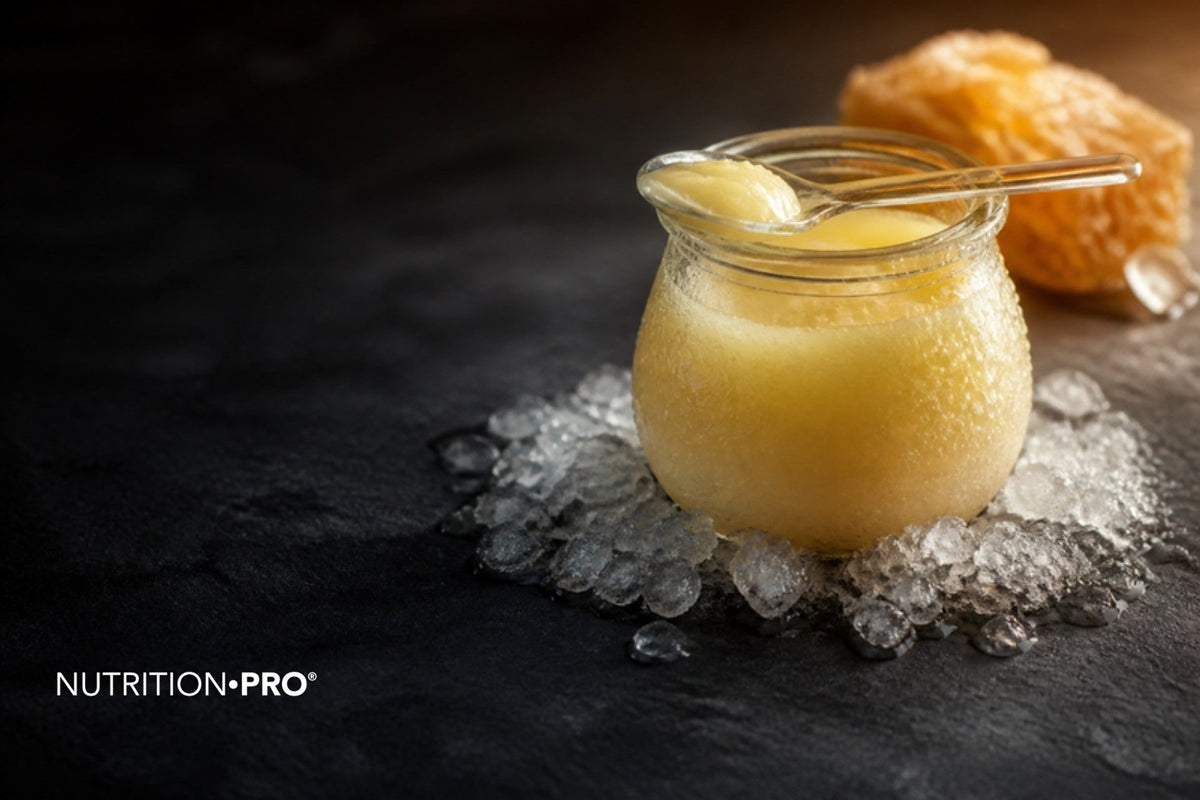
Ten months at room temperature: that's how long it took for furosine, a marker of protein aging, to increase sevenfold in a commercial royal jelly, compared to just 1.4 times for the same jelly kept at 4°C. A living product, sensitive to heat and time, royal jelly also varies depending on its form: fresh, it contains 60 to 70% water; freeze-dried, less than 5%.
This buying guide brings together what studies identified via PubMed show, from quality to precautions, with a grid for reading a label. The composition and studied effects are detailed in our complete royal jelly guide.

Fresh or freeze-dried : fresh jelly contains 60 to 70% water, freeze-dried jelly less than 5%; in one trial, 690 mg of dried jelly corresponded to 2,040 mg of fresh jelly. No human trial has directly compared the two forms. Cold significantly slows the aging of fresh jelly; freeze-drying facilitates storage, with, in one study, more furosine than in fresh jelly after 12 months, at equal temperature.
Quality, doses, precautions : 10-HDA, quite stable, is more informative about authenticity than freshness, which is better revealed by furosine and protein status; carbon isotopes reveal bee feeding on syrup. Trials lasting several weeks used 150 mg to 6 g daily depending on form, with uneven results. Allergy, rare but sometimes serious, remains the main risk, especially in case of asthma or atopic predisposition.
- Fresh, freeze-dried, in ampules: what are we talking about?
- Quality markers: water, proteins, 10-HDA
- Freshness is measurable: furosine, HMF and proteins
- What freeze-drying changes
- Storage: cold, without interruption
- Authenticity: what laboratories can detect
- Origin, hive management and labeling
- Trial doses, form by form
- How to take it: timing, duration, method
- Royal jelly, honey and propolis: combining them
- Precautions: allergy, asthma, interactions
- Reading a label: the seven-point grid
- Frequently Asked Questions
Fresh, freeze-dried, in vials: what are we talking about?
Royal jelly is secreted by young worker bees to feed larvae and the queen. In production, beekeepers transfer very young larvae into royal cells, then harvest the jelly approximately 72 hours later. The fresh jelly is this harvest, packaged as-is: according to a 2024 review, it contains 60 to 70% water, 9 to 18% protein, 7 to 18% sugars and 3 to 8% lipids.
The freeze-dried jelly is the same jelly, dried by vacuum sublimation at low temperature. The same review attributes to it less than 5% water, 27 to 41% protein, 22 to 31% carbohydrates and 15 to 30% lipids: the nutrients are concentrated. In a Japanese trial, tablets of dried jelly provided 690 mg per day, the equivalent of 2,040 mg of fresh jelly according to the authors, or approximately a 1 to 3 ratio.
Two other forms appear in studies. The enzyme-treated jelly is a freeze-dried powder whose proteins have been broken down into peptides; the authors of one trial present it as better digested and absorbed, with no identified comparative human study. The vials and beverages mix the jelly with other ingredients: in a six-month trial, the daily 100 mL beverage contained 3,000 mg of jelly, with fructose, citrate, vitamin B2 and flavorings. In an analysis of commercial products, ten jellies sold as pure contained 0.75 to 2.54% of 10-HDA, and seven products where jelly was only one ingredient (form not specified) had an undetectable to 0.054% content.
| Form | Water Content | Storage | What to Check |
|---|---|---|---|
| Fresh jelly | 60 to 70% | Keep refrigerated, without interruption | Origin, date, temperature indicated |
| Freeze-dried jelly | Less than 5% | Possible at room temperature, away from heat and humidity | Amount of powder per serving, equivalent in fresh jelly |
| Enzyme-treated jelly | Powder | Like a powder | Standardized 10-HDA content, amount per serving |
| Ampoule or beverage | Variable | According to the formula | Actual amount of royal jelly per ampoule, other ingredients |
Our Organic royal jelly belongs to the first category.
Since fresh jelly contains approximately two-thirds water, one dose of freeze-dried jelly corresponds to roughly three times fresh jelly, as in the study where 690 mg of dried jelly equaled 2,040 mg of fresh jelly. This ratio, calculated by our team, is used to interpret studies; it does not replace the label of a specific product.
Quality markers: water, proteins, 10-HDA
The10-hydroxy-2-decenoic acid, or 10-HDA, is a fatty acid unique to royal jelly. The international quality standard cited by several studies sets a minimum of 1.4% of 10-HDA, a value that these studies apply to fresh jelly. Measured levels are scattered: 0.8 to 3.2 g per 100 g in an Italian study, with an average of 2.5% for Italian jellies versus 1.6% for non-European jellies.
Form matters as much as origin. In a Turkish study, fresh jelly contained 1.90% 10-HDA and freeze-dried jelly 5.26%: by removing water, freeze-drying concentrates compounds. A 10-HDA percentage therefore only makes sense if one knows whether it refers to fresh jelly or powder.
10-HDA is also quite stable. After 7 days at 40°C, its content and that of several vitamins had not changed, while a 57 kDa protein was already degrading, all the more rapidly as temperature and duration increased. A 2025 review confirms this: 10-HDA often remains unchanged while the jelly's activity declines.
| Marker | Published values | What it indicates |
|---|---|---|
| Water | 60 to 70% in fresh jelly, less than 5% in freeze-dried | The form, and therefore the concentration |
| Proteins | 9 to 18% in fresh jelly, 27 to 41% in freeze-dried | The richness; their state informs on freshness |
| 10-HDA | Minimum of 1.4% in fresh jelly; 0.8 to 3.2% measured | Authenticity and richness, little on freshness |
| Furosine | 37.1 to 113.3 mg per 100 g of proteins in 15 commercial jellies | Protein aging, according to time and heat |
| Hydroxymethylfurfural | Undetectable at 4°C and −18°C for 9 months | Prolonged storage outside of cold conditions |
| Minor sugars and isotopes | Sucrose below 1.7% and erlose below 0.3% in 290 French jellies | Bee nutrition with syrup |
Freshness is measured: furosine, HMF and proteins
Over time and with heat, the proteins and sugars in royal jelly react together: this is the Maillard reaction, the one that browns toast, here in very subtle fashion. Its first indicator is furosine. This aging begins in the hive itself: furosine increased from 9.6 to 20.8 mg per 100 g of proteins between jelly harvested 1 day and 3 days after larval transfer.
In 15 commercial royal jellies, furosine ranged from 37.1 to 113.3 mg per 100 g of proteins; jellies of known origin, freshly harvested from beekeepers, contained an average of 41.7 mg, compared to 73.6 mg for imported jellies. Stored for 10 months, the same jelly increased from 72.0 to 500.8 mg at room temperature, compared to 100.5 mg at 4 °C. Nutritional loss remained minimal: 11.9% of lysine blocked at room temperature, 2.3% in cold storage.
Marconi E, Caboni MF, Messia MC, Panfili G. J Agric Food Chem 2002;50(10):2825-2829. DOI: 10.1021/jf0114987
A second marker,hydroxymethylfurfural (HMF), appears later in the same reaction. Monitored over 9 months, it remained below the detection threshold (0.13 mg/kg) in all jellies stored at 4 °C and −18 °C, while it increased exponentially at 25 °C.
<<<15>>> Proteins protéines are the most fragile. A proteomic analysis counted 85 protein spots in fresh jelly, compared to 81 after one year at −20 °C, 73 at 4 °C and 70 at room temperature, where several proteins (MRJP4, MRJP5) and an enzyme, glucose oxidase, had disappeared; the authors conclude that freezing best preserves the jelly. According to a 2025 review, glucose oxidase activity can drop by more than 97% in 55 days between 27 and 30 °C.
What freeze-drying changes
According to the 2025 review dedicated to royal jelly freshness, freeze-drying lowers water activity to a very low level, which slows most chemical and microbial degradation, preserves 10-HDA, proteins and polyphenols, and allows storage at room temperature.
Storage measurements provide nuances. In the Turkish study, over 6 months, according to the authors' summary, a microencapsulated form preserved its 10-HDA compared to freeze-dried jelly, both stored at room temperature, and to fresh jelly stored at 4 °C, while polyphenols and antioxidant and antimicrobial activities remained globally stable in all three forms.
Freeze-dried jelly proved more subject to the early stages of the Maillard reaction than fresh jelly: after 12 months, its furosine reached 253.4 mg per 100 g of proteins at 4 °C, compared to 54.9 mg for fresh jelly, and 884.3 mg compared to 332.5 mg at room temperature. After 18 months at room temperature, the powder reached 1,440.4 mg, or 24% of blocked lysine.
Messia MC, Caboni MF, Marconi E. J Agric Food Chem 2005;53(11):4440-4443. DOI: 10.1021/jf0404647
In fruit flies, freeze-dried jelly added to food shortened development, extended lifespan in males and increased female fertility: an animal result, which does not transfer to humans.
No form escapes time, then. Fresh jelly depends on an unbroken cold chain; powder gains in stability and ease of transport, but remains sensitive to duration and heat, especially outside the refrigerator. Most importantly, no human trial has directly compared fresh jelly and freeze-dried jelly face to face : the authors of a 2025 study write that the differences between the two forms remain poorly understood.
This powder with pre-digested proteins was used in trials conducted in Japan and China, sometimes standardized in 10-HDA (at least 3.5% in one trial). Its results do not transfer to fresh jelly or ordinary powder: each form should be judged on its own studies.
Storage: cold without interruption
The markers discussed above confirm this: furosine slowed and HMF undetectable in cold storage, protein profile close to fresh jelly after one year at −20 °C. According to the 2025 review, a spectroscopy study observed proteins stable for 3 days at room temperature, 7 weeks at 4 °C and 21 weeks at −20 °C. The same review emphasizes that repeated freezing and thawing can denature proteins, and that oxygen and light accelerate oxidation.
A study in a nematode worm illustrates the issue, with the reservations this animal model imposes. Jelly stored for 2 weeks at −20 °C extended worm lifespan by 16.37% at the highest concentration; stored at 4 °C or 25 °C, it had no further effect on their lifespan. Jelly stored at 4 °C still increased their mobility by 50% and their reproduction. That stored at 25 °C had lost its effect on mobility but still increased reproduction by approximately 15%; according to the authors, some of the active compounds do not depend on freshness. These results do not transfer to humans.
Our Organic Royal Jelly keeps fresh, between 2 and 6 °C, which is the refrigerator range, where analysis studies observe aging distinctly slower than at room temperature.
Authenticity: what laboratories can detect
To produce more, colonies can be fed with sugar syrups. However, sugar cane and corn leave a particular signature in the ratio between two forms of carbon. In a German study, authentic gels of European origin showed homogeneous values, from −26.7 to −24.9 ‰, while several commercial gels displayed −20.8 to −13.3 ‰, a sign of high-fructose corn syrup.
Colonies were fed with different sugars over six successive harvests. Natural gels showed an isotopic ratio of approximately −25 ‰, compared to up to −17 ‰ with cane sugar or corn hydrolysate. Maltose rose to 5.0% with starch hydrolysates, compared to less than 0.2% in authentic gels, and sucrose and erlose, naturally around 0.2%, reached 4.0% and 1.3% with cane or beet sugar. Combined, the two analyses detected feeding from the first harvests.
Wytrychowski M, Daniele G, Casabianca H. Anal Bioanal Chem 2012;403(5):1451-1456. DOI: 10.1007/s00216-012-5934-6
A French team compiled a database of 290 gels harvested from different French regions: sucrose remained below 1.7% and erlose below 0.3%, while they reached 3.9% and 2.0% in certain commercial samples, and 5.1% and 1.7% in gels from feeding experiments.
Does feeding change the nutritional value? In Korea, gel from colonies fed with sugar syrup contained more sucrose (7.5 compared to 2.7 g per 100 g) than that from colonies fed with honey, but neither 10-HDA, nor amino acids, nor total proteins differed. Certain minerals (potassium, iron, magnesium) were more abundant with honey: according to the authors, colony diet can modify nutritional quality.
Origin, beekeeping practices, and labeling
Origin varies composition, but not always in the same direction across studies: the Italian study found more 10-HDA in Italian gels, while the 2024 review notes that European gels generally contain less. Origin can also be verified in the laboratory through analysis of pollen present in traces or strontium isotopes, according to this review.
The beekeeping practices also matter. More than 90% of the world's gel is produced in China, largely by a bee lineage selected for its productivity, capable of feeding a very large number of royal cells.
In 25 colonies of a high-yield lineage, researchers grafted 64 to 320 larvae per colony. As the number of royal cells increased, 10-HDA content decreased, from 2.01% to 1.52%, and the amount of gel per cell decreased with the greater number of cells (0.60 g, compared to 0.71 to 0.79 g). Proteins, water, and antioxidant activity did not change, and all gels remained above the minimum of 1.4% 10-HDA.
Ma C, Ahmat B, Li J. Curr Res Food Sci 2022;5:1818-1825. DOI: 10.1016/j.crfs.2022.10.014
Theenvironment also matters. In an American study, colonies exposed to pollen containing multiple pesticides produced gel lower in 10-HDA, major proteins, and 24-methylenecholesterol, a key nutritive sterol, while earlier work showed that the gel itself remains free of residues thanks to filtering by nurse bees. We found no studies directly comparing the composition of organic and conventional gels.
These results describe the apiaries studied, not a particular product, but they explain why origin and traceability matter. Our Organic Royal Jelly, organic and 100% French, is certified French Royal Jelly, a label based on controlled origin and traceability.
Doses in trials, by form
A 2023 meta-analysis brought together 10 randomized trials and 512 participants: doses ranged from 500 to 6,000 mg per day, for 4 to 18 weeks. Only 4 out of 10 trials described the composition of the gel used, a gap that the authors cite as the main limitation of their work. On weight, body mass index, and fat mass, the overall effect was null, with weight loss limited to the subgroup of doses below 3,000 mg per day, for evidence judged to be of low quality.
In the table, the level of evidence is an assessment by the editorial team, based on the study design, its size, and duration.
| Form and dose per day | Duration and population | Result | Level of evidence |
|---|---|---|---|
| Fresh royal jelly, single dose taken on an empty stomach (10 g; 15 g at one location in the method) | One dose, 40 people with type 2 diabetes | No difference from placebo on blood glucose, insulin, and C-peptide at 2 hours | Weak, null result (Mobasseri, 2015) |
| 6 g, form not specified in the abstract | 4 weeks, 15 volunteers | Reduction in total cholesterol and LDL compared to controls | Very weak, very small sample size (Guo, 2007) |
| 100 mL beverage providing 3,000 mg of royal jelly | 6 months, 61 volunteers aged 42 to 83 years | No effect on lipids, weight, or blood pressure; modest increase in red blood cells and testosterone | Weak (Morita, 2012) |
| Tablets of dried royal jelly, 690 mg, equivalent to 2,040 mg of fresh royal jelly | 4 weeks, 100 healthy volunteers | Improved vascular function (+21.4% vs +0.05%); lipids unchanged | Weak, single trial funded by a bee product company (Fujisue, 2022) |
| Soft capsule of 1,000 mg, freeze-dried royal jelly according to the same research group | 8 weeks, 50 women with type 2 diabetes | Glycated hemoglobin reduced from 8.67% to 7.05% in the royal jelly group | Weak (Pourmoradian, 2014) |
| 150 mg of Greek-origin royal jelly | 3 months, 36 postmenopausal women, without a placebo group | HDL +7.7%, LDL −4.1% | Very weak, no control group (Lambrinoudaki, 2016) |
| Enzyme-treated royal jelly, 2.4 g in 6 tablets, at least 3.5% 10-HDA | 8 weeks, 43 people with symptoms of dry eye | More stable tear film at 4 weeks; tear secretion no different from placebo in the overall group | Weak (Inoue, 2017) |
| Enzyme-treated jelly, 1.2 g or 4.8 g | 1 year, 194 nursing home residents, average age 78.5 years | No effect on physical performance; decline in grip strength attenuated by approximately 1 kg, of uncertain clinical significance according to the authors | Moderate, modest effects (Meng, 2017) |
Another null result: a meta-analysis of 5 trials found no significant effect on fasting blood glucose (−0.95 mg/dL) or on glycated hemoglobin.
A dose of 1,000 mg of freeze-dried powder does not contain the same amount of jelly as 1,000 mg of fresh jelly, and an ampoule or capsule may contain other ingredients. Before comparing a product to a trial, check the form and quantity of jelly per dose indicated on the label.
How to take it: timing, duration, method
The trials administered royal jelly daily, for 4 weeks to 1 year, at varied times: a daily drink, or two tablets three times daily after meals. No identified study compared taking on an empty stomach versus with food, nor jelly left to dissolve under the tongue versus jelly swallowed. A 2025 review on allergy to hive products cites usage guidelines, treatment courses of 6 to 8 weeks two to three times per year, in spring and fall: these are habits, without trial support.
For our Organic royal jelly, the recommended use is simple: in the morning on an empty stomach, let the contents of a measuring spoon dissolve under the tongue. It can also be taken with a little honey or in fruit juice. These are practical tips, not study results.
Allergic reactions have been described from the first intake of royal jelly, for example in two young Japanese women, suggesting cross-reactions with other allergens. The 2025 review recommends using hive products with caution, starting with small quantities, even without known allergies.
Royal jelly, honey and propolis: combining them
Royal jelly is often taken with honey. Studies highlight the relatedness of hive products: in a 56-year-old woman, two anaphylaxis episodes after royal jelly were due to the MRJP3 protein, which also reacted with comb honey; her doctors advised her to avoid all hive products. In patients with atopic eczema who had never consumed jelly, a study demonstrated cross-reactions between jelly and bee venom, dust mites, certain crabs and cockroaches. The jelly may also contain pollen traces, involved in certain reactions, particularly in people sensitized to mugwort.
Propolis is another hive product, of a completely different nature: a resin that bees collect from tree buds, which our complete propolis guidepresents in detail. We identified no trials assessing the combination of royal jelly and propolis. Both products come from the hive: the same precaution applies in case of hive product allergy. Propolis is reserved for adults and children over 3 years old; medical advice during pregnancy, breastfeeding or under treatment.

Precautions: allergy, asthma, interactions
Allergy is the best-established risk. As early as 1996, Australian physicians described seven people who had an asthma attack, sometimes with anaphylaxis, after swallowing royal jelly, through a classic allergic mechanism; antibodies against its proteins were also present in 52% of 75 people allergic to other substances, with no known clinical manifestation in the latter. In Hong Kong, 7.3% of 300 patients followed for asthma had a positive skin test to jelly, almost all atopic, and 9 hospital employees out of 1,472 surveyed reported reactions (hives, eczema, rhinitis, asthma). According to the 2025 review, these antibodies are found in up to 17% of asthmatic adults and a third of people with atopic eczema; MRJP1, MRJP2 and MRJP3 proteins are the main allergens.
The severe cases reported by this review mainly concern atopic individuals: a 26-year-old asthmatic woman after a royal jelly drink with honey, another after tablets, a 15-year-old adolescent in anaphylaxis 15 minutes after taking it, and one death, that of an 11-year-old atopic child. Raw jellies, drinks, tablets: none of the identified studies show that one form would be less allergenic than another. The review recommends that atopic individuals (asthma, atopic eczema, allergic rhinitis) avoid royal jelly; the 2020 Japanese team also calls for warning them.
On the medication side, one possible interaction case has been published: in an 87-year-old man treated with warfarin, an anticoagulant, whose INR, the coagulation indicator monitored under this treatment, was stable between 1.9 and 2.4, the INR rose to 6.88 then 7.29, with blood in the urine, one week after starting royal jelly. Our article on the dangers and side effects of royal jelly details all the risks.
To avoid in case of known allergy to hive products or history of anaphylaxis. Medical advice first in case of asthma, atopic eczema, allergic rhinitis, allergy to dust mites or bee venom, anticoagulant treatment, pregnancy or breastfeeding. Not in children without medical advice. Emergency : widespread urticaria, facial or throat swelling, wheezing or discomfort after taking, call 15.
Reading a label: the seven-point checklist
| Mention | Why it matters |
|---|---|
| 1. The form | Fresh, freeze-dried, enzyme-treated or blended: water content ranges from 60 to 70% down to less than 5%, and doses can only be compared at equal forms. |
| 2. The quantity of royal jelly per serving | Indicated in royal jelly, not just in product: in products where royal jelly was only an ingredient, 10-HDA content ranged from undetectable to 0.054%. |
| 3. The 10-HDA, if indicated | A marker of richness and authenticity, to be read according to form: 1.4% minimum for fresh jelly according to the reference cited by studies, 5.26% measured in freeze-dried powder. |
| 4. Origin and traceability | Composition varies with region, flowering periods and hive management; laboratories can verify origin and detect syrup feeding. |
| 5. Storage and date | Aging depends on temperature and duration: furosine increased sevenfold over 10 months at room temperature. |
| 6. Other ingredients | Sugars, flavors or other plants change the nature of the product, as in the trial beverage which contained fructose, citrate and flavors. |
| 7. Allergy precaution | The 2025 review on hive product allergy advocates for more precise labeling that identifies allergens. |
In the 2023 meta-analysis, only 4 out of 10 trials specified their jelly composition: a complete label often tells you much more.
Fresh, non-freeze-dried and untransformed royal jelly, from organic farming and 100% French production, certified French Royal Jelly and harvested without overproduction. A 10 g jar with its measuring spoon, to be kept cool between 2 and 6°C, to be dissolved under the tongue in the morning on an empty stomach or mixed with a little honey.
View organic royal jellyOur complete royal jelly guide details its composition, 10-HDA and its studied effects.
Frequently asked questions
Fresh or freeze-dried royal jelly: which to choose?
Both forms can be of good quality if the jelly is authentic and well preserved, and no human trial has compared them head-to-head. Fresh jelly, untransformed, requires cold storage; freeze-dried jelly, more concentrated, keeps more easily. The choice depends mainly on your use, traceability and label clarity.
How much fresh jelly corresponds to 1 g of freeze-dried jelly?
Approximately 3 g. In one study, 690 mg of dried jelly corresponded to 2,040 mg of fresh jelly, a ratio close to 1 to 3 which is explained by the two-thirds water content of fresh jelly. Only the label of a specific product allows you to know its actual content.
How should royal jelly be taken?
Studies administered it daily, for 4 weeks to 1 year, on an empty stomach or after meals depending on the studies; none compared the timing of intake. For our Organic Royal Jelly, we recommend, for practical purposes and not based on a study, to let a measuring spoon dissolve under the tongue in the morning on an empty stomach, possibly with a little honey or in fruit juice.
What is the daily dose of royal jelly?
Multi-week studies used 150 mg to 6 g per day depending on the form: for example 1,000 mg in soft capsule, 3,000 mg in beverage form, or 690 mg of dried jelly equivalent to 2,040 mg of fresh jelly. These figures are only comparable in the same form; follow the quantity indicated on your product's label.
How long should a royal jelly treatment last?
Studies lasted 4 to 18 weeks in a meta-analysis of 10 trials, and up to 1 year in one study.
How should fresh royal jelly be stored?
In the refrigerator, between 2 and 6 degrees, in a tightly closed jar, with a clean and dry spoon.
Can royal jelly be frozen?
Analysis studies show that freezing, at around minus 18 to minus 20 degrees, best preserves the proteins in the jelly. Repeated freezing and thawing of the same jar can, however, denature the proteins: follow the manufacturer's instructions.
What is the best royal jelly?
Studies do not designate a better form or origin. They provide criteria: authentic jelly, of traceable origin, stored cold or freeze-dried under good conditions, with a label that specifies the form and quantity of jelly per serving.
Is royal jelly in ampoule form equivalent?
It depends on the formula: an ampoule combines jelly with other ingredients, and no identified study has analyzed ampoules specifically. A six-month study used a 100 mL beverage providing 3,000 mg of jelly. Check the amount of royal jelly per ampoule.
Who should not take royal jelly?
People allergic to hive products or who have experienced anaphylaxis. Medical advice is necessary in case of asthma, atopic eczema, allergy to dust mites or bee venom, anticoagulant treatment, pregnancy, breastfeeding, and in children.
Sources
The studies cited below were identified via PubMed.
- Marconi E, Caboni MF, Messia MC, Panfili G. Furosine: an appropriate marker for assessing the freshness of royal jelly. Journal of Agricultural and Food Chemistry, 2002;50(10):2825-2829. DOI
- Oršolić N, Jazvinšćak Jembrek M. Royal jelly: biological action and health benefits. International Journal of Molecular Sciences, 2024;25(11):6023. DOI
- Fujisue K, Yamamoto E, Sueta D, et al. Randomized double-blind comparative study of royal jelly on vascular endothelial function in healthy volunteers. Journal of Atherosclerosis and Thrombosis, 2022;29(9):1285-1294. DOI
- Messia MC, Caboni MF, Marconi E. Assessment of storage stability of freeze-dried royal jelly by furosine assay. Journal of Agricultural and Food Chemistry, 2005;53(11):4440-4443. DOI
- Dundar AN, Cinar A, Altuntas S, et al. The role of microencapsulation in maintaining the biological activity of royal jelly: comparison with fresh and freeze-dried forms during storage. Journal of the Science of Food and Agriculture, 2022;102(12):5502-5511. DOI
- Vajdi M, Musazadeh V, Khajeh M, et al. Effects of royal jelly supplementation on anthropometric indices: systematic review and dose-response meta-analysis of randomized trials evaluated by GRADE. Frontiers in Nutrition, 2023;10:1196258. DOI
- Hata T, Furusawa-Horie T, Arai Y, et al. Studies of royal jelly and cross-reacting allergens associated in patients with atopic dermatitis. PLoS One, 2020;15(6):e0233707. DOI
- Meng G, Wang H, Pei Y, et al. Effects of protease-treated royal jelly on muscle strength in elderly nursing home residents: a randomized, double-blind, placebo-controlled dose-response study. Scientific Reports, 2017;7(1):11416. DOI
- Morita H, Ikeda T, Kajita K, et al. Effect of six months of royal jelly consumption in healthy volunteers. Nutrition Journal, 2012;11:77. DOI
- Genç M, Aslan A. Quantification of trans-10-hydroxy-2-decenoic acid in pure royal jelly and royal jelly-based products by column liquid chromatography. Journal of Chromatography A, 1999;839(1-2):265-268. DOI
- Ma C, Ahmat B, Li J. Effect of the number of royal cells on royal jelly production and quality. Current Research in Food Science, 2022;5:1818-1825. DOI
- Ferioli F, Marcazzan GL, Caboni MF. Quantification of (E)-10-hydroxy-2-decenoic acid in pure royal jelly: comparison of a novel capillary electrophoresis method and liquid chromatography. Journal of Separation Science, 2007;30(7):1061-1069. DOI
- Kamakura M, Fukuda T, Fukushima M, Yonekura M. Degradation of a 57 kDa protein of royal jelly during storage: a possible freshness marker. Bioscience, Biotechnology, and Biochemistry, 2001;65(2):277-284. DOI
- Zhang Y, Sun J, Chen R, et al. Monitoring and preserving the freshness of royal jelly: review of analytical methods and preservation technologies. Foods, 2025;14(24):4300. DOI
- Ciulu M, Floris I, Nurchi VM, et al. A possible freshness marker of royal jelly: formation of 5-hydroxymethyl-2-furaldehyde according to temperature and storage duration. Journal of Agricultural and Food Chemistry, 2015;63(16):4190-4195. DOI
- Daniele G, Casabianca H. Sugar composition of French royal jelly, compared to commercial samples and those from artificial feeding. Food Chemistry, 2012;134(2):1025-1029. DOI
- Li JK, Feng M, Zhang L, et al. Proteomic analysis of modifications to major royal jelly proteins according to storage conditions. Journal of Proteome Research, 2008;7(8):3339-3353. DOI
- Kayashima Y, Yamanashi K, Sato A, et al. Freeze-dried royal jelly retains its biological activity on the development and physiology of Drosophila. Bioscience, Biotechnology, and Biochemistry, 2012;76(11):2107-2111. DOI
- Zhang C, Deng Y, Luo Z, et al. Effects of freshness and concentration of royal jelly on lifespan, growth, mobility, and reproduction of Caenorhabditis elegans. Foods, 2025;14(22):3839. DOI
- Inoue S, Kawashima M, Hisamura R, et al. Clinical evaluation of royal jelly supplementation in dry eye: a prospective randomized double-blind placebo-controlled trial and experimental model in mice. PLoS One, 2017;12(1):e0169069. DOI
- Stocker A, Rossmann A, Kettrup A, Bengsch E. Detection of royal jelly adulteration by analysis of carbon and nitrogen isotope ratios. Rapid Communications in Mass Spectrometry, 2006;20(2):181-184. DOI
- Wytrychowski M, Daniele G, Casabianca H. Combination of sugar analysis and isotopic mass spectrometry to detect the use of artificial sugars in royal jelly production. Analytical and Bioanalytical Chemistry, 2012;403(5):1451-1456. DOI
- Ghosh S, Jang H, Sun S, Jung C. Nutritional composition and quality evaluation of royal jellies according to colony feeding. Foods, 2024;13(12):1942. DOI
- Milone JP, Chakrabarti P, Sagili RR, Tarpy DR. Exposure of colonies to pesticides modifies the production and nutritional composition of honeybee royal jelly. Chemosphere, 2021;263:128183. DOI
- Mobasseri M, Ghiyasvand S, Ostadrahimi A, et al. Effect of fresh royal jelly intake on glycemic response in patients with type 2 diabetes. Iranian Red Crescent Medical Journal, 2015;17(9):e20074. DOI
- Guo H, Saiga A, Sato M, et al. Royal jelly supplementation improves lipoprotein metabolism in humans. Journal of Nutritional Science and Vitaminology, 2007;53(4):345-348. DOI
- Pourmoradian S, Mahdavi R, Mobasseri M, et al. Effects of royal jelly supplementation on glycemic control and oxidative stress in women with type 2 diabetes: a randomized clinical trial. Chinese Journal of Integrative Medicine, 2014;20(5):347-352. DOI
- Lambrinoudaki I, Augoulea A, Rizos D, et al. Greek royal jelly improves the lipid profile of menopausal women. Gynecological Endocrinology, 2016;32(10):835-839. DOI
- Mahboobi S, Jafarnejad S, Eftekhari MH. Royal jelly does not improve glycemic markers: systematic review and meta-analysis of randomized clinical trials. Complementary Therapies in Medicine, 2019;44:235-241. DOI
- Matuszewska-Mach E, Borysewicz P, Królak J, et al. Ensuring safe use of bee products: a review of allergic risks and their management. International Journal of Molecular Sciences, 2025;26(24):12074. DOI
- Li JD, Cui L, Xu YY, Guan K. A case of anaphylaxis caused by royal jelly major protein 3 and its cross-reactivity with honeycomb honey. Journal of Asthma and Allergy, 2021;14:1555-1557. DOI
- Thien FC, Leung R, Baldo BA, et al. Asthma and anaphylaxis induced by royal jelly. Clinical and Experimental Allergy, 1996;26(2):216-222. DOI
- Lee NJ, Fermo JD. Interaction between warfarin and royal jelly. Pharmacotherapy, 2006;26(4):583-586. DOI


