

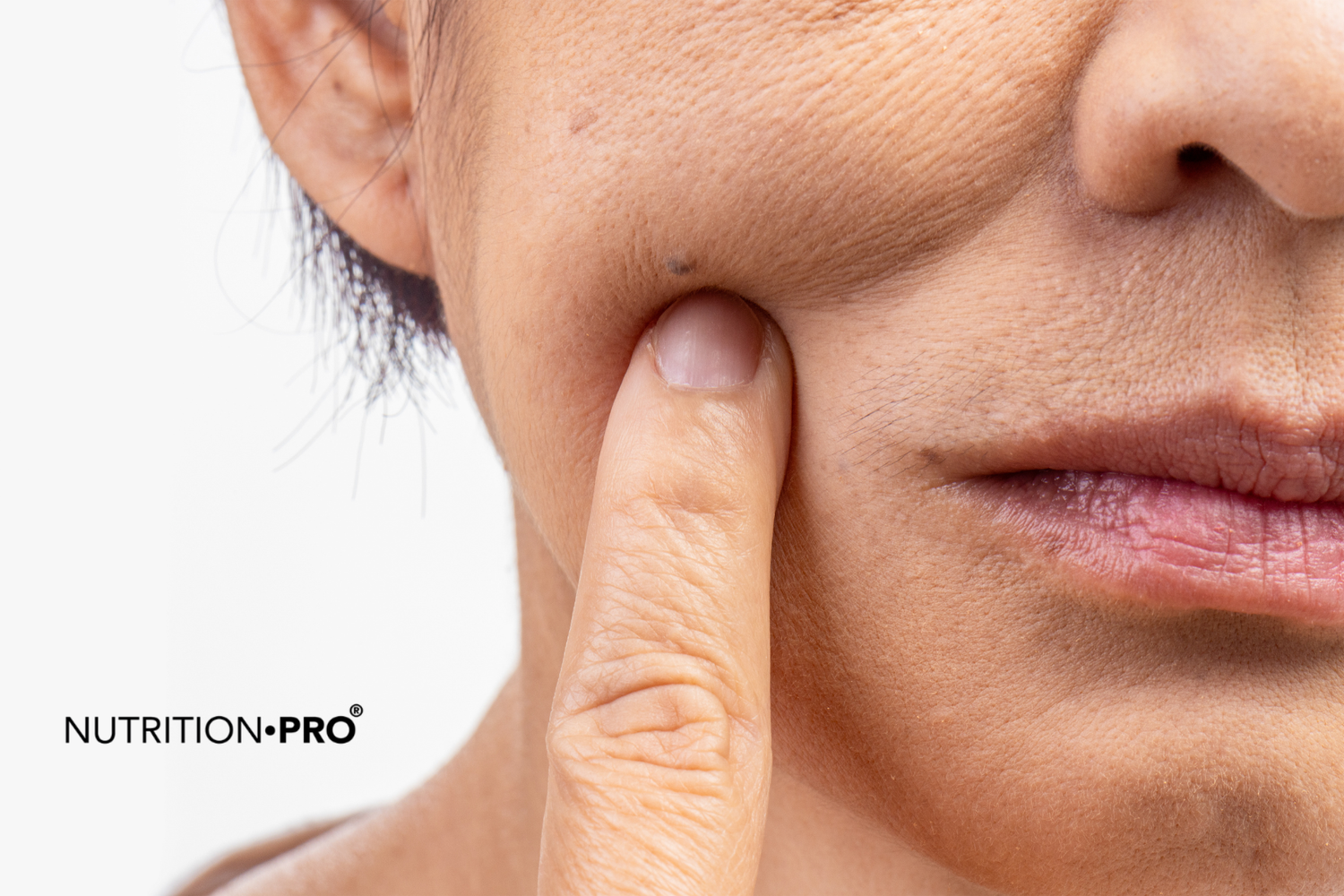
There is a scenario that many people know well: cream is applied morning and evening, it provides relief in the moment, and two hours later the skin feels tight again. You switch brands, upgrade to a premium line, add an oil, and the problem returns as soon as you close the jar. It's not a cream problem. The issue is that the treatment acts on an already-built wall, while the defect lies in the materials themselves.
This article details a randomized trial that measured, using instruments and over 12 weeks, what an intake of essential fatty acids changes in four objective skin parameters: hydration, transepidermal water loss, roughness, and scaling. Then what this approach doesn't address, and how it combines with what you're already doing on the surface.

The problem. The stratum corneum is a wall: dead cells are the bricks, lipids are the mortar. When this cement is depleted, water continuously escapes and cream compensates without correcting. What the trial measured. Over 12 weeks with borage oil: skin hydration significantly increased, transepidermal water loss reduced by approximately 10% by the sixth week, roughness and scaling significantly decreased on surface imaging, redness diminished after provoked irritation. Placebo showed no change on any of these parameters.
What it doesn't do. Treat eczema, the Cochrane review is unambiguous. Act on established wrinkles, the trial did not measure this and a review finds no effect on epidermal atrophy. How to use it. Two capsules with meals, keep your cream, take a photo at the start, check at six weeks, assess at twelve. If nothing changes: thyroid, iron, or a skin condition that isn't dry skin.
Why dry skin is really dry
The most superficial layer of the skin, the stratum corneum, is not a smooth membrane but a layered structure. Flattened dead cells, corneocytes, form the bricks. Between them, a lipid cement made of ceramides, cholesterol, and free fatty acids plays the role of mortar. It is this mortar, and not the cells, that ensures the seal: it prevents water from escaping outward and irritants from entering.
When this cement becomes depleted, two things happen simultaneously. Water evaporates more quickly, which is measured as transepidermal water loss, and the skin becomes more permeable to aggressors, hence the redness and sensitivity that often accompany dryness. The sensation of tightness is not a lack of water at the surface, it is a continuous leak from below.
An emollient deposits lipids and hydrating agents on the existing corneal layer. It seals, and it does so well: the effect is immediate and visible. But it does not intervene in the manufacture of the following cells, which continuously rise from the deep layers of the epidermis. A supply of essential fatty acids acts at that location: it provides raw material at the moment the mortar is being made. It is slower, and it does not stop at rinsing.
The 12-week trial, unfolded
Two groups of women ingested flaxseed oil or borage oil for 12 weeks, with a control group receiving placebo based on medium-chain fatty acids. The dose was 2.2 g of total fatty acids per day. In the borage group, plasma gamma-linolenic acid increased significantly. Skin irritation was induced by nicotinate: redness and blood flow were decreased compared to baseline in both oil groups. Skin hydration was significantly increased after 12 weeks. Transepidermal water loss was reduced by approximately 10% after 6 weeks of supplementation. Assessment of living skin surface revealed a significant decrease in roughness and scaling between week 0 and week 12. With the exception of hydration, none of these parameters were modified in the placebo group.
From Spirt S, Stahl W, Tronnier H, Sies H, Bejot M, Maurette JM, Heinrich U. Br J Nutr 2009;101(3):440-445. DOI: 10.1017/S0007114508020321
Why these measurements matter
Most studies on beauty supplements rely on questionnaires: do participants find their skin softer. This is useful, but it is also prime territory for the placebo effect. This trial did something different.
| Parameter | How it is measured | What it indicates |
|---|---|---|
| Transepidermal water loss | Probe placed on the skin, in g/h/m² | Barrier integrity; this is the reference marker in experimental dermatology |
| Skin hydration | Corneometry, electrical capacitance measurement | Water content of the stratum corneum |
| Roughness and desquamation | Surface imaging of living skin | State of relief and cohesion of corneocytes |
| Redness and blood flow | After provoked irritation with nicotinate | Skin reactivity to controlled stress |
The detail that gives weight to the whole is the placebo group. It received medium-chain fatty acids, so identical capsules containing fat, and it showed no movement on any of these parameters except for a slight variation in hydration. So it is neither the fat intake in itself, nor the fact of taking capsules, nor the season that explain the results.
The second useful detail is the timeline. Insensible water loss decreases as early as six weeks; hydration, roughness and desquamation require the full twelve weeks. This is consistent with the epidermal renewal time, which takes approximately one month in young adults and lengthens with age. The barrier repairs itself before texture visibly changes.
What other research confirms
The 2024 systematic review devoted to evening primrose oil examined all available clinical trials, indication by indication. Its conclusion on healthy volunteers is precise and worth citing as is: no significant effect was obtained on epidermal atrophy, but positive effects on skin were indeed achieved concerning hydration and barrier function. The authors are moreover critical on other indications, which makes this conclusion more credible.
The 2022 dermo-cosmetic review published in the International Journal of Cosmetic Science concludes that evening primrose oil, alongside sweet almond and jojoba, constitutes an effective ingredient for strengthening stratum corneum integrity, its recovery and its lipid ratio. The authors moreover emphasize a technical point: the quality and stability of the oil determine whether the reported effects are achieved, which directly relates to the extraction method and protection against oxidation.
Finally, a 2020 review on omega-3 and omega-6 in inflammatory skin diseases emphasizes that the combination of an omega-6 in the form of GLA and long-chain omega-3 appears to present the most interesting anti-inflammatory potential. The authors also remind us that beyond pathology, the objective of balanced fatty acid intake is simply to maintain and improve overall skin health.
From within or on the surface: what does what
| Approach | Where it acts | Timeline | What it does not do |
|---|---|---|---|
| Emollient cream | On the existing stratum corneum, on the surface | Immediate | Does not modify cells being produced; the effect stops when use stops |
| GLA (evening primrose, borage) | Raw material of the lipid cement, internally | 6 to 12 weeks | Does not replace a surface treatment; does not treat eczema |
| Hyaluronic acid | Water retention in tissues | A few weeks | Does not act on the lipids of the barrier |
| Collagen | Dermis, support matrix beneath the epidermis | 2 to 3 months | Does not act on the seal of the stratum corneum |
| Retinol | Cell renewal and signs of aging | Several weeks | May conversely dry out at first |
The practical reading is simple: these approaches do not compete, they work at different levels. On skin that is both dry and marked, GLA works on sealing while collagen works on support andhyaluronic acid works on water retention. The only true rule is to introduce only one at a time, a few weeks apart, to know what works.
A word on oils applied to the skin, since the question comes up. A 2017 review in the International Journal of Molecular Sciences reviewed the effects of topical application of nineteen plant oils, including borage, on barrier repair and skin inflammation. It is a distinct and legitimate pathway, but it is not interchangeable with the oral route: applying an oil acts on skin today, ingesting it acts on skin in the following weeks.
What this does not address
A 2013 Cochrane review pooled 27 trials and 1,596 participants, of which 19 on evening primrose oil and 8 on borage oil. Neither one, taken orally, improves overall eczema symptoms more than placebo, whether assessed by participants or physicians. The authors go so far as to conclude that with confidence intervals being tight, further studies on this subject would be difficult to justify.
Dry skin and eczema are two distinct situations. The first is a barrier imbalance, the second is a chronic inflammatory disease with an immune component. Patches that itch, redden, and return to the same spot require a dermatologist, not a supplement.
Wrinkles are not the object either. The 12-week trial measured roughness and flaking, that is, surface condition, not wrinkle depth. And the 2024 systematic review explicitly notes the absence of significant effect on epidermal atrophy in healthy volunteers. Better hydrated skin appears smoother, which is real and visible, but it is not the same as an action on established wrinkles.
The protocol in practice
60 capsules providing daily 500 mg of evening primrose oil and 500 mg of borage oil organic, obtained by cold pressing to preserve polyunsaturated fatty acids, with 10 mg of natural vitamin E that protects the oil from oxidation. Borage is the most concentrated plant source of GLA. Two capsules with meals, 30-day course.
View Evening Primrose / Borage OilRated 4.6/5 by our customers. Not recommended for pregnant and nursing women and people on anticoagulant treatment.
Choose what sounds most like you: the answer appears just below.
Leaky barrier, cream that patches without correcting. Two capsules with meals, cream retained, a photo at the start, a look at six weeks and an assessment at twelve. Also check your shower temperature: it's the most frequent aggravating factor and the easiest to correct.
GLA works on the sealing of the stratum corneum, the collagen works on the dermis below. They don't replace each other. Introduce them a few weeks apart rather than together, to find out which one works for you.
Patches that itch and recur in the same place describe a dermatosis, not dryness. The Cochrane review of 27 trials is clear: evening primrose and borage taken orally do not improve eczema. A dermatologist will make the correct diagnosis, and that's what will save you time.
Dry skin, sensitivity to cold, fatigue and dull hair combined suggest a slowed thyroid or low ferritin, two frequent and silent causes. Two blood tests settle the question, and no lipid intake will compensate for either one.
This test provides guidance; it does not replace professional medical advice.
Frequently asked questions
Understanding
Why does dry skin remain dry despite creams?
Because a cream acts on the surface that is already formed. The stratum corneum functions like a wall where dead cells are the bricks and lipids are the mortar: ceramides, cholesterol, and free fatty acids. If this lipid cement is depleted, water escapes continuously and cream compensates without correcting the problem. An intake of essential fatty acids works differently, on the raw material available when the next layer of cells is being formed.
What is transepidermal water loss?
It is the amount of water that evaporates continuously through the epidermis, measured by device. It is the reference marker for skin barrier integrity in experimental dermatology. The higher it is, the more the barrier leaks. It is a number, not an impression, and this is what makes the reference trial on borage oil interesting.
Why borage oil rather than another oil?
Because it is the most concentrated plant source of gamma-linolenic acid, an omega-6 that common dietary oils do not provide. The body produces it itself from linoleic acid, but through a slow enzyme whose activity varies among individuals and decreases with age. In the trial, plasma GLA actually increased in the borage group, confirming that the intake does reach the bloodstream.
The trial
What exactly does the 12-week trial show?
Women received 2.2 g of fatty acids daily in the form of borage oil, flaxseed oil, or a placebo based on medium-chain fatty acids. At 12 weeks, skin hydration was significantly increased. Transepidermal water loss had decreased by approximately 10% as early as 6 weeks. Surface roughness and scaling, assessed by surface imaging, were significantly reduced. After provoked irritation with nicotinate, redness and blood flow were decreased. Except for hydration, none of these parameters changed in the placebo group.
How long before seeing results?
Six weeks for the first measured effects in the trial, twelve for full effects. This is consistent with epidermal renewal, which takes approximately one month in young adults and longer with age. Before six weeks, it is too early to judge, and a photograph taken at the start in the same lighting helps reveal gradual improvement that daily mirror checks mask.
In practice
Should I stop using cream if I take capsules?
No, and that would be counterproductive. The two approaches do not work in the same location or on the same timeframe. An emollient deposits lipids and moisturizing agents on the existing stratum corneum, with an immediate effect that stops when you stop using it. Oral lipid intake provides raw material to cells as they are being formed, with a gradual effect over several weeks. The most effective approach is to use both.
What dose and when?
The trial used 2.2 g of fatty acids daily. Two capsules providing 500 mg of evening primrose oil and 500 mg of borage oil fall within this range. Take them with a meal, because these are oils and dietary fat from the meal promotes their absorption while reducing oily reflux, the most commonly reported discomfort.
Can it be combined with omega-3s, collagen, or hyaluronic acid?
Yes, the mechanisms are distinct and complementary. Omega-3s act on inflammation resolution, collagen on the dermis and its supporting matrix, hyaluronic acid on water retention in tissues, GLA on the lipid cement of the stratum corneum. A 2020 review emphasizes that combining omega-6 in the form of GLA with long-chain omega-3s appears to offer the most interesting anti-inflammatory potential.
Limitations
Does it work on eczema as well?
No. A 2013 Cochrane review of 27 trials and 1,596 participants concludes that neither evening primrose oil nor borage oil taken orally improves eczema more than placebo. Dry skin and atopic eczema are two different situations: the former is a barrier imbalance, the latter is a chronic inflammatory disease with an immune component. Eczema requires a dermatologist.
What about wrinkles or skin aging?
The 12-week trial measured roughness and flaking, not wrinkles. A 2024 systematic review also notes that in healthy volunteers, evening primrose oil showed no significant effect on epidermal atrophy, while improving hydration and barrier function. Better-hydrated skin appears smoother, which is not the same as acting on established wrinkles. Collagen and retinol address that question.
What should you do if skin remains dry after three months?
Look for an underlying cause rather than changing products. A slowed thyroid gives characteristic dry and rough skin. Iron deficiency, overall lipid intake that's too low, diabetes, certain medications, or simply very hot water and long showers cause lasting dryness. Skin that itches, reddens, or peels in patches is no longer simply dry skin but a dermatological condition, and that requires medical advice.
Who should avoid these capsules?
Pregnant and nursing women, and people taking anticoagulants or antiplatelet agents without medical advice, as a trial showed that evening primrose oil reduces platelet reactivity. It is prudent to stop before scheduled surgery. These precautions are detailed in our complete guide to evening primrose and borage.
Glossary
- Stratum corneum
- Corneal layer, the most superficial part of the epidermis; a stack of dead cells bound together by lipid cement.
- Corneocyte
- Flattened, nucleus-free cell of the corneal layer; the bricks of the skin barrier.
- Insensible water loss
- Water that continuously evaporates through the epidermis; instrumental marker of barrier integrity.
- Corneometry
- Measurement of water content in the corneal layer by electrical capacitance.
- Emollient
- Treatment that deposits lipids and hydrating agents on the surface to soften and limit evaporation.
- GLA
- Gamma-linolenic acid, a rare omega-6 found in borage and evening primrose seeds.
- Ceramides
- Family of lipids that make up the majority of intercellular cement in the corneal layer.
- Nicotinate test
- Controlled skin irritation induced in the laboratory to measure skin reactivity.
Sources
The studies cited below were identified via PubMed.
- De Spirt S, Stahl W, Tronnier H, Sies H, Bejot M, Maurette JM, Heinrich U. An intervention with flaxseed oil and borage oil supplements modulates skin condition in women. British Journal of Nutrition, 2009;101(3):440-445. DOI
- Sharifi M, Nourani N, Sanaie S, Hamedeyazdan S. Effect of Oenothera biennis oil on inflammatory diseases: systematic review of clinical trials. BMC Complementary Medicine and Therapies, 2024;24(1):89. DOI
- Blaak J, Staib P. Updated review of the efficacy and benefits of sweet almond, evening primrose and jojoba oils in skincare. International Journal of Cosmetic Science, 2022;44(1):1-9. DOI
- Lin TK, Zhong L, Santiago JL. Anti-inflammatory and skin barrier repair effects of topical application of certain plant oils. International Journal of Molecular Sciences, 2017;19(1):70. DOI
- Balić A, Vlašić D, Žužul K, Marinović B, Bukvić Mokos Z. Omega-3 versus omega-6 polyunsaturated fatty acids in the prevention and treatment of inflammatory skin diseases. International Journal of Molecular Sciences, 2020;21(3):741. DOI
- Bamford JTM, Ray S, Musekiwa A, van Gool C, Humphreys R, Ernst E. Oral evening primrose oil and borage oil in eczema. Cochrane Database of Systematic Reviews, 2013;(4):CD004416. DOI
- Kanda N, Hoashi T, Saeki H. Nutrition and atopic dermatitis. Journal of Nippon Medical School, 2021;88(3):171-177. DOI
- Mustonen AM, Nieminen P. Dihomo-gamma-linolenic acid: metabolism, derivatives and potential significance in chronic inflammation. International Journal of Molecular Sciences, 2023;24(3):2116. DOI


