

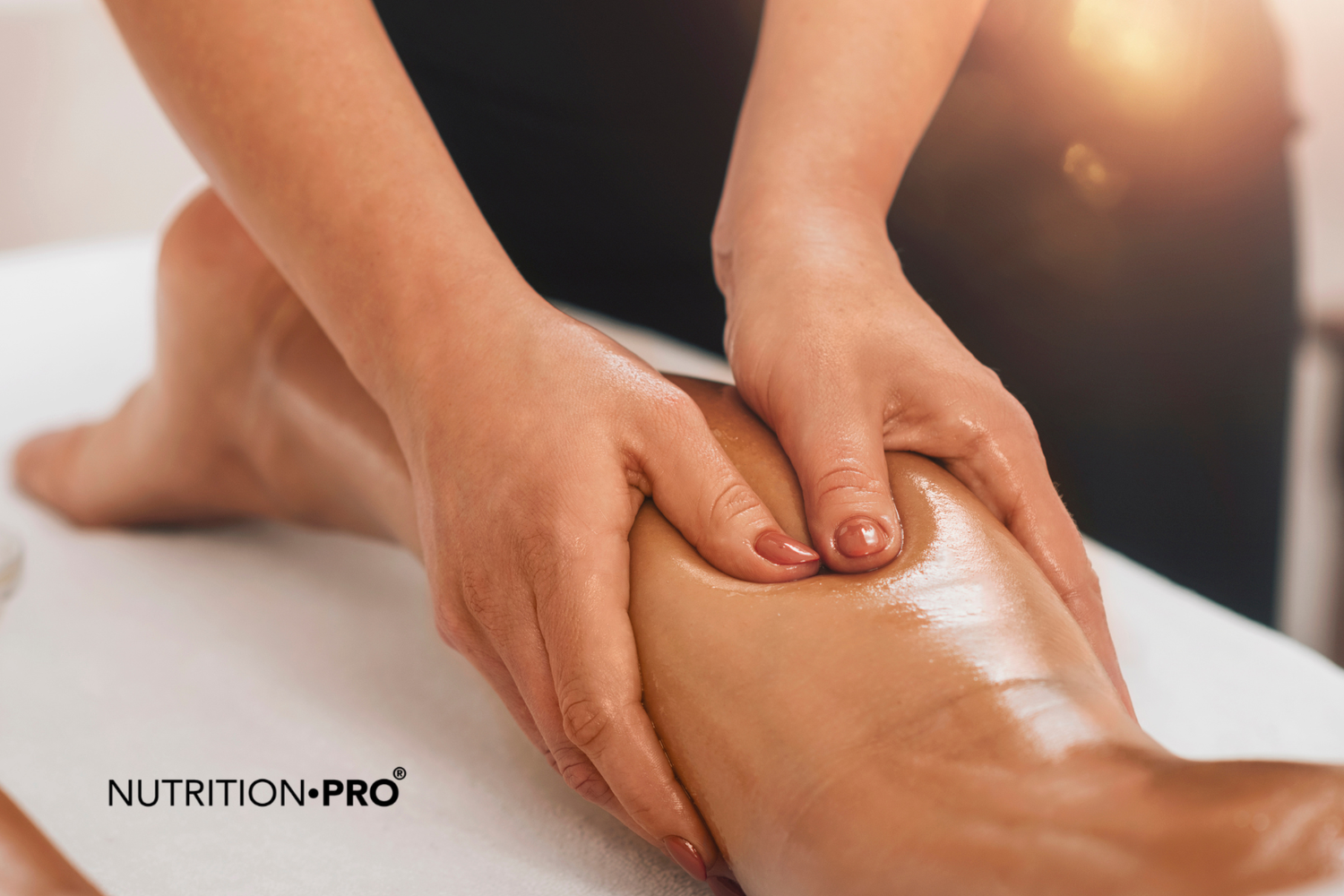
"Lymphatic drainage" is one of the most used terms in wellness, and one of the least defined. It designates both a massage, a promise of lighter legs, a slimming argument and a family of plants. Behind the word, there is a very real system, the lymphatic system, which recovers two to three liters of fluid in the tissues each day and which, unlike blood, has no pump.
This article takes the term seriously and examines what studies have measured for each of its means: the manual massage, evaluated by a Cochrane review in the most demanding situation possible; the venotonic plants, horse chestnut, red vine and rutin, with three Cochrane reviews and two randomized trials of 250 patients; and the daily practices that form the foundation. With the data, and the red line of a swollen leg that requires medical attention.

The massage. In lymphedema following breast cancer, the Cochrane review of six trials shows that added to compression, manual drainage provides 7% additional reduction in arm volume, and that it is safe. Mild to moderate forms respond best. Horse chestnut. Cochrane review: leg pain reduced in six out of seven trials, up to 42 mm on a scale of 100, leg volume reduced by 32 ml, one trial finding it as effective as compression stockings.
Red vine. Two randomized trials of 250 patients: at 720 mg per day, leg volume reduced by approximately 100 g and calf reduced by more than1.5 cm in 12 weeks, edema reduced at least as much as with compression according to the authors. Rutine. The most studied phlebotonic, 28 trials out of 69 in the Cochrane review: 30% reduced risk of edema, ankle refined by 4.3 mm. The red flag. One leg swollen on only one side, red, warm, painful—that's a blood clot: emergency.
The lymphatic system, and why it slows down
Blood brings oxygen and nutrients to tissues while filtering fluid out of capillaries. Some of this fluid returns through the veins; the rest, two to three liters per day, is recovered by the lymphatic system, filtered in the lymph nodes and returned to circulation. When this return is slower than the inflow, fluid accumulates: this isedema, the leg that swells by the end of the day, the shoe that pinches in the evening.
The difference with blood is decisive: lymph has no heart. It advances thanks to muscle contractions around the vessels, breathing, and valves that prevent it from flowing backward. This is why anything that immobilizes it slows it down, and anything that creates movement restarts it.
| What slows down lymph | Why |
|---|---|
| Prolonged standing or sitting | The calf muscles don't contract, the muscle pump is at a standstill |
| Heat | Veins dilate, venous return decreases, more fluid exits the capillaries |
| Tired veins, leaking valves | Blood stagnates in the legs, pressure increases, water passes into the tissues |
| Permeable capillaries | More fluid filters into the tissues than returns from them |
| Overweight, pregnancy, tight clothing | Compression of vessels at the level of the pelvis or thighs |
The three methods in this article act on these mechanisms: the massage and the gestures replace or restart the pump, the venotonic plants tighten the veins and capillaries so that less fluid exits and more returns.
Massage: what Cochrane measured
The manual lymphatic drainage is a slow massage, with light pressure, that follows the path of vessels toward the lymph nodes. It was evaluated by the Cochrane collaboration in the situation where the stakes are highest: the Arm lymphedema after breast cancer treatment, which affects more than one in five patients.
| What the review of six trials shows | Result |
|---|---|
| Massage added to compression bandaging | 7.11% additional reduction in arm volume, significant, two trials, 83 patients |
| Compression bandaging alone | 30 to 38.6% reduction: compression does the heavy lifting |
| Who responds best | Lymphedemas mild to moderate, more than severe cases |
| Massage versus pneumatic pump, with sleeve | 47 ml reduction in favor of massage, one trial of 24 patients |
| Pain, heaviness | 60 to 80% of participants improved, regardless of treatment |
| Safety | Well tolerated and safe in all trials |
The review addresses a pathology, not comfort. It establishes two transferable findings: massage actually displaces fluid, since it adds a measurable reduction to compression, and it is safe. It also establishes that compression does the essential work, and that massage is complementary.
For heavy legs without lymphedema, no trial of this caliber exists. The sensation of lightness after a session is real and reported by most people; it simply has not been measured with the same rigor. A lymphedema following cancer, however, requires a trained physical therapist.
Horse chestnut: the Cochrane review
The horse chestnut, Aesculus hippocastanum, owes its action toaescin, which reduces capillary permeability and strengthens vein walls. It is the most evaluated venotonic plant by the Cochrane collaboration, whose review has been updated five times.
| Criterion | Cochrane review result |
|---|---|
| Leg pain, seven trials versus placebo | Significantly reduced in six ; one trial quantified the difference at 42.4 mm on a 100-point scale |
| Leg volume, six trials, 502 patients | Reduced by 32.1 ml on average compared to placebo |
| Versus compression stockings, one trial | Horse chestnut could be equally effective |
| Adverse effects | Usually mild and rare |
| Authors' conclusion | Treatment effective and safe in the short term for chronic venous insufficiency |
The authors add that larger trials would be useful to confirm, which is the standard formula from Cochrane, but the verdict is in: effective and safe. For a plant, this is one of the clearest conclusions the collaboration has written. They also note why the question matters: compression, the standard treatment, is poorly tolerated and poorly adhered to, and an oral option addresses a real need.
Red vine: two trials of 250 patients
The red vine, Vitis vinifera, acts through its flavonoids, especially quercetinderivatives, which protect capillary walls. Two randomized, double-blind, multicenter trials of 12 weeks each measured its effect on leg volume using the most objective method, water displacement.
| Trial | What was measured | Result |
|---|---|---|
| First trial, 257 patients, mild stages | Leg volume, 720 mg per day | Approximately 100 g less than placebo at 12 weeks; under placebo leg volume had increased |
| Calf circumference | 1.3 to 1.7 cm less than placebo | |
| Symptoms | Improved in all groups at 6 weeks, continued improvement at 12 weeks only with red vine | |
| Second trial, 248 patients, moderate to severe stages | Leg volume, 720 mg per day | 19.9 ml less than placebo, effect size 0.28, considered clinically relevant |
| Leg pain | Reduced significantly | |
| Tolerability | Identical to placebo |
Rutin and phlebotropics: 69 trials
The rutin and its derivatives, the rutosides, are flavonoids present in buckwheat, citrus fruits and many plants. They are the most studied phlebotropics in the world : of the 69 randomized trials in the Cochrane review dedicated to phlebotropics, 28 focus on rutosides.
| Criterion | Result, 7,690 participants | Level of certainty |
|---|---|---|
| Leg edema | 30% lower risk than with placebo, 13 trials, 1,245 participants | Moderate |
| Ankle circumference | 4.27 mm less, 15 trials, 2,010 participants | Moderate |
| Quality of life | No measurable difference | Moderate |
| Adverse effects | Slightly more frequent than with placebo, mainly digestive | Moderate |
The picture is consistent with the two previous plants: a measurable effect on edema, modest, achieved with good but not perfect tolerability. The authors note that the trials are short and that long-term safety has not been studied, which argues for courses of treatment rather than permanent use.
Witch hazel and the complete formula
<<<23>>> Witch hazelhamamélis, Hamamelis virginiana, is rich in astringent tannins and is part of the traditional plants for venous comfort in Europe and North America. Its clinical documentation by oral route is thinner than that of the three others: we did not retain a randomized trial of the same level, and we prefer to be clear about it. Its role in a formula is that of a traditional complement to the active ingredients that, themselves, have trials.
| Plant | What it provides | Level of evidence |
|---|---|---|
| Horse chestnut | Escin: venous tone, less permeable capillaries, reduced pain and volume | Cochrane review, effective and safe |
| Red vine | Quercetin flavonoids: capillary protection, reduced leg volume | Two randomized trials of 250 patients |
| Rutin | Rutosides: reduced capillary permeability, reduced edema | 28 trials in the Cochrane review of phlebotonicss |
| Witch Hazel | Astringent tannins, traditional use for venous comfort | Tradition, few oral trials |
The three documented plants act on neighboring but distinct mechanisms : escin on the tone of the venous wall, red vine flavonoids and rutosides on capillary permeability through different molecules. Combining them covers both mechanisms of edema, blood that stagnates and fluid that leaks. This is why serious venotonic formulas have been combining them for a long time.
Each plant was studied alone in the trials cited. The combination itself has not been subject to a specific trial, and the doses from the trials, 720 mg of red vine extract for example, are a reference point for reading a label.
Daily actions, and when to consult
Lymph has no pump, and the first lymphatic drainage is what the body does when it moves. These actions are the foundation; plants and massage come in addition.
- Walking, climbing stairs, contracting the calves while seated: each contraction pushes blood and lymph upward.
- Elevate the legs at the end of the day and at night, above heart level if possible: gravity works for you.
- End the shower with a cool stream, from the ankles toward the thighs: the cold tightens dilated veins.
- Avoid direct heat on the legs, very hot baths, sauna, prolonged sun exposure.
- Move every hour during prolonged standing or sitting, when traveling, at the office.
- Compression, stockings or socks, remains the most documented action, the one Cochrane uses as a reference.
Swelling in one leg only, that appeared suddenly, painful, with skin that is red or warm : this is the picture of phlebitis, an emergency that is treated neither by massage nor by a plant, and which can worsen if not managed. Swelling that does not subside at night and with elevation. Skin that thickens, darkens, or an ulcer. Swelling associated with shortness of breath. And all lymphedema after cancer, which requires a trained physical therapist and custom compression.
What to do in practice
Frequently asked questions
Understanding
What is lymphatic drainage?
The term first designates a technique of manual massage, slow and superficial, which follows the path of lymphatic vessels to help lymph circulate toward the lymph nodes. By extension, it designates anything that promotes the evacuation of fluids that accumulate in tissues: daily measures, compression, and plants that act on veins and capillaries. This article reviews what studies show for each.
What is the lymphatic system for?
To recover the fluid that exits blood capillaries to nourish tissues, approximately two to three liters per day, and return it to blood circulation by filtering it through the lymph nodes. Unlike blood, lymph has no pump: it advances through muscle contractions, breathing, and the valves in its vessels. This is why immobility, prolonged standing, and heat slow it down, and why movement stimulates it.
Does lymphatic drainage cause weight loss?
No. It displaces water, not fat. A drainage session or a course of venotonics can reduce swelling and visually slim down an ankle or calf, which is real, but the number on the scale that changes is water, which returns if the cause persists. For fat, caloric deficit is what matters, and our weight loss guide details the rules.
Lymphatic drainage and cellulite?
Water retention contributes to the appearance of cellulite, and anything that improves venous and lymphatic return can smooth skin appearance. But cellulite also depends on the structure of adipose tissue and fibrous septa, which drainage does not affect. Our article on cellulite details what works at each level.
Massage
Is lymphatic drainage massage effective?
It has been rigorously evaluated in lymphedema after breast cancer, where the stakes are highest. A Cochrane review of six trials shows that, added to compression bandaging, manual drainage provides an additional 7% reduction in arm volume, and that it is safe and well-tolerated in all trials. People with mild to moderate lymphedema benefit the most. For ordinary heavy legs, there are no trials of this level; the reported sense of lightness is real but has not been measured the same way.
Plants
What does horse chestnut show?
The Cochrane review on horse chestnut seed extract for venous insufficiency concludes it is an effective and safe short-term treatment. Of seven trials versus placebo, six showed significant reduction in leg pain, with one trial measuring the difference at 42 mm on a 100-point scale. Six trials totaling 502 patients showed leg volume reduction of 32 ml on average compared to placebo. One trial suggests horse chestnut could be as effective as compression stockings. Adverse effects were rare and mild.
What does red vine leaf show?
Two double-blind randomized trials on red vine leaf extract, in 257 and then 248 patients, over 12 weeks. In the first, a dose of 720 mg per day reduced leg volume by approximately 100 g and calf circumference by more than one and a half centimeters compared to placebo, with symptom improvement continuing at 12 weeks only under active treatment. In the second, volume reduction was approximately 20 ml and leg pain decreased. The authors of the first trial consider the edema reduction at least equivalent to that reported for compression stockings.
What does rutin show?
Rutin and its derivatives, rutosides, are the most studied phlebotonic agents: 28 of the 69 trials in the Cochrane review on phlebotonics concern them. Across all phlebotonic agents, 7,690 participants, the review concludes with moderate certainty that they reduce leg edema, with 30% lower risk of edema, and ankle circumference of 4.3 mm less compared to placebo. Adverse effects, mainly digestive, were slightly more frequent than with placebo. Quality of life was not measurably affected.
And witch hazel?
Witch hazel is rich in astringent tannins and is part of traditional plants for venous comfort, often combined with horse chestnut and red vine leaf in formulas. Its clinical documentation by oral route is thinner than the other three: we did not select a randomized trial of the same level. Its role in a formula is that of a traditional complement to the active ingredients that, themselves, have trials.
Do plants replace compression stockings?
Two sources suggest they do for mild stages: the Cochrane review on horse chestnut cites one trial where it was as effective as stockings, and the red vine leaf trial judges edema reduction at least equivalent to that reported for compression. But compression remains the standard, especially at advanced stages, and the ideal is to combine them: plants are the option for those who cannot tolerate stockings, which Cochrane authors note as a real compliance problem.
In practice
How long before results?
Trials on red vine leaf show symptom improvement at 6 weeks and measurable leg volume reduction at 12 weeks. Trials on horse chestnut most often last 2 to 12 weeks. An 8 to 12-week course corresponds to what has been studied, and it is at the end of the course that volume measurement makes the difference.
What daily habits really help?
Those that restart the muscle pump and flow: walking, climbing stairs, contracting calves while seated, elevating legs at day's end, ending showers with cool water from ankles to thighs, avoiding direct heat and prolonged standing or sitting without movement. Compression remains the most documented action. These are the habits that plants accompany, not the reverse.
Can you take a venotonics formula long-term?
Trials covered periods of 2 to 12 weeks, and the Cochrane review on phlebotonics emphasizes that safety in the medium and long term has not been studied in these trials. A seasonal course, in summer or during periods of prolonged standing, corresponds to the studied durations. The plants in question have been used for a long time in Europe, and adverse effects reported in trials were rare and mild, mainly digestive.
How to combine massage, habits, and plants?
In this order of priority: daily habits, because lymph has no pump and movement is its engine; compression if legs swell; venotonics in an 8 to 12-week course to act on vein tone and capillary permeability; massage for comfort and, in lymphedema, as a complement to compression with a professional. None replaces the other, each has its measure in the studies.
Safety
What signs should prompt a consultation?
Swelling in only one leg, appearing suddenly, painful, with red or warm skin: this is the picture of phlebitis, an emergency that is treated neither by massage nor by plants. Swelling that does not subside with nighttime elevation, skin thickening or browning, an ulcer, shortness of breath associated. And any lymphedema after cancer, which requires a trained physiotherapist and custom compression.
Are there precautions?
Horse chestnut should not be taken with anticoagulant treatment without medical advice, nor in case of kidney or liver insufficiency. Pregnancy and breastfeeding call for caution with all these plants, due to lack of data. Phlebotonics can cause mild digestive upset; taking them with meals limits this. And sudden, one-sided, painful swelling should be evaluated before anything else.
What to remember about lymphatic drainage?
That manual massage provides measurable benefit as a complement to compression in lymphedema, and real comfort elsewhere. That three plants have solid trials: horse chestnut, with a Cochrane review finding it effective and safe, red vine leaf, with two trials of 250 patients that reduce leg volume, and rutin, the most studied phlebotonic, which reduces edema in 69 trials. That daily habits are the foundation. And that a swollen, red, hot, and painful leg requires urgent consultation.
Glossary
- Lymphatic system
- A network of vessels and nodes that collects fluid from tissues, filters it, and returns it to blood circulation.
- Lymphedema
- Chronic swelling due to lymphatic drainage failure, common after cancer surgery or radiotherapy.
- Edema
- Accumulation of fluid in tissues, visible as swelling.
- Chronic Venous Insufficiency
- Inability of the veins in the legs to properly return blood to the heart, with heaviness, pain, and swelling.
- Phlebotonic, venotonic
- Substance that tones the vein wall and reduces capillary permeability.
- Aescin
- Mixture of saponins from horse chestnut seeds, active on capillary permeability and venous tone.
- Rutosides
- Flavonoids derived from rutin, the most studied phlebotonic compounds worldwide.
- Manual Lymphatic Drainage
- Slow and superficial massage following the path of lymphatic vessels toward the nodes.
- Phlebitis
- Blood clot in a deep vein, most often in the leg; unilateral swelling, pain, warmth; medical emergency.
- Water Displacement Volumetry
- Objective measurement of limb volume by immersion, the reference standard for edema trials.
Sources
The studies cited below were identified via PubMed.
- Ezzo J, et al. Manual lymphatic drainage for lymphedema following breast cancer treatment. Cochrane Database of Systematic Reviews, 2015;(5):CD003475. DOI
- Pittler MH, Ernst E. Horse chestnut seed extract for chronic venous insufficiency. Cochrane Database of Systematic Reviews, 2012;(11):CD003230. DOI
- Kiesewetter H, et al. Efficacy of orally administered extract of red vine leaves AS 195 in patients with chronic venous insufficiency stages I and II: randomized, double-blind, placebo-controlled trial. Arzneimittel-Forschung, 2000;50(2):109-117. DOI
- Rabe E, et al. Efficacy and safety of an extract of red vine leaves in patients with chronic venous insufficiency: a double-blind, placebo-controlled study. European Journal of Vascular and Endovascular Surgery, 2011;41(4):540-547. DOI
- Martinez-Zapata MJ, et al. Phlebotonic agents for venous insufficiency. Cochrane Database of Systematic Reviews, 2020;(11):CD003229. DOI


