

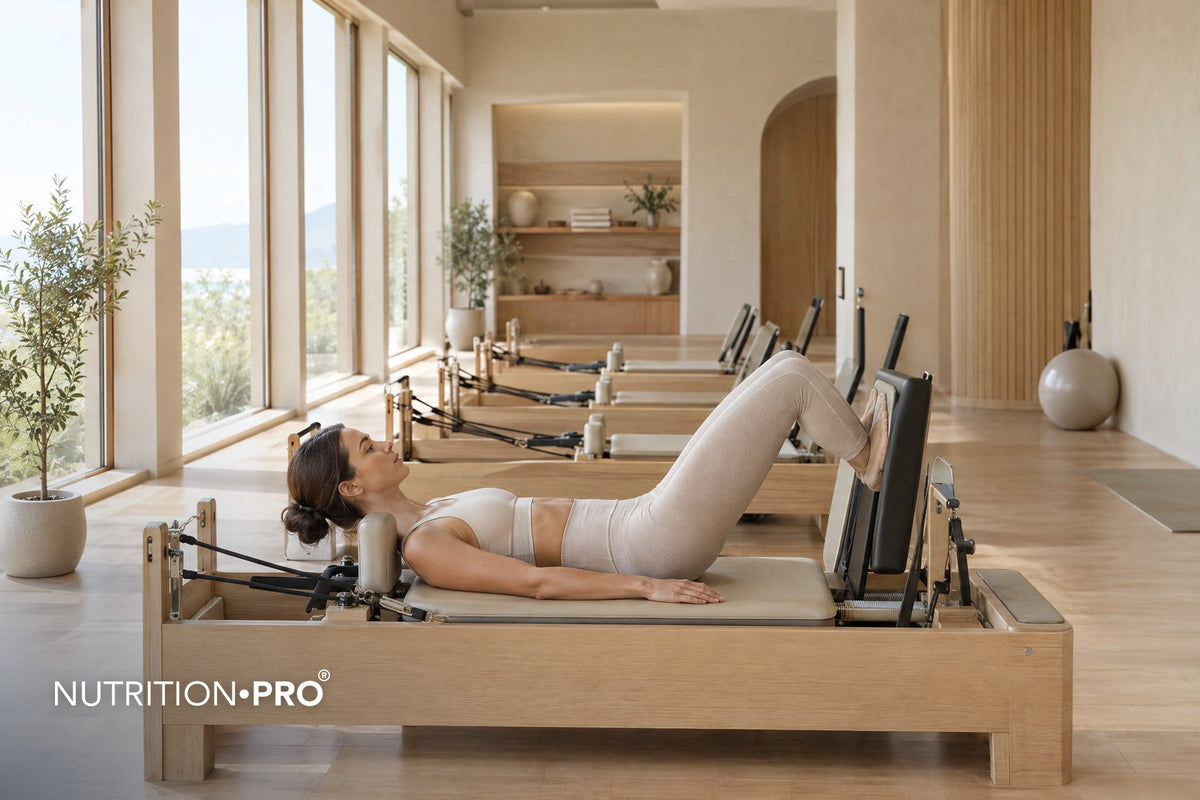
A carriage that slides on rails, springs that you attach to increase resistance, and straps for hands and feet: the reformer transforms Joseph Pilates exercises into resistance training. In a study conducted on 18 young women, two sessions of 15 exercises burned 2.59 kilocalories per minute on the reformer, compared to 1.93 on the mat.
This guide brings together what studies identified via PubMed show: benefits measured in sedentary women, seniors, athletes and in rehabilitation, trials comparing reformer and mat Pilates, actual intensity, trendy variations, number of sessions, pregnancy, mat work at home and collagen for joints.

On reformer or on the mat : both help you progress. In trials comparing them, most criteria do not differ, but the apparatus performed better on certain ones in 6 out of 9 trials, such as disability six months after chronic lower back pain or soccer players' agility, and the reformer burned slightly more in the only study that compares them: 2.59 kilocalories per minute versus 1.93.
Benefits and frequency : in 8 weeks of reformer work, overweight women increased their abdominal endurance test performance from 15 to 27 seconds. In lower back pain patients, two sessions per week performed better than one. During pregnancy, supervised Pilates reduces pain, but exercises performed lying on your back require caution and medical advice.
- The reformer: carriage, springs and straps
- Strength, stability and physique
- Seniors: balance, autonomy and fall prevention
- Athletes: agility, jumping and sprints
- Back pain and rehabilitation
- On reformer or on the mat: head-to-head trials
- Intensity and calories in a session
- Lagree and hot Pilates: what we know
- How many sessions per week?
- Pregnancy and reformer: caution and medical advice
- Between classes: mat Pilates at home
- Joints, tendons and collagen
- Frequently Asked Questions
The reformer: carriage, springs and straps
The reformer is the best-known piece of equipment in the Pilates method. Joseph Pilates intended it for performing his movements horizontally to protect the joints, by limiting the effects of gravity. He also designed the Cadillac, the chair (step chair) and the ladder barrel, but most of the current repertoire is divided between mat and reformer work.
The machine consists of a carriage that slides within a wooden or metal frame, connected to springs, pulleys and ropes ; you work lying down, sitting or standing. On the mat, you work mainly against body weight, sometimes with a ball, a ring or a resistance band; on apparatus, springs of varying intensities are added. Progress is made by changing springs or adding repetitions: 10 to 15 per set over 8 weeks, in one study with overweight women.
A session often begins lying on your back, feet on the bar, for leg work, then continues with sets for the arms using straps, exercises sitting or kneeling on the carriage and stretching. More springs doesn't always mean more difficult: for certain core exercises, a freer carriage becomes more unstable. These guidelines come from studio practice, not from studies.
Strength, core stability and physique
Studies on the reformer remain modest in size, but they point in the same direction. One of the most comprehensive involved 47 women aged 30 to 60, sedentary, overweight or obese, randomized to either follow or not follow 8 weeks of reformer training supervised by a physical therapist, three sessions of 50 to 60 minutes per week.
After 8 weeks of reformer work, endurance for trunk flexors improved from 15 to 27 seconds on the test, right hand grip strength increased from 20.9 to 23.4 kg and fat mass measured by bioimpedance decreased from 39.3 to 37.3%, while these values stagnated or worsened in the control group. Anxiety and depression scores also decreased; sleep quality did not change significantly.
Gökalp Ö, Kirmizigil B. Sci Rep 2025;15(1):23602. DOI: 10.1038/s41598-025-09683-8
In 78 inactive women, two one-hour sessions per week of apparatus-based Pilates for 8 weeks improved, compared to the control group, maximum oxygen consumption (VO2max), distance walked in a walking test and quality of life, without changing body composition measured by DXA absorptiometry.
Across all forms of Pilates combined, a meta-analysis of 12 studies in approximately 540 women found an average weight loss of 3.99 kg (very low certainty) and flexibility gains on the trunk flexion test (effect size of 0.69), but no significant effect on fat mass percentage or waist circumference. Our guide flat belly: what really works provides additional information on the subject.
An effect size relates the difference between two groups to the spread of measurements: by convention, 0.2 corresponds to a small effect, 0.5 to a medium effect and 0.8 to a large effect.
For posture, evidence remains limited in adults: a review of 18 studies with meta-analysis judges the improvement in shoulder alignment, lumbar lordosis or scoliosis to be of very low to low certainty, and of moderate certainty only in children and adolescents.
Seniors: balance, independence and falls
In people over 60, a meta-analysis of 39 randomized trials attributes to Pilates, compared to no exercise, effects of 0.36 on balance, 0.41 on flexibility, 0.51 on functional abilities, 0.63 on strength and 0.90 on fall risk; certainty is moderate for strength and fall risk, low for the rest. A more recent meta-analysis, 39 studies and 1,770 participants, confirms improved balance, but finds no reduction in the number of falls or fear of falling, and judges Pilates comparable to other forms of exercise.
The reformer is not essential at this age. In 48 active women averaging 65 years old who had never practiced Pilates, 8 weeks of mat or apparatus sessions, twice 50 minutes per week, improved leg and arm strength, aerobic endurance, flexibility and agility comparably.
The WHO recommends people over 65 varied activity combining balance and strengthening at least 3 days per week: a reformer class, supplemented by one or two mat sessions at home, fits this objective.
Athletes: agility, jumps and sprints
In athletes, Pilates is added to training rather than replacing it. One trial allocated 30 amateur footballers in their twenties between reformer, mat and control group: three Pilates sessions of 50 to 60 minutes per week for 8 weeks, in addition to three team trainings.
Both forms of Pilates improved balance, single-leg triple hop, agility and ball control. The reformer also improved vertical jump, from 41.2 to 45.3 cm, and performed better than mat on agility, a passing test and triple hop, with no difference for vertical jump, balance, flexibility or sprints.
Yılmaz O, Kaplan T, Batalik L. PLoS One 2025;20(5):e0324129. DOI: 10.1371/journal.pone.0324129
Mat Pilates also improved these players, without equipment. Adding sessions to training does require monitoring recovery: our guide fatigue or overtraining helps make the difference.
Back pain and rehabilitation
The Cochrane review dedicated to Pilates in low back pain, 10 trials and 510 participants, concludes a reduction in pain and disability compared to minimal intervention, with low to moderate quality evidence: approximately 14 points less pain on a 100-point scale in the short term. Compared to other exercises, no clear superiority emerges: the authors suggest choosing based on preferences and cost.
A more recent network meta-analysis, 118 trials and 9,710 adults with low back pain, nonetheless gave Pilates the best ranking score for pain (93%) as well as disability (98%): a trend, not an individual guarantee.
The reformer alone was tested in established pain. In 54 women aged 30 to 50 suffering from chronic lower back or neck pain, 6 weeks of reformer, two sessions of 45 minutes per week, reduced pain (effect sizes of 0.17 to 1.45 depending on measures), strongly decreased movement fear and improved sleep, compared to no exercise. For knees or shoulders, see our guide on joint pain.
On reformer or mat: head-to-head trials
Nine randomized trials presented in this guide directly compare the two formats. The longest followed low back pain patients for 6 months.
In 86 patients with chronic low back pain, 12 Pilates sessions over 6 weeks, on mat or apparatus, were compared by an evaluator blinded to patient group. Six months after randomization, the apparatus group showed lower disability (3-point difference), better capacity in activities they found difficult (1.1 points) and less movement fear (4.9 points), with no difference in pain or perceived overall effect.
da Luz MA, Costa LO, Fuhro FF, et al. Phys Ther 2014;94(5):623-631. DOI: 10.2522/ptj.20130277
In a second trial, in 98 low back pain patients, both groups improved in 12 weeks on pain, disability, movement fear and transversus abdominis activation, but faster with apparatus, whose feedback would help, according to the authors, integrate the method's principles. A network meta-analysis of 45 trials (2026) ranks both formats among the most favorable against disability related to chronic low back pain: effect size of −0.88 on apparatus (moderate confidence) and −0.64 on mat (very low confidence) versus a control group, with no definitive hierarchy according to its authors.
| Population | Protocol | Apparatus versus mat | Study |
|---|---|---|---|
| Chronic low back pain, 86 patients | 12 sessions over 6 weeks | Apparatus better at 6 months on disability and movement fear, not on pain | da Luz, 2014 |
| Chronic low back pain, 98 patients | 12 weeks | Progress in both groups, faster with equipment | Cruz-Díaz, 2017 |
| Women aged 65, 48 | 8 weeks, 2 sessions of 50 minutes | Comparable gains in strength, endurance, flexibility and agility | Mueller, 2021 |
| Healthy women, 20 | 8 weeks, 3 sessions of 50 minutes, on barrel | Comparable gains in muscle, fat mass and core activity | Seong, 2025 |
| Multiple sclerosis, 38 patients | 8 weeks, 2 sessions per week | Comparable gains, trunk flexor strength better on reformer | Bulguroglu, 2017 |
| Fibromyalgia, 28 women | 6 weeks, 2 sessions per week, at home on mat | No difference between groups | Caglayan, 2023 |
| Ankylosing spondylitis, 20 patients | 4 weeks, 2 sessions per week | Disease activity and fatigue improved on reformer | Kabul, 2025 |
| Amateur football players, 30 | 8 weeks, 3 sessions of 50 to 60 minutes | Agility, passes and triple jump better on reformer | Yılmaz, 2025 |
| Painful periods, 45 women | 12 weeks, 2 sessions of 60 minutes | Pain and sleep improved on reformer, depression and fatigue comparable | Şevgin, 2026 |
A clue to explain this comes from ultrasound imaging: in 26 experienced practitioners, the transverse abdominis was thicker during the hundred exercise on a reformer than during the same exercise on the mat, and the footprint exercise, performed without engaging the core, no longer activated this muscle. Execution matters as much as the tool.
In practice, the reformer provides adjustable resistance, a guided movement and a wide variety of exercises, but requires an equipped studio, meaning a budget and set schedules. The authors of the trial on painful periods conclude that, without a reformer, mat Pilates remains a practical alternative. Mat work requires more autonomy and can be practiced anywhere with just a simple mat, like our NP Pilates Mat.
Intensity and calories in a session
Energy expenditure during a session has only been measured in a handful of studies, with only one, according to a recent meta-analysis, comparing reformer and mat.
In 18 healthy young women, two sessions of 15 exercises, one on a reformer and one on a mat, were compared by measuring oxygen consumption. The reformer session cost 2.59 kcal per minute versus 1.93 on the mat, for 8.67 versus 6.44 ml of oxygen per kilogram per minute. Neither significantly elevated blood lactate levels, heart rate, or blood pressure above resting values.
de Souza Andrade L, da Silva Almeida I, Mochizuki L, et al. J Bodyw Mov Ther 2021;26:36-42. DOI: 10.1016/j.jbmt.2020.12.007
This meta-analysis of 6 studies estimates a typical session at 3.7 METs and 3.8 kcal per minute, or 3.0 METs and 2.9 kcal per minute in its most conservative estimate, considered the most reliable; certainty remains very low to low, and few participants had practiced on equipment. Rest periods of 60 seconds or less between exercises were associated with higher intensity.
The MET expresses exercise intensity in multiples of resting expenditure, and the WHO places moderate activity beyond 3 METs: Pilates sits at the boundary between light and moderate effort. In inactive women, Pilates on equipment improved VO2max in 8 weeks: the starting point matters.
| Activity | Measured intensity | Study |
|---|---|---|
| Reformer session, 15 exercises | 2.59 kcal per minute, 8.67 ml of oxygen per kilogram per minute | de Souza Andrade, 2021 |
| Mat session, 15 exercises | 1.93 kcal per minute, 6.44 ml of oxygen per kilogram per minute | de Souza Andrade, 2021 |
| Typical Pilates session, 6 studies | 3.0 to 3.7 METs; 2.9 to 3.8 kcal per minute | Vitor, 2026 |
| Pilates compared to walking | Like a walk at 3.2 km/h, less than at 4.8 km/h | Gultekin, 2024 |
To lose weight, a reformer session alone carries little weight: the 150 to 300 minutes of moderate-intensity endurance recommended each week by the WHO must be found elsewhere, for example through walking (see our guide walking for weight loss), and our article how many calories per day details the calculation of needs.
Lagree and hot Pilates: what we know
The Lagree, which is named after its creator, is practiced on a machine inspired by the reformer, with slow movements and prolonged time under tension. We found no studies indexed in PubMed dedicated to this method: its specific effects therefore remain unknown.
Hot Pilates is practiced in a heated room, and no PubMed study has directly evaluated it. The closest data comes from heated room yoga: in 16 regular Bikram yoga practitioners, heart rate increased by 62% during a 90-minute session, averaging 126.6 beats per minute, while diastolic blood pressure decreased by approximately 10%, which the authors link to vessel dilation caused by heat.
During pregnancy, women are advised to avoid thermal stress due to the risk of birth defects associated with a body temperature of 39°C or higher. In a review of 12 studies, conditions deemed safe for exercise outside water were established for 35 minutes at 80 to 90% of maximum heart rate, at 25°C and 45% humidity: a heated room falls outside this framework; as a precaution, we advise avoiding hot Pilates during pregnancy. For everyone: hydration, gradual return to activity, and stopping at any sign of discomfort.
How many sessions per week?
A Brazilian trial compared several frequencies in 296 adults suffering from chronic lower back pain: all received advice and a brochure, and three groups of 74 patients added 6 weeks of Pilates, at a rate of one, two, or three sessions per week.
Compared to the brochure alone, pain decreased by 1.2 points with one session per week, by 2.3 with two, and by 2.1 with three; disability decreased by 1.9, 4.7, and 3.3 points respectively. Two sessions performed significantly better than one. Economic analysis designated three sessions as the preferable option, and the authors note that the attention received and expectations may have contributed to the effect.
Miyamoto GC, Franco KFM, van Dongen JM, et al. Br J Sports Med 2018;52(13):859-868. DOI: 10.1136/bjsports-2017-098825
In the network meta-analysis of 118 trials cited above, the most beneficial programs against lower back pain included at least one to two Pilates or strengthening sessions per week. In the trials presented here, most protocols included 2 to 3 sessions of 45 to 60 minutes per week, for 4 to 12 weeks. The WHO recommends all adults perform muscle strengthening of at least moderate intensity 2 days per week or more: two reformer sessions, or one on reformer and one on mat, meet this requirement.
Pregnancy and reformer: caution and medical advice
The 2019 Canadian guidelines encourage physical activity throughout pregnancy in the absence of contraindication: it is associated with neither miscarriages nor premature births, and is accompanied by reduced severity of lower back and pelvic pain. In case of relative contraindication, discuss it with your doctor or midwife: activity may need to be adapted as the months progress.
According to a review of 13 studies published in 2026, of which 10 were combined in meta-analysis, a structured prenatal Pilates program reduces musculoskeletal pain by 2.59 points on a 10-point scale compared to usual care (moderate certainty), as well as pregnancy-related disability (low certainty). Participants were between 14 and 32 weeks of pregnancy, women with contraindication or multiple pregnancy were excluded, and adverse effects were not analyzed.
The reformer raises a particular question because a significant portion of its exercises are performed supine. A systematic review could not determine whether exercise in this position is safe or should be avoided during pregnancy: in observational studies, abnormal fetal heart rate patterns were noted in 20 out of 65 fetuses, or 31%, during acute exertion supine, and uterine blood flow decreased by 13% between rest on the left side and exercise supine, with no adverse effects reported in mothers.
Discuss the reformer with your doctor or midwife before starting or continuing. Prioritize a prenatal class with a trained instructor who adapts positions and limits time spent supine as trimesters progress. Stop and consult if you experience bleeding, contractions, loss of fluid, chest pain, or dizziness. Avoid hot Pilates. Marine Collagen drink and Novagen are not recommended for pregnant and breastfeeding women.
The nutritional needs of pregnancy are the subject of other guides, starting with the one onfolic acid.
Between classes: floor Pilates at home
Practicing at home can also yield results, at least with proper guidance. In 58 healthy adults aged 25 to 40, 8 weeks of Pilates with three one-hour sessions per week in small groups guided by a physical therapist improved core muscle endurance, depressive symptoms, and quality of life, with overall similar gains via videoconference and in-person. In fibromyalgia, a home-based floor program produced results comparable to the reformer.
Technique matters more on the floor, since the apparatus no longer guides the movement: a few supervised classes initially, then regular sessions at home, help maintain movement precision.
The mat must first stay in place: a non-slip base prevents it from sliding during planks or stretches. A thin and stable mat promotes balance and proprioception; if your knees are sensitive, a folded towel can provide additional cushioning. Plan for sufficient length to lie down completely.

Joints, tendons, and collagen
The reformer is often presented as having low impact on joints, but knees, ankles, and tendons do work, especially when combining sessions and other sports. Tendons, ligaments, and cartilage depend on a matrix whose type I and II collagens are the primary constituents.
In an initial trial, 139 young athletes with functional knee pain received 5 g of specific collagen peptides or placebo daily for 12 weeks: pain during activity decreased by 19.5 points on the visual analog scale, compared to 13.9 under placebo. The same team replicated the trial in a larger group.
In 180 adults aged 18 to 30 years, exercising more than 3 hours per week and experiencing knee pain during activity, 5 g daily of specific porcine collagen peptides for 12 weeks reduced pain during activity by 21.9 mm on a 100-point scale, compared to 15.6 mm under placebo; according to the physician, 23.0 versus 14.6 mm, a moderate effect. Pain at rest and after squats did not differ between groups.
Zdzieblik D, Brame J, Oesser S, et al. Nutrients 2021;13(2):523. DOI: 10.3390/nu13020523
Let's compare honestly with our products. Participants took 5 g daily of specific collagen peptides, porcine origin in the 2021 trial, dissolved in a glass of water; our Marine Collagen to drink provides 5,000 mg of Naticol® type 1 marine collagen hydrolysate per 25 ml shot. The dose is the same, but the formulation differs, and the authors specify that their results apply only to the tested product and cannot be transposed to other collagens.
Regarding tendons, in 50 men undergoing 14 weeks of heavy leg strength training, 5 g daily of specific collagen peptides increased patellar tendon cross-section more than placebo, with no significant difference between groups for strength and muscle volume. In a pilot trial in 20 patients with Achilles tendinopathy, 2.5 g taken twice daily, 30 minutes before calf strengthening, appears to have accelerated improvement in VISA-A functional score, +12.6 points in 3 months versus +5.3 under placebo, a result to be confirmed according to the authors. These trials also used specific peptide preparations, different from our marine collagens.
A 2024 meta-analysis of 19 trials and 768 participants summarizes these findings: when combined with regular training, collagen peptides improved tendon morphology (effect size 0.67, very low certainty), lean mass (0.48, moderate certainty), and maximum strength (0.19, a small effect). Dose does not explain everything: 15 g daily for more than 3 months did not further thicken the patellar tendon in one trial, while 5 g did in another.
Our marine collagens are also available in two other formats: Novagen, premium marine collagen, with 5 g of Naticol x3Peptide including 1,250 mg of tripeptides and 120 mg of vitamin C per dose, and Marine collagen powder, with 10 g of Naticol type 1 marine collagen, 210 mg of hyaluronic acid, and 80 mg of vitamin C per day. Our guides on collagen and joints, when to take collagen and recurrent tendinitis extend on the topic.
Marine Collagen to drink is not recommended for children, pregnant and nursing women, and persons allergic to salicylate derivatives; Novagen, for pregnant and nursing women. Joint or tendon pain that persists or swells warrants medical advice.
5,000 mg of Naticol® type 1 marine collagen hydrolysate per 25 ml shot, with 60 mg of vitamin C, 20 mg of coenzyme Q10 and 10 mg of hyaluronic acid, in grape flavor. One shot per day, a 20-day course, in a format that fits in your gym bag.
View Marine Collagen DrinkFor your floor sessions between classes, discover our NP Pilates Mat.
Frequently Asked Questions
What is Pilates reformer?
It's the Pilates method practiced on a reformer: a carriage that slides within a frame, connected to springs, pulleys and ropes. The springs add adjustable resistance and guide the movement, whether lying down, sitting or standing.
What's the difference between reformer Pilates and floor Pilates?
The principles are the same, the resistance changes. On the floor, you work against your body weight; on a reformer, springs are added to this and the carriage guides the movement. The reformer requires an equipped studio, the floor requires just a simple mat.
Is reformer Pilates more effective than floor Pilates?
Not in all aspects: most criteria don't differ, but in 6 out of 9 comparative trials, the machines had the advantage on certain criteria, such as disability six months after chronic lower back pain or agility in soccer players.
What are the benefits of reformer Pilates?
Gains in core strength, strength and flexibility, improved body composition, less anxiety and back pain. In overweight women, 8 weeks of reformer increased endurance sit-up test performance from 15 to 27 seconds.
How many times per week should you do reformer Pilates?
Two to three sessions of 45 to 60 minutes, as in most trials. In a trial with 296 lower back pain patients (74 per group), two sessions per week performed better than one. The WHO recommends muscle strengthening at least 2 days per week.
How many calories does a reformer Pilates session burn?
In a study of 18 young women, one reformer session burned 2.59 kcal per minute, compared to 1.93 on the floor. A meta-analysis places Pilates between 3.0 and 3.7 METs: a light to moderate intensity.
Does reformer Pilates make you lose weight?
Modestly. In overweight women, 8 weeks of reformer reduced weight from 76.0 to 74.7 kg and fat mass by approximately 2 points. Add the aerobic exercise recommended by the WHO, 150 to 300 minutes per week.
Can you do reformer Pilates while pregnant?
Only after consulting your doctor or midwife, in a supervised prenatal class. Prenatal Pilates reduces pain, but some reformer exercises are performed lying on your back, a position whose safety during exercise has not been established.
What is Lagree Pilates?
A method named after its creator, practiced on a machine inspired by the reformer, with slow movements and prolonged time under tension. No studies indexed in PubMed have evaluated it to date.
Does hot Pilates present risks?
It has not been studied as such. In heated yoga, average heart rate reached 126.6 beats per minute over 90 minutes. Stay hydrated, progress gradually and avoid this practice during pregnancy.
Do you need to buy a reformer Pilates machine to progress?
No. In all comparative trials, floor Pilates also led to progress, even though machines performed better on certain criteria in 6 out of 9, and online classes gave gains globally similar to in-person classes. A non-slip mat is enough to practice at home between classes.
Sources
The studies cited below were identified via PubMed.
- Şevgin Ö, Postacı S, Dikmen Hoşbaş B. Comparison of two Pilates methods in women suffering from painful menstruation: a randomized controlled trial. Scientific Reports, 2026;16(1). DOI
- Gökalp Ö, Kirmizigil B. Effects of reformer Pilates on body composition, strength and psychosomatic factors in overweight or obese women: a randomized controlled trial. Scientific Reports, 2025;15(1):23602. DOI
- Yılmaz O, Kaplan T, Batalik L. Randomized controlled trial on the effects of Pilates in football: comparison of mat and reformer methods on physical and technical performance. PLoS One, 2025;20(5):e0324129. DOI
- Vitor GBB, de Oliveira LC, Pessôa RAG, et al. Metabolic intensity and energy cost of Pilates exercises: systematic review and exploratory meta-analysis of limited and heterogeneous data. Systematic Reviews, 2026;15(1):42. DOI
- Martins FM, da Silva EG, Souza MA, et al. Eight weeks of apparatus-based Pilates improve quality of life and functional capacity in inactive adult women: a randomized controlled trial. The Journal of Sports Medicine and Physical Fitness, 2021;61(3):435-443. DOI
- Bajčetić Č, Rudović V, Novaković M, et al. Effects of Pilates programs on body composition, flexibility, strength, balance, functional performance, and respiratory function in adult women: systematic review and meta-analysis. Sports, 2026;14(9):407. DOI
- Roque GC, de Oliveira RG, Sorzi MV, de Oliveira LC. Do Pilates exercises improve postural alignment defects? Systematic review and meta-analysis. Musculoskeletal Care, 2024;22(4):e70009. DOI
- Fernández-Rodríguez R, Álvarez-Bueno C, Ferri-Morales A, et al. Pilates improves physical performance and reduces fall risk in older adults: systematic review and meta-analysis. Physiotherapy, 2021;112:163-177. DOI
- de Campos Júnior JF, de Oliveira LC, Dos Reis AL, et al. Effects of Pilates on postural balance and fall risk reduction in older adults: systematic review and meta-analysis. Complementary Therapies in Clinical Practice, 2024;57:101888. DOI
- Mueller D, Redkva PE, Fernando de Borba E, et al. Effect of mat or apparatus-based Pilates on functional capacity in older women. Journal of Bodywork and Movement Therapies, 2021;25:80-86. DOI
- Bull FC, Al-Ansari SS, Biddle S, et al. 2020 World Health Organization guidelines on physical activity and sedentary behavior. British Journal of Sports Medicine, 2020;54(24):1451-1462. DOI
- Yamato TP, Maher CG, Saragiotto BT, et al. Pilates for low back pain. Cochrane Database of Systematic Reviews, 2015;2015(7):CD010265. DOI
- Fernández-Rodríguez R, Álvarez-Bueno C, Cavero-Redondo I, et al. The best exercise options to reduce pain and disability in adults with chronic low back pain: Pilates, strengthening, core stabilization and mind-body practices, a network meta-analysis. Journal of Orthopaedic and Sports Physical Therapy, 2022;52(8):505-521. DOI
- Şahan N, Uluğ N, Özeren A. Effects of reformer Pilates on pain, psychological factors and sleep in chronic musculoskeletal pain: a randomized controlled trial. BMC Psychology, 2025;13(1):836. DOI
- da Luz MA, Costa LO, Fuhro FF, et al. Efficacy of mat or apparatus Pilates in patients with nonspecific chronic low back pain: a randomized controlled trial. Physical Therapy, 2014;94(5):623-631. DOI
- Cruz-Díaz D, Bergamin M, Gobbo S, et al. Comparative effects of 12 weeks of apparatus Pilates and mat Pilates on pain, function and transversus abdominis activation in chronic low back pain: a randomized controlled trial. Complementary Therapies in Medicine, 2017;33:72-77. DOI
- Robles-García M, González JLS, Sánchez-Sánchez JL, et al. Comparative effects of therapeutic exercise techniques and manual therapy on disability in nonspecific chronic low back pain: a network meta-analysis. Journal of Clinical Medicine, 2026;15(12):4809. DOI
- Seong D, Kim D. Effects of mat Pilates and barrel Pilates on body composition and muscle activity in adult women. Journal of Bodywork and Movement Therapies, 2025;44:686-690. DOI
- Bulguroglu I, Guclu-Gunduz A, Yazici G, et al. Effects of mat Pilates and reformer Pilates in patients with multiple sclerosis: a randomized controlled study. NeuroRehabilitation, 2017;41(2):413-422. DOI
- Caglayan BC, Basakci Calik B, Gur Kabul E, Karasu U. Efficacy of reformer Pilates in individuals with fibromyalgia: a randomized controlled trial. Reumatología Clínica (English Edition), 2023;19(1):18-25. DOI
- Kabul EG, Calik BB, Kuru S, Yigit M. Comparison of two Pilates methods in individuals with ankylosing spondylitis: a randomized controlled study. Journal of Bodywork and Movement Therapies, 2025;44:170-178. DOI
- Endleman I, Critchley DJ. Activity of transversus abdominis and internal oblique during Pilates exercises: measurement by ultrasound. Archives of Physical Medicine and Rehabilitation, 2008;89(11):2205-2212. DOI
- de Souza Andrade L, da Silva Almeida I, Mochizuki L, et al. What is the intensity of Pilates? Analysis of energy expenditure, blood lactate levels, and session intensity on apparatus and mat. Journal of Bodywork and Movement Therapies, 2021;26:36-42. DOI
- Gultekin SC, Ozcan Kahraman B, Kahraman T. Cardiorespiratory responses: Pilates compared to different walking speeds in healthy adults. Irish Journal of Medical Science, 2024;193(1):139-147. DOI
- Miranda Hurtado M, Meza Valladares C, Eblen-Zajjur A, Rodriguez-Fernandez M. Acute cardiovascular responses to a Bikram yoga session: an uncontrolled pilot trial. Journal of Alternative and Complementary Medicine, 2019;25(4):398-405. DOI
- Ravanelli N, Casasola W, English T, et al. Heat stress and fetal risk, environmental limits of exercise and passive heat exposure during pregnancy: a systematic review. British Journal of Sports Medicine, 2019;53(13):799-805. DOI
- Miyamoto GC, Franco KFM, van Dongen JM, et al. Different doses of Pilates in chronic low back pain: a randomized controlled trial with economic evaluation. British Journal of Sports Medicine, 2018;52(13):859-868. DOI
- Mottola MF, Davenport MH, Ruchat SM, et al. Canadian recommendations 2019 on physical activity during pregnancy. Journal of Obstetrics and Gynaecology Canada, 2018;40(11):1528-1537. DOI
- Song C, Shen Y, Tang X, et al. Pilates during pregnancy for maternal musculoskeletal pain and discomfort: a systematic review and meta-analysis. BMJ Open, 2026;16(5):e112441. DOI
- Mottola MF, Nagpal TS, Bgeginski R, et al. Is supine exercise associated with adverse effects in mother and fetus? A systematic review. British Journal of Sports Medicine, 2019;53(2):82-89. DOI
- Bulguroglu HI, Bulguroglu M. Effects of online and in-person Pilates in healthy individuals during the COVID-19 pandemic: a randomized controlled trial. BMC Sports Science, Medicine and Rehabilitation, 2023;15(1):12. DOI
- Zdzieblik D, Oesser S, Gollhofer A, König D. Improvement in activity-related knee discomfort following supplementation with specific collagen peptides. Applied Physiology, Nutrition, and Metabolism, 2017;42(6):588-595. DOI
- Zdzieblik D, Brame J, Oesser S, et al. Influence of specific bioactive collagen peptides on knee discomfort in physically active young adults: a randomized controlled trial. Nutrients, 2021;13(2):523. DOI
- Jerger S, Centner C, Lauber B, et al. Specific collagen peptides increase patellar tendon morphology adaptations after 14 weeks of heavy strength training: a randomized controlled trial. European Journal of Sport Science, 2023;23(12):2329-2339. DOI
- Praet SFE, Purdam CR, Welvaert M, et al. Oral supplementation with specific collagen peptides combined with calf strengthening improves function and reduces pain in Achilles tendinopathy. Nutrients, 2019;11(1):76. DOI
- Bischof K, Moitzi AM, Stafilidis S, König D. Impact of collagen peptides combined with prolonged physical training on strength, musculotendinous remodeling, functional recovery, and body composition in healthy adults: systematic review and meta-analysis. Sports Medicine, 2024;54(11):2865-2888. DOI


