

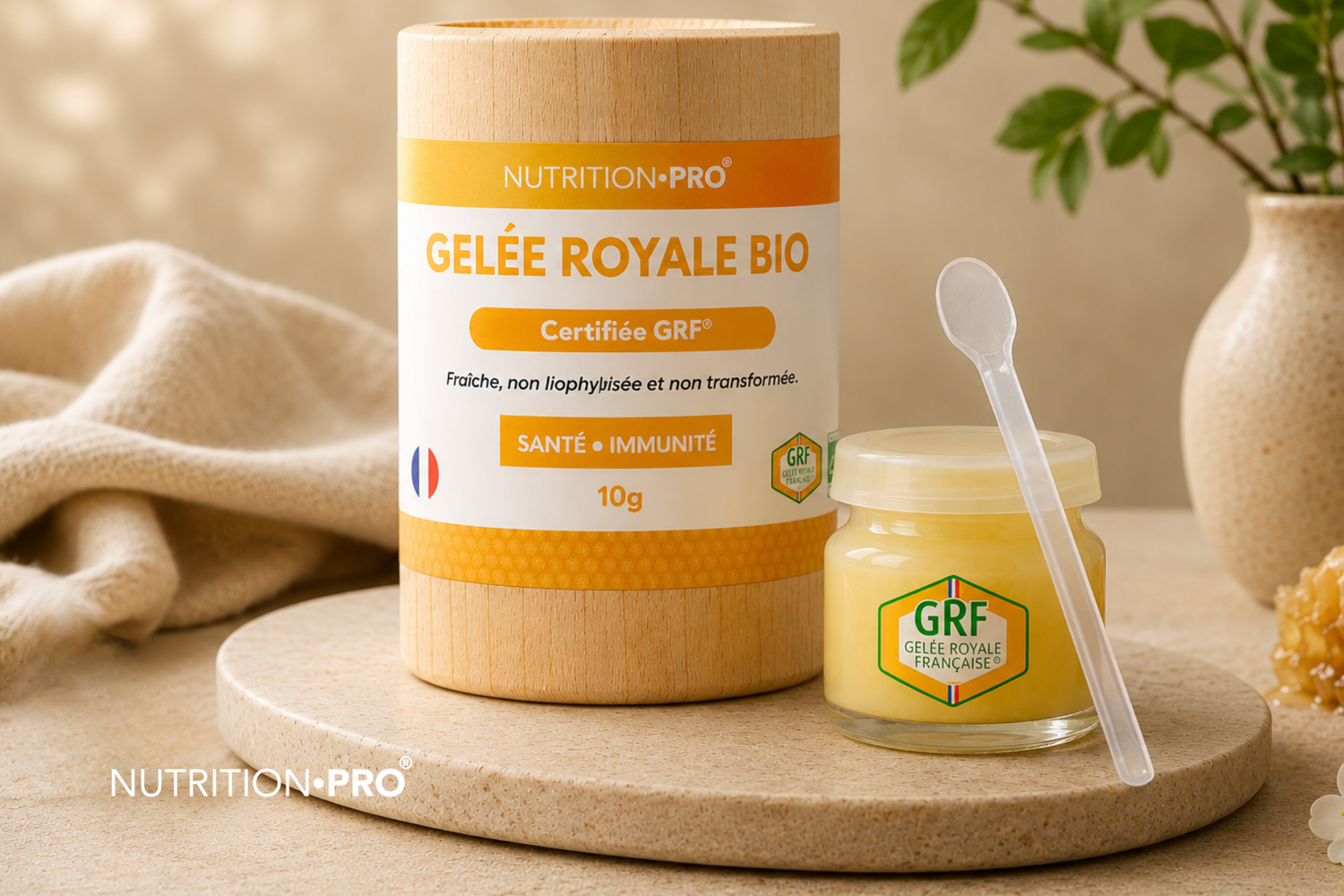
The royal jelly is one of the most precious and mysterious natural products from the hive. Nicknamed the "bee's milk," it nourishes exclusively the queen throughout her entire life — which can reach 5 years, compared to 45 days for a worker bee fed on honey. This spectacular difference in longevity sums up all the nutritional interest of this creamy and pearlescent substance. According to Karimi et al. 2024 in Frontiers in Nutrition (RCT 64 patients, 1000 mg/day), a 12-week course significantly improves cognitive function, BDNF and reduces stress. But not all royal jellies are equal: 90% of the global market is imported and freeze-dried, while fresh French royal jelly labeled GRF® represents the absolute premium standard. Here is the complete 2026 guide.

In brief: Royal jelly is a pearlescent and creamy substance produced by young worker bees (5-14 days) to nourish exclusively the queen. Composition: 60-70% water, 12-15% proteins (MRJP, royalactin), 10-16% carbohydrates, 3-6% lipids including 10-HDA (exclusive quality marker, minimum 1.4% according to ISO 12824:2016 standard). According to Karimi et al. 2024 in Frontiers in Nutrition (RCT 64 patients, 1000 mg/day 12 weeks): +cognition, +BDNF, -stress. According to Matsushita et al. 2020 in Climacteric (RCT 72 menopausal women, 3000 mg/day 6 months): maintenance of femoral bone density.
Concrete action: The label GRF® (French Royal Jelly®) guarantees 100% French production, fresh jelly fresh (non-freeze-dried), controlled 10-HDA, complete traceability. 90% of the global market is imported and freeze-dried (often from China), with partial degradation of heat-sensitive enzymes. Standard dosage: 0.5 to 1 g/day of fresh royal jelly taken sublingually in the morning on an empty stomach, treatment course of 4 to 6 weeks, to be repeated 2-3 times per year at seasonal changes. The GRF® Royal Jelly Nutrition•pro meets all these premium criteria.
- What is royal jelly? Origin, composition, mystery
- 10-HDA: the exclusive quality marker of royal jelly
- The GRF® (French Royal Jelly®) label explained
- Fresh vs freeze-dried: why it changes everything
- Scientifically documented benefits (fatigue, menopause, cognition)
- How to choose your royal jelly in 2026: 5 key criteria
- Dosage, sublingual intake, optimal treatment duration
- Responder profiles: who benefits most from royal jelly
- Myths and misconceptions (miracle cure, honey equivalence, freeze-dried OK)
- The quality combo: GRF® + fresh + 10-HDA > 1.4%
1. What is royal jelly? Origin, composition, mystery
The "milk of bees": 300 g per hive per season, exclusively for the queen
VS A WORKER BEE
Royal jelly is a creamy substance, pearly white, with a characteristic slightly tart flavor, produced by the young worker nurse bees aged 5 to 14 days. It is secreted by their hypopharyngeal and mandibular glands and deposited in royal cells to feed the queen exclusively throughout her entire life.
The biological mystery: the same larva, two radically different destinies
It is one of the most fascinating phenomena in nature: every female bee larva is genetically identical. Yet, depending on what she eats in the first 3 days, she will become either a worker bee (average lifespan 45 days), or a queen (lifespan 3 to 5 years, or 40 times longer). The difference? An exclusive diet of royal jelly for the queen, versus a honey-pollen mixture for workers. This dietary difference is enough to modify the larva's epigenetic development: the queen develops her reproductive organs, her size doubles, and her longevity skyrockets.
Detailed nutritional composition
Fresh royal jelly presents a composition of exceptional richness :
| Component | Typical proportion | Primary role |
|---|---|---|
| Water | 60-70% | Solvent for bioactive compounds |
| Proteins (including MRJP) | 12-15% | Royalactin, cell signaling, structure |
| Carbohydrates | 10-16% | Fructose, glucose, immediate energy |
| Lipids (including 10-HDA) | 3-6% | Quality marker, antimicrobial action |
| B vitamins | 0.1-0.3% | B1, B2, B3, B5, B6, B8, B9 (metabolism) |
| Minerals and trace elements | 0.8-1.5% | K, Ca, Mg, Fe, Zn, Cu, Mn |
| Free amino acids | 0.8% | 8 essential amino acids present |
The MRJP: the unique protein signature
The MRJP (Major Royal Jelly Proteins) represent more than 80% of proteins in royal jelly. Nine distinct MRJPs (MRJP-1 to MRJP-9) have been identified, with the most studied being royalactin (MRJP-1). It is this protein that orchestrates the royal development of the larva: it activates a cellular signaling pathway (EGFR receptor) that amplifies body size and longevity. Although the effects of royalactin in humans are not equivalent, its presence is a marker of authentic and fresh royal jelly.
A natural rarity that justifies its price
Royal jelly is one of the most precious natural products in the world. A complete hive produces barely 300 to 500 g of royal jelly per season, compared to several kilos or even dozens of kilos of honey. This rarity stems from the very nature of the product: the jelly is harvested only from royal cells (artificially prepared by the beekeeper via the pickingtechnique), before the larvae consume their entire ration.
2. 10-HDA: the exclusive quality marker of royal jelly
The fatty acid unique in the world found in NO OTHER natural product
FOR AUTHENTIC JELLY
The 10-HDA (10-hydroxy-2-decenoic acid, sometimes noted as 10H2DA) is arguably the most important component of royal jelly from a scientific standpoint. It is a unsaturated fatty acid with 10 carbons that presents an exceptional characteristic: it exists in no other natural product in the world. Neither in honey, nor in propolis, nor in any plant or animal food. It is the absolute signature of authentic royal jelly.
Why 10-HDA is the absolute quality criterion
Three major reasons make 10-HDA the official quality marker of royal jelly:
1. Absolute exclusivity. No other natural source contains 10-HDA. So if a "royal jelly" contains little or none at all, it is diluted, adulterated, poorly harvested, or of very poor quality.
2. International standardization. The ISO 12824:2016 standard (published by the International Organization for Standardization) sets the minimum threshold at 1.4% of 10-HDA on dry matter for a royal jelly to be qualified as such. Superior quality jellies exceed 1.8%, and the best reach 2% or more.
3. Documented bioactivity. 10-HDA possesses its own biological properties: antimicrobial action (effective against certain bacteria), neuroprotective action (Dubey 2023), antioxidant action, and weak estrogenic activity (interesting during menopause).
10-HDA quality levels
| 10-HDA Rate | Quality | Interpretation |
|---|---|---|
| < 1.4% | Non-compliant | Non-compliant with ISO 12824:2016, diluted or poor-quality jelly |
| 1.4 - 1.7% | Compliant | Minimum acceptable standard, authentic jelly |
| 1.7 - 2.0% | Very good | French standards, typical GRF® jelly |
| > 2.0% | Premium | Top of the market, high-end French artisanal jellies |
How to verify the 10-HDA of a royal jelly
Three possible sources of information: (1) Product label : rare but exists on premium jellies. (2) Producer's website : serious beekeepers publish batch analyses. (3) GRF® label : involves regular 10-HDA controls compliant with ISO standards. If no mention of 10-HDA anywhere and no third-party label, it is almost always an imported jelly standardized by blending. The Royal Jelly GRF® Nutrition•pro Complies with premium French standards in 10-HDA.
3. The GRF® label (French Royal Jelly®) explained
A collective trademark registered since 1995 by French producers themselves
The GRF® (French Royal Jelly®) label is a collective trademark registered by the French Royal Jelly Producers Association (GPGR), created in 1995. It brings together about a hundred specialized French professional beekeepers in artisanal royal jelly production, distributed throughout the country (Brittany, Pyrenees, Massif Central, Provence, etc.).
The 5 guarantees of the GRF® label
Guarantee 1: 100% French production. All worker bees producing must be raised in mainland France. Royal jelly must be harvested, packaged and labeled in France. No mixing with imported jelly, no purchase of foreign raw materials.
Guarantee 2: Fresh royal jelly only. The GRF® specifications require fresh harvest, never freeze-dried. Mandatory storage in the cold chain (between 2 and 5°C) from hive to consumer. This is the major difference from 90% of the global market.
Guarantee 3: Complete traceability. Each jar can be traced back to the producing beekeeper, even to the exact hive of origin. Batch numbering, harvest dates, quality analyses available upon request.
Guarantee 4: Respectful beekeeping practices. No over-exploitation of colonies (limitation of royal cells per hive), respect for the biological rhythm of bees, no use of chemicals or antibiotics, colonies' food preserved (bees keep their own honey and pollen).
Guarantee 5: Regular quality analyses. Regular checks of 10-HDA levels (minimum compliant with ISO 12824:2016), purity, absence of contaminants. Producers must provide analysis reports to maintain their certification.
GRF® vs standard imported royal jelly comparison
| Criteria | Fresh French GRF® | Standard imported jelly |
|---|---|---|
| Origin | 100% French, traceable | Often China (90% of market), opaque |
| Physical state | Fresh, never freeze-dried | Mostly freeze-dried |
| Storage | Cold chain 2-5°C mandatory | Room temperature (dehydrated) |
| Active enzymes | 100% preserved | Partially degraded by freeze-drying |
| 10-HDA level | Typically 1.7-2% (premium) | Variable (often minimal ISO) |
| Beekeeping practices | Respectful of colony rhythms | Often intensive, overexploitation |
| Price per gram | 3-4 €/g (artisanal production) | 0.5-1 €/g (industrial) |
| Availability | Limited (300-500 g/hive/season) | Nearly unlimited (mass production) |
The label GRF® is to royal jelly what AOC is to Bordeaux wines or what the MSC label is to sustainable fishing: an independent third-party guarantee of quality, origin, and respectful practices. It's the simplest reference point to distinguish authentic excellence royal jelly from imported industrial product. The Royal Jelly Nutrition•pro is GRF® certified.
4. Fresh vs freeze-dried: why it changes everything
Dehydration degrades heat-sensitive enzymes and fragile vitamins
VS FRESH HIVE JELLY
<<<31>>> Freeze-drying lyophilisation is an industrial process that involves freezing royal jelly at very low temperature (-40 to -50°C), then subliming the water under vacuum. Result: a dehydrated powder that is much easier to transport, store at room temperature, and package in capsules. It has become the global standard for logistical and economic reasons, but this process has a nutritional cost rarely explained to consumers.
What freeze-drying preserves... and what it degrades
Freeze-drying preserves relatively well: total proteins, the 10-HDA (relatively thermostable), the minerals, the sugars. However it partially degrades :
- Enzymes : the majority of naturally present enzymes are thermosensitive or pressure-sensitive, and lose their enzymatic activity after freeze-drying.
- Vitamin B5 (panthenate): particularly fragile, it is precisely one of the key vitamins in royal jelly.
- Fragile B Vitamins : partial losses in B1, B6, B9 depending on processing conditions.
- Tertiary Protein Structure : certain MRJPs may partially denature, affecting their bioactivity.
- "Concentration" Effect : 1 g of freeze-dried jelly ≈ 3 g of fresh jelly in dry matter equivalent, but this equivalence is rarely specified.
Why Freshness is the Scientific Standard
Serious clinical studies on royal jelly generally use fresh jelly or freeze-dried jelly recalculated in fresh equivalent. According to Karimi et al. 2024, the studied doses (1000 mg/day freeze-dried) correspond to approximately 3 g/day of fresh jelly. Fresh jelly remains considered the biological reference for evaluating the actual effect of royal jelly.
Recognizing Truly Fresh Jelly
Five concrete indicators: (1) Mandatory refrigeration (between 2 and 5°C) mentioned on the packaging. (2) Recent harvest date indicated (ideally < 12 months). (3) Pasty/creamy texture upon opening, never powdery. (4) Characteristic tangy taste (sometimes pungent), not neutral or sweetened. (5) Pearl-white to pale yellow color, never brownish (sign of oxidation or aging).
5. Scientifically Documented Benefits (fatigue, menopause, cognition)
Three areas with published randomized clinical trials on PubMed
Beyond its millennia-old traditional uses (ancient Egypt, Chinese medicine, Ayurveda), royal jelly is the subject of modern clinical studies that document several areas of effect. Here are the strongest scientific evidence to date.
Cognition, BDNF and Stress (Karimi 2024)
Menopause and bone density (Matsushita 2020)
Neuroprotection and 10-HDA (Dubey 2023)
According to Dubey et al. 2023 in Journal of Traditional and Complementary Medicine, 10-HDA exhibits binding affinity to tau proteins involved in Alzheimer's disease, increases acetylcholine levels (a key memory neurotransmitter), inhibits acetylcholinesterase (the enzyme that breaks down acetylcholine, a target of anti-Alzheimer treatments such as donepezil), and reduces neuroinflammation.
Athletic performance and oxidative stress (Miryan 2025)
According to Miryan et al. 2025 in Trials, an ongoing trial is evaluating 500 mg of royal jelly × 2/day for 2 weeks in 18 male endurance athletes, measuring oxidative stress (Nrf2, PGC-1α), aerobic performance, and blood pressure. An interesting avenue for athletes seeking to optimize recovery and mitochondrial biogenesis.
Traditional benefits (millennia-old use)
Beyond modern clinical trials, royal jelly has been used for millennia to: support general vitality (ancient Egypt, ancient China, Ayurveda), combat temporary fatigue, support seasonal changes, aid convalescence, enhance stress resilience, support periods of overwork.
6. How to choose your royal jelly in 2026: 5 key criteria
The reading framework to distinguish a premium product from an industrial one
FOR PREMIUM ROYAL JELLY
Choosing a quality royal jelly in 2026 is not a marketing question: it's a precise and verifiable technical checklist. Here are the 5 essential criteria.
Criterion 1: GRF® Label or explicit 100% French origin
The GRF® label (French Royal Jelly®) is the simplest and most reliable reference point. It guarantees French production, freshness, complete traceability and quality control. Otherwise, verify an explicit mention of "French origin" (not "packaged in France," a classic trap that can mask imported jelly). Be wary of vague mentions like "origin EU and non-EU."
Criterion 2: Fresh jelly, never freeze-dried
Check two mentions on the packaging: "fresh royal jelly" AND "store between 2 and 5°C". If the product can be stored at room temperature (capsules), it is necessarily freeze-dried jelly. This is not illegitimate, but the effect is reduced and the quality-to-price ratio is generally unfavorable.
Criterion 3: 10-HDA level mentioned
Ideally > 1.4% (compliant with ISO 12824:2016), preferably > 1.8% (French premium standard). If the 10-HDA is not mentioned either on the label or on the producer's website, ask by email: a serious producer provides the information without difficulty, an opaque reseller will dodge the question.
Criterion 4: Traceability and harvest date
Premium jelly mentions: harvest date (ideally less than 12 months old), batch number, producer name or cooperative, even the department/region of production. This is the transparency that distinguishes artisans from industrial producers.
Criterion 5: Pure composition, no additives
Verify that the only ingredient is: "royal jelly". Be wary of additions: sugars, flavorings, preservatives, added honey (which dilutes the jelly). Flavored royal jellies "lemon," "orange," etc. should be avoided (dilution + masking of characteristic taste).
limited budget
0.5 g/day for maintenance
Early-stage osteopenia
1 g/day for 4 to 6 months
Intensive recovery
1 g/day in pre-competition protocol
to bee products
Alternatives: ashwagandha, ginseng, maca
7. Dosage, sublingual administration, optimal treatment duration
The usage protocol that maximizes absorption and effects
OF A STANDARD TREATMENT
Reference dosage
For fresh royal jelly, the reference dose is 0.5 to 1 g per day (equivalent to a coffee bean or small pea). For lyophilized royal jelly, studies generally use 1000 to 3000 mg/day, which corresponds to approximately 3 to 9 g of equivalent fresh royal jelly (approximate ratio 1:3).
| Objective | Fresh dosage | Duration |
|---|---|---|
| Daily vitality maintenance | 0.5 g/day | 4-week treatments 2-3 times/year |
| Temporary fatigue, seasonal change | 1 g/day | 4 to 6 weeks |
| Menopause, osteopenia, hormonal support | 1 g/day | 3 to 6 months |
| Convalescence, intense overexertion | 1 g/day | 6 to 8 weeks |
| Competitive athlete, performance | 1 g/day | 4-6 weeks pre-competition |
The sublingual technique: why it's crucial
The sublingual intake is the scientifically recommended method for fresh royal jelly. Why? The sublingual mucosa is highly vascularized and permeable: active compounds pass directly into the bloodstream, bypassing the stomach and its acidity. Method: place the dose under the tongue, let it dissolve for 1 to 2 minutes, then swallow.
The optimal timing: morning on an empty stomach
Take royal jelly in the morning on an empty stomach, 15 to 30 minutes before breakfast. Two reasons: (1) maximum absorption on an empty stomach, (2) the natural "tonic" effect of royal jelly aligns with the morning circadian rhythm. Avoid taking it in the evening (possible stimulating effect in some sensitive individuals). Never heat royal jelly.
Essential storage
Fresh royal jelly must be stored in the refrigerator between 2 and 5°C, at all times, from the beekeeper to the end user. Once opened, consume within 6 months. Before opening, storage up to 12-18 months in the fridge. Never freeze (crystallization degrades the structure).
Seasonal treatment cycles
The ideal periods for a royal jelly course are seasonal changes : October-November (winter preparation, immune support), February-March (winter recovery, anti-fatigue), September (back to school, overexertion). For lasting results, do 2 to 3 courses of 4-6 weeks per year.
5 typical profiles where royal jelly produces its best results
The effect is not universal: certain profiles are clearly more responsive.
Highly responsive profile. Characteristics: 35-55 years old, high work load, recurring fatigue unrelated to pathology, non-restorative sleep, energy decline at end of day. Recommendations:
1 g/day of fresh royal jelly GRF® in a 4-6 week course , sublingual intake in the morning on an empty stomach. Combine if possible with magnesium bisglycinate (300-400 mg/day) and vitamin D3 (2000 IU/day). Expected effects: improved morning energy, better stress resistance, higher quality sleep.Profile 2: Woman 45-60 years old in peri/post-menopause
Profile with solid clinical evidence. Characteristics: hot flashes, fatigue, sleep disturbances, mood decline, early bone density loss (T-score < -1 on DEXA). Recommendations:
1 g/day of fresh royal jelly GRF® in a 3 to 6 month course , according to Matsushita 2020 protocol. Synergy with reinforced dietary calcium, vitamin D3, weight-bearing physical activity 3×/week. Not to be substituted for prescribed hormone treatments.Profile 3: Student or adult in convalescence
Traditional but very relevant profile. Characteristics: post-viral illness convalescence (flu, COVID), recent surgical procedure, period of intensive exams, fatigue post-acute episode. Recommendations:
1 g/day of fresh royal jelly GRF® in a 6 to 8 week course . Combine with acerola (natural vitamin C), zinc, regular sleep.Profile 4: Endurance or strength athlete
Emerging profile with promising data (Miryan 2025 ongoing). Characteristics: 25-50 years old, regular training (5-10h/week), pursuit of optimal performance and recovery, high oxidative stress. Recommendations:
1 g/day of fresh royal jelly in a 4-6 week pre-competition course , or continuously with 4-week breaks every 12 weeks. Synergy with EPA omega 3, magnesium, creatine.Profile 5: Senior 65+ years old in cognitive prevention
Profile with very interesting emerging data. Characteristics: 65-85 years old, mild memory complaints, family history of neurodegeneration, desire for active prevention. Recommendations:
0.5 to 1 g/day of fresh royal jelly GRF® in a 3 month course, to be repeated 2 times per year . Synergy with DHA omega 3, vitamin D3, regular cognitive activity, Mediterranean diet.ANONYMIZED CLINICAL CASE
Profil : Woman, 52 years old, confirmed perimenopause for 14 months. Symptoms: daily hot flashes (5-8 per day), persistent morning fatigue despite 8 hours of sleep, unexplained mood decline, irritability, weight gain of 4 kg in 1 year. Assessment: DEXA early osteopenia (T-score -1.6 at left hip), normal thyroid panel, ferritin 35 µg/L (low-normal range). No hormone replacement therapy (personal reluctance).
Approach proposed by the treating physician: Natural support with 1 g/day of fresh royal jelly GRF® taken sublingually in the morning for 6 months. Combined with vitamin D3 (2000 IU/day), reinforced dietary calcium (dairy products, calcium-rich mineral waters), brisk walking 45 min/day, muscle-strengthening sessions 2×/week.
Results at 3 months: Subjective reduction in hot flashes (from 5-8/day to 2-3/day), improved morning energy, more restorative sleep. At 6 months: stable control DEXA, weight loss of 1.5 kg, noticeably improved mood. Renewal of the treatment planned for winter to support immunity and stabilize benefits.
Myths and misconceptions about royal jelly
5 false beliefs that circulate and lead to unsuitable purchases
Myth 1: "Royal jelly is a miracle cure that heals everything"
FALSE, it's a supplement, not a medication. Royal jelly has documented effects (fatigue, menopause, cognition according to recent studies), but it does not cure any disease. It does not replace hormone replacement therapy in menopause, nor treatment for confirmed osteoporosis, nor an antidepressant. It is a nutritional support for vitality, to be integrated into an overall healthy lifestyle.
Myth 2: "Royal jelly and honey are the same thing"
ABSOLUTELY FALSE, these are two completely different products. Honey is floral nectar transformed by adult forager bees and stored as a food reserve. Royal jelly is a glandular secretion from young nurse worker bees, produced solely to feed the queen and larvae under 3 days old. Different composition, different biological function, different price (€300 per kg for French royal jelly vs €8-15/kg for quality French honey). Royal jelly contains 10-HDA, which is exclusive to it and does not exist in any honey.
Myth 3: "Freeze-dried royal jelly is equivalent to fresh"
FALSE, equivalence is partial. Freeze-drying preserves most proteins, 10-HDA and minerals, but degrades heat-sensitive enzymes, certain fragile vitamins (particularly B5), and partially alters the tertiary structure of proteins. For traditional uses (vitality, fatigue), fresh remains the scientific gold standard. If you buy freeze-dried, multiply the dose by approximately 3 to obtain the equivalent of 1 g of fresh.
Myth 4: "All royal jellies are equal, origin doesn't matter"
ABSOLUTELY FALSE. 90% of the global market is produced in China according to highly variable standards (often intensive, sometimes with residual antibiotics). French GRF® royal jelly costs 5 to 10 times more per gram because artisanal production respects the biological rhythm of colonies (300-500 g/hive/season), guarantees freshness (cold chain), ensures complete traceability, and meets independent third-party quality standards.
Myth 5: "Royal jelly is safe, you can take as much as you want"
FALSE, there are real contraindications. Royal jelly is generally well tolerated, but: allergy to hive products (risk of severe anaphylaxis, sometimes fatal), allergic asthma (to be avoided or medical advice required), history of angioedema (strong contraindication), hormone-dependent cancers (weak estrogenic effect, caution advised), pregnancy and breastfeeding (medical advice required). Always perform a test with a very small dose the first time.
The quality combo: GRF® + fresh + 10-HDA > 1.4%
Three criteria combined for a royal jelly that delivers on its promises
2026 STANDARD
After this comprehensive overview of royal jelly, its composition, its quality marker 10-HDA, the GRF® label and the difference between fresh vs lyophilized, the ideal supplement in 2026 checks the following 3 criteria: (1) GRF® Label guaranteeing 100% French origin and respectful beekeeping practices, (2) Fresh state (never lyophilized, stored in the refrigerator between 2 and 5°C), (3) 10-HDA content higher than 1.4% compliant with ISO 12824:2016 (ideally > 1.8%).
Very few products on the French market meet these 3 criteria simultaneously, and even fewer at a reasonable price. The Organic Royal Jelly GRF® Nutrition•pro is positioned precisely on this premium standard, with a 10 g jar at €39.99 allowing 10 to 20 days of treatment depending on dosage. For a 6-month menopause treatment (1 g/day), plan for 6 jars; for a standard 4-6 week treatment, 2-3 jars are sufficient.
Allergy to hive products : absolute contraindication. This includes allergy to pollen, bee venom, propolis, honey. Allergic reactions to royal jelly can range from simple hives to Quincke's edema and potentially fatal anaphylactic shock. First use : always perform a test with a minimal dose (1/4 of the normal dose) the first time. Uncontrolled allergic asthma : avoid or seek medical advice. History of Quincke's edema or anaphylactic shock : avoid completely. Hormone-dependent cancers (breast, uterus, ovary): caution due to weak estrogenic effect, oncology consultation recommended. Pregnancy and breastfeeding : limited specific data, medical advice recommended. Children under 3 years old : avoid (immune system still immature). Drug interactions : poorly documented, but inform your doctor if taking anticoagulant or antihypertensive medication. Royal jelly never replaces prescribed medical treatment.
Frequently asked questions about royal jelly
What is royal jelly and what is its composition?
Royal jelly is a creamy, pearlescent substance produced by young worker bees (nurse bees) aged 5 to 14 days, secreted by their hypopharyngeal and mandibular glands. It feeds the queen exclusively throughout her life. Typical composition: 60-70% water, 12-15% proteins (including the MRJPs, notably royalactin), 10-16% carbohydrates (fructose, glucose), 3-6% lipids (including 10-HDA, quality marker), B vitamins (B1, B2, B3, B5, B6, B8, B9), minerals and trace elements.
What is 10-HDA in royal jelly?
The 10-HDA (10-hydroxy-2-decenoic acid) is the unique and exclusive fatty acid of royal jelly: it is not found in any other natural product. It is the internationally recognized scientific quality marker: authentic, high-quality royal jelly must contain between 1.4% and 2% of 10-HDA. The international standard ISO 12824:2016 sets the minimum at 1.4%. According to Dubey et al. 2023 in Journal of Traditional and Complementary Medicine, 10-HDA exerts documented neuroprotective effects.
What is the GRF® label (French Royal Jelly®)?
GRF® is a registered collective mark of the French Royal Jelly Producers Association, created in 1995. The label guarantees: (1) 100% French production, (2) Harvesting exclusively fresh royal jelly (non-freeze-dried), (3) Complete traceability from hive to end user, (4) Regular analysis of 10-HDA and purity, (5) Respectful beekeeping practices, without overexploitation of colonies. It is a independent and traceable quality standard.
What is the difference between fresh and freeze-dried royal jelly?
Major difference in nutritional integrity. Fresh royal jelly retains 100% of its original composition: active enzymes, fragile B vitamins (B5 in particular), intact MRJP proteins, fully bioavailable 10-HDA. Freeze-dried royal jelly undergoes dehydration at -50°C followed by vacuum sublimation which partially degrades heat-sensitive enzymes and certain vitamins, and concentrates dry matter (3 g of freeze-dried ≈ approximately 10 g of fresh). 90% of royal jellies on the market are imported and freeze-dried.
What are the scientifically proven benefits of royal jelly?
Several clinical effects are documented by randomized trials. According to Karimi et al. 2024 in Frontiers in Nutrition (RCT 64 patients, 1000 mg/day 12 weeks): significant improvement in cognitive function (+4.71 points), increase in BDNF, stress reduction (-3.33 points). According to Matsushita et al. 2020 in Climacteric (RCT 72 postmenopausal women, 3000 mg/day 6 months): maintenance of femoral bone mineral density facing normal post-menopause loss.
Is royal jelly effective against fatigue?
Yes, it is one of its most documented traditional uses. Royal jelly contains a unique cocktail of energy-boosting nutrients: B vitamins (B1, B2, B5 especially), essential amino acids (all 8 present), MRJP proteins, trace elements. Relevant during occasional fatigue, seasonal changes, periods of stress, convalescence. 4 to 6-week course at 500-1000 mg/day of fresh royal jelly.
What is the optimal dosage of royal jelly?
For fresh royal jelly, the reference dosage is 0.5 to 1 g per day (1/2 to 1 coffee bean), to be taken in the morning on an empty stomach for optimal absorption. For a revitalization course: 1 g/day for 4-6 weeks. For long-term maintenance: 0.5 g/day. For freeze-dried royal jelly, the dosages typically used in clinical studies are 1000 to 3000 mg/day (divide by 3-4 for fresh equivalent). Fresh French royal jelly is taken pure under the tongue (sublingual) or diluted in a little honey.
How to take fresh royal jelly?
Three recommended methods. (1) Sublingual route : place a dose directly under the tongue, allow to dissolve for 1-2 minutes before swallowing. This is the method that best preserves the active compounds. (2) Diluted in honey or fruit juice : for those who don't like the taste. (3) On a small spoon, swallowed in the morning on an empty stomach, 15-30 minutes before breakfast. Storage must be kept in the refrigerator between 2 and 5°C. Never heat.
Does royal jelly help during menopause?
Yes, clinical studies confirm it. According to Matsushita et al. 2020 in Climacteric (RCT 72 post-menopausal women ages 45-60, 3000 mg/day for 6 months), royal jelly maintains femoral bone mineral density and preserves hip structural parameters, whereas the placebo group experiences expected bone loss. Effects also reported: improvement in hot flashes, support for vitality, emotional balance. Royal jelly appears to be active via weak estrogenic activity. Should not be substituted for prescribed hormone treatments.
Does royal jelly have side effects?
Royal jelly is generally well tolerated. Possible but rare adverse effects: allergic reactions (sometimes severe such as anaphylaxis) in persons allergic to pollen, bee venom, or other hive products. Mild stimulating effect in some sensitive individuals if taken late in the day (prefer morning). Contraindications : known allergy to hive products, uncontrolled allergic asthma, history of angioedema. Caution in cases of hormone-dependent cancers.
How to recognize quality royal jelly?
Five criteria to verify. (1) GRF® label or explicit 100% French origin. (2) Mention 'fresh' and 'non-freeze-dried' (to be refrigerated). (3) 10-HDA content mentioned (minimum 1.4% according to ISO 12824:2016, ideally > 1.8%). (4) Recent harvest date (less than 12 months). (5) No additives, sugar, flavor, or added preservatives.
Why is French royal jelly more expensive?
French production is less industrial and more costly. Royal jelly is one of the most expensive natural products to produce in the world : a hive produces barely 300-500 g of royal jelly per season, vs tons of honey. French production is artisanal, follows the natural rhythm of colonies, respects strict beekeeping standards, and guarantees freshness (cold chain). China produces 90% of the world's royal jelly, primarily through freeze-drying.
Can royal jelly and propolis be combined?
Yes, it's a classic combination in hive phytotherapy. Royal jelly and propolis complement each other perfectly: royal jelly provides vitality, essential nutrients, and light hormonal support; propolis provides antimicrobial, antiviral, and immunomodulatory action. Particularly interesting synergy in autumn/winter, during recovery, or periods of immune fatigue. Nutrition•pro offers both: Fresh French Royal Jelly GRF® 10 g and Organic Propolis.
How long should a royal jelly treatment course last?
The standard duration of a treatment is 4 to 6 weeks. Ideal periods: preparation for winter (October-November), post-winter recovery (February-March), seasonal changes, periods of fatigue or overload, convalescence, perimenopause. For lasting effects, repeat 2 to 3 treatment courses per year with breaks of 2-3 months. Fresh royal jelly keeps 12 to 18 months in the refrigerator unopened, and 6 months after opening.
Can royal jelly be given to children?
With caution. Children under 3 years old : avoid (immature immune system, increased allergic risk). Children 3 to 12 years old : possible at half-dose (0.2-0.5 g/day of fresh royal jelly) in short courses of 3-4 weeks during school fatigue, convalescence, exam periods. Pediatrician's advice recommended. Adolescents : adult dosage applicable. Always start with a very reduced dose (1/4 of dose) to test for absence of allergic reaction.
Glossary
- Royal jelly
- Creamy white-pearlescent substance produced by young worker honeybees nurses (5-14 days) via their hypopharyngeal and mandibular glands. Exclusive food of the queen throughout her entire life. Composition: 60-70% water, MRJP proteins, lipids including 10-HDA, B vitamins, minerals.
- 10-HDA (10-hydroxy-2-decenoic acid)
- Unsaturated fatty acid with 10 carbons, exclusive to royal jelly (does not exist in any other natural product). Official quality marker set at minimum 1.4% by ISO 12824:2016 standard. Bioactive properties: antimicrobial, neuroprotective, antioxidant, weak estrogenic.
- MRJP (Major Royal Jelly Proteins)
- Family of 9 proteins (MRJP-1 to MRJP-9) representing over 80% of royal jelly proteins. The most studied is royalactin (MRJP-1). Marker of authenticity and freshness.
- Royalactin
- 57 kDa protein (MRJP-1) identified by Masaki Kamakura in 2011. Demonstrated to be capable of inducing queen differentiation in honeybee larvae via the EGFR signaling pathway.
- GRF® (French Royal Jelly®)
- Collective trademark registered in 1995 by the French Royal Jelly Producers Association. Guarantees 100% French production, fresh royal jelly (non-freeze-dried), complete traceability, regular 10-HDA quality analyses, respectful beekeeping practices.
- Freeze-drying
- Industrial dehydration process by sublimation: freezing at very low temperature (-40 to -50°C) then evaporation under vacuum. Relatively preserves the majority of compounds, but degrades heat-sensitive enzymes and certain fragile vitamins (notably B5).
- Sublingual administration
- Route of administration where the product is placed under the tongue for direct absorption by richly vascularized mucous membranes, without passage through the stomach. Preserves actives sensitive to gastric acidity. Recommended method for fresh royal jelly.
- Bone mineral density (BMD)
- Quantity of minerals (calcium, phosphorus) contained in a bone volume, measured by DEXA densitometry. Normal: T-score > -1. Osteopenia: -1 to -2.5. Osteoporosis: < -2.5. Royal jelly supports maintenance of BMD in post-menopause according to Matsushita 2020.
- BDNF (Brain-Derived Neurotrophic Factor)
- Brain neurotrophic factor, protein essential for growth, survival and plasticity of neurons. Biological marker of brain health. Increased by royal jelly according to Karimi 2024.
- ISO 12824:2016 standard
- International standard that establishes quality specifications for royal jelly: composition, minimum 10-HDA rate (1.4%), purity criteria, standardized analysis methods. Reference for evaluating the authenticity of royal jelly.
Scientific sources
- Karimi E, Arab A, Sepidarkish M, Khorvash F, Saadatnia M, Amani R. Effects of the royal jelly consumption on post-stroke complications in patients with ischemic stroke: results of a randomized controlled trial. Front Nutr 2024;10:1227414. DOI: 10.3389/fnut.2023.1227414
- Matsushita H, Shimizu S, Morita N, Watanabe K, Wakatsuki A. Effects of royal jelly on bone metabolism in postmenopausal women: a randomized, controlled study. Climacteric 2020;24(2):164-170. DOI: 10.1080/13697137.2020.1806815
- Dubey R, Sathiyanarayanan L, Sankaran S, Arulmozhi S. Nootropic effect of Indian Royal Jelly against okadaic acid induced rat model of Alzheimer's disease: Inhibition of neuroinflammation and acetylcholinesterase. J Tradit Complement Med 2023;14(3):300-311. DOI: 10.1016/j.jtcme.2023.11.005
- Karimi E, Khorvash F, Arab A, Sepidarkish M, Saadatnia M, Amani R. The effects of royal jelly supplementation on oxidative stress, inflammatory mediators, mental health, cognitive function, quality of life, and clinical outcomes of patients with ischemic stroke: study protocol for a randomized controlled trial. BMC Nutr 2023;9(1):32. DOI: 10.1186/s40795-023-00690-4
- Miryan M, Tadibi V, Sadeghi E, Najafi F, Saber A, Abbaspour M, Pasdar Y. The effect of royal jelly in oxidative stress, athletic performance, and mitochondrial biogenesis-related gene expression in endurance athletes: study protocol for a double-blind crossover trial. Trials 2025;26(1):69. DOI: 10.1186/s13063-025-08780-3


