

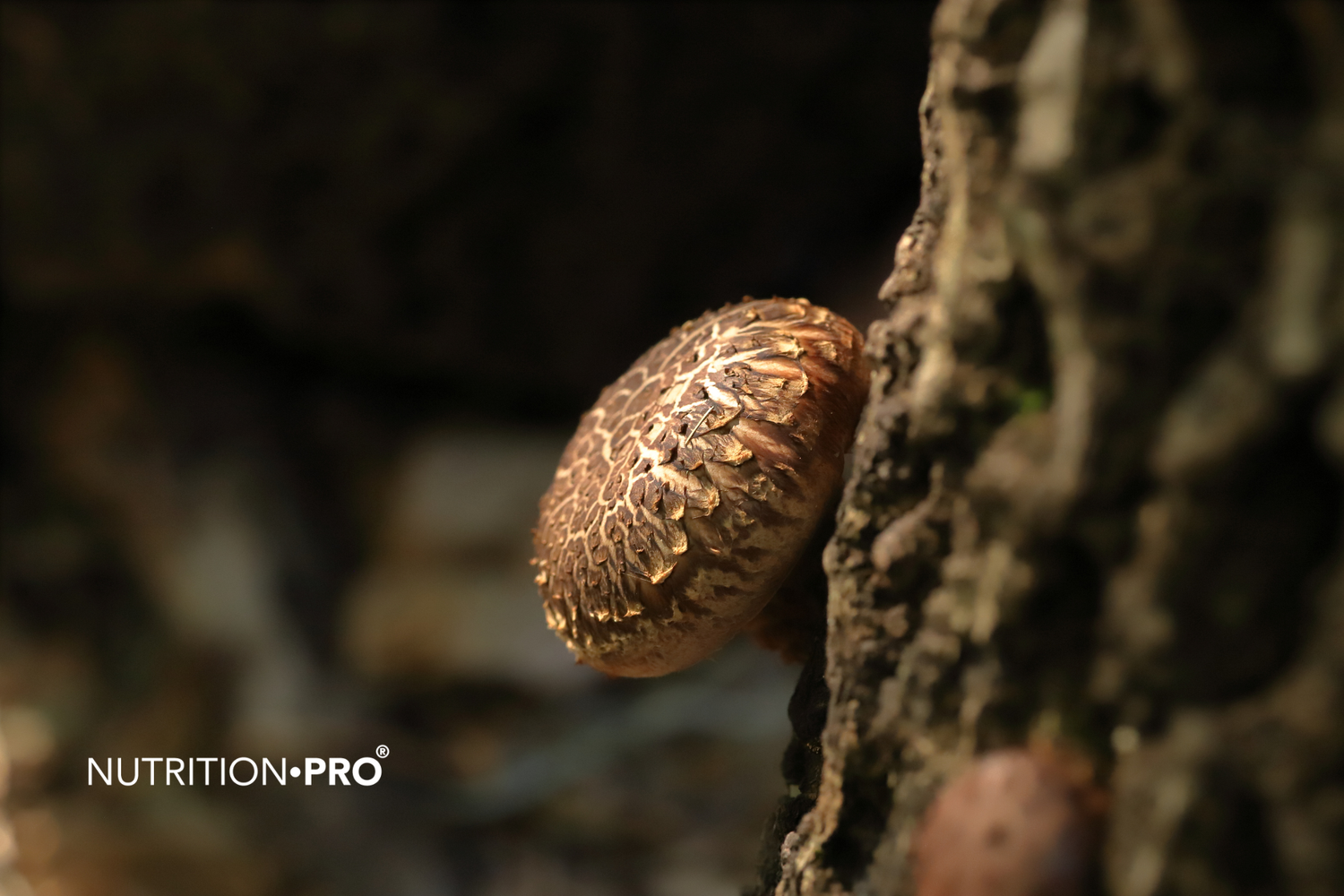
Shiitake is the most consumed edible mushroom in the world after the button mushroom. Millions of people eat it without any problems. Yet there is an adverse effect so characteristic that it bears its name: shiitake dermatitis, a skin rash in linear streaks evoking scratch marks, which was the subject of a pharmacovigilance report by Anses.
The remarkable point is that it is entirely preventable, and the rule can be summed up in three words: cook the shiitake. This article explains the mechanism, why cooking changes everything, how to recognize the rash, what this does or does not imply for a supplement, and other effects reported for this species.

Shiitake dermatitis. A rash of red papules in linear streaks, called flagellate, on the trunk and limbs, sometimes the face, with itching and without mucosal involvement. Photosensitivity may accompany it. It resolves spontaneously, with treatment being symptomatic.
The mechanism and the solution. A hypersensitivity reaction to lentinan, a polysaccharide from the mushroom. This compound is heat-labile : insufficient cooking appears as a determining factor. The rule is therefore simple: never consume raw or undercooked shiitake. Other reported effects: contact urticaria, allergic asthma, phototoxicity, pneumonitis in cultivators exposed to spores, diarrhea after ingestion of large quantities. The regulatory point: the immune claim was explicitly refused in 2012 for shiitake and maitake.
Shiitake dermatitis, described in detail
This eruption has several names: shiitake dermatitis, shiitake toxidermia, or flagellate dermatitis, the latter term describing its appearance.
| Characteristic | Description |
|---|---|
| Appearance | Red papules arranged in linear streaks, resembling scratch marks or whip marks |
| Location | Primarily the trunk and extremities, sometimes the face |
| Dominant symptom | Itching, typically reported |
| Mucous membranes | No involvement, which is an important diagnostic clue |
| Particularity | A photosensitivity reaction may accompany the rash |
| Course of the condition | Spontaneous resolution, symptomatic treatment aimed at relief |
The rash typically appears in the days following consumption. Result: the person doesn't make the connection to a meal eaten several days earlier, and the doctor looks elsewhere. This is precisely why it's essential to know this reaction exists: reporting shiitake consumption immediately guides the diagnosis, whereas without this information the rash remains puzzling. Consult your doctor and mention what you ate.
Lentinan, and why cooking changes everything
The mechanism discussed is a hypersensitivity reaction to lentinan, a polysaccharide found in shiitake. And this compound has a decisive property: it is thermolabile, that is to say degraded by heat.
From this follows the central clinical observation: inadequate cooking clearly appears as a determining factor in the occurrence of dermatitis. The cases described involve consumption of raw or undercooked mushrooms.
On the fine mechanisms, the literature is not unanimous, and it's honest to say so. Some authors postulate an unpredictable reaction occurring in genetically predisposed individuals, regardless of dose. Other studies highlight a dose-dependent relationship. Both hypotheses coexist, but they converge on the same practical approach.
Never consume raw shiitake. And beware of cooking methods that aren't really cooking: a quick pan sear, marinating, adding at the very end of preparation, sliced shiitake on a salad. These preparations give the impression the mushroom has been cooked when the heat received is insufficient. These are exactly the contexts in which dermatitis is described.
Fresh or supplement: what changes
The question logically arises: if the problem comes from a compound destroyed by heat and raw consumption, is a supplement at risk?
The cases described involve consumption of fresh mushroom, raw or insufficiently cooked. Supplements are made from dried mushrooms then processed, which involves heat steps. However, it would be imprudent to conclude zero risk: manufacturing processes vary from one manufacturer to another, and we have no data allowing us to assert that every form of supplement is free from this risk.
Other reported effects
| Effect | Context |
|---|---|
| Contact urticaria | Mushroom handling |
| Allergic asthma | Allergic reaction, repeated exposure in particular |
| Phototoxicity | Described independently of flagellate dermatitis, reinforces sun protection precaution |
| Pneumonitis | Essentially occupational, from inhalation of spores among cultivators |
| Contact dermatitis | Handling, distinct from food-related flagellate dermatitis |
| Diarrhea | After ingestion of large quantities of shiitake |
The line on pneumonitis deserves clarification, as it is often cited out of context to alarm. This is a respiratory condition linked torepeated inhalation of spores in people working in mushroom cultivation. It is an occupational exposure, unrelated to eating a shiitake dish or taking a supplement. Mentioning it is honest; allowing people to believe it concerns the consumer would not be.
Precautions and populations
In case of immunosuppressive treatment, of autoimmune disease or after a transplant : mushroom polysaccharides act on immune pathways and can theoretically interfere.
In pregnant or breastfeeding women and inchildren : specific data are lacking for concentrated supplementation. Cooked shiitake as a common food follows different logic.
In case ofknown mushroom allergy : abstain, as cross-reactivity risk exists.
In case of chronic treatment whatever it may be: the pharmacist's reflex remains the simplest and most effective.
A useful comparison to place this species among others, because the whole point is to reason case by case rather than in bulk:
| Species | Its specific precaution |
|---|---|
| Shiitake | Dermatitis linked to lentinan, avoided by sufficient cooking of fresh mushroom |
| Chaga | Renal risk linked to oxalates, documented by clinical cases of nephropathy |
| Reishi | Drug interactions, particularly anticoagulants and scheduled surgery |
What the law allows to be said
On this species, the regulatory situation is clearer than elsewhere, and it deserves to be known.
In 2012, European health authorities ruled for the prohibition of the claim relating to the stimulation of immune defenses for dietary supplements containing shiitake or maitake, due to lack of convincing evidence of their effectiveness. This is not a pending claim awaiting evaluation: this is a claim that was examined and rejected. Any brand that displays today "strengthens immune defenses" on a shiitake is therefore in clear breach, and not in a gray area.
Beyond this refusal, claims concerning plants and mushrooms are pending evaluation at the European level, which means thatno health effect can be claimed with certainty for shiitake.
Our position does not change from one article to another: we provide the composition, source and precautions, and we leave the reader to consult the literature. This is also what our article on what studies show concerning shiitakedoes, which is the counterpart to this one.
Shiitake is an ordinary food with a characteristic that is not. Its emblematic adverse effect is spectacular, benign, and entirely avoidable by a cooking measure. This is arguably the only case in this series where the major precaution is neither with the doctor nor the pharmacist, but with the pan. The rest—immunosuppressive treatment, autoimmune disease, pregnancy—follows the same rules as for other mushrooms.
Frequently asked questions
Shiitake dermatitis
Is shiitake dangerous?
It is the most consumed edible mushroom in the world after the button mushroom, and it is consumed without problem by millions of people. There is, however, a well-identified adverse effect specific to this species: shiitake dermatitis, a characteristic skin rash that occurs after consumption of raw or insufficiently cooked mushrooms. This is not poisoning in the classical sense; it is a hypersensitivity reaction, and it is preventable.
What is shiitake dermatitis?
It is a very characteristic skin rash, called flagellate: red papules arranged in linear streaks, resembling scratch marks, located mainly on the torso and limbs, sometimes on the face. Itching is typical. There is no involvement of mucous membranes. A photosensitivity reaction has also been reported. The rash resolves spontaneously, with treatment being symptomatic.
Why does this dermatitis occur?
The mechanism involved is a hypersensitivity reaction to lentinan, a polysaccharide constituent of shiitake. Decisive point: this compound is heat-labile, meaning it is degraded by heat. Insufficient cooking appears clearly as a determining factor in its occurrence. Some authors suggest an unpredictable reaction in genetically predisposed individuals, while other studies show a dose-dependent relationship.
How long after consumption does it appear?
It typically occurs in the days following consumption, which explains why it is often poorly linked to its cause: the patient does not connect it to a meal eaten several days earlier. This is precisely why its existence must be known, and shiitake consumption should be reported at the appointment, which immediately guides the diagnosis.
Is shiitake dermatitis serious?
It is spectacular and very uncomfortable due to itching, but it resolves spontaneously and its treatment is symptomatic. It is not a life-threatening emergency. Nevertheless, it deserves a medical consultation, first to establish the diagnosis and rule out other causes of rash, and second because a photosensitivity reaction may accompany it and warrant precautions regarding sun exposure.
Should sun exposure be avoided in case of dermatitis?
A photosensitivity reaction has been reported in the context of this dermatitis, which justifies protecting affected areas from sun exposure during the episode. Your doctor will clarify the course of action based on the presentation. Cases of phototoxicity have also been described independently, which reinforces this precaution.
What should you do if a rash appears?
Stop consumption and consult, clearly reporting what you ate or took, when, and in what form. This information guides the diagnosis, as shiitake dermatitis has a characteristic presentation that the doctor will recognize if the origin is indicated. An adverse effect possibly linked to a supplement can also be reported as part of nutrivigilance.
Cooking and forms
Must shiitake always be cooked?
Yes, and this is the most important precaution. Since the compound in question is degraded by heat, sufficient cooking prevents the reaction. Avoid raw shiitake in all forms, as well as very brief cooking: quick pan-frying, marinating, or adding at the end of preparation. The cases described specifically involve raw or undercooked consumption.
Does a supplement in capsule form present the same risk?
The dermatitis described is associated with consumption of fresh raw or insufficiently cooked mushroom. Supplements are made from dried mushrooms that are then processed, which involves thermal steps, but processes vary among manufacturers and it would be imprudent to claim zero risk. The prudent rule remains the same: if a rash appears after starting a supplement, stop and consult.
Other effects and populations
What other adverse effects are reported?
Beyond dermatitis, cases of contact urticaria, allergic asthma, phototoxicity, pneumonitis, and contact dermatitis have been described. Some of these manifestations mainly concern workers cultivating mushrooms, exposed by inhalation to spores. Diarrhea has also been reported after ingestion of large quantities.
Are mushroom cultivators more exposed?
Yes, and this is a rarely mentioned point. People working in mushroom cultivation can develop respiratory conditions, particularly pneumonitis, through repeated inhalation of spores. This is occupational exposure, unrelated to food consumption, but it is part of the documented effects profile for this species.
Can you be allergic to shiitake?
Yes, allergic reactions have been described, notably contact urticaria and allergic asthma. If you are allergic to other mushrooms, caution is advised before any consumption or supplementation. In case of respiratory distress, extensive urticaria, or swelling after intake, seek emergency care.
Does shiitake interact with medications?
As with other mushrooms, vigilance primarily concerns immunosuppressive treatments, as mushroom polysaccharides act on immune pathways. More broadly, any chronic treatment warrants discussion with your doctor or pharmacist. Shiitake does not have the documented bleeding precaution profile of reishi or the oxalate risk of chaga.
Can you take shiitake during pregnancy?
As a cooked food, shiitake is part of standard diet. However, concentrated supplementation during pregnancy or breastfeeding should not be undertaken without medical advice, as specific data are lacking. During these periods, the general rule is to take no supplements without validation from a healthcare professional.
Is shiitake discouraged in autoimmune disease?
Caution is warranted, as with all functional mushrooms. Their polysaccharides act on immune pathways, which could theoretically interfere with autoimmune disease or contradict immunosuppressive treatment. Medical advice is necessary before any supplementation in these situations, including after transplantation.
Does shiitake present the same risk as chaga or reishi?
No, and this is the value of reasoning species by species. Chaga carries a renal risk linked to its oxalate content, documented by clinical cases. Reishi has a profile centered on drug interactions, notably with anticoagulants. Shiitake has a specific cutaneous effect linked to lentinan and cooking. Three species, three distinct safety profiles.
Legal Framework
Can you say that shiitake stimulates immunity?
No, not in commercial communication. In 2012, European authorities ruled against the claim regarding immune defense stimulation for supplements containing shiitake or maitake, due to lack of convincing evidence. This is a rare case where authorities took an explicit position: the claim was reviewed and rejected.
Is shiitake authorized for sale in France?
Yes, shiitake is sold fresh in commerce and as a dietary supplement. What is regulated is the messaging: beyond the explicit rejection of the immunity claim, allegations concerning plants and mushrooms are pending evaluation at the European level. No health effects can therefore be claimed with certainty.
What should be retained about shiitake safety?
That it is a common food, widely consumed, whose main identified adverse effect is characteristic dermatitis linked to lentinan and insufficient cooking. That it is benign and avoidable, the rule being simple: never consume raw or undercooked shiitake. And that, like other mushrooms, immunosuppressive treatment, autoimmune disease, pregnancy, or breastfeeding warrant medical advice before any supplementation.
Glossary
- Shiitake (Lentinula edodes)
- Edible mushroom native to Asia, the most consumed in the world after the button mushroom.
- Lentinan
- Polysaccharide constituent of shiitake, implicated in dermatitis through a hypersensitivity reaction.
- Thermolabile
- Describes a substance degraded by heat, which explains the decisive role of cooking.
- Flagellate Dermatitis
- Linear streak eruption resembling whip marks, the characteristic presentation of this reaction.
- Hypersensitivity
- Excessive immune system reaction to a normally tolerated substance.
- Photosensitivity
- Abnormal skin reactivity to light, which may accompany the eruption.
- Pneumonitis
- Inflammatory lung condition, described in cultivators through repeated inhalation of spores.
- Nutrivigilance
- National system for reporting adverse effects potentially linked to a dietary supplement.
Sources
- National Food Safety, Environment and Labor Authority. Poisoning from shiitake mushrooms, toxicovigilance report, 2021. Description of flagellate dermatitis, the mechanism of lentinan hypersensitivity, and the decisive role of cooking. anses.fr
- Reference data on supplements containing shiitake, maitake, and reishi, documenting reported effects: contact urticaria, allergic asthma, phototoxicity, pneumonitis in cultivators, diarrhea after ingestion of large quantities.
- Position of European authorities in 2012 in favor of prohibiting the claim of immune defense stimulation for supplements containing shiitake or maitake, due to lack of convincing evidence.
- European Parliament and Council. Regulation (EC) 1924/2006 concerning nutritional and health claims. eur-lex.europa.eu


