

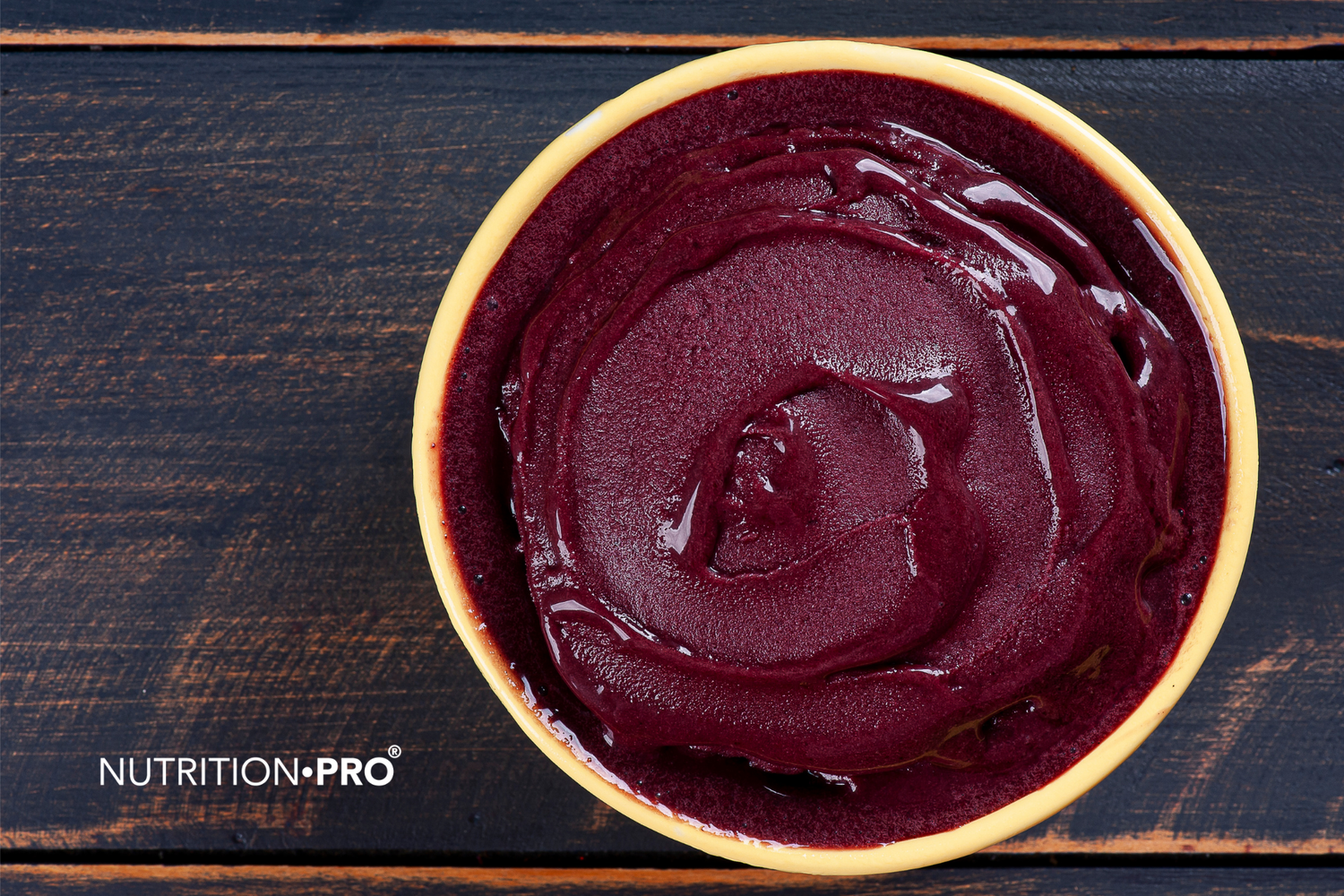
Açaí is the fruit of an Amazonian palm tree, Euterpe oleracea, consumed for centuries by populations living along the Amazon River delta. It arrived in Europe through the trend of colorful bowls, which gave it a somewhat superficial reputation. The reality is more interesting: it is a nutritionally atypical fruit, and it has been the subject of an unusually large number of scientific studies for a food of this type.
This guide reviews the current state of knowledge based on literature indexed in PubMed. Its composition, very different from that of other berries. What the 23 clinical trials identified in humans show. Recent data on post-exercise recovery. What preclinical research is exploring without it yet being applicable to humans. And how to choose a powder, where quality variations are considerable.

Its composition. Açaí stands out clearly from other berries: its pulp is rich in lipids, predominantly monounsaturated, and relatively moderate in sugars, whereas most fruits do the opposite. It provides anthocyanins, the pigments responsible for its purple color, as well as other phenolic compounds and fiber.
What human trials show. An integrative review published in Nutrition Reviews identified 23 clinical trials. Their results suggest that açaí may contribute to improve antioxidant defenses and to mitigate metabolic stress and inflammation. The authors report, however, a considerable heterogeneity between studies. Regarding sports: a randomized trial reports increased plasma antioxidant capacity of 11% and better recovery of knee flexor strength after a jump protocol. On the safety side: available reviews report no notable adverse effects at dietary doses.
What açaí is, and where it comes from
Açaí is the fruit ofEuterpe oleracea, a palm tree of the Arecaceae family, cultivated for millennia in Central and South America as a versatile food plant. The berries grow in clusters, are dark purple at maturity, and measure approximately one centimeter. The edible portion is thin: the bulk of the fruit's volume is occupied by a pit.
A vocabulary point deserves clarification, as it recurs in the studies. Two closely related species are marketed under the name açaí: Euterpe oleracea, the most common, and Euterpe precatoria, found notably in western Amazonia. A third species of the same genus, Euterpe edulis, is known in Brazil as juçara. These species are closely related but not identical, and some studies focus specifically on one or the other.
As noted in a critical review published in Nutrients, the recent introduction of this fruit outside its native region has exploded global demand. The bioactive compounds of interest are present in several parts of the plant, the pulp, the skin, the leaves and the seeds, but it is the pulp that constitutes the food.
A composition apart among fruits
If one had to take away just one thing about açaí, it would be this: it does not behave like other berries.
| Component | What distinguishes açaí |
|---|---|
| Lipids | Its pulp is rich in fat, which is very unusual for a fruit. The fatty acids present are predominantly monounsaturated, with oleic acid dominating, along with a share of polyunsaturates |
| Sugars | Moderate content compared to most fruits, which explains the low sugar taste of pure pulp and the frequent addition of sugar in commercial preparations |
| Anthocyanins | Pigments responsible for the purple color, main phenolic compounds studied in this fruit |
| Other phenolic compounds | The review published in Nutrients attributes the studied properties to numerous phenolic compounds present in different parts of the plant |
| Fiber | Present in notable quantity in the pulp |
This particularity also has a practical consequence for storage. The anthocyanins are sensitive to heat and oxidation, which makes the processing method decisive for a product whose value relies largely on these compounds. We return to this in the section devoted to choosing a powder.
What human trials show
This is the central point of this guide, and it deserves to be detailed. An integrative review published in Nutrition Reviews catalogued all clinical trials that evaluated the effects of açaí and juçara consumption in humans, in the Science Direct and Medline databases.
| Element | What the review reports |
|---|---|
| Number of trials | 23 clinical trials identified |
| Distribution | 17 on açaí, 5 on juçara, 1 on both berries simultaneously |
| Results suggested | Contribution to improving antioxidant defenses, and to reducing metabolic stress and inflammation |
| Main limitation | Considerable heterogeneity between trials |
| Second limitation | Few studies characterized the bioactive compounds of the administered food matrix |
| Authors' conclusion | More clinical trials are encouraged to strengthen the evidence |
Twenty-three clinical trials is little for a drug and it is a lot for a fruit. Few foods commonly marketed as superfoods have a human body of evidence this size.
The verb used by the authors is important: the results suggest a contribution. This is cautious wording, justified by the two limitations they identify themselves.
The first,heterogeneity, means that the trials differ in their populations, doses, durations, and outcome measures, making quantitative synthesis difficult. The second is more subtle and highly instructive: few studies characterized the bioactive compounds actually present in the administered product. However, anthocyanin content varies greatly depending on origin, ripeness, and processing method. Two trials using "açai" may therefore have administered quite different substances.
What can honestly be said: the signal exists, it is consistent from study to study regarding antioxidant defense, and it requires confirmation through more homogeneous and better characterized trials.
A critical review published in Nutrients reaches a converging conclusion: clinical trials suggest that açai can protect against metabolic stress induced by oxidation, inflammation, vascular abnormalities, andphysical exertion. This last point has been the subject of more recent and precise studies, detailed in the following section.
Recovery after exercise: recent data
A randomized trial published in Research in Sports Medicine evaluated the effect of açai supplementation on markers of muscle recovery. Its protocol is interesting because it is demanding and concrete.
| Parameter | Detail |
|---|---|
| Participants | 12 men, crossover study over 21 days |
| Supplementation | 40 g per day of dehydrated açai (Euterpe precatoria) for 7 days, versus placebo |
| Damage protocol | 10 sets of 10 countermovement jumps, 1 minute recovery between sets |
| Measurements | Blood markers, muscle ultrasound, muscle soreness, maximum isometric strength, at 0, 24, 48, and 72 hours |
The results
- Plasma antioxidant capacity, measured in Trolox equivalents, increased by 11% at 24 hours in the açaí group, with a significant time-treatment interaction.
- The maximum isometric strength of knee flexors recovered better in the açaí group, at 24 hours and at 72 hours.
- No difference was observed infatigue index, neither for the extensors nor for the flexors, indicating comparable fatigue in both conditions.
What it contributes: objectively measured results, on a biological marker and on mechanical performance, with a standardized muscle damage protocol. The fact that force recovery was improved at 24 and 72 hours is concrete data, not an impression.
Its limitations: twelve participants, all men, on a single exercise modality, and with Euterpe precatoria, a related but distinct species from the one usually commercialized. The effect is observed only on knee flexors, not on extensors. This is an encouraging result that justifies larger-scale studies, not an established demonstration.
Another randomized controlled trial deserves mention for its originality. Thirty people suffering fromchronic tinnitus received either 100 mg of açaí extract or placebo for three months. The açaí group showed a significant reduction in tinnitus-related discomfort, measured by a validated questionnaire. Conversely, no significant effect was observed on oxidative metabolism biomarkers, which the authors themselves note as requiring further investigation.
What preclinical research explores
A significant portion of the literature on açaí is preclinical, that is, conducted on cultured cells or in animals. These studies do not allow for conclusions in humans, and it would be misleading to present them otherwise. They do, however, indicate the directions that research is exploring, and as such they deserve to be known.
The critical review published in Nutrients identifies, based on in vitro and in vivo studies, antioxidant and anti-inflammatory activities, as well as effects described as cardioprotective, gastroprotective, hepatoprotective, neuroprotective, renoprotective, antilipidemic, antidiabetic, and antineoplastic.
A systematic review published in PLoS One specifically examined the antitumor aspect in animal models. Of 60 publications identified, 9 articles met the criteria, totaling 747 animals. Anticarcinogenic and chemopreventive activities were observed across all models studied, and no genotoxic effects were found.
These results concern cells and rodents. The transition to humans is never automatic, and the history of nutrition is full of elegant mechanisms that have not yielded clinical results. None of these effects can be attributed to acai in a person, and no health claim is authorized in this regard.
It is important to be particularly clear on the oncology side: this work falls under fundamental research on animal models. Nothing authorizes presenting acai as having any role in the prevention or treatment of cancer in humans, and attributing to a food the property of treating a disease is prohibited by European regulations. Moreover, people undergoing oncology treatment must report any supplement to their healthcare team.
Safety and regulatory framework
In terms of tolerance, acai behaves as what it is: a food. The critical review published in Nutrients highlights theabsence of notable adverse effects at the studied uses, and the systematic review on animal models found no genotoxic effects. A systematic evidence-based review published in the Journal of Dietary Supplements also compiled available data on safety, interactions, and dosage.
The precautions to note are those that apply to any food concentrated in powder form:
- Allergy : rare, but possible as with any fruit. In case of skin reaction, respiratory discomfort, or swelling, stop and consult a healthcare provider.
- Pregnancy and breastfeeding : consumed as a food, acai raises no particular concerns; concentrated supplementation, however, requires medical advice, as specific data are limited.
- Current treatment : as with any supplement, inform your doctor or pharmacist.
- Product quality : plants concentrate what their environment contains, which makes batch-by-batch analysis a real safety criterion.
Health claims concerning plants and fruits are pending evaluation at the European level. In practice, no authorized health claim exists for acai, and no effect can be reliably attributed to it on labeling or in commercial communications.
This does not mean that studies do not exist, and this article has just presented several. It means that publishing a study and obtaining a claim are two distinct processes, the latter requiring a dossier to be submitted, evaluated, and approved. This is why we describe here a composition and the state of research, without promising any benefit.
How to choose and use a powder
| Criterion | To avoid | To favor |
|---|---|---|
| Composition | Blends with sugar, maltodextrin, flavorings or colorants | Açaí pulp as the sole ingredient |
| Process | High-temperature drying, process not specified | Freeze-drying, which better preserves anthocyanins, which are heat-sensitive |
| Part used | Vague mention of "fruit" | Pulp clearly indicated |
| Testing | No quality control mentioned | Batch-by-batch testing, heavy metals and microbiology, accessible certificate |
| Color and odor | Pale or brownish powder, no odor | Deep purple, characteristic odor with a slight cocoa note |
The line on the process is what matters most for this fruit. Anthocyanins are pigments sensitive to heat and oxidation. Aggressive drying degrades precisely the compounds that make the product worthwhile, without this being visible on the packaging. The powder's color actually gives a useful indication: a true purple is a better sign than a dull shade.
The sugar question, and it's not where you'd think
Pure açaí has a moderate sugar content for a fruit, and a taste that many find not very sweet, almost earthy. What makes an açaí bowl very high in calories and very sweet is therefore not the fruit: it's the additions. Commercial preparations are frequently sweetened, sometimes supplemented with guarana syrup or concentrated juices, then served with granola, honey and dried fruits.
Making your own bowl from pure pulp or powder therefore radically changes the nutritional profile of the result, and this is probably the most useful advice in this section.
In practice
The powder mixes well into yogurt, fromage blanc, a smoothie or a bowl of cereal flakes. Its texture and flavor pair well with red berries and banana, which provide the sweetness it lacks. No reference dose has been established, as study protocols vary widely, ranging from 100 mg of extract in the tinnitus trial to 40 g of dehydrated powder per day in the sports recovery trial: follow the instructions on the product label you purchase.
Açaí is a real food, with a genuinely atypical composition and an unusually robust research corpus for a fruit. Twenty-three clinical trials suggest a contribution to antioxidant defenses, with limitations that their authors acknowledge. It's neither a miracle berry nor a simple trend product: it's a nutrient-dense and interesting fruit that should be chosen based on its composition and processing method rather than its reputation.
Frequently asked questions
Understanding açaí
What exactly is açaí?
It's the fruit of Euterpe oleracea, an Amazonian palm tree of the Arecaceae family, cultivated for millennia in Central and South America as a versatile food plant. The purple berries grow in clusters and measure approximately one centimeter, with a thin edible portion, most of the volume being occupied by a pit. It's the pulp that constitutes the food.
What makes it special compared to other berries?
Its composition, which is inverted compared to most fruits. Where berries are generally rich in sugars and poor in fats, açaí pulp is rich in fat, predominantly monounsaturated with a dominance of oleic acid, and moderate in sugars. It also provides anthocyanins, the pigments responsible for its purple color, as well as other phenolic compounds and fiber.
Why does açaí have almost no sweet taste?
Because it genuinely isn't very sweet. Its sugar content is moderate for a fruit, and its fat-rich profile gives it a creamy texture and a taste that many describe as earthy or slightly cocoa-like. It's precisely for this reason that commercial preparations frequently add sugar, syrup, or concentrated juices.
Are there multiple açaí species?
Yes, and it's useful to know for reading studies. Euterpe oleracea is the most common and most commercialized. Euterpe precatoria is found notably in western Amazonia and is the subject of separate research, including the trial on muscle recovery. A related species, Euterpe edulis, is known in Brazil as juçara. These species are close but not identical.
What studies show
What do clinical trials in humans say?
An integrative review published in Nutrition Reviews identified 23 clinical trials, including 17 on açaí, 5 on juçara, and 1 on both. Their results suggest that these berries may contribute to improving antioxidant defenses and mitigating metabolic stress and inflammation. The authors note, however, considerable heterogeneity among trials and encourage further research.
Twenty-three trials, is that a lot?
It's little for a drug and a lot for a fruit. Few commonly sold superfoods have a human research corpus of this size. This isn't enough to establish a health effect, particularly due to heterogeneity between studies, but it places açaí in a different category from ingredients for which only cellular data is available.
Why do the authors mention heterogeneity?
Because the trials differ in their populations, doses, durations, and outcome measures, making quantitative synthesis difficult. The authors also note that few studies characterized the bioactive compounds actually present in the administered product. Since anthocyanin content varies significantly by origin, ripeness, and processing method: two trials using açaí may have administered quite different products.
Does açaí help with recovery after exercise?
A randomized trial published in Research in Sports Medicine tested 40 g per day of dehydrated açaí for 7 days in 12 men, before a protocol of 10 sets of 10 jumps. Plasma antioxidant capacity increased by 11% to 24 hours, and maximum isometric strength of knee flexors recovered better at 24 and 72 hours than under placebo. No difference in fatigue index. Twelve participants, all men: it's encouraging, not established.
What did the tinnitus trial show?
A randomized placebo-controlled trial followed 30 people with chronic tinnitus for three months, with 100 mg of açaí extract. The açaí group showed a significant reduction in tinnitus-related discomfort, measured by a validated questionnaire. Conversely, no significant effect was observed on biomarkers of oxidative metabolism, which the authors note as requiring further investigation.
What's the value of cell and animal studies?
They indicate the directions explored by research, without allowing conclusions in humans. Available reviews identify, based on in vitro and in vivo work, antioxidant and anti-inflammatory activities as well as effects described as cardioprotective, hepatoprotective, neuroprotective, or antidiabetic. The transition to humans is never automatic, and none of these effects can be attributed to açaí in a person.
Does açaí have an effect on cancer?
No, nothing allows us to affirm this in humans, and we must be categorical about this. A systematic review compiled 9 preclinical studies totaling 747 animals, reporting anticarcinogenic and chemopreventive activities in the models studied, without genotoxic effect. These are fundamental research works on rodents. Attributing to a food the property to treat or prevent a disease is prohibited by European regulations, and people being followed in oncology must report any supplement to their care team.
Safety and regulation
Does acai present any risks?
It behaves like what it is, a food. The critical review published in Nutrients emphasizes the absence of notable adverse effects at the studied uses, and the review on animal models found no genotoxic effects. The precautions to note are those of any food concentrated in powder form: possibility of allergy, medical advice for concentrated supplementation during pregnancy or breastfeeding, and reporting in case of ongoing treatment.
Is there an authorized health claim?
No. Claims concerning plants and fruits are pending evaluation at the European level, and no authorized claim exists for acai. This does not mean that studies do not exist, but that publishing a study and obtaining a claim are two distinct processes: the latter requires a file to be submitted, evaluated, and validated.
Can it be consumed during pregnancy?
Consumed as a food, acai does not raise any particular concerns. Concentrated supplementation in powder or extract form, however, requires medical advice, as specific data in this population are limited. The general rule applies: during pregnancy and breastfeeding, no supplement without validation by a health professional.
Choosing and Using
How to recognize a quality powder?
Five criteria. A single ingredient, acai pulp, with no sugar, maltodextrin, flavor, or colorant. An indicated drying process, freeze-drying better preserving anthocyanins. The part used clearly mentioned. Analytical controls lot by lot with accessible certificate. And a useful visual indicator: a sustained purple, with a characteristic odor slightly cocoa-like.
Why does the drying process matter so much?
Because anthocyanins, the main compounds studied in this fruit, are pigments sensitive to heat and oxidation. Aggressive drying degrades precisely what makes the product worthwhile, without this appearing on the packaging. This is also why the color of the powder is an indicator: a frank purple is a better sign than a dull or brownish hue.
Are acai bowls sweet?
Commercial preparations often are, but the fruit is not to blame. Pure acai has a moderate sugar content and a slightly sweet taste. What makes a bowl caloric and sweet are the additions: sugar, guarana syrup, concentrated juices, then granola, honey, and dried fruits upon serving. Composing your bowl yourself from pure pulp or powder radically changes the result's profile.
What quantity to consume?
No reference dose is established, and study protocols are highly variable: from 100 mg of extract in the tinnitus trial to 40 g of dehydrated powder per day in the sports recovery trial. Follow the indications on the labeling of the product you purchase, and remember that this is a calorie-dense food, not a neutral powder.
What to remember about acai?
That it is a real food, with an atypical composition among fruits, rich in monounsaturated lipids and moderate in sugars, and an unusually substantial body of research. That 23 clinical trials suggest a contribution to antioxidant defenses and to the mitigation of metabolic stress, with limitations acknowledged by their authors. And that the choice of product, composition and process, matters more than the fruit's reputation.
Glossary
- Acai (Euterpe oleracea)
- Fruit of an Amazonian palm tree, whose pulp constitutes the edible part.
- Euterpe precatoria
- Related species, found notably in western Amazonia, used in certain trials.
- Juçara (Euterpe edulis)
- Another species of the same genus, studied jointly with acai in several works.
- Anthocyanins
- Pigments responsible for the purple color, main phenolic compounds studied in this fruit, sensitive to heat.
- Phenolic compounds
- Family of plant molecules to which anthocyanins belong, widely studied in nutrition.
- Freeze-drying
- Drying by sublimation at low temperature, which better preserves heat-sensitive compounds.
- Antioxidant capacity in Trolox equivalents
- Measure of the antioxidant capacity of a biological sample, used in the recovery trial.
- Preclinical study
- Research conducted on cells or in animals, before any human trial.
Sources
The studies cited below were identified via PubMed.
- Baptista SL, et al. Biological activities of acai (Euterpe oleracea Mart.) and juçara (Euterpe edulis Mart.) consumption in humans: integrative review of clinical trials. Nutrition Reviews, 2021;79(12):1375-1391. DOI
- Laurindo LF, et al. Açai (Euterpe oleracea Mart.) in health and disease: a critical review. Nutrients, 2023;15(4):989. DOI
- Dos Reis TMP, et al. Effects of açai supplementation (Euterpe precatoria Mart) on muscle recovery markers following a jump protocol. Research in Sports Medicine, 2024;32(4):580-596. DOI
- Oppitz SJ, et al. Açai supplementation (Euterpe oleracea Martius) in the treatment of chronic tinnitus: effects on perception, anxiety levels, and oxidative metabolism biomarkers. CoDAS, 2022;34(4):e20210076. DOI
- Alessandra-Perini J, et al. Anticancer potential, molecular mechanisms, and toxicity of Euterpe oleracea (açai) extract: a systematic review. PLoS One, 2018;13(7):e0200101. DOI
- Ulbricht C, et al. Evidence-based systematic review of açai (Euterpe oleracea) by the Natural Standard Research Collaboration. Journal of Dietary Supplements, 2012;9(2):128-147. DOI
- European Parliament and Council. Regulation (EC) 1924/2006 on nutrition and health claims made on foods. eur-lex.europa.eu


