

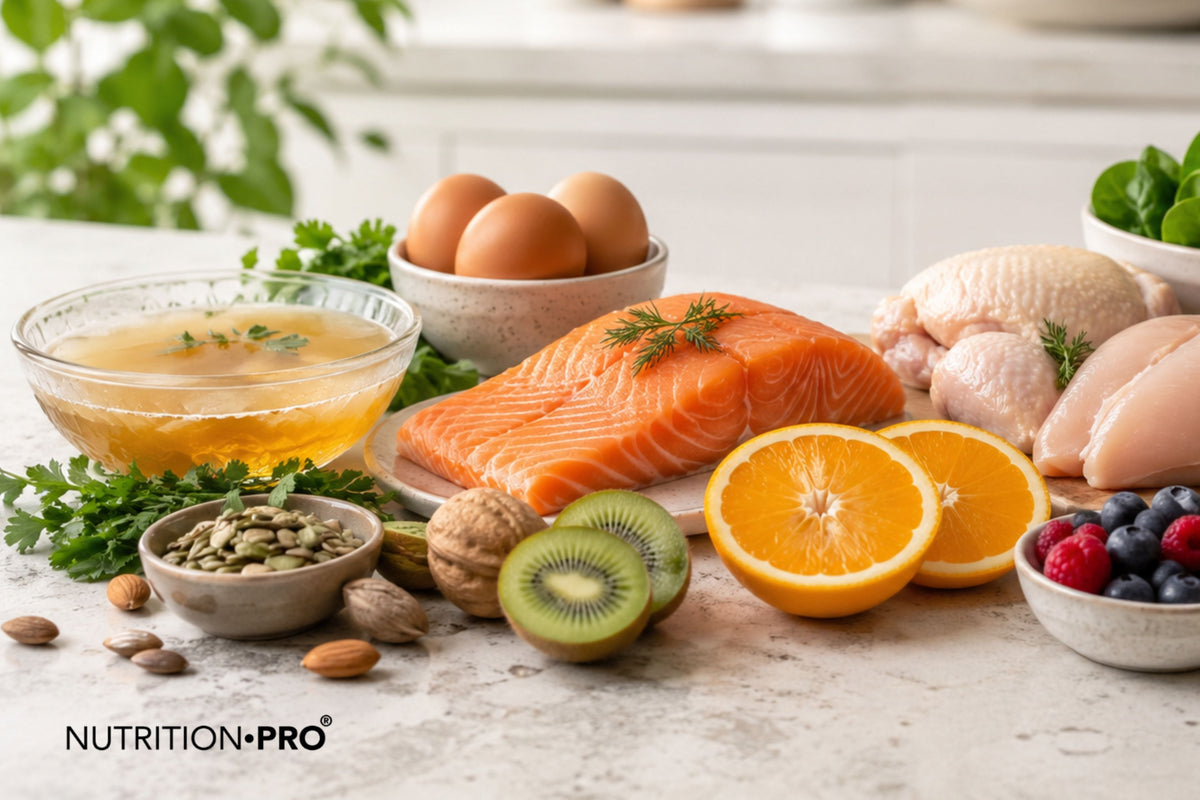
"Eating collagen-rich foods for beautiful skin": the idea appeals, and the internet is full of lists of foods "packed with collagen". But these articles gloss over one detail.
Consuming collagen doesn't deposit it directly into your skin: your body digests it like any other protein. What matters is giving it the right building blocks and the right tools so it can manufacture its own collagen. Here, without myths, are the foods that truly boost your production.


Eating "collagen-rich foods" doesn't transfer it to your skin: it's digested into amino acids. To boost your production, two levers: (1) the building blocks, proteins rich in glycine and proline (bone broth, fish skin, eggs, poultry, legumes); (2) especially the cofactors, vitamin C above all (citrus, kiwi, bell pepper, berries), then zinc and copper. Conversely, excess sugar, UV and tobacco destroy collagen. When diet isn't enough, hydrolyzed collagen takes over.
The myth: eating collagen isn't enough
Let's first correct the most widespread belief: that the collagen from bone broth would directly strengthen that of our skin. That's not how digestion works.
Collagen is a large protein. Like all proteins, digestion cuts it into amino acids and peptides, which join the body's pool. The body uses these for multiple purposes, including, potentially, making collagen where it needs it: nothing guarantees that an amino acid from your broth will end up in the dermis.
Food isn't useless despite this: its role is indirect, it supplies the raw materials and tools for your own collagen factory. This brings us to the two real levers.
The 2 real levers: the bricks and the cofactors
Making collagen is like building a wall: you need bricks (the materials) and workers with their tools (the enzymes and their cofactors). If either is missing, the wall doesn't go up.
- The bricks : the amino acids of collagen (glycine, proline, hydroxyproline), provided by proteins. A diet too low in protein immediately limits production.
- The cofactors : the micronutrients without which enzymes don't assemble these amino acids into solid fibers. The most important is vitamin C, essential for the key step, followed by zinc and copper.
The effective strategy: combine the two, by pairing proteins and vitamin C in the same meal. Let's see which foods to choose for each category.
The "brick" foods (amino acids)
These foods provide the amino acids your body will reuse to build collagen. Animal sources of connective tissue are the richest, but all proteins contribute.
The bone broth releases gelatin and collagen amino acids (its content varies depending on preparation). Whole fish or with skin and eggs (rich in proline) also provide it. On the plant side, legumes supply useful amino acids without containing collagen. The key point: sufficient and regular protein intake.
Vitamin C: the number one cofactor
If you had to remember just one nutrient, it would be this one. Vitamin C is not a simple "bonus": it is essential for collagen production, as a cofactor of enzymes that stabilize fibers. Without it, even with all the building blocks in the world, the wall won't hold.
This role is well documented. According to a review by Pullar et al. 2017 in Nutrients, vitamin C contributes essentially to skin health, particularly by stimulating collagen synthesis, and dietary intake of it is a key determinant (DOI: 10.3390/nu9080866).
The winning strategy: combine building blocks and vitamin C in the same meal (fish + red pepper, eggs + kiwi). This is also why quality collagen supplements are enriched with vitamin C.
Zinc, copper and other cofactors
Vitamin C is not alone: two minerals also play a cofactor role in collagen formation, zinc and copper. They activate key enzymes, and a deficiency can slow down synthesis.
To this are added antioxidant foods (berries, green vegetables, green tea): they don't produce collagen but protect the collagen already present against oxidative stress. The other side of the strategy: produce more, and preserve what you have.
Foods and habits that destroy collagen
Boosting production is pointless if you destroy it elsewhere. Three enemies to know.
Excess sugar (glycation)
Excess sugar triggers glycation : it binds to collagen fibers, stiffens and weakens them (loss of firmness, accelerated aging). Reducing simple sugars directly protects your collagen.
UV rays and excessive sun exposure
UV rays generate free radicals that degrade collagen fibers, even without visible sunburn. Daily sun protection is one of the most effective anti-aging measures.
Tobacco and excess alcohol
Tobacco reduces tissue oxygenation and slows collagen production; alcohol promotes dehydration and oxidative stress. Limiting these two factors clearly supports your skin.
When diet is not enough
Taking care of your plate is the first step, and the most important one, but it has its limits. Modern diet often provides little glycine (we mainly consume animal muscles, which are poor in connective tissue), and natural collagen production decreases with age, starting in the mid-twenties, then accelerates at menopause.
This is where hydrolyzed collagen becomes truly valuable: predigested into short peptides that are well absorbed, its skin efficacy is documented. According to a meta-analysis by de Miranda et al. 2021 (Int J Dermatol, 19 trials), it improves hydration, elasticity and wrinkles after approximately 90 days (DOI: 10.1111/ijd.15518).
The ideal approach is not to choose, but to combine : a plate rich in protein and vitamin C, plus a course of hydrolyzed collagen to directly provide peptides and cofactor. To choose well, see our guide to the best collagen according to your objective, and for quantities, our article on optimal daily dosage.
Frequently asked questions
What are the foods richest in collagen?
Direct sources are animal connective tissues: bone broth, fish skin, gelatin, organ meats. But collagen that is eaten is digested into amino acids; it doesn't transfer to the skin as-is. Most useful: foods that supply the building blocks (proteins rich in glycine and proline) and cofactors, with vitamin C leading the way.
Can you increase your collagen through diet?
Yes, indirectly. Diet doesn't deliver ready-made collagen, but provides the raw materials (amino acids) and cofactors (vitamin C, zinc, copper) necessary for its production. A diet rich in protein and vitamin C, combined with good lifestyle habits, truly supports natural production.
Is vitamin C essential for collagen?
Yes. It's an essential cofactor: without it, the body cannot form stable collagen fibers. According to a review in Nutrients (Pullar 2017), dietary vitamin C stimulates collagen synthesis and protects skin. Citrus fruits, kiwi, peppers and red berries are therefore a priority.
Is bone broth effective for collagen?
It provides gelatin and amino acids from collagen, an interesting source of building blocks. But its actual content varies and it is still digested like any protein. Useful as part of a collagen-supportive diet, without being miraculous, and best combined with adequate vitamin C intake.
Learn more
- Collagen synthesis
- Production of collagen by the body from amino acids, under the action of enzymes and cofactors such as vitamin C.
- Amino acids
- The building blocks of proteins. Collagen is primarily composed of glycine, proline, and hydroxyproline.
- Cofactor
- Essential micronutrient for the proper functioning of an enzyme. Vitamin C, zinc, and copper are cofactors in collagen synthesis.
- Glycation
- A reaction in which sugar binds to collagen fibers, stiffens and weakens them, accelerating skin aging.
- Hydrolyzed collagen
- Collagen pre-digested into short peptides for optimal absorption. The form used in supplements.
- Pullar JM, Carr AC, Vissers MCM. The Roles of Vitamin C in Skin Health. Nutrients. 2017;9(8):866. doi:10.3390/nu9080866
- de Miranda RB, Weimer P, Rossi RC. Effects of hydrolyzed collagen supplementation on skin aging: a systematic review and meta-analysis. Int J Dermatol. 2021;60(12):1449-1461. doi:10.1111/ijd.15518
About this article Written by the Nutrition•pro team based on scientific literature indexed on PubMed. This article is informational and does not replace personalized medical or dietary advice. In case of food allergies, pregnancy, or medical treatment, please consult a healthcare professional. Discover our editorial methodology.


