

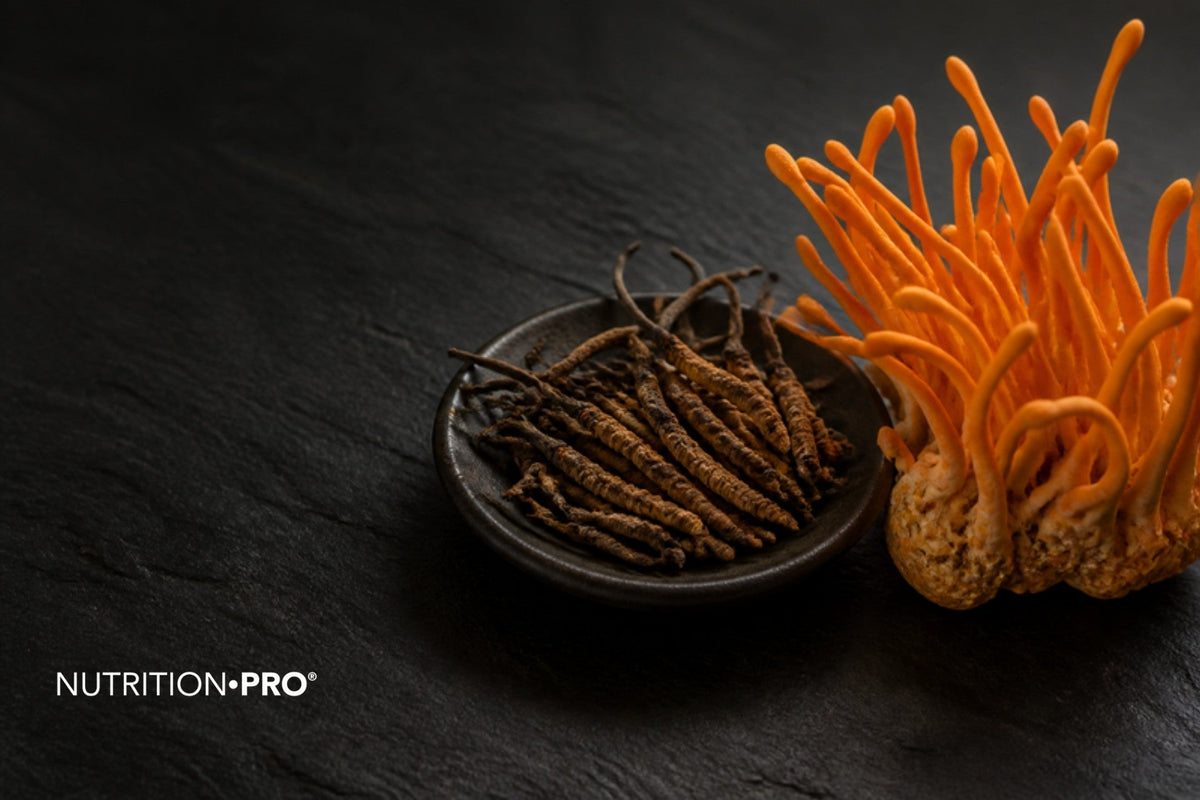
The term cordyceps can refer to a wild fungus collected at high altitude on a mummified caterpillar, an orange cultivated fungus, or a mycelium produced in fermentation tanks. A 2002 study already identified more than ten species and forms sold under the same Chinese name, with value gaps that could exceed a factor of 100. Choosing between militaris and sinensis therefore begins with understanding what you're talking about.
This guide brings together what studies identified via PubMed show: the botanical difference between the two species, the economics of wild sinensis, measured levels of active compounds, fruiting body and mycelium, counterfeits and contaminants, then each human trial classified according to the preparation actually tested, including null results, followed by a method for reading a label.

Two different fungi : wild Ophiocordyceps sinensis grows on butterfly larvae at high altitude, in the Himalayas and on the Tibetan plateau; it is rare, expensive, and threatened. Cordyceps militaris, from a different family, is cultivated and forms an orange fruiting body, richer in cordycepin according to analyses. Wild sinensis also exposes users to counterfeits and, for the larva, to arsenic.
Modest trials, to be read form by form : most trials labeled sinensis tested fermented mycelium (Cs-4 or Hirsutella sinensis), almost never the wild fungus. On the militaris side, only one indexed trial we identified clearly describes a fruiting body extract, on 12 men. Several trials are null, including one negative result on sleep. Neither species stands out; the choice depends on a clearly identified preparation.
- Cordyceps: one name for several fungi
- Wild sinensis, a high-altitude fungus that has become rare
- Wild, cultivated, mycelium: the forms sold
- Cordycepin, adenosine, ergosterol: what analyses measure
- Fruiting body or grain mycelium: why the part matters
- Counterfeits, arsenic, and lead
- Trials labeled sinensis: mostly fermented mycelium
- Trials on militaris: few and often short-term
- All trials, species by species
- How to read a cordyceps label
- Precautions and interactions
- Frequently Asked Questions
Cordyceps: One Name for Several Fungi
The genus Cordyceps long grouped more than 400 species of insect-parasitic fungi. In 2007, genetic analysis of 162 species showed that this genus did not form a natural group. The Cordycipitaceae family was validated based on the type species, Cordyceps militaris, with fleshy and colored fruiting bodies; a new family, Ophiocordycipitaceae, was created for species with dark and leathery fruiting bodies, and the Chinese cordyceps became Ophiocordyceps sinensis. The name Cordyceps sinensis remains used in commerce and studies, but the two species are no longer in the same family.
A study published in Planta Medica in 2002 noted that more than ten species of Cordyceps and their asexual forms were sold under the Chinese name sinensis, and that the value of these products could differ by more than 100 times. Analysis of a DNA region unambiguously distinguished sinensis from militaris and closely related species.
Sinensis itself is not a simple organism. Its asexual form, the one that grows in culture, is most often identified as Hirsutella sinensis, but a 2025 study on 173 strains notes that this link remains debated: it describes 17 distinct genotypes and several fungi that coexist within the natural complex. What is harvested at high altitude therefore does not strictly equate to what is cultivated.
The fruiting body is the fructification, the visible part of the fungus. The mycelium is the network of filaments that grows in its substrate: larva, grain, or liquid medium. Our complete cordyceps guide presents its uses and dosages.
Wild sinensis, a high-altitude fungus that has become rare
Wild Ophiocordyceps sinensis infects ghost moth larvae buried in the alpine meadows of China, Bhutan, Nepal, and India, then a brown stem emerges from the soil: this is what foragers seek. Used by traditional Chinese medicine for over 2,000 years, demand for it exploded in China during the fifteen years leading up to 2018.
A 2018 study published in the Proceedings of the National Academy of Sciences describes it as one of the most precious biological commodities in the world, a source of income for hundreds of thousands of foragers. In four countries, foragers report a decline in production, linked primarily to overexploitation, but also to warming: the fungus is more productive in cold zones near permafrost.
The harvest of caterpillar fungus represents 50 to 70% of household income for thousands of Himalayan communities, for a market estimated at between 5 and 11 billion dollars in Asia. Genetic analysis of samples from 94 production zones allows their geographic origin to be traced.
Wang Z, Da W, Negi CS, et al. Proc Biol Sci 2022;289(1973):20212650. DOI : 10.1098/rspb.2021.2650
In the Darchula district, at the far western edge of Nepal, a survey recorded 384.1 kg harvested in 2014-2015, for approximately 4.7 million dollars paid to gatherers, or around 12,000 dollars per kilogram before intermediaries (editorial calculation).
Full sinensis cultivation, fungus and larva, was recently developed in China using larvae raised for this purpose. An analysis of 98 metabolites published in 2021 classified these fruiting bodies cultivated with natural cordyceps; this is a chemical comparison, without human testing.
Wild, cultivated, mycelium: the forms sold
Since wild sinensis is rare, the first alternative consisted of isolating a cultivable strain from natural fungus, then fermenting it in tanks to produce mycelium. The Cs-4 strain, used in several trials, is presented as derived from Cordyceps sinensis; other preparations use Hirsutella sinensis or Paecilomyces hepiali, a strain isolated from natural sinensis and, according to a 2018 study, widely employed as a sinensis substitute in medicine and health foods. These mycelia are neither the wild fungus nor a fruiting body.
Cordyceps militaris , meanwhile, is cultivated until it forms its orange fruiting body. A 2010 review lists the techniques: cultures on hulled rice or sawdust, or in liquid medium. Depending on the technique, the fruiting body, mycelium, or both with their substrate are harvested.<<<13>>> Raw material
| Matière première | What it is | In trials |
|---|---|---|
| Wild Ophiocordyceps sinensis | Fungus and mummified butterfly larva, harvested at altitude | No controlled trial identified in healthy volunteers |
| Sinensis cultivated on farmed larvae | Recent cultivation of the complete complex | Chemical analyses only |
| Fermented mycelium Cs-4, Hirsutella sinensis, Paecilomyces hepiali | Strains isolated from sinensis, cultivated in tanks | The majority of so-called sinensis trials |
| Cordyceps militaris, fruiting body | Orange cultivated fruiting body, whole or in extract form | One clearly identified indexed trial, single dose |
| Cordyceps militaris, mycelium | Filaments cultivated on grain or in liquid medium | Several trials, including one mixture cultivated on oats |
Our Cordyceps falls in the fourth category: a 4:1 concentrated extract of Cordyceps militaris fruiting body, 1,800 mg of extract per two capsules. This choice reflects the traceability of the species and the part used; it does not mean that a trial tested this product, which is not the case.
Cordycepin, adenosine, ergosterol: what analyses measure
Cordycepin , or 3'-deoxyadenosine, close to adenosine, is the most cited compound of the genus. Analyses measure it alongside adenosine, mannitol, polysaccharides and ergosterol, with highly variable results depending on the species, part, strain, substrate and extraction method.<<<39>>> Analytical study, Analytical and Bioanalytical Chemistry 2015
In five authentic samples of Cordyceps sinensis and five of substitutes, cordycepin represented 0.0076% to 0.029% by weight, and mannitol 0.33% to 18.9%. Two glycosides were found only in the authentic samples, making them authenticity markers.
Hu H, Xiao L, Zheng B, et al. Anal Bioanal Chem 2015;407(26):8059-8066. DOI : 10.1007/s00216-015-8978-6
In 2006, a Taiwanese team measured higher levels of cordycepin and adenosine in an extract of cultivated militaris than in a natural sinensis extract. Yet, in vitro, the sinensis extract better protected lipoproteins from oxidation (67.1% inhibition at 1 mg per mL, versus 50.5%), and cordycepin as well as adenosine, tested alone, showed no notable antioxidant activity.
In 2019, a Chinese study compared aqueous extracts of fermented mycelia from three strains, including Paecilomyces hepiali, with fruiting bodies of cultivated militaris and wild militaris. Cordycepin was detected only in cultivated fruiting bodies of militaris. Fermented mycelia, however, contained higher levels of crude polysaccharides and triterpenes.
For militaris, a 2026 review reports 325 to 377 mg of cordycepin per 100 g of dry fruiting body in two of the 16 samples cited, and 5.28 to 8.37 mg per gram depending on the extraction solvent. Relative to weight, these two fruiting bodies contain more than ten times more cordycepin than the richest samples from the 2015 study (editorial calculation, on different samples).
| Material analyzed | Measured content | Study |
|---|---|---|
| Authentic sinensis and substitutes | Cordycepin 0.0076 to 0.029%; mannitol 0.33 to 18.9% | Hu, 2015 |
| Militaris fruiting body | Cordycepin 325 to 377 mg per 100 g dry in 2 samples out of 16 | Jędrejko Review, 2026 |
| Fermented mycelia, including Paecilomyces hepiali | Cordycepin not detected; higher levels of polysaccharides and triterpenes | Qiao, 2019 |
| Militaris: fruiting body, mycelium, liquid cultures | Ergosterol 1.36 to 2.50 mg per gram | Huang, 2015 |
| Wild militaris | Ergothioneine 130 to 140 mg per kilo of dry mycelium, 382 to 799 mg per kilo of dry fruiting body | Jędrejko Review, 2026 |
<<<27>>> Ergosterolergostérol, the sterol of fungi, reached 1.36 to 2.50 mg per gram in fruiting bodies, mycelia, and liquid cultures of militaris; two hours of UV-B converted part of it to vitamin D2. One limitation remains: in rats, cordycepin is quickly transformed into 3'-deoxyinosine by adenosine deaminase, and its maximum blood concentration reached only 7.8 ng per mL after an injection of 10 mg per kilo. A product's content does not indicate what reaches the body.
Fruiting body or mycelium on grain: why the part matters
The part used matters as much as the species. A fruiting body is harvested alone; a mycelium cultivated on grain is often dried and ground together with that grain. The most cited study on militaris provides an example.
In 28 active young adults, the tested preparation, 4 g per day, was a blend containing a biomass of cordyceps mycelium cultivated on organic oats and other mushrooms. One week produced no significant difference from placebo. Among the 10 volunteers who continued for two more weeks, VO2max increased by 4.8 mL per kilo per minute, compared to 0.9 under placebo.
Hirsch KR, Smith-Ryan AE, Roelofs EJ, et al. J Diet Suppl 2017;14(1):42-53. DOI : 10.1080/19390211.2016.1203386
This trial, often summarized by the phrase militaris improves VO2max, therefore tested a blend of mushrooms in mycelium on oats form, and its favorable result is based on ten people. Fruiting body and mycelium do not have the same chemical profile, and neither part is universally superior: what matters is that the label states which one is used.
We chose the fruiting body for our entire mycotherapy range. Our Reishi is an extract of Ganoderma lucidum fruiting body, to be taken in the evening (two capsules), and our Lion's Mane a 4:1 extract of Hericium erinaceus fruiting body. Our mycotherapy synthesis compares the available studies for each mushroom.

Counterfeits, arsenic and lead
The more expensive a product, the more it is imitated. A 2020 study reminds us that counterfeits are sold as natural Chinese cordyceps and proposes a genetic test that detects both the fungal DNA and that of the host larva, validated on 11 commercial samples. The 2026 review on militaris also recalls cases of falsified supplements, where anabolic steroids replaced a plant extract, important information for tested athletes.
Regarding metals, a 2018 study analyzed three batches of wild sinensis from Qinghai. Lead, cadmium and mercury were more concentrated in the stem, but arsenic was found mainly in the larva. Only 8.69% of total arsenic was in inorganic form, the most toxic, and risk quotients remained below 1: the authors conclude there is no obvious risk for reasonable consumption.
In Taiwan, two patients taking cordyceps powder developed lead poisoning (blood lead levels of 130 and 46 µg per deciliter), one with loss of appetite and signs of anemia. The powder contained up to 20,000 ppm of lead. Levels normalized after discontinuation, with chelation therapy for the symptomatic patient.
Wu TN, Yang KC, Wang CM, et al. Sci Total Environ 1996;182(1-3):193-195. DOI: 10.1016/0048-9697(96)05054-1
These cases remain rare and old. Supplements analyzed in Serbia, including sinensis preparations, contained little metal: 0.130 to 0.360 mg of lead and less than 0.03 to 0.46 mg of arsenic per kilo.
The documented risk mainly depends on the product's origin: powders from unknown sources, sinensis sold in bulk, products without identified species or parts. A product that indicates the species, the part used and the nature of the extract can be verified more easily. Athletes subject to testing should have the composition of any supplement verified with their federation, as our doping guide.
So-called sinensis trials: mostly fermented mycelium
We identified no controlled trial in healthy volunteers explicitly on wild sinensis. So-called sinensis trials tested fermented myceliums, most often the Cs-4 strain, or formulas combining several plants, with mixed results.
In 20 seniors aged 50 to 75, 12 weeks of Cs-4 at 1 g per day increased the metabolic threshold by 10.5% and the ventilatory threshold by 8.5%, with no change under placebo; VO2max did not vary. The authors call it a pilot study.
In 22 trained male endurance cyclists, 5 weeks of Cs-4 in tablets at 3 g per day changed neither peak VO2 (59.1 then 57.1 mL per kg per minute, versus 59.9 then 60.1 under placebo), nor ventilatory threshold, nor time trial (62.1 minutes versus 61.4 under placebo).
Parcell AC, Smith JM, Schulthies SS, et al. Int J Sport Nutr Exerc Metab 2004;14(2):236-242. DOI: 10.1123/ijsnem.14.2.236
Two other trials in cyclists are null. In 17 competitive enthusiasts, two weeks of a formula with Cs-4 (1,000 mg), rhodiola (300 mg) and other ingredients per three capsules changed neither peak VO2 (4.14 versus 4.10 L per minute), nor time to exhaustion, nor maximum power. In 8 men, a formula combining sinensis and rhodiola changed neither muscle oxygenation, nor VO2max, nor time to exhaustion.
One trial conducted at altitude is favorable: in 18 trained men at 2,200 meters for two weeks, 1,400 mg of Rhodiola crenulata and 600 mg of Cordyceps sinensis per day lengthened running time to exhaustion by 5.7%, versus 2.2% under placebo, without isolating each plant's contribution. Our Rhodiola provides 640 mg of extract per day at 1% salidrosides, without cordyceps: neither its composition nor its dose matches these formulas, and our analysis of 13 trials on rhodiola and sport examines the plant alone.
Outside of sport, three trials are null. In 96 students, 30 days of a supplement combining sinensis and reishi improved no cognitive domain. In 84 type 2 diabetics, 3 g per day of reishi, with or without sinensis, for 16 weeks changed neither glycated hemoglobin nor fasting blood glucose. In 85 asthmatic children on inhaled corticosteroids, a formula of five plants containing sinensis, for 6 months, did not reduce corticosteroids better than placebo.
With another strain, Paecilomyces hepiali, a mycelium extract at 1.68 g per day for 8 weeks increased natural killer cell cytotoxic activity by 38.8% compared to placebo in 79 healthy Korean adults; two of the authors were affiliated with private companies.
The most numerous data concern patients, in trials conducted in China. A Cochrane review of 22 studies and 1,746 people with chronic kidney disease finds a creatinine reduction of 60.76 µmol per liter with cordyceps preparations added to treatment, but with high or uncertain risk of bias in all studies: no definitive conclusion. Another Cochrane review, in 447 kidney transplant recipients, describes cordyceps used in China as an immunosuppressive adjuvant. In 240 patients with chronic bronchitis, a preparation of Hirsutella sinensis (Cs-C-Q80 strain) at 6 g per day for 48 weeks reduced exacerbations (0.43 versus 1.56 under placebo), with as many adverse effects (29.6% versus 30.4%). These results concern monitored patients.
Trials on militaris: few and often short
The part of militaris tested is rarely specified. In 79 Korean men, 1.5 g per day of ethanol-treated militaris for 4 weeks increased natural killer cell activity, lymphocyte proliferation and two immune messengers more than placebo, without significant adverse effect. In Thailand, a drink of militaris fermented in liquid medium, providing 2.85 mg of cordycepin, increased natural killer cell activity in 40 adults over 8 weeks, differently according to sex, without toxicity.
In 22 long-distance runners, 1,800 mg per day of a mycelium extract of militaris over 16 weeks of training increased ferritin when it was declining under placebo, further improved hemoglobin at 8 weeks and reduced creatine kinase, a marker of muscle damage, at 16 weeks; running performance did not differ from placebo.
In 12 young active men, a single dose of 1 g of Cordyceps militaris fruiting body extract, standardized to at least 2.5 mg of cordycepin and 150 mg of beta-glucans per gram, taken 30 minutes before maximal exercise, yielded shorter reaction times after exercise on the Stroop test (963.92 versus 1,034.33 milliseconds according to the abstract, 964.08 versus 1,042.83 in the tables), without modifying the exertion-related acceleration observed in both conditions, and higher resting oxygen consumption (0.37 versus 0.24 L per minute). Peak VO2, blood glucose, blood pressure and heart rate did not change.
Farzan H, Koushkie Jahromi M. PLoS One 2026;21(7):e0351725. DOI: 10.1371/journal.pone.0351725
This is the only PubMed-indexed trial we identified with a clearly described fruiting body extract: small, limited to men and a single dose. The tested extract is not ours, and our product sheet does not provide cordycepin or beta-glucan content.
In 59 depressed patients suffering from insomnia, 3 g per day of Cordyceps militaris in tablets, added for 6 weeks to an antidepressant, duloxetine, did not improve sleep: the insomnia score even decreased more under placebo. Depression scores did not differ between groups, and adverse effects were comparable.
Zhou J, Chen X, Xiao L, et al. Front Psychiatry 2021;12:754921. DOI: 10.3389/fpsyt.2021.754921
In 65 patients with mild to moderate COVID-19, 500 mg militaris capsules three times daily did not significantly reduce recovery time (6.6 days versus 7.3 under placebo), even though the authors conclude favorably on secondary criteria. A 2026 review examined the five studies of militaris in healthy subjects published between 2017 and 2024 (321 participants, 1 to 12 g per day, 1 to 16 weeks): inconsistent results, no low-risk-of-bias study, four of five not registered. Three of these five studies are not indexed in PubMed: a militaris-based mushroom blend (1 to 2 g per day for 4 weeks, or 12 g for 1 week), 180 young swimmers (8 g per day of boiled militaris, 7 weeks) and 48 runners (1 g per day of fresh ground fruiting body, 3 weeks). Our article on cordyceps and sports performance details the results during exercise.
All trials, species by species
The level of evidence is an editorial assessment (size, duration, placebo, clarity of preparation).
| Tested preparation | Population, dose, duration | Result | Level of evidence |
|---|---|---|---|
| Cs-4 mycelium (Chen, 2010) | 20 seniors, 1 g per day, 12 weeks | Thresholds +10.5% and +8.5%, VO2max unchanged | Low, pilot study |
| Cs-4 mycelium (Parcell, 2004) | 22 trained cyclists, 3 g per day, 5 weeks | Null | Moderate |
| Cs-4 and rhodiola (Earnest, 2004) | 17 cyclists, 2 weeks | Null | Low, blend |
| Sinensis and rhodiola (Colson, 2005) | 8 men | Null | Very weak, mixture |
| Sinensis and Rhodiola crenulata (Chen, 2014) | 18 men at altitude, 600 mg cordyceps per day, 2 weeks | Running +5.7% vs +2.2% | Weak, mixture |
| Sinensis and reishi (Tsuk, 2017) | 96 students, 30 days | Null on cognition | Moderate, mixture |
| Reishi with or without sinensis (Klupp, 2016) | 84 diabetics, 3 g per day, 16 weeks | Null on blood glucose | Moderate, mixture |
| Paecilomyces hepiali mycelium (Jung, 2019) | 79 adults, 1.68 g per day, 8 weeks | Natural killer cells +38.8% | Moderate, single trial |
| Hirsutella sinensis Cs-C-Q80 (Shu, 2024) | 240 patients, 6 g per day, 48 weeks | Bronchitis exacerbations 0.43 vs 1.56 | Moderate in patients |
| Militaris mycelium on oats, in mixture (Hirsch, 2017) | 28 then 10 active adults, 4 g per day, 1 then 3 weeks | Null at 1 week, VO2max +4.8% at 3 weeks | Weak |
| Militaris, unspecified part (Kang, 2015) | 79 men, 1.5 g per day, 4 weeks | Immune markers increased | Moderate, single trial |
| Fermented militaris beverage (Ontawong, 2024) | 40 adults, 8 weeks | Natural killer cells on the rise, by gender | Low |
| Militaris mycelium extract (Nakamura, 2024) | 22 runners, 1,800 mg per day, 16 weeks | Ferritin and creatine kinase, performance unchanged | Low |
| Militaris fruiting body extract (Farzan, 2026) | 12 men, 1 g, single dose | Shorter reaction times, non-significant interaction, peak VO2 unchanged | Low |
| Militaris in tablets (Zhou, 2021) | 59 depressed patients, 3 g per day, 6 weeks | Negative effect on sleep | Moderate |
| Militaris in capsules (Dubhashi, 2023) | 65 patients, 1.5 g per day, 15 days | Recovery time non-significant | Low |
Two key findings emerge: no trial directly compares militaris and sinensis in humans, and most trials focus on mycelia or blends, at highly variable doses and durations. Results therefore cannot be transferred from one preparation to another.
How to read a cordyceps label
The following points are practical reading tips, drawn from analytical studies, not trial results.
Applied to our Cordyceps, this framework gives: Cordyceps militaris, fruiting body, 4:1 concentrated extract, 1,800 mg of extract per two capsules, bottle of 60 capsules for one month. Our fact sheet provides no cordycepin or polysaccharide content, and we are not inventing it here.
Precautions and interactions
Trials report few adverse effects, at frequencies close to placebo. Several situations nevertheless warrant caution, regardless of species.
Anticoagulants and antiplatelet agents. An extract of militaris mycelium enriched in cordycepin slowed platelet aggregation in rats and clot formation in mice; several authors were affiliated with a pharmaceutical laboratory. These animal data justify medical advice during anticoagulant treatment or before surgery.
Immunosuppressants, transplant, and autoimmune diseases. Cordyceps is used in China as an immunosuppressive adjuvant in kidney transplant recipients, while other trials describe stimulation of immune markers. These effects require medical team consultation in case of transplant, immunosuppressant use, or autoimmune disease.
Antidiabetic drugs and kidneys. The trial in diabetics showed no effect on blood sugar, but medical advice remains recommended under antidiabetic treatment. Trials in renal patients were conducted under medical supervision and do not justify self-medication.
Pregnancy and breastfeeding : no human data in the identified studies; our mushrooms are not recommended in these situations. Children : our products are reserved for adults. Mushroom allergy : caution. Treatments : medical advice under anticoagulant, antidiabetic, or immunosuppressant therapy. Origin : avoid powders of unknown origin, due to cases of lead poisoning. Sport : have the composition verified by your federation.
A 4:1 concentrated extract of Cordyceps militaris fruiting body, the cultivated species, in HPMC vegetable capsules. Two capsules per day provide 1,800 mg of extract, to be taken in the morning or 30 to 60 minutes before exertion, in a course of at least 30 days. Vegan, gluten-free, lactose-free, and GMO-free, in a bottle of 60 capsules.
View the CordycepsFrequently asked questions
What is the difference between Cordyceps militaris and Cordyceps sinensis?
These are two species from different families. Sinensis, now called Ophiocordyceps sinensis, grows wild on butterfly larvae at high altitudes; it is rare and very expensive. Militaris is cultivated and forms an orange fruiting body, which is richer in cordycepin according to analyses.
Cordyceps militaris or sinensis: which one to choose?
No trial compares the two species in humans, and wild sinensis is virtually absent from trials, replaced by fermented mycelia such as Cs-4. The choice mainly depends on a clearly identified preparation: species, part used, type of extract, and dose.
Is Cordyceps militaris as effective as sinensis?
Studies cannot determine this. So-called sinensis trials mostly tested fermented mycelia, with mixed results in athletes; those on militaris are few and short. No direct comparison has been published.
Why is wild cordyceps sinensis so expensive?
It grows only in a few high-altitude meadows in the Himalayas and the Tibetan plateau, is harvested by hand, and is declining due to overexploitation and warming. In Nepal, it was paid at around $12,000 per kilogram to gatherers in 2014-2015 (editorial calculation).
What is Cs-4?
A strain of mycelium presented as derived from Cordyceps sinensis and produced by fermentation. It improved ventilatory thresholds in 20 seniors at 1 g per day for 12 weeks, but had no effect in 22 trained cyclists at 3 g per day for 5 weeks.
Which cordyceps contains the most cordycepin?
The fruiting body of militaris: up to 325 to 377 mg per 100 g dry weight in certain samples, compared to 0.0076 to 0.029% by weight in sinensis samples and substitutes. Several fermented mycelia contained no detectable quantity.
Fruiting body or mycelium: what is the difference?
The fruiting body is the fructification; the mycelium is the network of filaments, cultivated on grain or in liquid medium. Their chemical profiles differ, and a grain mycelium can be sold with its substrate.
How to recognize fake cordyceps sinensis?
With the naked eye, it is difficult: laboratories use genetic tests or chemical markers specific to authentic samples. An abnormally low price and the absence of specific species or origin information are warning signs.
Does cordyceps sinensis contain arsenic or lead?
Arsenic in wild sinensis concentrates in the larva, with a risk deemed low for reasonable consumption in a 2018 study. Two lead poisonings were reported in Taiwan with contaminated powder.
How is Cordyceps militaris cultivated?
On husked rice or on sawdust, or in liquid medium, according to a 2010 review. The orange fruiting body, the mycelium, or both with their substrate are harvested: the label should specify which part is used.
Who should not take cordyceps?
It is not recommended during pregnancy, breastfeeding, or in children. Medical advice is essential when taking anticoagulants, antidiabetics, or immunosuppressants, after a transplant, in cases of autoimmune or kidney disease, and caution in case of mushroom allergy.
Sources
The studies cited below were identified via PubMed.
- Sung GH, Hywel-Jones NL, Sung JM, et al. Phylogenetic classification of Cordyceps and clavicipitaceous fungi. Studies in Mycology, 2007;57:5-59. DOI
- Chen YQ, Wang N, Zhou H, Qu LH. Differentiation of medicinal Cordyceps species by ribosomal DNA ITS sequence analysis. Planta Medica, 2002;68(7):635-639. DOI
- Li XZ, Li YL, Zhu JS. Three-dimensional structural heteromorphs of sex-type proteins in Hirsutella sinensis and in the natural insect-fungus complex Cordyceps sinensis. Journal of Fungi, 2025;11(4):244. DOI
- Hopping KA, Chignell SM, Lambin EF. The decline of caterpillar fungus in the Himalayan region under climate change and overexploitation. Proceedings of the National Academy of Sciences of the United States of America, 2018;115(45):11489-11494. DOI
- Wang Z, Da W, Negi CS, et al. Characterization, monitoring and conservation of caterpillar fungus from the Himalayan region using hybrid enrichment anchored markers. Proceedings of the Royal Society B: Biological Sciences, 2022;289(1973):20212650. DOI
- Pouliot M, Pyakurel D, Smith-Hall C. High altitude organic gold: the Ophiocordyceps sinensis production network in far western Nepal. Journal of Ethnopharmacology, 2018;218:59-68. DOI
- Tang R, Qiu XH, Cao L, et al. Metabolomic profile of Ophiocordyceps sinensis and its derived products according to developmental stage and rearing mode. Insects, 2021;12(8):666. DOI
- Ge M, Guo R, Lou HX, Zhang W. An extract of Paecilomyces hepiali mycelium induces lipolysis in 3T3-L1 adipocytes through hormone-sensitive lipase phosphorylation and perilipin downregulation. BMC Complementary and Alternative Medicine, 2018;18(1):326. DOI
- Das SK, Masuda M, Sakurai A, Sakakibara M. Medicinal uses of Cordyceps militaris fungus: current state and perspectives. Fitoterapia, 2010;81(8):961-968. DOI
- Hu H, Xiao L, Zheng B, et al. Identification of chemical markers of Cordyceps sinensis by liquid chromatography coupled to tandem mass spectrometry. Analytical and Bioanalytical Chemistry, 2015;407(26):8059-8066. DOI
- Yu HM, Wang BS, Huang SC, Duh PD. Comparison of protective effects of cultivated Cordyceps militaris and natural Cordyceps sinensis against oxidative damage. Journal of Agricultural and Food Chemistry, 2006;54(8):3132-3138. DOI
- Qiao J, Shuai Y, Zeng X, et al. Comparison of chemical composition, bioactive compounds and in vitro antitumoral activity of four products derived from Cordyceps strains from China. International Journal of Medicinal Mushrooms, 2019;21(4):331-342. DOI
- Jędrejko M, Jędrejko K, Granda D, et al. Current evidence on ergogenic effects and recovery from Cordyceps militaris supplementation in humans: a narrative review. Nutrients, 2026;18(5):781. DOI
- Huang SJ, Lin CP, Mau JL, et al. Effect of UV-B irradiation on the content of active substances and antioxidant properties of the medicinal caterpillar fungus Cordyceps militaris. International Journal of Medicinal Mushrooms, 2015;17(3):241-253. DOI
- Li M, Liu F, Guo L, et al. Distribution and pharmacokinetic characteristics of cordycepin in rats, studied by high-resolution mass spectrometry and synchronized blood-brain microdialysis. Biomedical Chromatography, 2025;39(4):e70038. DOI
- Hirsch KR, Smith-Ryan AE, Roelofs EJ, et al. Cordyceps militaris improves high-intensity exercise tolerance after acute and chronic supplementation. Journal of Dietary Supplements, 2017;14(1):42-53. DOI
- Zhang FL, Yang XF, Wang D, et al. A simple and effective method to distinguish authentic commercial Chinese cordyceps from its counterfeits. Scientific Reports, 2020;10(1):2974. DOI
- Zhou L, Wang S, Hao Q, et al. Bioaccessibility and risk assessment of heavy metals, and arsenic speciation analysis in Cordyceps sinensis. Chinese Medicine, 2018;13:40. DOI
- Wu TN, Yang KC, Wang CM, et al. Lead intoxication caused by contaminated cordyceps, a Chinese medicinal plant: two cases. Science of the Total Environment, 1996;182(1-3):193-195. DOI
- Stilinović N, Škrbić B, Živančev J, et al. Elemental content and antioxidant activity of commercial dietary supplements based on edible mushrooms. Food & Function, 2014;5(12):3170-3178. DOI
- Chen S, Li Z, Krochmal R, et al. Effect of Cs-4 (Cordyceps sinensis) on exercise performance in healthy older adults: a double-blind placebo-controlled trial. Journal of Alternative and Complementary Medicine, 2010;16(5):585-590. DOI
- Parcell AC, Smith JM, Schulthies SS, et al. Cordyceps sinensis supplementation ([Cs-4 mycelium preparation]) does not improve endurance performance. International Journal of Sport Nutrition and Exercise Metabolism, 2004;14(2):236-242. DOI
- Earnest CP, Morss GM, Wyatt F, et al. Effects of a commercial herbal formula on the performance of cyclists. Medicine and Science in Sports and Exercise, 2004;36(3):504-509. DOI
- Colson SN, Wyatt FB, Johnston DL, et al. Cordyceps sinensis and Rhodiola rosea supplementation in male cyclists and effects on muscle oxygen saturation. Journal of Strength and Conditioning Research, 2005;19(2):358-363. DOI
- Chen CY, Hou CW, Bernard JR, et al. A supplement based on Rhodiola crenulata and Cordyceps sinensis improves aerobic performance after short altitude training. High Altitude Medicine & Biology, 2014;15(3):371-379. DOI
- Tsuk S, Lev YH, Rotstein A, et al. Clinical effects of a commercial supplement combining Ophiocordyceps sinensis and Ganoderma lucidum on cognitive function in healthy young volunteers. International Journal of Medicinal Mushrooms, 2017;19(8):667-673. DOI
- Klupp NL, Kiat H, Bensoussan A, et al. Randomized double-blind placebo-controlled trial of Ganoderma lucidum on cardiovascular risk factors in metabolic syndrome. Scientific Reports, 2016;6:29540. DOI
- Wong EL, Sung RY, Leung TF, et al. Randomized double-blind placebo-controlled trial of herbal medicine in asthmatic children. Journal of Alternative and Complementary Medicine, 2009;15(10):1091-1097. DOI
- Jung SJ, Jung ES, Choi EK, et al. Immunomodulatory effects of a Cordyceps mycelium extract (Paecilomyces hepiali; [mycelium extract]): randomized double-blind clinical trial. BMC Complementary and Alternative Medicine, 2019;19(1):77. DOI
- Zhang HW, Lin ZX, Tung YS, et al. Cordyceps sinensis (traditional Chinese medicine) in the treatment of chronic kidney disease. Cochrane Database of Systematic Reviews, 2014;2014(12):CD008353. DOI
- Hong T, Zhang M, Fan J. Cordyceps sinensis (traditional Chinese medicine) in kidney transplant recipients. Cochrane Database of Systematic Reviews, 2015;2015(10):CD009698. DOI
- Shu X, Xu D, Qu Y, et al. Efficacy and tolerability of Cordyceps sinensis (Hirsutella sinensis, Cs-C-Q80) in chronic bronchitis. Frontiers in Pharmacology, 2024;15:1428216. DOI
- Kang HJ, Baik HW, Kim SJ, et al. Cordyceps militaris strengthens cell-mediated immunity in healthy Korean men. Journal of Medicinal Food, 2015;18(10):1164-1172. DOI
- Ontawong A, Pengnet S, Thim-Uam A, et al. Randomized controlled clinical trial of the effects of a Cordyceps militaris beverage on immune response in healthy adults. Scientific Reports, 2024;14(1):7994. DOI
- Nakamura A, Shinozaki E, Suzuki Y, et al. Effect of Cordyceps militaris mycelium extract administration on blood markers of anemia in long-distance runners. Nutrients, 2024;16(12):1835. DOI
- Farzan H, Koushkie Jahromi M. Acute Cordyceps militaris supplementation, elevated resting oxygen consumption and faster reaction times: randomized crossover trial. PLoS One, 2026;21(7):e0351725. DOI
- Zhou J, Chen X, Xiao L, et al. Efficacy and tolerance of Cordyceps militaris as a supplement to duloxetine in insomnia of depressed patients: 6-week randomized double-blind placebo-controlled trial. Frontiers in Psychiatry, 2021;12:754921. DOI
- Dubhashi S, Sinha S, Dwivedi S, et al. Early trends on the efficacy of Cordyceps militaris in mild to moderate COVID-19 inflammation. Cureus, 2023;15(8):e43731. DOI
- Kwon HW, Shin JH, Lim DH, et al. Antiplatelet and antithrombotic effects of a cordycepin-enriched Cordyceps militaris extract ([coded extract]) ex vivo, in vivo and in vitro. BMC Complementary and Alternative Medicine, 2016;16(1):508. DOI


