

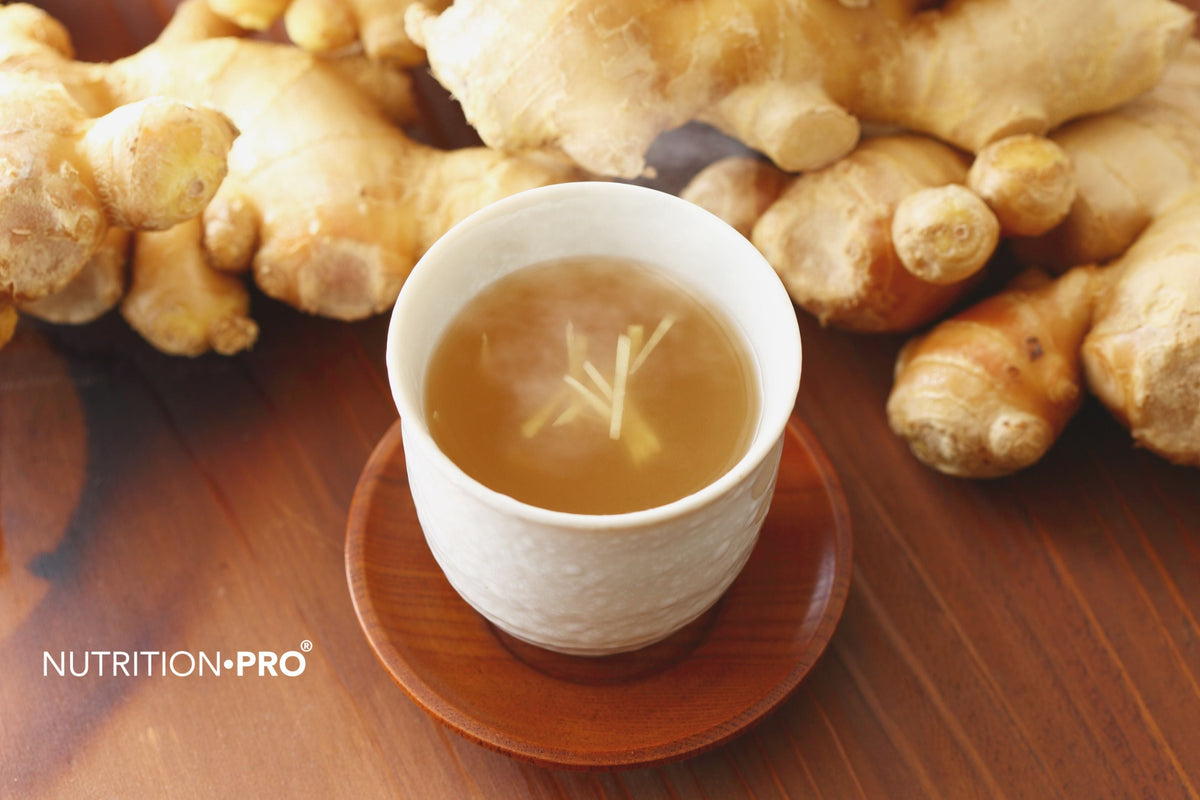
A pungent root behind countless promises, ginger has carried a reputation as an aphrodisiac for centuries. But does it truly ignite desire, or is it mostly a good story? Here's what the research actually says about ginger, libido, testosterone, and fertility—without overselling anything.
Honest spoiler: the science is far more nuanced than the legend. And that's precisely what makes the subject interesting.

Zingiber officinale root in dosed organic capsules, to enjoy gingerols without the sharp taste, taken as a regular course.
Ginger has an old reputation as an aphrodisiac, but no human trials show an effect on libido or erectile function. What is documented is indirect: in 100 men, 250 mg of ginger twice daily reduced sperm DNA fragmentation (Hosseini, Int J Reprod Biomed, 2016), an antioxidant effect linked to fertility, not desire. In animal studies, ginger increases testosterone via nitric oxide (Akinyemi, Toxicology Reports, 2015). Its true proven benefits lie elsewhere: antioxidant, anti-inflammatory, digestion support, nausea relief (Mao, Foods, 2019). Bottom line: an excellent health habit, not a miracle aphrodisiac.
- Aphrodisiac: what's its reputation worth?
- What the science says (and doesn't say)
- Ginger, testosterone, and sperm
- The plausible real mechanism: antioxidant and circulation
- What ginger is truly proven for
- How to use it
- Ginger or other options for libido?
- Precautions and when to consult
- Frequently asked questions
Aphrodisiac: what's its reputation worth?
Ginger has accompanied humanity for millennia. In traditional Chinese medicine as in Ayurveda, this "hot" root is associated with vitality, digestion, and sometimes sexual vigor. This image of a tonic and sensual spice has endured through the centuries.
The problem is that tradition describes a use, not proof of effectiveness. Many "warming" foods have inherited an aphrodisiac label without any modern study confirming it. Ginger is no exception: its reputation is ancient, but it rests on popular experience, not clinical trials. This is exactly why we must look at what research says.
What science says (and doesn't say)
Let's be clear about the state of knowledge, because this is where many articles exaggerate. When looking for rigorous clinical trials on "ginger and libido" or "ginger and erectile function" in humans, you find essentially nothing. Desire and erectile function have simply not been seriously tested with ginger in controlled trials.
What exists falls into three levels, from strongest to weakest: one human finding on male fertility (sperm DNA), animal data on testosterone, and mechanisms (antioxidant, nitric oxide) that make certain effects plausible without proving them. Ginger, testosterone, and sperm
Key takeaway
Randomized double-blind trial (human)
Hosseini J, et al. Int J Reprod Biomed 2016;14(8):533-540.
PubMed: PMID 27679829 Concretely, ginger improved the
integrity of sperm DNA, a useful marker in fertility, likely through an antioxidant effect. On the other hand, it did not increase "visible" sperm parameters. This is encouraging for fertility, but it says nothing about desire or erectile function. On the
testosterone side, positive results come from animal studies. In rats, ginger increased testosterone and improved reproductive function markers by reducing oxidative stress.Animal study (rat)
Le gingembre a augmenté la testostérone et amélioré la mobilité des spermatozoïdes, via l'inhibition de l'arginase et la hausse de l'oxyde nitrique.
Akinyemi AJ, et al. Toxicol Rep 2015;2:1357-1366. DOI : 10.1016/j.toxrep.2015.10.001
These animal data help understand a mechanism, but do not automatically translate to humans. Presenting ginger as a human "testosterone booster" would go well beyond the evidence.
The real plausible mechanism: antioxidant and circulation
If ginger were to play a role, it would likely be through indirect pathways rather than a dedicated "desire" effect. Its active principles, gingerols and shogaols, are recognized for their antioxidant, anti-inflammatory, and cardiovascular-protective properties.
The link with sexual health is logical in theory: erectile quality depends largely on blood circulation andnitric oxide, and fertility is sensitive to oxidative stress. It is precisely the nitric oxide pathway that was implicated in the animal study. Ginger supporting circulation and combating oxidative stress could therefore, in theory, contribute to favorable conditions.
What ginger is actually proven to do
Rather than overinvesting in the aphrodisiac angle, it's better to take advantage of what ginger really does. A landmark review of its bioactive compounds provides a portrait of it.
Ginger possesses multiple activities: antioxidant, anti-inflammatory, antimicrobial, cardiovascular-protective, anti-nausea, and antiemetic.
Mao QQ, et al. Foods 2019;8(6):185. DOI : 10.3390/foods8060185
Here is how the different claims about ginger are honestly ranked:
| Claim | Level of evidence |
|---|---|
| Aphrodisiac (libido, desire) | Traditional, no human trials. |
| Erectile function | Not demonstrated; hypothesis via circulation. |
| Sperm DNA / fertility | Modest human trial (Hosseini 2016). |
| Testosterone | Animal data only (Akinyemi 2015). |
| Nausea and digestion | Well demonstrated (Mao 2019). |
| Antioxidant, anti-inflammatory | Well demonstrated (Mao 2019). |
To incorporate ginger easily, without the pungent taste and with regular dosing: our organic ginger capsules, to take as a course as part of a vitality and digestive comfort approach.
Discover ginger →How to use it
Ginger suits all uses, and the form is chosen mainly based on your preference:
- Fresh : grated into dishes, infusions, or juices. Ideal for cooking, less precise dosing.
- Powdered : convenient in a hot beverage or preparation. Noticeable taste.
- In capsules : standardized dosing, without the pungency, easy to take as a course.
For dosing, the human trial used 250 mg of powder twice daily ; in regular use, the equivalent of 1 to 2 g of ginger per day is well tolerated. No need to exceed this: beyond 4 g/day, digestive discomfort and interaction risk increase. And as with any vitality support, it's the consistency over several weeks that matters.
Ginger or other options for libido?
Ginger is a good health reflex, but if your specific goal is libido or fitness, here's how to navigate without illusions:
If you prefer a supplement formulated for this purpose, our Libido • Fertility range offers solutions such as Libido Man or Libido Duo, to consider as part of a comprehensive approach.
Precautions and when to consult
Ginger may thin the blood : caution and medical advice in case of anticoagulant or antiplatelet treatment, and before surgery. It should also be avoided in case of gallstones, limited in case of marked reflux , and at high doses during pregnancy (moderate culinary use is generally considered acceptable, but seek advice).
You experience erectile dysfunction or decreased libido that develops or persists. These signs may reveal an underlying cause (cardiovascular, hormonal, metabolic, psychological, medication side effect) that warrants investigation. No supplement, ginger included, should delay this evaluation.
Frequently Asked Questions
Is ginger really aphrodisiac?
Its reputation is mainly traditional. To date, no human clinical trial shows that ginger increases libido or improves erectile function. The documented benefits are indirect (antioxidant effect, circulation support), not a direct effect on desire. It's an interesting health food, not a proven aphrodisiac.
Does ginger increase testosterone?
In animals, yes: ginger increased testosterone via the nitric oxide pathway (Akinyemi, Toxicology Reports, 2015). But these results have not been confirmed by robust human trials: it is premature to present it as a human testosterone booster.
Does ginger improve fertility and sperm?
Human data exists: in 100 infertile men, 250 mg of ginger twice daily for 3 months reduced sperm DNA fragmentation compared to placebo (Hosseini, Int J Reprod Biomed, 2016), without changing standard sperm parameters. This is an antioxidant effect on DNA, promising but modest.
Does ginger help with erectile dysfunction?
No human study demonstrates this. Theoretically, its antioxidant effects and impact on nitric oxide could support circulation, which plays a role in erection, but this remains an unverified hypothesis. Persistent disorders warrant medical consultation, as they may reveal a cardiovascular or hormonal cause.
What dose of ginger per day?
In the sperm trial, the dose was 250 mg of powder twice daily. In routine use, the equivalent of 1 to 2 g of ginger per day is well tolerated (fresh, powder, or capsules). Beyond 4 g per day, digestive discomfort and interactions become more likely.
Should ginger be taken fresh, in powder, or in capsules?
All three provide the same active compounds (gingerols, shogaols). Fresh is ideal in cooking, powder is convenient in beverages, capsules offer precise dosing without the pungent taste. The choice depends on your preference: consistency is what matters most.
Does ginger affect female libido?
There is likewise no human trial showing an effect of ginger on female desire. The same indirect mechanisms apply (antioxidant, circulation, vitality), without evidence of a specific effect. The aphrodisiac reputation applies to both sexes but remains traditional.
How long before you see results?
Ginger has no immediate aphrodisiac effect. On documented markers (sperm quality), the human trial lasted 3 months. For digestion or nausea, the effect may be rapid. View it as background support, not an instant-acting product.
What precautions and contraindications?
Caution in case of anticoagulant or antiplatelet treatment (bleeding risk), gallstones, marked reflux, and at high doses during pregnancy. In case of treatment or medical condition, seek advice from a doctor or pharmacist before starting a course.
Ginger, ginseng, or maca for libido?
None is a miracle aphrodisiac. Ginseng is primarily studied for fatigue and vitality, maca for well-being and fertility, ginger for its antioxidant and digestive profile. For libido itself, direct human evidence is limited in all cases: lifestyle habits remain the primary lever.
- Gingerols
- Main active pungent compounds in fresh ginger, responsible for its antioxidant effects.
- Shogaols
- Compounds derived from gingerols, more concentrated in dried ginger, also bioactive.
- Nitric oxide
- Vasodilation molecule, key to blood circulation and erectile function.
- Sperm DNA fragmentation
- Breaks in sperm DNA; elevated levels are associated with reduced fertility.
- Oxidative stress
- Imbalance between free radicals and antioxidants, which can damage cells and sperm.
- Adaptogen
- Plant believed to help the body better resist stress; term often associated with ginseng.
- Hosseini J, Mardi Mamaghani A, Hosseinifar H, et al. The influence of ginger (Zingiber officinale) on human sperm quality and DNA fragmentation: a double-blind randomized clinical trial. Int J Reprod Biomed 2016;14(8):533-540. PubMed: PMID 27679829
- Akinyemi AJ, Adedara IA, Thome GR, et al. Dietary supplementation of ginger and turmeric improves reproductive function in hypertensive male rats. Toxicol Rep 2015;2:1357-1366. DOI: 10.1016/j.toxrep.2015.10.001
- Mao QQ, Xu XY, Cao SY, et al. Bioactive compounds and bioactivities of ginger (Zingiber officinale Roscoe). Foods 2019;8(6):185. DOI: 10.3390/foods8060185


