

You're searching for "homemade pre-workout" because you don't feel like paying thirty euros for a colored powder, and you're right to question it: an effective pre-workout comes down to just three properly dosed ingredients, and none of the three needs a blend to work.
This guide takes the dosing positions of the ISSN and translates them into kitchen terms: a strong coffee dosed to your body weight, a measure of creatine every day, and beta-alanine if your efforts last one to four minutes. Three recipes by weight and by training duration, a comparison of doses against market products, and the three cases where a powder performs better. It extends our pre-workout guide.

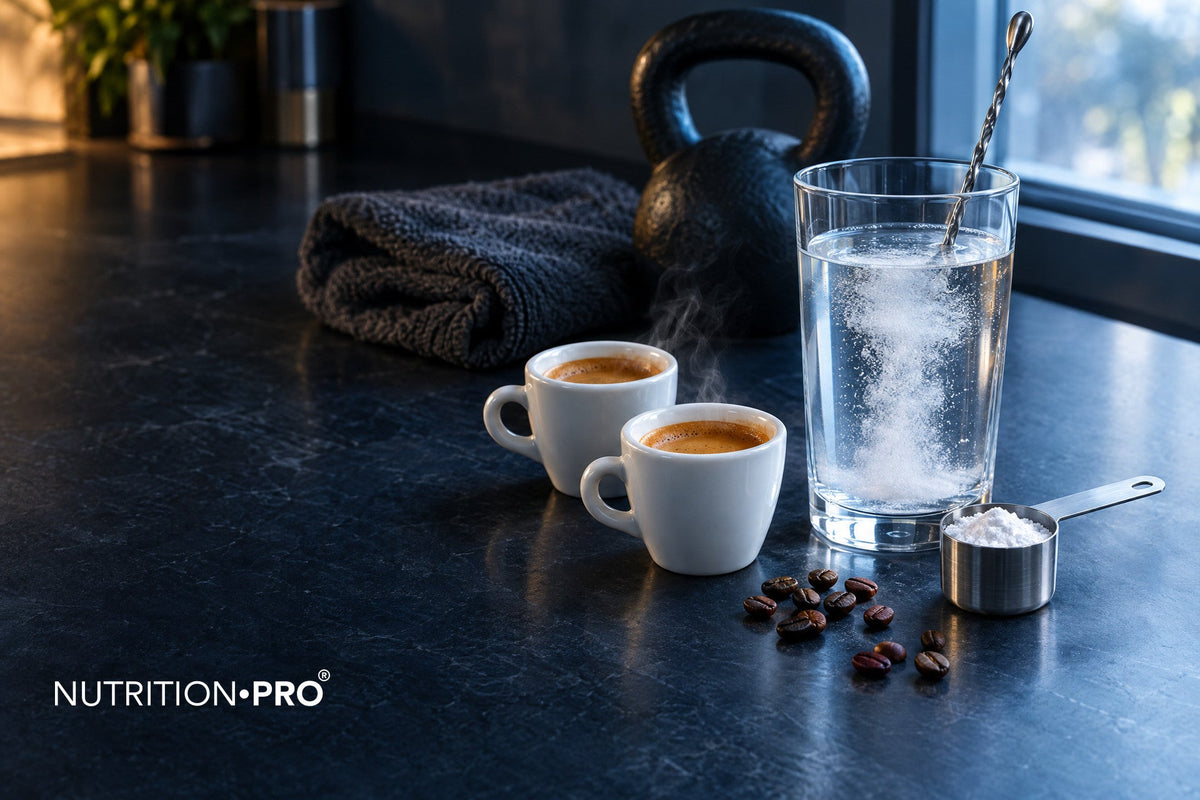
The recipe fits in three lines. Caffeine at 3 mg per kilogram, 60 minutes before, that's two to three espressos depending on body weight, the only immediate effect according to the ISSN. Creatine 3 g every day, at any time, including rest days, because it works through saturation and not before the session. Beta-alanine 4 to 6 g per day in 1.6 g doses, at least four weeks, only if your efforts last one to four minutes.
The comparison : this homemade version beats the average of the hundred best-selling pre-workouts on caffeine from 85 kg onward, surpasses them on creatine and beta-alanine because it takes them every day, and contains nothing unnecessary. Where powder performs better on three points: dosing precision, logistics at the gym, and citrulline. And six hours before bedtime, stop the coffee.
Why homemade is possible
Our pre-workout guide established it ingredient by ingredient: out of eighteen ingredients in an average serving, three have solid data, and each works through a mechanism that doesn't need the other two. Caffeine works within an hour, at 3 to 6 mg per kilo, and the ISSN position clarifies that the source matters little at equal doses. Creatine works by saturating muscle stores, at 3 to 5 g per day, and the timing of intake during the day has virtually no importance. Beta-alanine works by carnosine loading, at 4 to 6 g per day for at least four weeks, for efforts lasting one to four minutes. Nothing in these three mechanisms requires powder: a coffee, a measure, and if needed, a packet of pure beta-alanine does the same thing.
The three recipes, by weight and by hour
60 minutes before your session : coffee for 3 mg of caffeine per kilo. For 60 kg, 180 mg, two espressos. For 75 kg, 225 mg, two to three espressos or two large cups of filter coffee. For 90 kg, 270 mg, three espressos. A strong matcha or yerba mate replaces an espresso.
Every day, at whatever time suits you : 3 g of creatine monohydrate in a large glass of water, or directly in your coffee. Rest days included. Saturated in three to four weeks.
For whom: classic weight training, strength, short and intense sessions. This is the pre-workout for 95% of practitioners.
Recipe 1, plus 1.6 g of pure beta-alanine, two to four times per day, with meals, every day, for at least four weeks before expecting any results. Outside your session: this isn't a daily ingredient, it's a monthly ingredient.
For whom: 400 and 800 meters, rowing, sprint swimming, combat sports, crossfit and hyrox by stations, long sets and supersets. Our beta-alanine article details the effort window and the tingling.
No caffeine. 400 mg taken six hours before bedtime further shortens the night, and a short night costs more than caffeine delivers. Daily creatine carries performance, beta-alanine takes over if it's in your window, and a carbohydrate meal three to four hours before bed helps you fall asleep.
For whom: anyone training in the evening and sleeping at 11 p.m. Our article on caffeine details the Detroit trial.
An espresso contains 60 to 100 mg of caffeine depending on the machine, grind, and roast; a 250 ml filter contains 80 to 150. Coffee is therefore an approximation within a few tens of milligrams, not a precise dose. For most practitioners, that's sufficient. To precisely test your response to 3 then 5 mg per kilogram, pure caffeine in a dosed tablet is the right tool. And in any case, the pre-workout dose adds to your morning coffee.
Dose accounting: homemade versus market
| Ingredient | Study dose | Average pre-workout on the market | Homemade, recipe 1, 75 kg |
|---|---|---|---|
| Caffeine | 3 to 6 mg/kg, or 225 to 450 mg | 254 mg, fixed dose | 225 to 270 mg, adjustable by weight |
| Creatine | 3 to 5 g per day, every day | 2.1 g, training days: 6 to 8 g per week | 3 g every day: 21 g per week |
| Beta-alanine | 4 to 6 g per day, every day, 4 weeks | 2.0 g, training days: 6 to 8 g per week | Recipe 2: 3.2 to 6.4 g per day: 22 to 45 g per week |
| Citrulline | 6 to 8 g of malate, small effect | 4.0 g | Absent |
| Tyrosine, taurine, arginine | No performance data | Present in more than one product in two | Absent |
| Proprietary blend | Unverifiable | 44% of ingredients | None |
The table says what it says. On caffeine, the homemade version adjusts to body weight where the serving is fixed, and exceeds the market from 85 kg onward. On creatine and beta-alanine, the homemade version wins on frequency : three to six times more grams per week, because you take them every day, which is the only way these two ingredients work. And it contains nothing without data. It's not that the homemade version is better formulated; it's that the average market puts good ingredients in the wrong place.
What a powder does more of
Precision. A powder lists its caffeine in milligrams; coffee varies twofold depending on the cup. For someone who wants to know their dose and their response, that's a clear advantage. Logistics. A shaker in your bag, at the gym, no machine or cup needed, at the exact time. Citrulline. The only pump ingredient with positive meta-analysis, small effect but measured at 6 to 8 g of malate, and there's none in the kitchen; our dedicated article says what it's worth.
These three advantages exist only if the powder is dosed to study values : caffeine listed in milligrams and within your range, citrulline at 6 g minimum if included, no proprietary blend, and above all no creatine or beta-alanine in the serving, since these two are taken daily separately. A powder that puts 2 g of beta-alanine and 2 g of creatine in the daily dose, like the average of the hundred best sellers, is no better than homemade: it's worse, leaving you believing these two ingredients are covered when they're not.
Pure creatine monohydrate, Creapure label, 3 g per day, every day, in your morning coffee or a glass of water. The foundation ingredient of the homemade pre-workout, the one with the most data of the entire list, and it works even on days you don't train.
View CreatineFor caffeine in infusion on daytime training days, our yerba mate and our matcha. An espresso works too.
Frequently asked questions
Can you make an effective homemade pre-workout?
Yes, because a pre-workout that works relies only on three properly dosed ingredients, according to the International Society of Sports Nutrition positions: caffeine at 3 to 6 mg per kilogram, 60 minutes before, the only immediate effect; creatine at 3 to 5 g per day, every day, which works through saturation and not before the session; and beta-alanine at 4 to 6 g per day for at least four weeks, if efforts last one to four minutes. None of the three needs a blend to work. A strong coffee, a measure of creatine, and if needed, pure beta-alanine reproduce exactly what the trials tested.
What's the basic recipe?
For a 70 kg person and a daytime session: two strong espressos or one large filter coffee, roughly 150 to 250 mg of caffeine, 60 minutes before the session, aiming for 3 mg per kilogram; one 3 g measure of creatine monohydrate, at any time of day, every day including rest days; one large glass of water. That's all. For efforts lasting one to four minutes, add 1.6 g of beta-alanine two to four times per day, every day, for at least four weeks, outside of training time.
How much coffee for 3 mg per kilogram?
It depends on weight and coffee, and that's the limit of homemade. An espresso contains roughly 60 to 100 mg of caffeine, a 250 ml filter coffee 80 to 150 mg. For 60 kg, 180 mg, so two espressos; for 75 kg, 225 mg, so two to three; for 90 kg, 270 mg, so three. The uncertainty is several dozen milligrams depending on the machine and roast. If you want an exact dose, pure caffeine in milligram-dosed tablets is the solution, not coffee.
Does coffee work as well as pure caffeine?
The ISSN position indicates that caffeine improves performance regardless of source—coffee, capsule, gum, drink—at equal dose, with optimal timing varying by form. The difference isn't efficacy but precision: a capsule gives 200 mg, coffee gives between 60 and 150 depending on the cup. For someone wanting to test their response to a known dose, pure caffeine is clearer; for everyday use, coffee works fine.
Should you put creatine in the pre-workout?
No, and that's the point the market blends miss. Creatine works through progressive saturation of muscle stores, at 3 to 5 g per day for three to four weeks, according to ISSN position, and the timing of intake during the day has practically no importance. Putting it in the pre-session shaker only on training days, like the 2.1 g in the average pre-workout, saturates nothing. It's taken every day, whenever suits you, and can perfectly well be mixed into your coffee or morning glass of water.
What does a powder do that homemade doesn't?
Three things, and only if it's properly dosed. Precision: a fixed dose of caffeine in milligrams, whereas coffee varies. Logistics: a shaker in the gym, with no coffee machine or cup needed. And citrulline, which has a modest measured effect at 6 to 8 g of malate and isn't found in your kitchen. On the other hand, a powder that puts 2 g of beta-alanine and 2 g of creatine in the scoop, like the average of the top hundred bestsellers, doesn't perform better than homemade: it performs worse, because it delivers these two filler ingredients at the wrong timing.
What to remember about homemade pre-workout?
That it reproduces the studies with three ingredients: caffeine dosed at 3 mg per kilogram one hour before, creatine 3 g every day, beta-alanine in daily loading if efforts are one to four minutes long. That caffeine is an approximation of the dose, not a precise measurement. That creatine has no place in a pre-workout scoop, homemade or purchased. That powder wins on precision, logistics, and citrulline, provided it's dosed to study values. And that six hours before bed, caffeine stops.
Sources
The studies cited below were identified via PubMed.
- Guest NS, VanDusseldorp TA, Nelson MT, et al. International Society of Sports Nutrition position stand: caffeine and exercise performance. Journal of the International Society of Sports Nutrition, 2021;18(1):1. DOI
- Kreider RB, Kalman DS, Antonio J, et al. International Society of Sports Nutrition position stand: safety and efficacy of creatine supplementation in exercise, sport, and medicine. Journal of the International Society of Sports Nutrition, 2017;14:18. DOI
- Trexler ET, Smith-Ryan AE, Stout JR, et al. International Society of Sports Nutrition position stand: beta-alanine. Journal of the International Society of Sports Nutrition, 2015;12:30. DOI
- Jagim AR, Harty PS, Camic CL. Common ingredient profiles of multi-ingredient pre-workout supplements. Nutrients, 2019;11(2):254. DOI


