

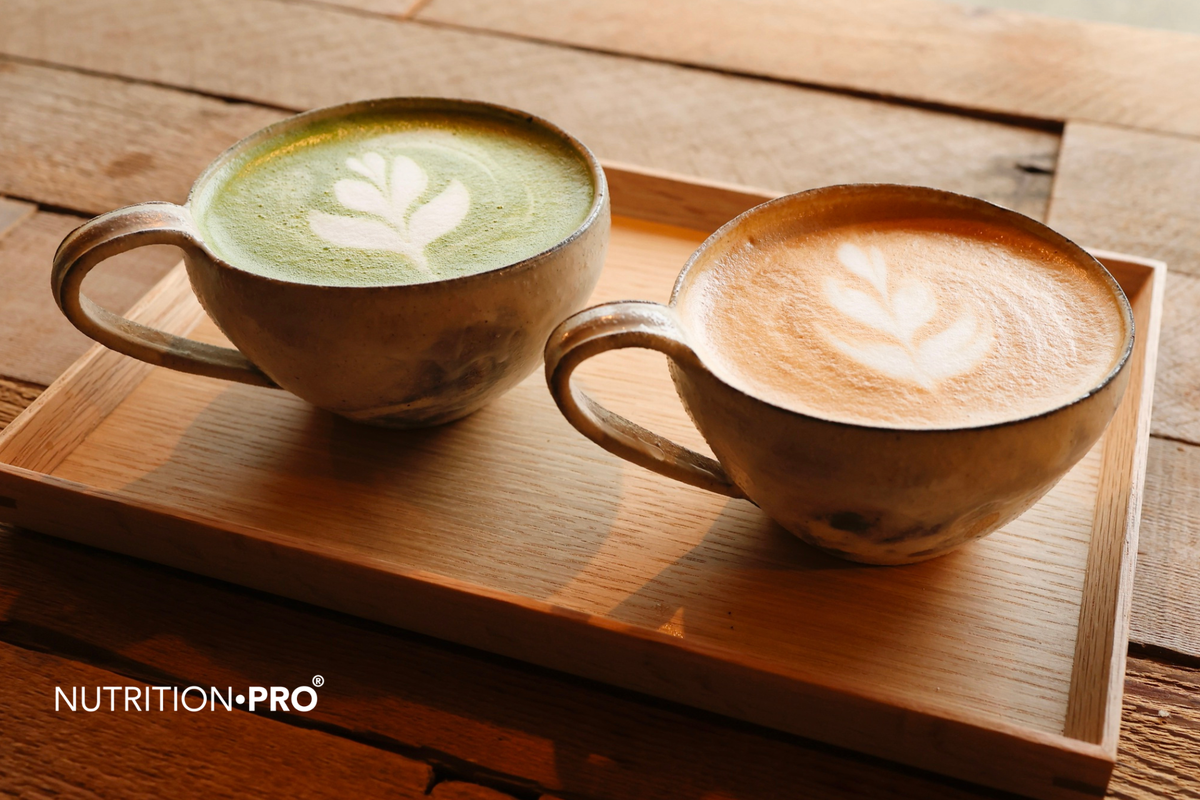
Let's start by clearing up a misconception, because it's still circulating widely: the caffeine in matcha and that in coffee are exactly the same molecule. "Theine" doesn't exist as a distinct substance—chemists established this in the nineteenth century. If matcha doesn't produce the same sensation as an espresso, it's not because it contains different caffeine.
The real difference lies in what accompanies it. Green tea contains an amino acid that coffee doesn't: L-theanine. A crossover trial compared, in the same individuals, theanine alone, caffeine alone, both together, black tea, and placebo, measuring not only reaction times but also brain activity associated with attention. The result is clear, and it explains why the question isn't which one wins, but which one suits which moment.

Same molecule. Caffeine is identical in both. What changes is theanine, present in green tea and absent from coffee. The key trial. In 20 volunteers, in a crossover design across five conditions, reaction time improved under theanine, under caffeine, and under their combination, but not under black tea or placebo. On the brain response measured in event-related potentials, the combination exceeded placebo, theanine alone, and caffeine alone.
The most striking result. In children with attention disorder, caffeine alone degraded inhibitory control, whereas the caffeine plus theanine combination improved overall cognitive score and reduced mind-wandering network activity. The doses. A matcha bowl at 1.5 g provides 40 to 70 mg of caffeine, a filter coffee 80 to 100. What coffee does better: a rapid and sharp rise, a much broader health corpus, and a cost per cup incomparable.
The Same Molecule, Two Contexts
Both coffee and green tea are among the natural sources of caffeine, alongside cacao, kola nut, guarana, and yerba maté. A reference review on caffeine in foods reminds us that its performance benefits concern physical endurance, fatigue reduction, and improved alertness and concentration, and that moderate consumption is considered safe. This applies to all these sources equally.
Where green tea sets itself apart is through L-theanine. This amino acid is almost specific to the tea plant, and coffee contains none. In matcha, its concentration depends directly on the shading of the tea plants: deprived of light, the leaf retains more of it instead of converting it to catechins. This is why matcha, which is made from shaded leaves consumed whole, provides more L-theanine than an ordinary brewed green tea.
The Trial That Separates the Effects
In 20 healthy male volunteers, five conditions were compared: L-theanine at 200 mg, caffeine at 160 mg, their combination, a cup of black tea, and placebo with distilled water. Measurements included simple visual reaction time and recognition reaction time, as well as brain event-related potentials. Mean recognition reaction time improved significantly under L-theanine, under caffeine, and under the combination, but not under tea or placebo. L-theanine and caffeine each elicited an N2-P300 amplitude significantly superior to placebo, while the combination elicited an amplitude significantly superior to placebo, to L-theanine alone, and to caffeine alone. The authors conclude that L-theanine and caffeine appear to have additive effects on attention at high doses.
Kahathuduwa CN, Dassanayake TL, Amarakoon AMT, Weerasinghe VS. Nutr Neurosci 2016;20(6):369-377. DOI: 10.1080/1028415X.2016.1144845
Three things to take from this trial, and one caveat.
First, caffeine alone works. It improves reaction time and brain response compared to placebo. A cup of coffee is not a placebo, and this article will not claim otherwise.
Second, the combination performs better than each one separately on the brain measurement. This is the central point. It's not that L-theanine replaces caffeine, it's that it adds to it.
Finally, a detail often overlooked: the cup of black tea improved nothing. It provided too little L-theanine and too little caffeine to produce a measurable effect. Dosage matters, and this is an argument in favor of matcha rather than a standard infusion, since matcha consumes the entire leaf.
The authors found no statistically significant interaction between theanine and caffeine. They therefore speak of additive effects and not synergistic ones in the strict sense. The distinction is real and worth noting: the two substances add up, they don't amplify each other. This is quite sufficient to explain the difference felt between a bowl of matcha and a coffee, but it's a step below what marketing generally makes of it.
A systematic review of 21 studies on green tea reaches the same conclusion, stated more broadly: the effects of green tea cannot be attributed to a single constituent, and cognitive benefits are observed under the combined influence of caffeine and L-theanine, whereas separate administration of either one has less impact.
The most counter-intuitive result
The acute effects of L-theanine, caffeine and their combination were examined on sustained attention, inhibitory control and overall cognition in boys aged 8 to 15 years with attention deficit hyperactivity disorder, in a four-arm randomized crossover protocol with washout period and functional MRI. Caffeine degraded inhibitory control, with theanine showing a trend to degrade it as well. In contrast, the combination improved overall cognitive score, improved discrimination in the Go/NoGo task and showed a trend to improve inhibitory control. It was also associated with decreased reactivity of a brain network related to mind wandering, the default mode network.
Kahathuduwa CN, Wakefield S, West BD, et al. Sci Rep 2020;10(1):13072. DOI: 10.1038/s41598-020-70037-7
This is a proof-of-concept result, on a very small sample size and in a particular population, and therefore no clinical recommendations should be drawn from it. But it illustrates better than anything else what this article is about: caffeine alone and caffeine accompanied by theanine do not only produce effects of different intensity, they can produce effects in opposite directions on certain functions.
Inhibitory control is the ability to restrain an impulsive response, not to click, not to respond too quickly. It is precisely what caffeine-induced nervousness degrades, and it is the most frequent complaint of people who say they don't tolerate coffee well. The decreased activity of the network associated with mind wandering goes in the same direction: less distraction, not just more alertness.
Other work on theanine alone points in this direction. In sleep-deprived young adults, 200 mg of theanine improved selective visual attention by reducing false alarms and improving the ability to distinguish the target from distractors, whereas placebo produced nothing of the sort.
Why balance matters more than dose
A Japanese trial published in Nutrients adds the missing piece, and it's important for choosing a matcha. Caffeine, it reads, exerts a strong antagonistic effect against theanine. The researchers compared commercial matchas and found that the stress-reducing effect only appeared when the molar ratio between caffeine and EGCG on one side, theanine and arginine on the other, remained below two.
In other words, the reasoning of this article does not automatically apply to any green powder. A matcha highly loaded with caffeine and catechins, from late harvests and little shade, functionally resembles an ordinary caffeinated beverage. It is the shading and the first harvest that push this ratio in the right direction, and this is developed in our complete matcha guide.
The comparison, line by line
| Criterion | Matcha | Coffee |
|---|---|---|
| Caffeine per cup | 40 to 70 mg per 1.5 g of powder | 80 to 100 mg filtered, 60 to 80 mg espresso |
| L-theanine | Present, especially when the leaf has been shaded | Absent |
| Effect profile | Gradual rise, sustained attention | Rapid and pronounced rise |
| Antioxidants | Catechins including EGCG, whole leaf consumed | Chlorogenic acids, in notable quantity |
| Acidity | Low, often better tolerated in case of reflux | Higher |
| Effect on iron absorption | Reduces non-heme iron, drink away from meals | Comparable effect, same precaution |
| Long-term health data | Limited, prudent critical review | Considerable epidemiological corpus |
| Preparation | Bowl, whisk, water at 80 °C, one to two minutes | Machine or filter, a few seconds |
| Cost per cup | Significantly higher, especially in ceremonial grade | Low |
What coffee does better
It rises faster and higher. When the goal is to overcome marked drowsiness, to push through to the finish line or to prepare for physical effort, a pronounced and rapid dose is what's needed, and coffee delivers it better. The benefits of caffeine on physical endurance are among the best-established in all of sports nutrition.
It is infinitely better documented for long-term health. Hundreds of cohort studies have followed coffee consumers for decades, on various health criteria. Matcha has nothing comparable: the most recent critical review concludes that evidence remains limited and no firm conclusions can be drawn. On this ground, the comparison isn't even close. Our article on coffee and health covers the subject.
It costs far less and is prepared in a few seconds. A ceremonial grade matcha requires a bowl, a whisk, water at the right temperature and two minutes of attention. It's pleasant for those who enjoy the ritual, but a constraint for those with only three minutes between two meetings.
It doesn't eliminate caffeine, and someone truly intolerant to caffeine won't tolerate it any better beyond a certain dose. It doesn't prevent insomnia if drunk at five o'clock in the afternoon. And there is no trial that has specifically measured the famous energy crash after coffee versus after matcha: what can be said is that the combination acts better on attention than caffeine alone, and that the dose in a bowl is lower. It's a plausible explanation for the perception, not a proof.
Choose according to the moment
It's not about replacing, it's about distributing. One coffee in the morning when you need to get started, and a bowl of matcha in early afternoon when you need to stay alert without compromising your night's sleep. The only thing to watch is total daily caffeine and the time of your last intake: with a half-life of about five hours, what you drink at 4 PM is still active at 9 PM.
Leaves from the first harvest fromUji, near Kyoto, shade-grown and then stone-ground. The shade-growing is precisely what preserves the L-theanine, which everything described in this article depends on. Organic, single ingredient, one bowl of 1.5 g at 80°C.
View the Organic Matcha TeaContains caffeine. Use with caution in cases of sensitivity, heart rhythm disorders, anxiety, or insomnia.
Choose what suits you best: the answer appears just below.
Two factors work in your favor. The dose in one bowl of matcha is lower than that of a filter coffee, and the L-theanine that comes with it changes the effect profile, as shown in the inhibitory control study. Start with one bowl in the morning as a replacement for your second coffee rather than your first.
This is the most logical use: coffee in the morning when you need to start, matcha in early afternoon when you need to sustain energy. The lower dose is gentler on evening sleep, and the sustained attention study is based exactly on this need. Set yourself a time limit rather than counting cups.
When you need a strong, fast dose, coffee performs better, and the data on caffeine and physical performance are among the most robust in sports nutrition. Matcha is not meant to replace coffee everywhere, and this article does not claim otherwise.
Matcha contains caffeine, often less than coffee but genuinely present. It is not a decaffeinated beverage and it will not resolve a true intolerance. If fatigue is the real issue, our article on the mental fatigue and the one on low ferritin explore avenues that do not involve stimulants.
This test provides guidance; it does not replace the advice of a healthcare professional.
Frequently Asked Questions
The Molecule
Is matcha caffeine different from coffee caffeine?
No, it's exactly the same molecule. The term "theine," still commonly used, refers to the caffeine in tea: chemists established as far back as the nineteenth century that it was the same compound. What changes is not the caffeine but what accompanies it. In matcha, it comes with L-theanine, an amino acid that coffee does not contain.
How much caffeine is in a bowl of matcha compared to coffee?
A bowl prepared with 1.5 g of powder typically provides between 40 and 70 mg of caffeine. A cup of filtered coffee contains roughly 80 to 100 mg, an espresso about 60 to 80 mg. A bowl of matcha is therefore in practice less concentrated than filtered coffee. The caffeine content of matcha relative to dry weight is high, but only a small quantity is consumed.
Does theanine cancel out the effects of caffeine?
No, but it moderates them, and the relationship goes both ways. A Japanese study showed that caffeine exerts a strong antagonistic effect against theanine, to the point that the stress-reducing effect of matcha is only observed if the molar ratio between caffeine and EGCG on one side, theanine and arginine on the other, remains below two. In other words, the two molecules counterbalance each other, and the balance between them determines the effect experienced.
The Studies
Which study really compares the two?
A five-arm crossover placebo-controlled trial conducted in 20 healthy volunteers compared five conditions: theanine alone at 200 mg, caffeine alone at 160 mg, the combination of the two, a cup of black tea, and a placebo. Researchers measured both reaction time in an attention task and the associated brain response using evoked potentials. This is the cleanest available protocol for separating what each component does.
What was the result?
Reaction time in visual recognition improved under theanine, under caffeine, and under the combination, but not under black tea or placebo. On brain response, the combination produced an amplitude significantly higher not only than placebo, but also than theanine alone and caffeine alone. The authors conclude that theanine and caffeine appear to have additive effects on attention at high doses.
Is there a result that clearly sets the two apart?
Yes, and it's counterintuitive. In a brain imaging study conducted in boys with attention deficit disorder, caffeine alone impaired inhibitory control, that is, the ability to suppress an impulsive response. Theanine alone showed a tendency to impair it as well. But their combination improved overall cognitive scores and conversely showed a tendency to improve this inhibitory control, with a decrease in activity in the brain network associated with mind-wandering. This is a very small sample in a particular population, to be read as a proof of principle.
Does matcha really avoid the energy crash?
There is no study that has specifically measured the energy drop after coffee compared to after matcha. What is established is that the combination of caffeine and theanine produces an effect on attention superior to caffeine alone, and that the caffeine dose in a bowl of matcha is lower than that of filtered coffee. These two factors are sufficient to explain a gentler rise, without being able to claim a proven result on the decline.
In Practice
Can you get the same effect by adding theanine to your coffee?
This is indeed what the studies did, since they administered theanine and caffeine separately and then together. The doses used were 200 mg of theanine and 160 mg of caffeine, significantly more theanine than a bowl of matcha provides. The practical difference lies in the rest: matcha also provides catechins, chlorophyll, and carotenoids, and it is consumed as a beverage rather than as a supplement.
In which cases does coffee remain the best choice?
When a strong and quick dose is needed, before physical exertion or to fight marked drowsiness. Coffee peaks faster and higher. It also benefits from considerable epidemiological evidence on long-term health criteria, far beyond what matcha has available. And it costs significantly less per cup. Matcha is not intended to replace it everywhere.
In which cases is matcha preferable?
When nervousness, heart palpitations, or the jitteriness from coffee are problematic, when the goal is sustained attention over several hours rather than a peak, and in early afternoon when you want to avoid compromising sleep with a higher dose. It is also the choice of those who appreciate the preparation ritual, which is not a minor detail in daily use.
Can you drink both in the same day?
Yes, provided you count total caffeine. A coffee in the morning and a bowl of matcha in early afternoon remain within reasonable amounts for most adults. The point of caution is not the combination but the timing: caffeine has a half-life of about five hours, which means that a dose at four in the afternoon is still active at nine in the evening.
Does matcha stain teeth or irritate the stomach like coffee?
Matcha is significantly less acidic than coffee, making it often better tolerated by sensitive stomachs and those prone to reflux. On the teeth, green tea stains less than coffee and black tea. On the other hand, like all green tea, it reduces the absorption of non-heme iron: it's better to drink it away from meals if your ferritin is low.
Glossary
- L-theanine
- An amino acid quasi-specific to tea, responsible for umami flavor; associated with a state of calm alertness.
- Theine
- Former name for caffeine from tea; it is the same molecule, the distinct designation is no longer used in chemistry.
- Evoked potentials
- Electrical brain responses measured at the scalp in reaction to a stimulus; allow objective measurement of attention.
- N2-P300 Amplitude
- Component of evoked potentials associated with attentional processing; the larger it is, the greater the attentional resources mobilized.
- Inhibitory Control
- Capacity to restrain an impulsive or automatic response; this is what caffeine-induced nervousness degrades the most.
- Default Mode Network
- Brain network active at rest, associated with mind-wandering; its reactivity was decreased under the theanine and caffeine combination.
- Additive Effect
- Two substances whose effects add together without multiplying; this is the term retained by the authors, more cautious than synergy.
- Half-life
- Time after which blood concentration is divided by two; approximately five hours for caffeine in adults.
Sources
The studies cited below were identified via PubMed.
- Kahathuduwa CN, Dassanayake TL, Amarakoon AMT, Weerasinghe VS. Acute effects of theanine, caffeine and their combination on attention. Nutritional Neuroscience, 2016;20(6):369-377. DOI
- Mancini E, Beglinger C, Drewe J, Zanchi D, Lang UE, Borgwardt S. Effects of green tea on cognition, mood and human brain function: systematic review. Phytomedicine, 2017;34:26-37. DOI
- Kahathuduwa CN, Wakefield S, West BD, et al. Effects of L-theanine and caffeine combination on sustained attention and inhibitory control in children with ADHD: proof-of-concept trial with neuroimaging. Scientific Reports, 2020;10(1):13072. DOI
- Unno K, Furushima D, Hamamoto S, et al. Stress-reducing function of matcha green tea in animal experiments and clinical trials. Nutrients, 2018;10(10):1468. DOI
- Karunaratne UW, Dassanayake TL. Effect of L-theanine on selective attention in a traffic-related reaction task in sleep-deprived young adults. Nutritional Neuroscience, 2025;28(4):471-480. DOI
- Heckman MA, Weil J, Gonzalez de Mejia E. Caffeine in foods: comprehensive review on consumption, functionality, safety and regulatory aspects. Journal of Food Science, 2010;75(3):R77-87. DOI
- Sokary S, Al-Asmakh M, Zakaria Z, Bawadi H. The therapeutic potential of matcha tea: critical review of human and animal studies. Current Research in Food Science, 2022;6:100396. DOI
- Hidese S, Ogawa S, Ota M, et al. Effects of L-theanine administration on stress-related symptoms and cognitive functions in healthy adults. Nutrients, 2019;11(10):2362. DOI


