

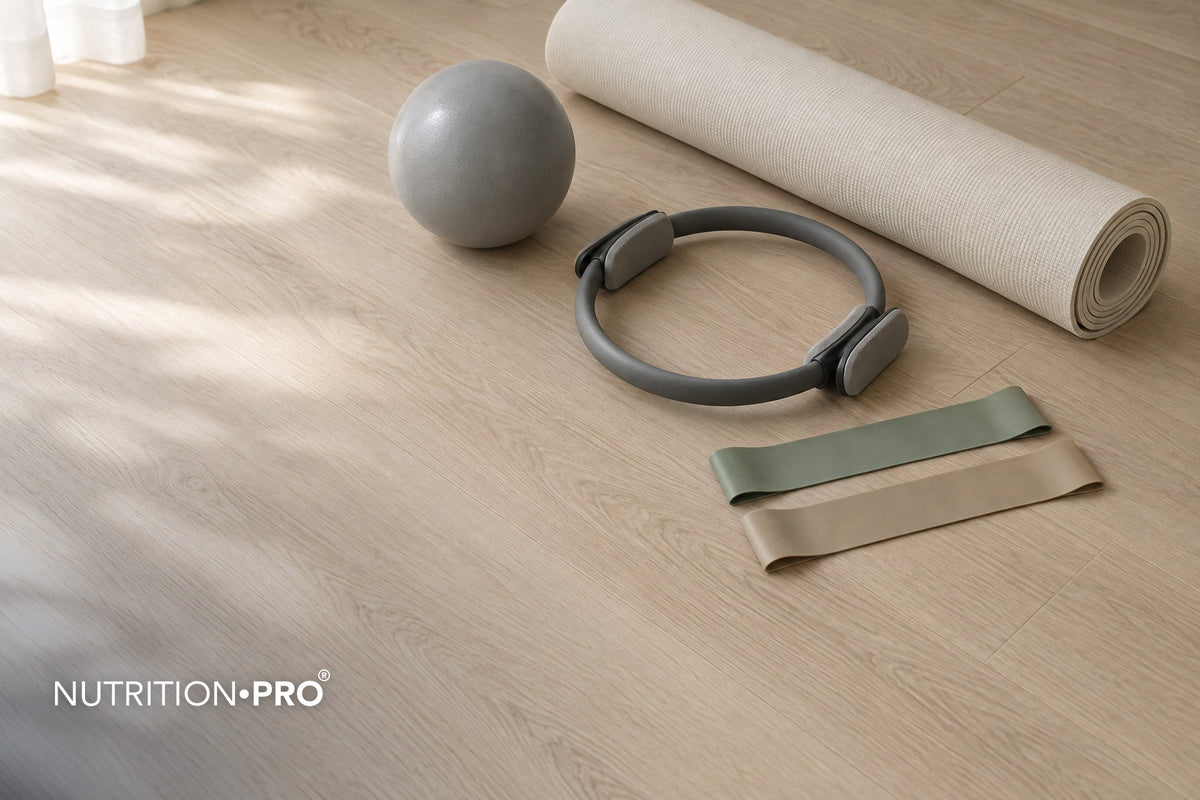
Twelve weeks, two one-hour sessions per week, a simple mat: in a randomized trial conducted with 50 active middle-aged adults, a floor Pilates routine of approximately 25 exercises was enough to improve abdominal endurance, hamstring flexibility, and upper body endurance, without any machine. The mat is the primary piece of Pilates equipment, and often the only one. Still, it must be chosen carefully: too thick, it makes standing postures less stable; too thin, it can strain sensitive knees.
This guide brings together what studies identified via PubMed show about Pilates equipment: mat thickness, grip and hygiene, then stability ball, ring, resistance bands, massage roller, reformer and non-slip socks. Followed by proteins during strength training, and a starter kit based on your profile.

The mat : floor Pilates has proven itself on a simple mat. Among seniors, a meta-analysis of 9 trials attributes large effects to it on dynamic balance, strength and flexibility. Standing on foam, the body sways more than on a hard floor: for standing postures, a thin mat keeps contact points close to the ground, an additional cushion protects sensitive knees and back. Grip, size and maintenance matter just as much as thickness.
Accessories and proteins : resistance bands deliver strength gains close to those of machines and dumbbells, the stability ball and ring increase trunk work, the massage roller adds approximately 4% flexibility in the short term. On the nutrition side, gains in lean mass linked to strength training plateau around 1.6 g of protein per kilo per day: whey helps reach this level when diet alone is insufficient, and added nothing to Pilates among practitioners who already consumed 1.3 g per kilo per day.
- The mat, foundation of floor Pilates
- Thickness: thin for balance, thick for support
- Grip, surface, size and weight: the selection guide
- Mat hygiene and maintenance
- The stability ball: trunk and balance
- Small Pilates ball and ring
- Resistance bands: strength without machines
- The massage roller: flexibility and recovery
- The reformer, the plank and non-slip socks
- Strength training and proteins
- The starter kit based on your profile
- Frequently asked questions
The mat, foundation of mat Pilates
Pilates is practiced on spring-loaded equipment, like the reformer, or on the floor, on a mat: it's this form that lends itself to home practice, and it has its own research. The one cited in the introduction gives a measure of it: in 12 weeks, the basic mat routine improved endurance and flexibility compared to the control group, without changing posture or balance.
In people aged 60 and over, mat Pilates had large effects compared to control groups on dynamic balance (effect size 1.10), muscle strength (1.13), flexibility (1.22) and cardiorespiratory endurance (1.48). Five of the 9 trials were of good methodological quality.
Bueno de Souza RO, Marcon LF, Arruda ASF, et al. Am J Phys Med Rehabil 2018;97(6):414-425. DOI: 10.1097/PHM.0000000000000883
A broader review of 30 randomized trials in people over 60, of varying quality, found benefits in 27 of them, especially for balance; its authors consider the method accessible and safe for most people, "with just a mat on the floor".
One limitation frequently comes up: consistency. In a review of 7 studies conducted in 397 adults aged 50 and over on average, suffering from chronic back pain, neck pain, knee osteoarthritis or osteoporosis, mat Pilates proved as effective as other exercises, with no notable adverse effects, but adherence was good in group settings and poor at home. At home, you need to organize yourself: a fixed time slot, a guided session, a mat ready to unroll, like our NP Pilates Mat, which rolls up in one motion.
Meta-analyses often express their results in effect size, which relates the difference between two groups to the spread of measurements. By convention, 0.2 corresponds to a small effect, 0.5 to a medium effect and 0.8 to a large effect.
Thickness: thin for balance, thick for support
Researchers use foam to make balance tests more challenging. In 32 adults averaging 22.5 years old, body movements increased significantly on three foams of different firmness compared to a hard floor, with more knee movements to stabilize, and the nature of the foam modified the effect, oscillations being most often maximal on the firmest foam. These laboratory blocks are not mats, but the principle holds for standing or single-leg postures: on a compressible surface, staying stable requires more work. In practice, a thin mat keeps support close to a hard floor; a soft surface can, conversely, intentionally increase the difficulty of a balance exercise.
The knees are often the sensitive point. In a study validating a kneeling test on soft, firm and hard surfaces, conducted on 324 knees, arthritic knees achieved at 110 degrees of flexion a tolerance score 42 points lower out of 100 than knees without symptoms, and knees with a prosthesis 26 points lower. In this case, no need to sacrifice everything for thickness: place a cushion or folded towel under the knees on all fours, or fold up the end of the mat, and keep a firm surface for the rest. Our guide onosteoarthritis details other strategies.
The guidelines below are practical tips, not study results:
| Thickness | Strengths | Best for |
|---|---|---|
| 3 to 5 mm, thin and firm | Stable support, good ground feel, easy to transport | Standing postures, planks, balance, studio classes |
| 6 to 10 mm, intermediate | More cushioning under the spine, pelvis and knees | Rolling movements, quadruped exercises, sensitive bone contact points |
| 15 to 20 mm, thick foam | Maximum comfort in lying position | Lying work and stretching, not standing postures |
| Cushion or folded towel, as a supplement | Protects a specific area without sacrificing stability | Knees in quadruped position, sacrum during rolling movements |
Our NP Pilates Mat chose fineness: 3 mm, thin and stable, to prioritize balance and movement precision. For a sensitive back or knees, add a cushion where the contact point is bony.
Grip, surface, size and weight: the selection criteria
Grip comes first: the mat must stay in place on the floor and grip under hands and feet, even during sweaty sessions; a hand slipping during planks is a lost posture and a fall risk. Smooth surfaces clean quickly, textiles like microsuede provide softness and absorption; on the base, rubber grips well on the floor, synthetic foams are lighter.
For size, allow approximately 60 cm in width for the shoulders, and a length that accommodates the head, back and pelvis in lying position.
| Criterion | What to look for | NP Pilates Mat |
|---|---|---|
| Thickness | Thin for stability, thicker for comfort at contact points | 3 mm, thin and stable |
| Grip | A base that doesn't slip on the floor, a surface that grips under hands | Non-slip rubber base |
| Surface | Soft to the touch, absorbent if you sweat | Soft and absorbent microsuede, even during long sessions |
| Dimensions | Approximately 60 cm wide, head and pelvis on the mat in lying position | 61 x 173 cm |
| Weight and portability | Lightweight and easy to roll if you transport it | 1.75 kg, rolls up in one motion |
Mat hygiene and maintenance
A study analyzed bacterial DNA sampled from skin-contact surfaces in four Memphis gyms: machines, dumbbells, railings and handles. Most bacterial genera identified were of human or environmental origin, Staphylococcus was the most frequent genus, and a few potentially pathogenic genera, such as Salmonella or Klebsiella, were present in low abundance, without DNA analysis determining whether they were alive.
The risk should be put in perspective. Another study, conducted in two gyms, found no pathogenic bacteria on equipment, only benign skin species, but viruses, most often rhinoviruses, on 63 of 100 surfaces touched with hands; disinfection twice daily for one week did not reduce their frequency. Washing hands before and after your session remains a simple gesture.
In practice: a personal mat, or a towel over the shared mat at the gym. After sessions that make you sweat, wipe with a damp cloth with mild soap, let dry flat before rolling, away from sun and heat, according to the manufacturer's instructions, especially for a textile surface. Our NUTRITION•PRO Pilates Mat, which rolls up in one motion, can become your personal mat in group classes.
The stability ball: core and balance
The large ball, known as a Swiss ball or stability ball, makes every contact point unstable. In 30 untrained women, 5 weeks of sit-ups and back extensions on a stability ball increased electrical activity in the abdominal and back muscles, as well as balance scores, more than the same exercises on the ground, with no change in measured strength.
In seniors, strengthening on unstable surfaces, such as Swiss balls or balance cushions, had large effects compared to no training or usual activity on static balance (1.34, 2 studies) and dynamic balance (1.18, 3 studies), in studies involving 128 participants. Compared to the same strengthening on stable ground, in adolescents and young adults, the additional gain was small (0.09 for balance). No study compared this work to the same strengthening on stable ground in seniors. The quality of studies was rather low.
Behm DG, Muehlbauer T, Kibele A, Granacher U. Sports Med 2015;45(12):1645-1669. DOI : 10.1007/s40279-015-0384-x
The ball is therefore a good tool to vary and intensify core work, to be introduced progressively. Size reference: sitting on the inflated ball, hips and knees at right angles, feet flat. Start sitting near a wall before progressing to plank or bridge positions, and reserve exercises standing on the ball for supervised practitioners.
In case of dizziness, balance disorders, osteoporosis, or recent falls, use the ball only while sitting, near a stable support, or with a professional. Remove any sharp objects from the exercise area and regularly check the condition and inflation of the ball.
Small ball and Pilates ring
The small soft ball and the ring, or Pilates circle, slip between the knees, ankles, or hands. Their benefit has been measured in laboratory settings during exercise, more than across training programs.
In 28 men in their twenties, abdominal activation during the Hundred increased from the exercise without an accessory to the exercise with a small soft ball, then with the Pilates ring. It was also stronger with legs extended than with knees bent at 90 degrees.
Kim YS, Lee N. J Bodyw Mov Ther 2021;27:529-534. DOI : 10.1016/j.jbmt.2021.04.005
The ball can also accompany the roll-up. In 40 adults aged 20 to 30, a roll-up with a ball produced abdominal electrical activity comparable, with no significant difference, to a classical trunk roll-up, the curl-up. In practice, hold it in your hands.
Technique, however, weighs as much as the accessory. In 26 experienced practitioners, ultrasound showed that the deep abdominal muscles, the transverse and small oblique, thickened during classical floor exercises; but when the spine imprint on the floor was performed without drawing in the belly, their activity no longer differed from rest. To learn more about the abdominal muscles, see our guide to getting visible abs.
Practical tips. In bridge position, squeeze the ring between your knees as you lift your pelvis. During the Hundred, hold it between your ankles, legs extended if your back allows. Sitting, press it at chest height, arms extended. Lying on your side, place it on the outside of your knees and push to open. Standing, squeeze it between your palms. Aim for 8 to 12 slow presses, exhaling.
Elastic bands: strength without machines
Elastic bands are one of the best-studied accessories for strength. A meta-analysis of 8 studies comparing elastic bands, tubes, or bands, and conventional equipment, machines, or dumbbells, finds no difference in strength gains, neither for the lower body nor the upper body, across varied populations and protocols. In adults aged 60 to 79, another meta-analysis of 11 studies and 834 participants attributes large effects from elastic bands on strength in healthy individuals (1.30) or those with functional limitations (1.01), and a moderate effect in disease (0.54).
In 4,754 seniors living at home, averaging 70 years old, all forms of strengthening increased strength compared to no exercise: machines (1.34), free weights (1.15), elastic bands (0.93), mixed forms (0.88), and bodyweight (0.71). Machines produced the largest and most consistent effect. With properly chosen load, volume, and duration, the authors conclude that the choice can be made according to preferences, enjoyment, and practicality.
Wiedenmann T, Held S, Morat T, et al. Gerontology 2025;71(7):576-588. DOI : 10.1159/000546346
Bands integrate easily into Pilates: in a small trial in 22 menopausal women with low back pain, 8 weeks of Pilates, two sessions per week, with or without elastic resistance, reduced pain and disability and increased lumbar strength in both groups.
One caution: many bands are made of natural latex. According to a French meta-analysis, latex allergy affects approximately 1.37% of the general population and 4.32% of healthcare workers; in case of allergy, choose latex-free bands. In practice, two or three resistances are sufficient to make progress: shorten the band or move to a higher resistance when 15 repetitions become easy.
The massage roller: flexibility and recovery
Before exercise, the roller improved flexibility by 4.0% and sprint performance by 0.7%, with no notable effect on jumping or strength. After exercise, it reduced perceived muscle soreness by 6.0% and limited the decline in sprint performance (+3.1%) and strength (+3.9%). The authors consider these effects rather weak and more justified as warm-up than as recovery.
Wiewelhove T, Döweling A, Schneider C, et al. Front Physiol 2019;10:376. DOI : 10.3389/fphys.2019.00376
On joint range of motion, a meta-analysis of 26 trials finds a net immediate effect of the roller compared to no exercise, with an effect size of 0.74, but no advantage over stretching (−0.02). Used regularly, it also works: in a meta-analysis of 11 studies and 290 participants averaging 24 years old, several weeks of roller use increased range of motion with an effect the authors consider moderate (0.82), more so beyond 4 weeks. The gain concerned the hamstrings and quadriceps, not ankle flexion when rolling the calves.
In practice, a few slow passes per muscle group are sufficient, at the end of the warm-up or after the session, avoiding joints, bony prominences, and the lower back. For recovery, our guide on muscle soreness covers other methods.
The reformer, the platform, and non-slip socks
The reformer is a sliding carriage recalled by springs. In 86 adults with chronic lower back pain, 12 Pilates sessions over 6 weeks were compared on mats and on equipment: at 6 months, the equipment group showed slightly less disability, a 3-point difference on the scale used, and less fear of movement, with no difference in pain. In menopausal women, a meta-analysis of 11 trials found more domains of improved quality of life with equipment (7) than on the floor (3), with certainty of evidence ranging from very low to moderate. In the ultrasound study mentioned above, the transverse also worked more during a Hundred on a reformer than on a mat.
The Pilates platform most often refers to a foldable platform equipped with elastic bands or springs, which reproduces certain reformer movements at home; no study identified via PubMed has evaluated it as such, unlike the mat and studio equipment. The term also refers to plank hold, a central Pilates floor exercise.
Non-slip socks have not been studied in Pilates, but a gait study in 24 healthy adults sheds light on their benefit: with ordinary socks or open-backed slippers, the heel braked less effectively than with bare feet, whereas with non-slip socks, it did not differ significantly from bare feet. On an adherent mat, bare feet are sufficient; on a reformer, a smooth floor, or for hygiene reasons in group classes, textured socks can limit slipping, by extrapolation from this gait study.
Strength training and protein
Pilates, especially with bands or reformer, is a form of strength training. In a meta-analysis of 49 trials and 1,863 participants, adding protein to resistance training lasting at least 6 weeks increased maximum strength by an average of 2.49 kg and lean mass by 0.30 kg. Lean mass gains plateaued around 1.6 g of protein per kilogram of body weight per day, including diet; the effect was more pronounced in trained practitioners and diminished with age. Our guide to building muscle details the calculation.
In 19 trained Pilates practitioners, 10 weeks of reformer and Cadillac, at least twice per week, increased trunk muscle endurance by 23 to 48% and increased the sit-and-reach flexibility test from 13.3 to 17.2 cm. A whey protein at 0.6 g per kilogram per day, which raised protein intake in the supplemented group from 1.26 to 1.78 g per kilogram, added no effect compared to a maltodextrin placebo.
Karpouzi C, Kypraiou A, Mougios V, Petridou A. J Int Soc Sports Nutr 2025;22(1):2472891. DOI: 10.1080/15502783.2025.2472891
The authors conclude that, in these trained women, approximately 1.3 g of protein per kilogram per day is sufficient to support Pilates adaptations; 10 weeks may be too short, and beginners as well as low protein consumers remain to be studied. A supplement therefore added nothing at this level of intake; in practice, it can help meet your needs when diet alone is insufficient: small appetite, quick meals, busy days. Our list of 20 protein-rich foods helps clarify your plate.
A large network meta-analysis provides complementary insight: across 235 trials and 20,980 untrained seniors averaging 73 years old, often frail, sarcopenic, or sedentary, the combination of whey and strength training ranked first for muscle mass and leg strength; in direct comparison, it outperformed strength training alone, with a moderate effect on muscle mass (0.67) and more modest effect on leg strength (0.44). The authors note high heterogeneity, possible publication bias, and more mild adverse effects, muscle soreness and digestive troubles, than with usual care.

If your diet is insufficient, our 100% Whey Isolate provides 22.9 g of protein per 30 g serving. We recommend one serving in the morning and one after training on training days, one in the morning and one in the evening on rest days; our guide on whey details its effects and common misconceptions.
Creatine is the other supplement studied with strength training in middle-aged and older adults: in a meta-analysis of 22 studies and 721 participants averaging 57 to 70 years old, it increased lean mass by 1.37 kg more than placebo, with small effects on strength (0.35 on bench press, 0.24 on leg press). In menopausal women, a meta-analysis of 7 trials and 608 participants found +0.37 kg lean mass and +7.5 kg on leg press; benefits appeared with at least 5 g per day combined with strength training, not in trials using 3 g or less without strength training, and kidney markers did not change. Our creatine monohydrate powder is pure creatine monohydrate; our article on creatine for women details its use.
The starter kit according to your profile
What studies say about each accessory, and the strength of this evidence:
| Accessory | What studies show | Strength of evidence |
|---|---|---|
| Mat, Floor Pilates | Major effects on balance, strength and flexibility in seniors | Meta-analysis of 9 trials, unequal quality |
| Stability ball | Greater core activation; better balance in seniors than without training | Weak: 3 studies in seniors |
| Small ball, ring | Greater abdominal activation during exercise | Laboratory studies, small sample sizes |
| Resistance bands | Gains close to standard equipment; machines lead in seniors | Multiple meta-analyses |
| Massage roller | +4.0% flexibility short-term, −6.0% perceived pain | Meta-analyses, modest effects |
| Reformer and apparatus | Slightly less disability at 6 months than floor exercises in lower back pain | One trial and one meta-analysis, very low to moderate certainty |
| Non-slip socks | No significant difference compared to barefoot walking | One small study, none in Pilates |
For seniors, the major issue is falls. The reference Cochrane review, 108 trials and 23,407 participants averaging 76 years old, shows that balance and functional exercises reduce falls by 24%, with high certainty, and programs that add strengthening probably reduce them by 34%.
For the back, a network meta-analysis of 217 trials and 20,969 participants with chronic lower back pain ranks Pilates among the most effective exercises for pain and disability, alongside the McKenzie method and, for pain, functional restoration. The Cochrane review dedicated to Pilates, 10 trials and 510 participants, finds it more effective than minimal intervention, with low to moderate quality evidence, with no clear superiority over other exercises. At home, in a trial of 32 adults with lower back pain, the group following 3 weeks of video-guided Pilates, three sessions per week, saw their pain decrease by 25.6 mm on a 100 mm scale, close to the McKenzie group (28.0 mm).
Massage roller : do not roll over joints, varicose veins, painful areas or recent injuries. Elastic bands : latex-free models in case of allergy, and replace at the first sign of tearing. Osteoporosis, prosthesis, pregnancy : have a professional validate rolling and twisting exercises. Protein and creatine : medical advice if you have kidney disease; whey, derived from milk, is not suitable in case of milk protein allergy.
A soft, absorbent microsuede coating on a non-slip rubber base, which anchors each posture to the ground, from core work to stretching. Thin and stable at 3 mm, it prioritizes balance and movement precision; at 61 x 173 cm and 1.75 kg, it rolls up effortlessly to move from living room to studio. Designed for Pilates, yoga, mobility and meditation.
View the Pilates MatTo complement your strengthening routine, also discover our 100% Whey Isolate, 22.9 g of protein per 30 g serving.
Frequently Asked Questions
What thickness for a Pilates mat?
For most exercises, a thin and firm mat, approximately 3 to 6 mm, provides the stability needed for support and balance; 6 to 10 mm provide more cushioning for the back and knees. Beyond that, standing postures become less stable: standing on foam, the body sways more than on a firm floor.
Pilates mat or yoga mat: what's the difference?
The same mat can be used for both. Pilates involves more rolling and lying exercises, which benefit from some cushioning, while yoga involves more standing postures, which require a thin, highly grippy mat.
A thick Pilates mat of 15 or 20 mm, for whom?
These foam mats are suitable for lying work when bony support points are sensitive, but they compress under standing support or hand pressure. An alternative: keep a thin mat and place a cushion or folded towel under the sensitive area.
Why wear non-slip socks for Pilates?
To limit slipping on a reformer or smooth floor, and for hygiene in group classes. No studies have evaluated them for Pilates, but when walking, in 24 adults, they did not differ significantly from bare feet for heel braking, unlike regular socks.
What accessories to begin Pilates at home?
A thin, grippy mat is enough to start. Next come elastic bands for strengthening, with strength gains close to those of machines and dumbbells according to a meta-analysis of 8 studies, a small ball or ring for the core, then a stability ball and massage roller.
What exercises can you do with a Pilates ring?
The simplest: squeeze the ring between your knees in a bridge, hold it between your ankles during the Hundred, press it at chest height with arms extended. In one study, the Hundred with a ring engaged the abs more than without an accessory or with a small ball.
What is the Pilates ball for?
The large stability ball makes support unstable and engages the core more; in seniors, strengthening on unstable surfaces significantly improved balance compared to no training, in only 3 studies. The small soft ball is placed under the pelvis, between the knees or in the back to guide a movement.
What size Pilates ball should you choose?
Practical guide: sitting on the inflated ball, hips and knees form a right angle, feet flat on the ground. Too small, the ball raises the knees above the hips. Start near a wall or support.
What is a Pilates board?
Most often, a foldable platform equipped with elastic bands or springs that reproduces certain reformer movements at home; no identified study has evaluated it as such. The term also refers to plank hold, a central exercise in mat Pilates.
How to clean a Pilates mat?
After sessions where you sweat, wipe with a damp cloth and mild soap, then let the mat dry flat before rolling it up, following the manufacturer's instructions. In a studio, a personal mat limits contact with bacteria from other practitioners; in one study, staphylococcus was the most frequent genus on gym facility surfaces.
Is a massage roller useful for Pilates?
Yes, with modest effects: before exercise, it improves flexibility by approximately 4%, and after exercise it reduces perceived muscle soreness by approximately 6%, according to a meta-analysis of 21 studies. Used for several weeks, especially beyond 4, it increases the range of motion of the hamstrings and quadriceps.
Do you need to take protein when doing Pilates?
Not necessarily. In practitioners who were already consuming 1.3 g of protein per kilogram per day, whey added nothing to 10 weeks of Pilates. Protein matters most if your intake is low or if you're aiming for muscle gain: with strength training, lean mass gains plateau around 1.6 g per kilogram per day. In untrained seniors, often frail, whey combined with strength training performed better than strength training alone.
Sources
The studies cited below were identified via PubMed.
- Kloubec JA. Pilates for improving muscular endurance, flexibility, balance and posture. Journal of Strength and Conditioning Research, 2010;24(3):661-667. DOI
- Bueno de Souza RO, Marcon LF, Arruda ASF, et al. Effects of mat Pilates on functional physical performance in older adults: meta-analysis of randomized controlled trials. American Journal of Physical Medicine and Rehabilitation, 2018;97(6):414-425. DOI
- Pereira MJ, Mendes R, Mendes RS, et al. Benefits of Pilates in older adults: systematic review and meta-analysis. European Journal of Investigation in Health, Psychology and Education, 2022;12(3):236-268. DOI
- Denham-Jones L, Gaskell L, Spence N, Pigott T. Systematic review of the effectiveness of Pilates on pain, disability, physical function and quality of life in older adults with chronic musculoskeletal conditions. Musculoskeletal Care, 2022;20(1):10-30. DOI
- Patel M, Fransson PA, Lush D, et al. Effects of the properties of a foam surface on body movements in standing position. Acta Oto-Laryngologica, 2008;128(9):952-960. DOI
- Calvert ND, Smith A, Kuster L, et al. The kneeling test is a valid method for assessing kneeling tolerance. Knee Surgery, Sports Traumatology, Arthroscopy, 2019;27(11):3705-3712. DOI
- Mukherjee N, Dowd SE, Wise A, et al. Diversity of bacterial communities on gym facility surfaces in an American metropolitan area. International Journal of Environmental Research and Public Health, 2014;11(12):12544-12561. DOI
- Goldhammer KA, Dooley DP, Ayala E, et al. Prospective study of bacterial and viral contamination of exercise equipment. Clinical Journal of Sport Medicine, 2006;16(1):34-38. DOI
- Cosio-Lima LM, Reynolds KL, Winter C, et al. Effects of ball exercises and classic floor exercises on early trunk stability and balance adaptations in women. Journal of Strength and Conditioning Research, 2003;17(4):721-725. DOI
- Behm DG, Muehlbauer T, Kibele A, Granacher U. Effects of strengthening exercises on unstable surfaces on strength, power, and balance across the lifespan: systematic review and meta-analysis. Sports Medicine, 2015;45(12):1645-1669. DOI
- Kim YS, Lee N. Comparative analysis of trunk muscle activation according to accessories and knee angle during modified Pilates Hundred. Journal of Bodywork and Movement Therapies, 2021;27:529-534. DOI
- Rizza QP, Miranda AFB, Felício LR, Dionisio VC. Electromyographic activity of abdominal muscles during exercises with and without upper limb assistance in healthy individuals: cross-sectional study. Journal of Bodywork and Movement Therapies, 2025;42:614-619. DOI
- Endleman I, Critchley DJ. Activity of the transverse abdominis and internal oblique muscles during Pilates exercises: measurement by ultrasound. Archives of Physical Medicine and Rehabilitation, 2008;89(11):2205-2212. DOI
- Lopes JSS, Machado AF, Micheletti JK, et al. Effects of elastic resistance training or conventional resistance training on muscle strength: systematic review and meta-analysis. SAGE Open Medicine, 2019;7:2050312119831116. DOI
- Martins WR, de Oliveira RJ, Carvalho RS, et al. Elastic resistance training to increase muscle strength in older adults: systematic review with meta-analysis. Archives of Gerontology and Geriatrics, 2013;57(1):8-15. DOI
- Wiedenmann T, Held S, Morat T, et al. Effects of different strengthening modalities on muscle strength in community-dwelling older adults: network meta-analysis. Gerontology, 2025;71(7):576-588. DOI
- Castro JB, Lima VP, Mello DB, et al. Effects of Pilates with and without elastic resistance on health parameters in menopausal women with low back pain. Pain Management, 2022;12(4):509-520. DOI
- Bousquet J, Flahault A, Vandenplas O, et al. Natural rubber latex allergy in healthcare workers: a systematic review of the data. The Journal of Allergy and Clinical Immunology, 2006;118(2):447-454. DOI
- Wiewelhove T, Döweling A, Schneider C, et al. Meta-analysis of the effects of foam rolling on performance and recovery. Frontiers in Physiology, 2019;10:376. DOI
- Wilke J, Müller AL, Giesche F, et al. Acute effects of foam rolling on range of motion in healthy adults: a systematic review with multilevel meta-analysis. Sports Medicine, 2020;50(2):387-402. DOI
- Konrad A, Nakamura M, Tilp M, et al. Effects of foam rolling training on range of motion: a systematic review and meta-analysis. Sports Medicine, 2022;52(10):2523-2535. DOI
- da Luz MA, Costa LO, Fuhro FF, et al. Efficacy of mat or equipment-based Pilates in patients with non-specific chronic low back pain: a randomized controlled trial. Physical Therapy, 2014;94(5):623-631. DOI
- de Almeida PP, de Oliveira RG, de Almeida LIM, de Oliveira LC. Effects of Pilates on health-related quality of life in postmenopausal women: a systematic review and meta-analysis. Quality of Life Research, 2024;33(8):2067-2079. DOI
- Hübscher M, Thiel C, Schmidt J, et al. Slip resistance of non-slip socks: an accelerometer approach. Gait and Posture, 2011;33(4):740-742. DOI
- Morton RW, Murphy KT, McKellar SR, et al. A systematic review, meta-analysis, and meta-regression of the effect of protein supplementation on muscle mass and strength gains induced by resistance training in healthy adults. British Journal of Sports Medicine, 2018;52(6):376-384. DOI
- Karpouzi C, Kypraiou A, Mougios V, Petridou A. Effects of protein supplementation during Pilates training on body composition, core muscle endurance, and flexibility in trained women: a randomized controlled trial. Journal of the International Society of Sports Nutrition, 2025;22(1):2472891. DOI
- Lin CL, Huang SW, Chen HC, et al. Searching for the best protocol among combinations of protein sources and exercise modalities in older adults: network meta-analysis and meta-regression of randomized controlled trials. Nutrients, 2026;18(9):1409. DOI
- Chilibeck PD, Kaviani M, Candow DG, Zello GA. Effect of creatine during resistance training on lean mass and muscle strength in older adults: meta-analysis. Open Access Journal of Sports Medicine, 2017;8:213-226. DOI
- Naddafha S, Antonio J, Kreider RB, Stout JR. Creatine monohydrate, lean mass, strength and bone density in postmenopausal women: systematic review and meta-analysis. Journal of the International Society of Sports Nutrition, 2026;23(1):2668435. DOI
- Sherrington C, Fairhall NJ, Wallbank GK, et al. Exercise to prevent falls in older people living at home. The Cochrane Database of Systematic Reviews, 2019;1(1):CD012424. DOI
- Hayden JA, Ellis J, Ogilvie R, et al. Certain types of exercise are more effective than others in people with chronic low back pain: network meta-analysis. Journal of Physiotherapy, 2021;67(4):252-262. DOI
- Yamato TP, Maher CG, Saragiotto BT, et al. Pilates for low back pain. The Cochrane Database of Systematic Reviews, 2015;2015(7):CD010265. DOI
- Zygouna L, Lytras D, Kasimis K, et al. Comparison of the effectiveness of video-guided home-based McKenzie and Pilates programs in patients with non-specific chronic low back pain: a randomized controlled trial. Journal of Bodywork and Movement Therapies, 2025;45:598-605. DOI


