

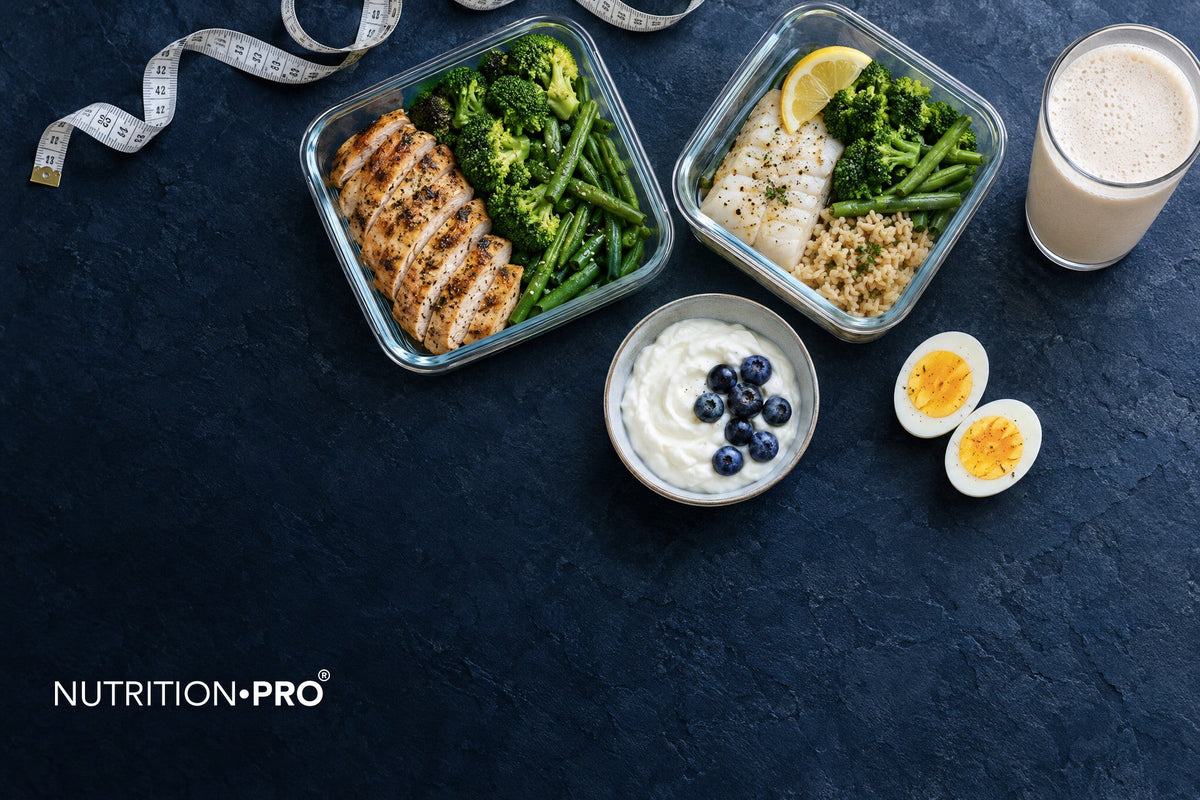
A successful cut means fat loss while preserving muscle. A caloric deficit lowers weight; what determines whether that weight is fat or muscle is primarily training and protein intake. It's the most well-studied nutritional lever for cutting.
This guide provides study benchmarks: how many grams of protein per day based on your profile, what you actually gain in lean mass and fat, the dose per meal, the role of whey, timing of intake, what changes for women versus men, and what trials say about kidneys and bones.

How Much : 1.6 to 2.2 g of protein per kilogram of body weight per day for a strength training practitioner in moderate deficit; 2.3 to 3.1 g per kg of lean mass for an already lean individual in significant deficit, or 2.0 to 2.6 g per kg of body weight at 15% body fat; 1.2 to 1.6 g per kg without training. What You Actually Gain : at equal calories, 0.87 kg more fat lost and 0.43 kg of lean mass preserved across 24 trials; in a 4-week trial at 40% deficit, 2.4 g per kg even resulted in gaining 1.2 kg of lean mass.
How : four meals of 0.25 to 0.4 g per kg, or 20 to 40 g each; proteins rich in leucine like whey when a meal lacks it; timing matters less, daily total comes first, and 30 to 40 g of casein at bedtime increases overnight muscle protein synthesis. Safety : no signal of kidney issues in healthy adults across 28 trials, and slightly less bone loss during weight loss; medical advice recommended if you have kidney disease.
- Why Protein Matters More During a Cut
- How Much Per Day: Study Ranges
- What You Really Gain: Muscle, Fat, Satiety
- How Much Per Meal, and How Often
- Which Proteins to Choose
- When to Take Your Whey During a Cut
- Woman, man: what changes
- Kidneys, bones: what studies say
- The plan, in order
- Frequently asked questions
Why protein matters more during a cut
A caloric deficit causes weight loss, but part of that weight can come from lean mass, especially when the deficit is significant and you're already lean. The landmark systematic review in lean resistance trainees under caloric restriction shows this: fat mass decreased in all studied groups, but lean mass dropped by 0.3 to 2.7 kg in 9 out of 13 groups. The only lean group in a large deficit that preserved its lean mass was the one eating the most protein, 2.5 to 2.6 g per kilo.
Two mechanisms protect muscle: resistance training, which signals the body to preserve it, and sufficient protein intake, which provides the building blocks to rebuild it. The second is what diet controls, and studies allow us to quantify it.
How much per day: ranges from studies
Forty young men followed a deficit of approximately 40% of their needs for four weeks, with six sessions per week of resistance training and high-intensity intervals. Half received 2.4 g of protein per kilo per day, the other 1.2 g. With the higher intake, lean mass increased by 1.2 kg, versus 0.1 kg, and fat mass decreased by 4.8 kg, versus 3.5 kg. Performance improved similarly in both groups.
Longland TM, Oikawa SY, Mitchell CJ, Devries MC, Phillips SM. Am J Clin Nutr 2016;103(3):738-746. DOI: 10.3945/ajcn.115.119339
| Profile | Daily intake | For 60 kg | For 80 kg | Source |
|---|---|---|---|---|
| No training, in deficit | 1.2 to 1.6 g per kilo | 72 to 96 g | 96 to 128 g | Review, AJCN 2015 |
| Resistance training, moderate deficit | 1.6 to 2.2 g per kilo | 96 to 132 g | 128 to 176 g | Meta-analysis 2018, ISSN position 2017 |
| Already lean, significant deficit | 2.3 to 3.1 g per kilo of lean mass | 104 to 140 g, at 25% body fat | 156 to 211 g, at 15% body fat | 2014 Systematic Review |
The reference meta-analysis on muscle building, 49 trials and 1,863 adults, places the plateau for lean mass gain at 1.62 g per kilogram per day, with a confidence interval reaching 2.2 g. However, it excludes trials in a deficit, where requirements are higher: during a cutting phase, 1.6 g per kilogram is a floor rather than a target. The position statement from the International Society of Sports Nutrition goes in the same direction.
The leaner you are and the harder the deficit, the higher the requirement. The 2014 review recommends 2.3 to 3.1 g per kilogram of lean mass, a unit that avoids overestimating requirements when body fat is high: at 15% body fat, this comes to 2.0 to 2.6 g per kilogram of body weight. Conversely, in a moderate 25% deficit, a 2025 trial in 21 recreational athletes found no advantage to 2.2 g per kilogram compared to 1.2 or 1.6 g over six weeks; with approximately seven people per group, it lacked statistical power, but it reminds us that the requirement follows the severity of the deficit.
What you actually gain: muscle, fat, satiety
Twenty-four trials, 1,063 adults, compared a high-protein diet and a standard diet at equal calories, for an average of 12 weeks. With more protein, weight decreased by 0.79 kg more and body fat by 0.87 kg more, lean mass loss was reduced by 0.43 kg, and the decline in resting energy expenditure was limited to 595.5 kJ per day, or approximately 142 kcal. Satiety was better in 3 out of 5 trials.
Wycherley TP, Moran LJ, Clifton PM, Noakes M, Brinkworth GD. Am J Clin Nutr 2012;96(6):1281-1298. DOI: 10.3945/ajcn.112.044321
Proteins also cost more energy to digest. A meta-analysis of 52 studies published in 2024 shows that a meal higher in protein increases energy expenditure related to digestion, and that over diets lasting from a few days to one year, total expenditure and resting expenditure are somewhat higher; the type of protein changes nothing about this effect. As for satiety, the review in theAmerican Journal of Clinical Nutrition judges it modest: more sensation of fullness, without a measured decrease in the amount eaten at the next meal. In the long term, consistency is what produces results.
They don't make you lose weight on their own: it's the caloric deficit that causes fat loss. They change the quality of the loss, directing the body toward fat rather than muscle, and they make the deficit a bit easier to maintain. Beyond your requirements, extra protein remains calories.
How much per meal, and how often
The position statement from the International Society of Sports Nutrition recommends servings of 0.25 g per kilogram, or 20 to 40 g, providing 700 to 3,000 mg of leucine, every three to four hours. A 2018 review details the calculation: 0.4 g per kilogram per meal over at least four meals to reach 1.6 g per kilogram, and up to 0.55 g per kilogram per meal to aim for 2.2 g. Practically speaking, 24 to 33 g per meal for 60 kg, 32 to 44 g for 80 kg.
Thirty-six active young men received 0, 25, or 100 g of milk protein after a full-body weight training session, with measurement of muscle protein synthesis over twelve hours. With 100 g, it was approximately 20% higher than with 25 g during the first four hours and approximately 40% higher between the fourth and twelfth hour. The response lasted more than twelve hours, and amino acid oxidation remained negligible.
Trommelen J, van Lieshout GAA, Nyakayiru J, et al. Cell Rep Med 2023;4(12):101324. DOI: 10.1016/j.xcrm.2023.101324
This trial nuances the idea of a ceiling of 20 or 30 g per meal: a large serving is not wasted, it is used over a longer period. Distribution over four meals remains the practical basis, because it facilitates reaching the total and satiety throughout the day; but a protein-rich meal after a complete session is not wasteful. Our ranking of protein-rich foods gives quantities per serving to compose these meals.
Which proteins to choose
Forty adults aged 35 to 65 with excess weight followed a 750 kcal deficit per day for fourteen days, with 27 g of whey isolate, 26 g of soy, or carbohydrates twice daily. After the restriction, muscle protein synthesis after the meal had only decreased by 9% with whey, compared to 28% with soy and 31% with carbohydrates. Before the diet already, whey stimulated it more than soy.
Hector AJ, Marcotte GR, Churchward-Venne TA, et al. J Nutr 2015;145(2):246-252. DOI: 10.3945/jn.114.200832
The reason lies in the composition: fast-digesting proteins, rich in essential amino acids and leucine, stimulate muscle protein synthesis the most, according to the position statement from the International Society of Sports Nutrition, which also notes that supplements help achieve objectives by limiting calories. This is the interest of an isolate during a cutting phase: our whey provides 22.9 g of protein for 117 kcal and 1.8 g of carbohydrates per 30 g serving.
Other sources count equally in the total: lean meats, fish, eggs, dairy products, legumes and soy. For the effect on energy expenditure, the type of protein changes nothing. Our comparison of plant and animal proteins details the differences between sources.
When to take your whey during a cutting phase
In the meta-analysis of 49 trials, timing of intake, dose after exercise, and protein source play a minor role, if any. The International Society of Sports Nutrition recommends taking them before or after your workout, according to individual tolerance, noting that the effect of training on muscle protein synthesis lasts at least 24 hours.
In practice, whey is best used where it helps reach the daily total: after your workout, at breakfast often lacking in protein, or as a snack to complement a light meal. In the evening, a dose of 30 to 40 g of casein at bedtime increases muscle protein synthesis overnight, without hindering fat utilization; these findings apply to casein, which dairy products like cottage cheese or skyr are rich in.
Women, men: what differs
Thirty-two women aged 18 to 30 with excess weight followed a 25% caloric restriction and a resistance training program for eight weeks, with or without a reduced eating window. In the groups consuming 1.6 g of protein per kilogram per day, lean mass increased significantly, and visceral and subcutaneous fat decreased in all groups.
Bagherpour F, Arazi H, Rajabi H, Campbell BI. Int J Sport Nutr Exerc Metab 2025;35(6):493-509. DOI: 10.1123/ijsnem.2025-0010
The meta-analysis of 49 trials found no clear difference between sexes in protein response, but with far fewer data in women. The per-kilogram benchmarks are therefore the same: 96 to 132 g per day for a 60 kg woman who does resistance training, 128 to 176 g for an 80 kg man. What changes in practice is portion size: 24 to 33 g per meal for the first, 32 to 44 g for the second.
Kidneys, bones: what the research shows
Twenty-eight trials involving 1,358 adults without kidney disease compared high protein intakes of at least 1.5 g per kilogram, 20% of energy, or 100 g per day to normal or low intakes. Changes in glomerular filtration rate, the marker of kidney function, did not differ between groups.
Devries MC, Sithamparapillai A, Brimble KS, et al. J Nutr 2018;148(11):1760-1775. DOI: 10.1093/jn/nxy197
In twelve trained men, 2.6 then 3.3 g per kilogram per day for two periods of eight weeks did not alter markers of kidney and liver function, lipids, or blood glucose. And during weight loss of at least three months, a 2019 meta-analysis shows that high protein intake moderately limits bone density loss, total and lumbar: protein does not weaken bones.
The reassuring trials excluded people with kidney disease. A nephrology review notes that very high intake increases the filtration workload on the kidneys and should be approached with caution in those at high renal risk: diabetes with kidney involvement, known kidney disease, single kidney. In these situations, the target should be set with your doctor.
The plan, in order
22.9 g of protein for 117 kcal and 1.8 g of carbs per 30 g serving, a whey isolate manufactured in France, fast to digest and rich in essential amino acids. One serving after your workout or to supplement a light protein meal, without impacting your cutting calorie budget. In case of kidney disease, consult your doctor.
View the Whey IsolateOur guide whey and proteins breaks down what science proves.
Frequently Asked Questions
How much protein per day when cutting?
For a strength training athlete in moderate deficit, the best-supported range is 1.6 to 2.2 g per kilogram of body weight per day. For an already lean subject in marked deficit, the reference is 2.3 to 3.1 g per kilogram of lean mass, or 2.0 to 2.6 g per kilogram of body weight at 15% body fat. Without training, 1.2 to 1.6 g per kilogram is sufficient.
Protein while cutting to lose weight: does it help?
It's the calorie deficit that burns fat; proteins improve the quality of the loss. At equal calories, across 24 trials, high-protein diets resulted in 0.87 kg more fat loss and preserved 0.43 kg more lean mass, with modest satiety effect and slightly elevated energy expenditure.
How much protein for a woman when cutting?
The same per-kilogram benchmarks as for men: 1.6 to 2.2 g per kilogram per day with strength training, or 96 to 132 g for 60 kg. In overweight women with a 25% deficit and strength training, 1.6 g per kilogram increased lean mass in 8 weeks, and visceral fat decreased in all groups.
How much protein for a man when cutting?
For 80 kg with strength training, 128 to 176 g per day; for an already lean man in marked deficit, 156 to 211 g at 15% body fat. With approximately 40% deficit, 2.4 g per kilogram yielded 1.2 kg more lean mass and 4.8 kg less fat in 4 weeks, versus 0.1 kg and 3.5 kg with 1.2 g per kilogram.
What is the best protein for cutting?
Fast proteins rich in essential amino acids and leucine, such as whey, stimulate muscle protein synthesis the most. Under calorie restriction, synthesis after meals dropped only 9% with whey isolate, compared to 28% with soy. The daily total remains the primary criterion, and all sources contribute to it.
When should you take whey while cutting?
When it helps you reach your daily total: after your workout, or to supplement a light protein meal. Timing plays a minor role according to the reference meta-analysis, and the training effect on muscle protein synthesis lasts at least 24 hours. Before or after your session, based on digestive comfort.
How much whey per serving?
Guidelines range from 0.25 to 0.4 g of protein per kilogram per meal, or 20 to 40 g. A 30 g serving of whey isolate provides 22.9 g of protein, or 0.38 g per kilogram for 60 kg. A larger serving is not wasted: after a full-body session, 100 g of protein extended muscle synthesis beyond 12 hours.
Should you take protein before bed when cutting?
It's not mandatory, but 30 to 40 g of casein at bedtime increases muscle protein synthesis overnight without hindering fat utilization. It's a useful way to reach your daily target when daytime intake fell short.
Is too much protein dangerous for the kidneys?
In healthy adults, 28 trials show no difference in kidney filtration changes between high and normal intakes. In trained men, 2.6 to 3.3 g per kilogram over 4 months altered no kidney or liver markers. In case of kidney disease or high risk, intake should be set with a doctor.
What to remember about protein when cutting?
Aim for 1.6 to 2.2 g per kilogram per day with strength training, more if already lean and the deficit is strict. Spread it across four meals of 20 to 40 g each. Prioritize sources rich in leucine like whey when meals lack it. And maintain a moderate deficit: it's the deficit and training that determine what's lost—fat or muscle.
Sources
The studies cited below were identified via PubMed.
- Helms ER, Zinn C, Rowlands DS, Brown SR. Systematic review of protein intake during caloric restriction among lean strength training practitioners: argument for higher intakes. International Journal of Sport Nutrition and Exercise Metabolism, 2014;24(2):127-138. DOI
- Longland TM, Oikawa SY, Mitchell CJ, Devries MC, Phillips SM. Higher protein during an energy deficit combined with intense exercise promotes lean mass gain and fat mass loss: a randomized trial. American Journal of Clinical Nutrition, 2016;103(3):738-746. DOI
- Leidy HJ, Clifton PM, Astrup A, et al. The role of protein in weight loss and its maintenance. American Journal of Clinical Nutrition, 2015;101(6):1320S-1329S. DOI
- Morton RW, Murphy KT, McKellar SR, et al. Systematic review, meta-analysis, and meta-regression of the effect of protein supplements on muscle mass and strength gains associated with resistance training in healthy adults. British Journal of Sports Medicine, 2018;52(6):376-384. DOI
- Jäger R, Kerksick CM, Campbell BI, et al. International Society of Sports Nutrition position stand: protein and exercise. Journal of the International Society of Sports Nutrition, 2017;14:20. DOI
- Kanaan MF, Nait-Yahia S, Doucet É. Effects of high protein intake during energy restriction on body composition, metabolism, and performance in recreational athletes. European Journal of Clinical Nutrition, 2025;79(6):544-552. DOI
- Wycherley TP, Moran LJ, Clifton PM, Noakes M, Brinkworth GD. High-protein hypocaloric diets versus standard diets: meta-analysis of randomized trials. American Journal of Clinical Nutrition, 2012;96(6):1281-1298. DOI
- Guarneiri LL, Adams CG, Garcia-Jackson B, et al. Effects of protein quantity and type on diet-induced thermogenesis: systematic review and meta-analysis. Advances in Nutrition, 2024;15(12):100332. DOI
- Schoenfeld BJ, Aragon AA. How much protein can the body use in a single meal for muscle building? Implications for daily distribution. Journal of the International Society of Sports Nutrition, 2018;15:10. DOI
- Trommelen J, van Lieshout GAA, Nyakayiru J, et al. The anabolic response to protein after exercise has no upper limit in magnitude or duration in humans. Cell Reports Medicine, 2023;4(12):101324. DOI
- Hector AJ, Marcotte GR, Churchward-Venne TA, et al. Whey preserves myofibrillar protein synthesis postprandially during short-term energy restriction in overweight or obese adults. Journal of Nutrition, 2015;145(2):246-252. DOI
- Bagherpour F, Arazi H, Rajabi H, Campbell BI. High protein intake with restricted eating window and resistance training: reduced adipose tissue and preserved lean mass in overweight women, randomized trial. International Journal of Sport Nutrition and Exercise Metabolism, 2025;35(6):493-509. DOI
- Devries MC, Sithamparapillai A, Brimble KS, et al. Renal function changes similarly in healthy adults with high or normal protein intake: systematic review and meta-analysis. Journal of Nutrition, 2018;148(11):1760-1775. DOI
- Antonio J, Ellerbroek A, Silver T, Vargas L, Peacock C. Effects of a high protein diet on health markers and body composition: crossover trial in resistance-trained men. Journal of the International Society of Sports Nutrition, 2016;13:3. DOI
- Wright CS, Li J, Campbell WW. Effects of protein amount on bone mass after weight loss: systematic review and meta-analysis. Advances in Nutrition, 2019;10(6):1089-1107. DOI
- Ko GJ, Rhee CM, Kalantar-Zadeh K, Joshi S. Effects of high protein diets on kidney health and longevity. Journal of the American Society of Nephrology, 2020;31(8):1667-1679. DOI


