

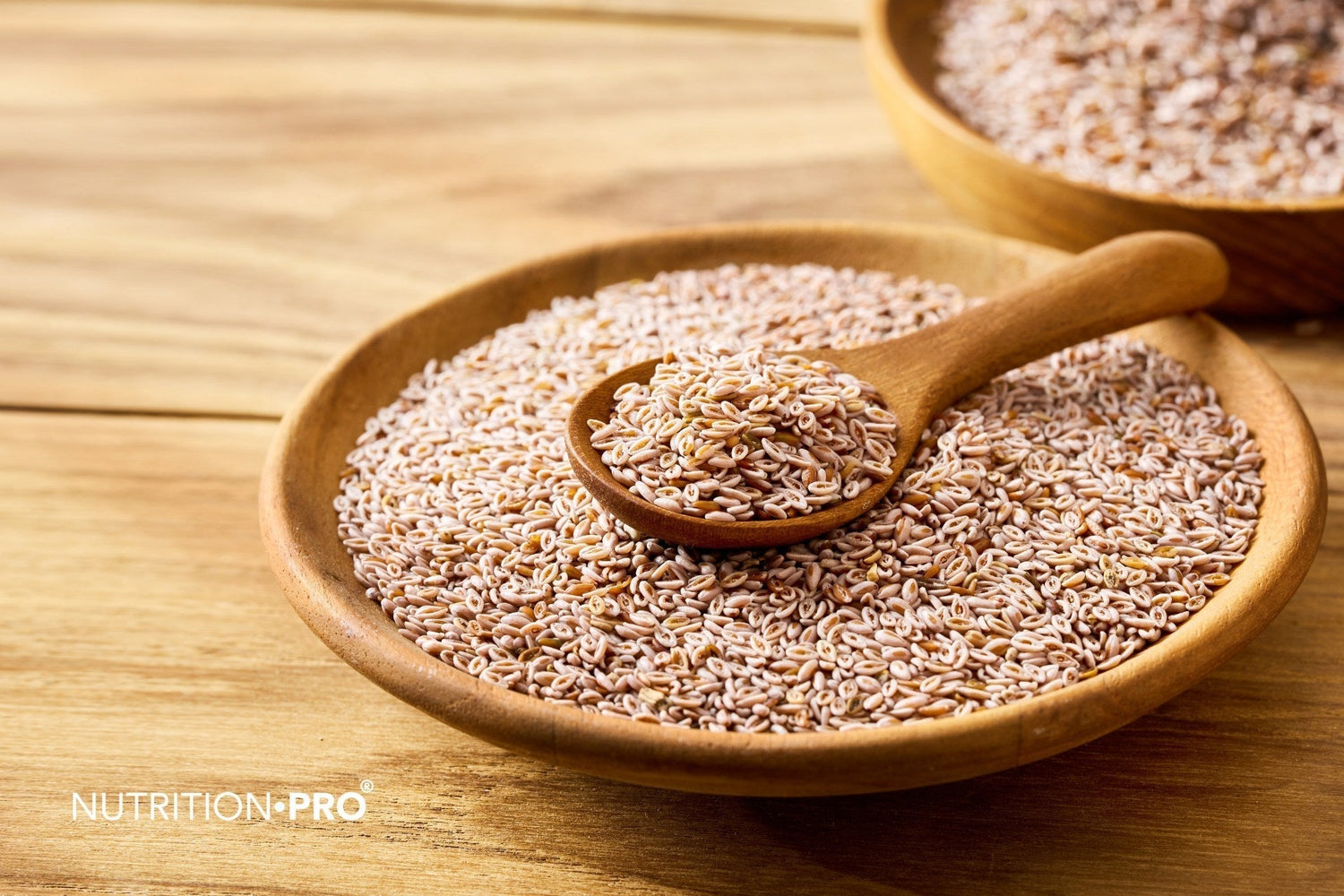
Blonde psyllium is one of the rare fibers able to display health claims validated by EFSA : unlike many "weight loss" plants whose promises have been rejected, psyllium has science on its side for digestive transit and cholesterol. This small seed from India has become an essential for digestive comfort, and its benefits go far beyond.
This comprehensive guide takes stock with evidence: what blonde psyllium is, how it works, its benefits classified by level of proof (transit, cholesterol, blood sugar, satiety, irritable bowel), at what dosage, how to use it daily, and with what precautions, especially the golden rule about water. Without exaggerated promises, and without a single fabricated testimonial.

100% husk of Plantago ovata from organic farming, with no additives. A soluble fiber for transit, cholesterol and satiety, to be mixed into water, a smoothie or yogurt. Available in 100 g and 500 g.
Blonde psyllium (Plantago ovata) is a soluble fiber whose husk forms a gel when in contact with water. Two benefits are recognized by EFSA: it contributes to maintaining normal cholesterol levels (from 7 g per day) and to increasing fecal bulk volume (transit). A meta-analysis of 28 trials confirms an LDL reduction of approximately 0.33 mmol/L (Jovanovski, Am J Clin Nutr, 2018), and it improves blood sugar levels especially in people with imbalanced levels (Gibb, Am J Clin Nutr, 2015). A regulator of transit in both directions, it also supports satiety. Golden rule: always take it with a large glass of water.
- What is blonde psyllium?
- How it works: the mucilage gel
- Benefits classified by level of proof
- Psyllium and transit: constipation and diarrhea
- Psyllium and cholesterol: the EFSA claim
- Psyllium, blood sugar and type 2 diabetes
- Psyllium, satiety and weight loss
- Psyllium and irritable bowel syndrome
- Dosage and how to use it
- Blonde psyllium or black psyllium?
- Choosing your psyllium wisely
- Safety, precautions and contraindications
- Frequently asked questions
1. What is blonde psyllium?
Blonde psyllium comes from the seeds of a herbaceous plant, Plantago ovata, also called ispaghul. What interests us is the seed coat of the seed, the husk, exceptionally rich in soluble fiber and mucilages.
Used for centuries, psyllium is today one of the best-documented fibers. Its distinctive feature: it is a soluble, viscous and poorly fermented fiber. This combination is rare and valuable, because it explains effects that many other fibers do not have, as we will see (McRorie, J Acad Nutr Diet, 2017). Organic blonde psyllium powder integrates easily into daily life, simply mixed into a liquid.
2. How it works: the mucilage gel
It all comes from its ability to absorb water and form a gel. This gel acts at several levels of the digestive tract:
- In the small intestine, its viscosity slows the absorption of fats and sugars, which helps lower cholesterol and smooth blood sugar levels (McRorie, J Acad Nutr Diet, 2017).
- In the colon, because it resists fermentation, the gel remains intact and retains water until the end: it increases stool volume and makes stools softer and easier to pass (McRorie, Dig Dis Sci, 2017).
- In the stomach, by swelling, it prolongs the sensation of satiety.
This is a key point, often overlooked: not all fibers are equal. Rapidly fermented fibers (such as inulin) do not have this effect on stools, and some can even be constipating. Psyllium, on the other hand, owes its effectiveness to its non-fermented gel (McRorie, Dig Dis Sci, 2017).
3. The benefits of psyllium, ranked by level of evidence
Here is an honest hierarchy, from the best proven to the most limited. A dietary supplement supports a healthy lifestyle, it does not replace treatment.
Transit and intestinal comfort
Constipation as well as overly soft stools.
Psyllium contributes to increasing fecal bulk and regulates transit in both directions (McRorie, Dig Dis Sci, 2017).
Cholesterol
From 7 g per day.
It contributes to the maintenance of normal cholesterol levels, with an LDL reduction of approximately 0.33 mmol/L (Jovanovski, Am J Clin Nutr, 2018).
Blood sugar and type 2 diabetes
Especially in case of imbalance.
It improves blood sugar proportionally to the initial imbalance (Gibb, Am J Clin Nutr, 2015).
Irritable bowel syndrome
Soluble fiber recommended.
Soluble fibers such as psyllium are preferred, unlike insoluble bran (McKenzie, BDA, 2016).
Satiety and weight management
A support, not a miracle appetite suppressant.
It prolongs satiety and reduces hunger between meals (Brum, Appetite, 2016).
Blood pressure
Not to be overinterpreted.
One trial showed no sustained effect on blood pressure, with a healthy diet performing better (Pal, Br J Nutr, 2011).
4. Psyllium and transit: constipation and diarrhea
It is the most well-known use of psyllium, and one of the best proven. In case of constipation, its gel retains water in the colon, which increases stool volume and makes it softer and easier to evacuate, without irritating the mucous membrane (McRorie, Dig Dis Sci, 2017). The EFSA moreover recognizes that psyllium contributes to an increase in fecal bolus volume.
Less well-known: it also helps in case of overly soft stools or diarrhea. The same gel absorbs excess water and gives consistency to stools. This is what makes psyllium a true regulator, capable of normalizing stool form in both situations (McRorie, J Acad Nutr Diet, 2017). To benefit from it, one essential condition: drink sufficient water. See our digestion and transit.
5. Psyllium and cholesterol: the EFSA health claim
It is one of psyllium's most solid assets, and one of the few to benefit from an authorized health claim by EFSA : from 7 g per day, it contributes to the maintenance of normal cholesterol levels. The mechanism is elegant: by forming a gel, psyllium traps some of the bile acids and slows cholesterol absorption, forcing the body to draw from its reserves.
In 28 controlled trials (nearly 1900 participants), a median dose of approximately 10 g of psyllium per day significantly reduces LDL cholesterol, non-HDL cholesterol, and apolipoprotein B.
Jovanovski E, et al. Am J Clin Nutr 2018;108(5):922-932. DOI: 10.1093/ajcn/nqy115
This effect is confirmed by a comprehensive review of foods that act on LDL: viscous soluble fibers such as oats, barley, and psyllium are among the high-evidence options (Schoeneck, Nutr Metab Cardiovasc Dis, 2021). Psyllium is therefore a relevant supplement to a heart-healthy diet, without replacing prescribed treatment.
100% Plantago ovata husk, to be mixed in a glass of water, smoothie, or yogurt. For transit, cholesterol, and satiety.
Discover blonde psyllium →6. Psyllium, blood sugar, and type 2 diabetes
By slowing sugar absorption, psyllium gel helps reduce blood sugar spikes after meals. Interestingly and honestly: its benefit is proportional to the initial imbalance. A meta-analysis of 35 trials shows almost no effect in people with normal blood sugar, modest effect in at-risk people, and the most pronounced effect in patients treated for type 2 diabetes, with a decrease in fasting blood glucose and HbA1c (Gibb, Am J Clin Nutr, 2015).
A 12-month trial in overweight adults also observed a decrease in insulin and LDL with fiber supplementation including psyllium (Pal, Nutrients, 2017). Psyllium therefore integrates well into a blood sugar management strategy, alongside diet. See our collection blood sugar.
7. Psyllium, satiety, and weight loss
Psyllium is a gentle natural appetite suppressant. By forming a voluminous gel in the stomach, it increases the feeling of fullness and reduces hunger between meals. Two controlled trials showed that a dose of approximately 6.8 g before meals significantly decreased hunger and food cravings, while increasing satiety (Brum, Appetite, 2016).
That said, let's be honest: no fiber causes weight loss on its own. Psyllium is a support that facilitates portion control, provided it is integrated into a balanced diet and physical activity. It complements other approaches in our appetite controlcollection, and our guides feeling hungry after eating and sustainable weight loss will help you structure your approach.
Blonde psyllium helps better manage appetite while supporting transit. Simple to incorporate, 100 g or 500 g format.
Discover blonde psyllium →8. Psyllium and irritable bowel syndrome
Irritable bowel syndrome (IBS) combines abdominal pain, bloating, and transit disorders. From a dietary standpoint, not all fibers are equal: recommendations from the British Dietetic Association favor soluble fibers, such as psyllium, and advise against increasing insoluble fibers like wheat bran, which can worsen symptoms (McKenzie, BDA, J Hum Nutr Diet, 2016).
Psyllium can therefore help regulate transit and improve comfort, provided it is introduced gradually, at low doses, and your tolerance is monitored. In case of IBS, medical or dietary advice remains recommended to personalize the approach.
9. Dosage and how to consume it
Psyllium is simple to use, but a few rules make all the difference for comfort and safety:
As for uses, the powder is very versatile: in a glass of water or juice, in a smoothie, mixed with yogurt or applesauce, or as a natural gluten-free binder in cooking and baking (breads, pie doughs). Always start with small amounts.
10. Blonde psyllium or black psyllium?
The two are often confused, but they differ by species and gentleness:
| Criterion | Blonde psyllium | Black psyllium |
|---|---|---|
| Plant | Plantago ovata (ispaghul) | Plantago afra / psyllium |
| Mucilage | Richer | Slightly less |
| Digestive gentleness | Very gentle | Slightly more irritating |
| Level of evidence | Most studied | Less data |
| Common use | Digestion, cholesterol, satiety | Digestion |
For daily digestive comfort, the blonde psyllium is the reference choice, like our organic blonde psyllium.
11. Choosing your psyllium wisely
A few practical criteria:
- The species : choose true blonde psyllium (Plantago ovata), the gentlest and most studied.
- Purity : a product in pure husks, without additives, added sugar or flavoring.
- Organic : a fiber consumed regularly benefits from being organically grown.
- The form : powder is versatile (beverages, cooking) and economical, especially in larger sizes.
This is exactly the profile of our organic blonde psyllium powder : 100% Plantago ovata husk, organic, without additives, in 100 g or 500 g.
12. Safety, precautions and contraindications
When used correctly, psyllium is very well tolerated. Precautions mainly come down to one simple but essential rule: water.
Always with plenty of water : taken without sufficient liquid, psyllium can swell too quickly and cause bloating, discomfort, or even risk of esophageal or intestinal obstruction. Drink a large glass of water with each dose.
Increase gradually to limit bloating and gas during the adjustment period. Medications : psyllium may reduce the absorption of certain medications; space it at least 2 hours apart. Contraindications : digestive narrowing or obstruction, swallowing disorders. In case of diabetes, digestive disease, pregnancy, or treatment, consult a healthcare professional before starting any course.
With these simple precautions, blonde psyllium is a safe and valuable fiber to incorporate sustainably into your lifestyle.
Select what applies best to you: your recommendation appears immediately. This is a guideline, not medical advice.
It's its most proven use: a transit regulator in both directions. The organic blonde psyllium, with a large glass of water, taken in gradual increments.
Psyllium contributes to maintaining normal cholesterol levels (EFSA, from 7 g/day) and helps regulate blood sugar. The organic blonde psyllium fits into your lifestyle, complementing medical supervision.
By swelling in the stomach, psyllium prolongs satiety. Take the organic blonde psyllium before meals, and explore the appetite control.
Frequently Asked Questions
What are the proven benefits of blonde psyllium?
Two benefits are recognized by EFSA: psyllium contributes to maintaining normal cholesterol levels (from 7 g per day) and to an increase in fecal bulk, thus supporting transit. Its soluble fiber also helps regulate blood sugar in people with imbalances and supports satiety (Gibb, Am J Clin Nutr, 2015).
How does blonde psyllium work?
Its husk is rich in soluble fibers that absorb water and form a viscous, non-fermented gel. This gel increases stool volume and water content, slows cholesterol and glucose absorption, and prolongs satiety (McRorie, J Acad Nutr Diet, 2017).
Is psyllium effective against both constipation AND diarrhea?
Yes, it's a regulator in both directions. Its gel retains water: it softens and increases stool volume in case of constipation, and thickens stools in case of overly liquid stools (McRorie, Dig Dis Sci, 2017). You must take it with sufficient water.
How much psyllium per day?
Generally 5 to 10 g per day (1 to 2 teaspoons), to be increased gradually. For the effect on cholesterol, EFSA recommends at least 7 g per day. Always drink a large glass of water with each dose.
Does psyllium cause weight loss?
Not directly. By swelling in the stomach, it prolongs satiety and helps better manage appetite (Brum, Appetite, 2016), which can support a weight management approach. But it doesn't cause weight loss on its own: it's the caloric deficit that counts.
Does psyllium reduce cholesterol?
Yes, it's one of its best-established effects. A meta-analysis of 28 trials shows that approximately 10 g per day reduces LDL cholesterol by about 0.33 mmol/L (Jovanovski, Am J Clin Nutr, 2018), and the EFSA authorizes the claim from 7 g per day.
What is the difference between blonde psyllium and black psyllium?
Blonde psyllium (Plantago ovata, or ispaghul) is richer in mucilage and milder, ideal for transit and digestive comfort. Black psyllium (Plantago afra) is somewhat more irritating. The blonde variety is the most commonly used and best studied.
Does psyllium have side effects or precautions?
Always take it with plenty of water, otherwise it can cause bloating or even risk of obstruction. Increase the dose gradually, and space it at least 2 hours apart from medication intake as it can reduce its absorption. Should be avoided in cases of digestive narrowing or obstruction.
When should you take psyllium, before or after meals?
For satiety and blood sugar control, take it before or during meals. For transit, it can be taken away from meals. In all cases, with a large glass of water, and preferably not just before bedtime.
Is psyllium suitable for irritable bowel syndrome?
Dietary recommendations favor soluble fibers like psyllium, which are better tolerated than insoluble wheat bran that can worsen symptoms (McKenzie, BDA, J Hum Nutr Diet, 2016). Should be introduced gradually and according to individual tolerance.
- Plantago ovata
- A plant from India and Iran, also called ispaghul, whose seed coat yields blonde psyllium.
- Seed coat
- The outer envelope of the seed, the part rich in soluble fiber used as psyllium.
- Mucilage
- A soluble fiber that swells upon contact with water to form a viscous gel.
- Soluble fiber
- Fiber that dissolves in water and forms a gel, as opposed to insoluble fibers (wheat bran).
- Fermentation
- Degradation of fiber by colon bacteria. Psyllium is minimally fermented, which explains its effect on stools.
- LDL cholesterol
- The "bad" cholesterol, whose excess promotes deposits in the arteries.
- HbA1c
- Glycated hemoglobin, reflecting average blood sugar levels over the past two to three months.
- McRorie JW, McKeown NM. Understanding the physics of functional fibers in the gastrointestinal tract: an evidence-based approach to resolving enduring misconceptions about insoluble and soluble fiber. J Acad Nutr Diet 2017;117(2):251-264. DOI : 10.1016/j.jand.2016.09.021
- Jovanovski E, et al. Effect of psyllium (Plantago ovata) fiber on LDL cholesterol and alternative lipid targets: a systematic review and meta-analysis of randomized controlled trials. Am J Clin Nutr 2018;108(5):922-932. DOI : 10.1093/ajcn/nqy115
- Gibb RD, et al. Psyllium fiber improves glycemic control proportional to loss of glycemic control: a meta-analysis. Am J Clin Nutr 2015;102(6):1604-1614. DOI : 10.3945/ajcn.115.106989
- Pal S, et al. Effect on insulin, glucose and lipids in overweight/obese adults of 12 months consumption of two different fibre supplements in a randomised trial. Nutrients 2017;9(2):91. DOI : 10.3390/nu9020091
- Brum JM, et al. Satiety effects of psyllium in healthy volunteers. Appetite 2016;105:27-36. DOI : 10.1016/j.appet.2016.04.041
- McRorie JW, Chey WD. Fermented fiber supplements are no better than placebo for a laxative effect. Dig Dis Sci 2017;61(11):3140-3146. DOI : 10.1007/s10620-016-4304-1
- McKenzie YA, et al. British Dietetic Association systematic review and evidence-based practice guidelines for the dietary management of irritable bowel syndrome in adults (2016 update). J Hum Nutr Diet 2016;29(5):549-575. DOI : 10.1111/jhn.12385
- Schoeneck M, Iggman D. The effects of foods on LDL cholesterol levels: a systematic review of the accumulated evidence. Nutr Metab Cardiovasc Dis 2021;31(5):1325-1338. DOI: 10.1016/j.numecd.2020.12.032
- Pal S, et al. The effects of 12-week psyllium fibre supplementation or healthy diet on blood pressure and arterial stiffness in overweight and obese individuals. Br J Nutr 2011;107(5):725-734. DOI: 10.1017/S0007114511003497


