

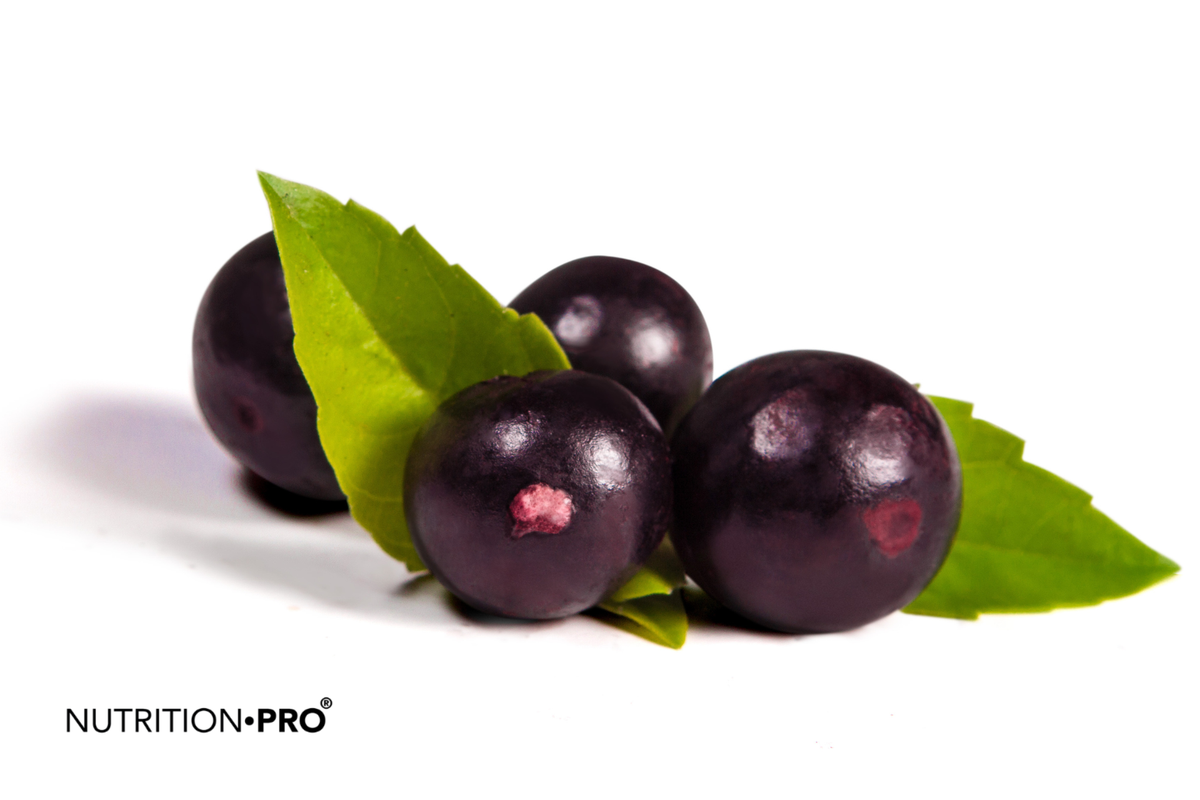
Açaí is rarely presented as a sports nutrition product, and that's a shame: it's probably the area where the data concerning it is most concrete. A randomized trial measured, following a muscle damage protocol, an increase in plasma antioxidant capacity and better strength recovery.
This article presents these findings with their limitations, then places them in a broader and more solid context: that of the class of anthocyanins, to which açaí belongs, and for which a recent umbrella review finds an effect on muscle soreness with a moderate level of certainty. And it addresses a debate that most articles ignore: should we really try to block oxidative stress after exercise?

What has been measured on açaí. A randomized crossover trial in 12 men, with 40 g per day of dehydrated açaí for 7 days before a protocol of 10 sets of 10 jumps. Results: plasma antioxidant capacity increased by 11% at 24 hours, and better recovery of isometric strength of knee flexors at 24 and 72 hours. No difference in fatigue index.
The context that matters more. An umbrella review of 53 meta-analyses of randomized trials, evaluating 24 nutritional interventions, finds a significant effect of anthocyanins and polyphenols on the reduction of muscle soreness, with a level of certainty moderate according to the GRADE method. Acai belongs to this class. The debate to know: systematic antioxidant supplementation could interfere with training adaptations, which suggests targeting high-load periods rather than continuous consumption.
The acai trial, in detail
This trial, published in Research in Sports Medicine, deserves to be detailed because it is the only one to have specifically measured muscle recovery under acai, and because its Crossover design Making each participant their own control.
| Protocol Element | Detail |
|---|---|
| Participants | 12 men, crossover study over 21 days, each completing the protocol twice with 7 days between sessions |
| Supplementation | 40 g per day of dehydrated açaí (Euterpe precatoria) for 7 days, versus placebo |
| Damage Protocol | 10 sets of 10 countermovement jumps, 1 minute recovery between sets |
| Blood Markers | Creatine kinase, lactate dehydrogenase, antioxidant capacity in Trolox equivalents, at 0 and 24 hours |
| Functional Measurements | Muscle ultrasound, muscle soreness, maximum isometric strength of knee extensors and flexors, at 0, 24, 48, and 72 hours |
The results, precisely
- Plasma antioxidant capacity : significant time-treatment interaction, with an increase of 11% at 24 hours in the açaí group.
- Isometric strength of knee flexors : significantly better recovery in the açaí group, at 24 hours and at 72 hours.
- Fatigue Index : no difference, neither for extensors nor for flexors, indicating that both conditions produced comparable fatigue. The protocol was therefore well matched.
What is solid in this trial: the measurements are objective, a biological marker and mechanical performance, and the crossover design neutralizes individual differences. The fact that fatigue was identical in both arms strengthens the interpretation: it's not that the açaí group fatigued less, it's that it recovered better.
What limits its scope: twelve participants, all men, a single exercise modality, and the observed effect on flexors only, not on extensors. The species used, Euterpe precatoria, is moreover similar but distinct fromEuterpe oleracea most commonly marketed. This is a result that warrants larger-scale studies, not an established demonstration.
The context: what the anthocyanin class is worth
A trial on twelve people is not enough to conclude. But açai is not an isolated case: it belongs to a class of compounds, anthocyanins, whose effect on recovery has been evaluated on a much larger scale.
An umbrella review published in Nutrition Reviews compiled 53 meta-analyses of randomized trials, evaluating 24 nutritional interventions on 10 criteria related to muscle damage induced by exercise. Each conclusion was rated according to the GRADEmethod, which grades the certainty of evidence.
| Intervention | Observed Effect | Certainty Level |
|---|---|---|
| Anthocyanins | Reduction in muscle soreness | Moderate |
| Polyphenols | Reduction in muscle soreness | Moderate |
| HMB | Reduction in creatine kinase and lactate dehydrogenase | Moderate |
| L-carnitine | Reduction in creatine kinase and muscle soreness | Moderate |
| Branched-chain amino acids | Reduction in delayed-onset muscle soreness | Moderate |
| Curcumin, ginseng | Reduction in muscle soreness | Moderate |
Of the 24 interventions evaluated, only a handful stands out with a moderate certainty level, and anthocyanins are among themThis is a result that few people know about, and which places açaí within a far better documented category than itself.
Two honest clarifications are necessary, however. The first: this result concerns muscle soreness, not performance or strength. The second: it concerns the class of anthocyanins, studied primarily through sources other than açaí, notably berry juices. Nothing guarantees that one source is exactly equivalent to another, as anthocyanin content varies substantially from one product to the next.
What this allows us to say, and what it does not
| What is reasonable to say | What is not |
|---|---|
| One trial measured better force recovery and increased antioxidant capacity | "Açaí improves recovery," stated as an established fact |
| Anthocyanins reduce muscle soreness with a moderate level of certainty | "Açaí reduces muscle soreness," transposing a class result to a specific product |
| The signal justifies taking an interest during high-load training phases | "Açaí improves performance," which no data supports |
| It is a nutrient-dense food, well tolerated, and easy to incorporate | A demonstrated health effect that current data does not allow us to claim |
This distinction is not methodological pedantry. It has a direct practical consequence: it tells you what to expect. If you take açaí hoping to run faster, you will be disappointed. If you integrate it as an anthocyanin source during a high-load training phase, you are within the framework of what the data suggests.
The debate: should we block oxidative stress?
This is the most interesting and rarely discussed point in this dossier. It rests on a counterintuitive idea: oxidative stress produced by exercise is not only damage, it is also a signal.
Reactive oxygen species generated during exercise participate in signaling pathways that trigger training adaptations : mitochondrial biogenesis, strengthening of the body's own antioxidant defenses, muscle remodeling. A logical reasoning follows: if we systematically eliminate this signal through massive antioxidant supplementation, don't we riskattenuating the adaptations that training seeks precisely to produce ?
This hypothesis has been studied mainly with isolated antioxidants at high doses, notably vitamins C and E in supplementation, a context in which it has raised real concern. It is less clear-cut for dietary polyphenol intake from whole fruits, which work through more diverse mechanisms and at different doses.
We do not present this debate as an argument against açaí: that would go further than the data allows. We present it because it exists, because it is taken seriously in exercise physiology, and because it leads to a nuanced practical conclusion rather than to systematic consumption.
Where to place açaí among other tools
A polyphenol intake cannot be compared to what actually structures recovery. Here is the order that the data imposes.
| Priority | Tool | Status |
|---|---|---|
| 1 | Sufficient and regular sleep | The best-established tool, and free. No intake compensates for it |
| 2 | Adequate protein intake | Proteins contribute to the maintenance and growth of muscle mass |
| 3 | Training load management | Coherent progression and easy days: the variable that determines most injuries and plateaus |
| 4 | Sufficient energy and carbohydrate intake | Under-nutrition and recovery are incompatible |
| 5 | Polyphenol and anthocyanin intake, including açaí | Documented effect on muscle soreness at the class level, with moderate certainty. A supplement, not a foundation |
This hierarchy explains why we will never present açaí as a central recovery product. An athlete who sleeps six hours, eats too little, and chains hard weeks will get nothing from a fruit powder, whatever it may be. The same athlete, with their fundamentals in place, can reasonably take an interest in it.
A word on creatine, often cited in the same conversation: it follows a different logic, that of performance on short and intense efforts, not recovery after muscle damage. The two are not interchangeable. We detail its case in our guide to supplements and performance.
In practice: dose, timing, quality
Açaí is a food, not a banned substance. The risk for a competitor therefore does not come from the molecule but from the product, through cross-contamination in production. The principle of strict liability places the consequence on the athlete, regardless of the source of contamination. The solution is the same as for any supplement: prioritize products analyzed batch-by-batch by an independent laboratory. We develop this point in our guide on banned substances in sport.
Açaí is not a performance product, and no one should sell it as such. It's a source of anthocyanins, a class with a moderately certain effect on muscle soreness, and for which one specific trial measured improved strength recovery. This deserves a place, in fifth position, after sleep, protein, training load, and energy intake. Placing more hope in it than that would be looking at the wrong lever.
Frequently asked questions
What the data shows
Does açaí help recovery after exercise?
A randomized crossover trial in 12 men measured, with 40 g per day of dehydrated açaí for 7 days before a protocol of 10 sets of 10 jumps, an 11% increase in plasma antioxidant capacity at 24 hours and better isometric strength recovery of knee flexors at 24 and 72 hours. No difference in fatigue index. This is a real signal, in a small sample.
Is twelve participants enough to conclude?
No, and it must be said. Twelve men, only one exercise modality, an effect observed on flexors only and not on extensors: this justifies larger-scale studies, not an established demonstration. The crossover design, where each participant serves as their own control, does however strengthen the internal quality of the trial.
What does research say about anthocyanins in general?
Context matters most. An umbrella review published in Nutrition Reviews compiled 53 meta-analyses of randomized trials, evaluating 24 nutritional interventions. Anthocyanins and polyphenols showed a significant effect on reducing muscle soreness, at a moderate level of certainty according to the GRADE method. Of 24 interventions evaluated, few reach this level.
Can this class result be applied to açaí?
With caution. The result concerns the class of anthocyanins, studied primarily through sources other than açaí, notably berry juices. Anthocyanin content varies greatly from one product to another, depending on origin, ripeness, and process. Nothing guarantees that one source is exactly equivalent to another: this is a reason to take an interest, not proof.
Does açaí improve performance?
No data supports it. Available results concern recovery after muscle damage and antioxidant capacity markers, not performance. In the available trial, the fatigue index was identical between groups, by the way. If your goal is performance on short, intense efforts, this isn't the right product.
The antioxidant debate
Do we really need to block oxidative stress after exercise?
This is a genuine debate in exercise physiology. Reactive oxygen species generated during exercise are not just damage: they participate in signaling pathways that trigger training adaptations. Systematically suppressing this signal through massive antioxidant supplementation could therefore attenuate these adaptations. The question is taken seriously and deserves to be understood.
Does this debate apply to fruits like acai?
Less clearly. This hypothesis has primarily been studied with isolated antioxidants at high doses, particularly vitamins C and E in supplementation, a context in which it raised genuine concern. It is less clear-cut for polyphenols from whole fruits, which act through more diverse mechanisms and at different doses. We are not presenting this as an argument against acai, but as a reason to target its use rather than consume it continuously.
When should you take it, and when should you abstain?
The reasonable approach is periodization. Target periods when recovery takes priority over adaptation: close competitions, very dense training blocks, tournaments, return from injury. Stay lighter during development phases, where the goal is precisely to trigger adaptation. It's the same logic that governs training itself.
In practice
What dose should you take?
The trial used 40 g per day of dehydrated powder for 7 days, which is a substantial quantity. No reference dose has been established otherwise, with acai trials using highly variable quantities, down to 100 mg extracts in other contexts. Follow the directions listed on your product label.
Should you take it before or after your session?
Often misunderstood point: in the trial, supplementation lasted 7 days before the muscle damage protocol, not after. So it's not a one-time post-session intake but a supply established beforehand. This points toward a period-based logic rather than precise timing around training.
How do you integrate it practically?
The powder mixes into yogurt, a smoothie, or a bowl. For sports use, pairing it with a protein source makes sense from a recovery standpoint, as proteins contribute to the maintenance and growth of muscle mass. An acai bowl with a dose of protein forms a coherent base for post-workout recovery.
Which powder should you choose for this use?
Three criteria. A single ingredient, acai pulp, without sugar or maltodextrin. A specified drying process, freeze-drying better preserving anthocyanins which are heat-sensitive. And batch-by-batch analytical testing with an accessible certificate. With a fruit whose value lies precisely in its anthocyanins, aggressive drying degrades exactly what you're looking for.
Is there a risk for a tested athlete?
Acai is a food, not a banned substance. The risk therefore doesn't come from the molecule but from the product, through cross-contamination in production, and the principle of strict liability places the consequence on the athlete regardless of origin. The solution is the same as for any supplement: prioritize products analyzed batch-by-batch by an independent laboratory.
Comparisons and limitations
Acai or creatine, which to choose?
The question is poorly framed, as both follow different logics. Creatine concerns performance in short, intense efforts. Acai involves anthocyanin intake, whose documented benefit applies to muscle soreness and recovery. They don't substitute for each other and don't target the same objective.
Where does acai rank among recovery strategies?
In fifth position. Sleep comes first, the best-established and free lever, then protein intake, then training load management, then sufficient energy intake. Polyphenols and anthocyanins come next, as a supplement. An athlete who sleeps six hours and eats too little will get nothing from a fruit powder, regardless of which one.
Does acai replace proteins after training?
No, these are two separate inputs. Proteins contribute to the maintenance and growth of muscle mass, and form the nutritional foundation of recovery. Acai provides anthocyanins, whose documented benefit applies to muscle soreness. Combining them makes sense; substituting them does not.
Can you claim that acai improves recovery?
Not on a label or in marketing communication. No health effect has been demonstrated for acai to date. This doesn't prevent describing what research has measured, as this article does, but it prohibits making it a product claim.
Is acai suitable for endurance sports?
The available trial involved a jump protocol, thus muscle damage induced by eccentric contractions, typically found in running and especially in trail running on descents. The mechanism is therefore plausible, but no trial has specifically evaluated acai on prolonged endurance efforts. The class-level result on muscle soreness remains the most general benchmark.
What should you remember about acai and sport?
That a specific trial measured an increase in antioxidant capacity and better force recovery, on twelve participants. That the anthocyanin class, to which it belongs, emerges from an umbrella review with an effect on muscle soreness at a moderate level of certainty. That it's not a performance product. And that it ranks after sleep, proteins, training load, and energy intake.
Sources
The studies cited below were identified via PubMed.
- Dos Reis TMP, et al. Effects of acai supplementation (Euterpe precatoria Mart) on markers of muscle recovery following a jump protocol. Research in Sports Medicine, 2024;32(4):580-596. DOI
- Talebi S, et al. Nutritional interventions for exercise-induced muscle damage: umbrella review of systematic reviews and meta-analyses of randomized trials. Nutrition Reviews, 2024;82(5):639-653. DOI
- Baptista SL, et al. Biological activities of acai and juçara consumption in humans: an integrative review of clinical trials. Nutrition Reviews, 2021;79(12):1375-1391. DOI
- Laurindo LF, et al. Acai (Euterpe oleracea Mart.) in health and disease: a critical review. Nutrients, 2023;15(4):989. DOI
- European Commission. Register of authorized nutrition and health claims, entries related to proteins. ec.europa.eu


