

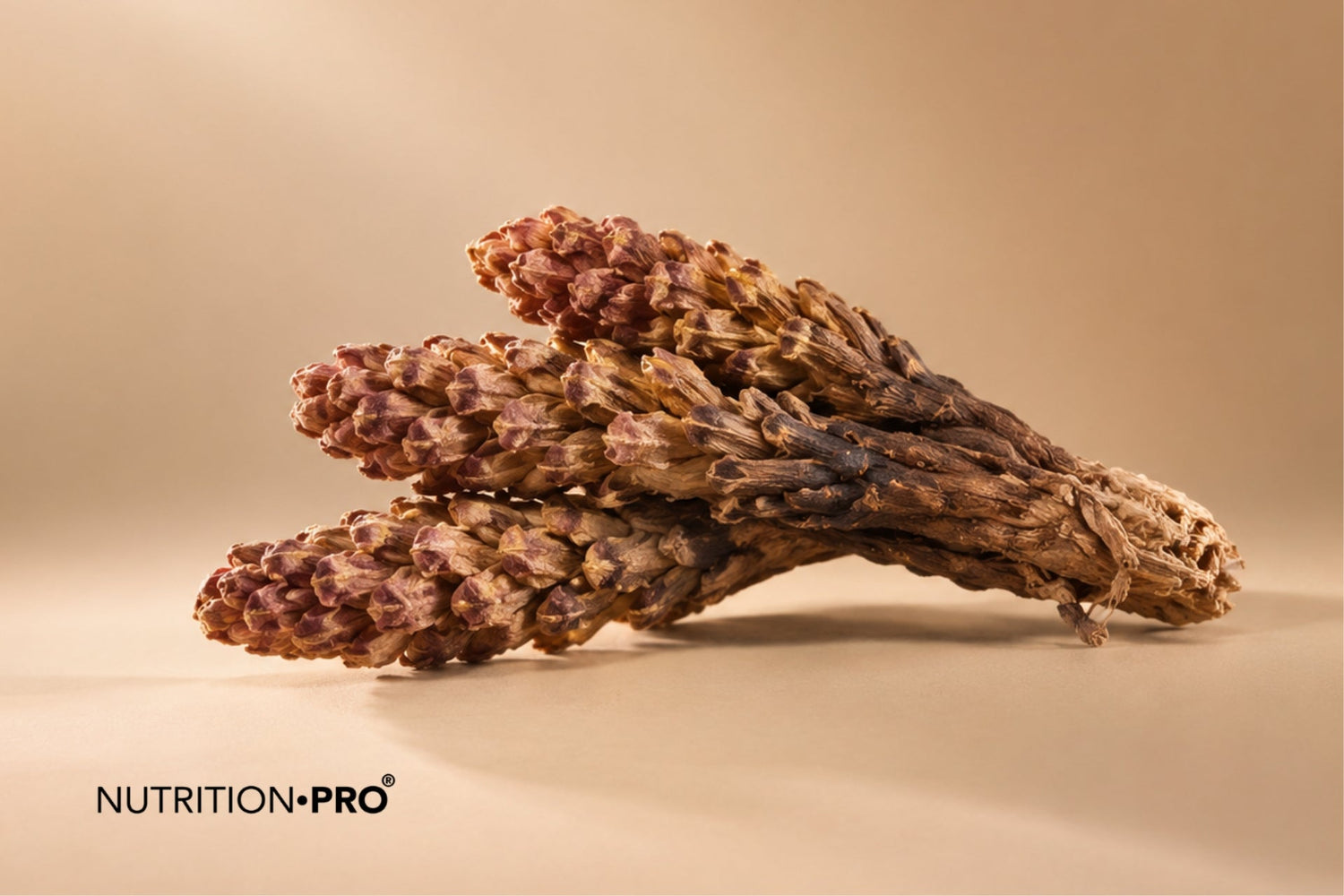
The cistanche, a parasitic desert plant used for centuries in traditional Chinese medicine, is generating growing interest in the West for its attributed effects on male vitality, testosterone, and energy. Yet purchasing it in France raises a genuine regulatory question that few websites address honestly.
The reality is more nuanced than what is often written: there are several species of cistanche, and not all of them have the same status in France. The best-known and most widely marketed varieties (Cistanche tubulosa and Cistanche deserticola) are not authorized in French dietary supplements, while a third species (Cistanche salsa) does appear on the positive list. This article provides a factual overview of the regulations and proposes legal and evidence-backed alternatives for those who were interested in cistanche.
The regulatory status of a plant in France is not an absolute judgment on its safety or ineffectiveness. It reflects the state of assessment by French and European health authorities at a given point in time. For cistanche, the main issue is theabsence of a complete safety dossier validated for the tubulosa and deserticolaspecies, and not any demonstrated danger.
In France, only Cistanche salsa appears on the positive list of plants authorized in dietary supplements (Decree of June 24, 2014). Cistanche tubulosa and Cistanche deserticola, the species most commonly used in Asian and Anglo-Saxon supplements, are not authorized as dietary supplements in France.
This restriction is based on theabsence of a complete safety dossier validated by ANSES, and not on demonstrated dangerousness. Cistanche deserticola is also listed inAppendix II of CITES, due to the ecological fragility of its wild populations in the deserts of Central Asia.
For those who were looking for cistanche for male vitality, legal and well-studied alternatives exist: Tribulus terrestris, maca, ashwagandha, panax ginseng, fenugreek. All appear on the French positive list and benefit from documented traditional use.
- Cistanche: what is it?
- 3 commercial species, 3 different regulatory statuses
- Why tubulosa and deserticola are not authorized in France
- Cistanche salsa: the only authorized one, but rarely available
- CITES: cistanche deserticola, a protected species
- Why is it still found for sale online?
- Risks of purchasing non-compliant cistanche
- Legal and effective alternatives for male vitality
- Our choice: Tribulus terrestris
- Decision table: what to do if you were looking for cistanche?
- FAQ
Cistanche: what is it?
A genus of several species
The genus Cistanche encompasses several botanically distinct species, the main ones used commercially being:
- Cistanche tubulosa : widely found in the Taklamakan Desert and Central Asia, this is the most commonly used species in modern dietary supplements for its claimed effects on testosterone and performance.
- Cistanche deserticola : the Chinese desert cistanche, traditionally the most prized in traditional Chinese medicine. An ecologically protected species.
- Cistanche salsa : a species less commercially distributed internationally but listed in certain traditional Asian pharmacopoeias.
Known active composition
Cistanche species share a rich phytochemical composition: phenylethanoid glycosides (echinacoside, acteoside, tubuloside), iridoids, polysaccharides, lignans. Theechinacoside is one of the primary analytical markers used to identify and standardize commercial extracts.
3 commercial species, 3 different regulatory statuses
| Species | France Status | CITES Status | Commercial Use |
|---|---|---|---|
| Cistanche tubulosa | Not authorized | Not listed | The best-selling internationally in vitality supplements |
| Cistanche deserticola | Not authorized | Appendix II | Historical traditional Chinese use |
| Cistanche salsa | Authorized (Annex I, Order 2014) | Not listed | Very rarely sold in mainstream supplements |
This table summarizes the core of the issue: when a French website mentions "cistanche" without specifying the species, there is a 95% chance it is referring to tubulosa or deserticola, which are therefore species not authorized in France. The precise botanical distinction is essential, something that many retailers omit either deliberately or out of ignorance.
Why tubulosa and deserticola are not authorized in France
The positive list principle
In France, dietary supplements are governed by Decree No. 2006-352 of March 20, 2006, supplemented by theOrder of June 24, 2014. The latter establishes the exhaustive list of plants whose preparations may be used in dietary supplements, along with their conditions of use.
The principle is clear: anything not explicitly authorized is prohibited. This approach, known as a "positive list," is protective for the consumer but may seem restrictive: it excludes plants for which the scientific assessment has not been completed, even if they may be widely used elsewhere in the world.
The role of ANSES
TheANSES evaluates the safety profile of plants being considered for inclusion on the positive list. For a species to be authorized, its traditional use in food must be demonstrated, or its toxicological profile must have been characterized through robust studies. This process requires comprehensive scientific data that cistanche tubulosa and deserticola have not, to date, been able to provide for the European market.
A situation that could evolve
The absence of listing is not permanent. Any operator in the sector can submit a file to the DGCCRF to update the list. If the traditional uses of cistanche in China or Central Asia are thoroughly documented and a satisfactory toxicological profile is demonstrated, future listing remains theoretically possible. However, as things stand (2026), the sale in France of a dietary supplement containing Cistanche tubulosa or deserticola constitutes a regulatory non-compliance.
Cistanche salsa: the only authorized species, but rarely available
In practice, however, Cistanche salsa is rarely commercialized on a large scale compared to its cousins tubulosa and deserticola. There are several reasons for this:
- It is less concentrated in echinacoside and acteoside than Cistanche tubulosa according to several comparative phytochemical studies.
- Theindustry has historically favored Cistanche tubulosa notably for its claimed properties on testosterone and physical performance.
- The production supply chain for salsa is less structured internationally, with fewer suppliers offering standardized extracts.
As a result: even when actively searching, it is very difficult for a French consumer to find a compliant dietary supplement based on Cistanche salsa. This makes this authorization theoretically valid but commercially marginal.
CITES: cistanche deserticola, a protected species
A parasitic plant with a fragile ecological balance
Cistanche is a obligate parasitic plant. Cistanche deserticola depends entirely on its host trees, primarily Haloxylon ammodendron (black saxaul) and Haloxylon persicum (white saxaul), which grow in the deserts of northern China and Mongolia. Yet these saxauls are themselves threatened by desertification, overgrazing, and logging.
This chain of ecological dependency makes Cistanche deserticola a particularly vulnerable species. This is why the international trade of this species is subject to CITES permits ensuring that it does not threaten the plant's survival in the wild. This protection is in addition to the French non-authorization, which further limits compliant commercial access to this species.
Why is it still available for sale online?
The grey area of cross-border purchases
A French consumer who purchases a dietary supplement from a foreign website (Amazon US, Chinese sites, Anglo-Saxon distributors) receives a product that complies with the regulations of the country of origin, but not necessarily with French regulations. From a strictly legal standpoint:
- For personal use and in small quantities, French customs generally tolerate importation without prosecution, even if the product is not authorized on French soil.
- However, the resale in France of a product containing an unauthorized plant is strictly prohibited and subject to penalties.
- French operators who distribute these products in France are in clear violation of theDecree of June 24, 2014.
This situation creates a market ambiguity: consumers can in theory import for personal use, but no serious French operator can legally distribute it.
Risks of purchasing non-compliant cistanche
Quality and contamination
Dietary supplements manufactured in accordance with European standards are subject to strict controls : analysis of heavy metals (lead, cadmium, mercury, arsenic), pesticides, mycotoxins, microbiological contamination. Products imported from outside the regulated European zone are exempt from these requirements. Several studies have regularly revealed contaminations in unregulated Asian-origin dietary supplements.
Concealed doping substances
Some supplements intended for "muscle building" or "testosterone boosting" sold abroad have been identified as containing undeclared doping substances on the label: anabolic steroids, selective androgen receptor modulators (SARMs), prohormones. This risk does not specifically concern cistanche itself, but the market segment in which it is often sold.
Recourse in case of adverse effects
In the event of an adverse effect linked to a product purchased abroad, the French nutrivigilance system cannot intervene, and avenues for recourse are extremely limited. Choosing products purchased in France guarantees full regulatory oversight in the event of a problem.
Legal and effective alternatives for male vitality
A plant-by-plant approach
| Plant | Traditional indication | Status in France |
|---|---|---|
| Tribulus terrestris | Male toning, libido, physical performance | Permitted (positive list) |
| Maca (Lepidium meyenii) | Vitality, endurance, male and female libido | Permitted (positive list) |
| Ashwagandha (Withania somnifera) | Adaptogen, stress, vitality, male hormonal support | Permitted (positive list) |
| Panax Ginseng | General toning, energy, sexual vitality | Permitted (positive list) |
| Fenugreek (Trigonella foenum-graecum) | Male toning, physical performance, libido | Authorized (positive list) |
All these plants have the advantage of combining a long traditional use, a complete European safety dossier and modern clinical studies documenting their effects. They are effective, legal, and accessible through controlled French suppliers.
Our choice: Tribulus terrestris
Why Tribulus is a genuine alternative
The Tribulus terrestris (Maltese cross, "puncture vine") has been used since antiquity in Ayurvedic medicine (under the name gokshura) and in traditional Chinese medicine. Like cistanche, it is traditionally associated with male toning, vitality, physical performance, and libido. Its recognized active compounds are steroidal saponins, notably protodioscin, considered the activity markers.
On the regulatory side, Tribulus terrestris L. is explicitly listed on the French positive list of plants authorized in dietary supplements (Decree of June 24, 2014, Annex I). Its use is therefore fully compliant and raises no legal ambiguity.

Tribulus Terrestris: 120 capsules
Standardized extract of Tribulus terrestris L., a traditional plant for male vitality. Listed on the French positive list, manufactured in accordance with European good manufacturing practices. A clear and compliant alternative to unauthorized cistanche species.
View Tribulus Terrestris →To go further on Tribulus
If you wish to explore in greater depth the benefits, mechanisms of action and clinical studies of Tribulus terrestris, check out our complete guide on tribulus to naturally increase testosterone levels. You will find detailed indications, traditional usage protocols and scientific references.
For profiles more oriented toward male libido and sexual desire, our formula Male Libido combines Tribulus with other authorized traditional plants, in a synergy designed for this specific purpose. The guide how to naturally boost male libido details the recommended holistic approach.
Decision table: what to do if you were looking for cistanche?
FAQ: all your questions about cistanche in France
Is cistanche really banned in France?
Not cistanche in general, but the most commercially available species are. According to theDecree of June 24, 2014 establishing the list of plants authorized in food supplements in France, only Cistanche salsa appears on the positive list. Cistanche tubulosa and Cistanche deserticola, which are the species most commonly used in commercial supplements, are not authorized. Their sale in France as a food supplement is therefore prohibited.
Why are Cistanche tubulosa and deserticola not authorized?
The French system is based on a positive list: only plants listed in Annex I of theDecree of June 24, 2014 may be included in the composition of a food supplement. Cistanche tubulosa and deserticola are not listed, primarily due to the absence of a complete European safety dossier validated by ANSES. The absence of listing does not mean the plant is dangerous, but that it has not undergone a favorable evaluation for this use.
Can cistanche be purchased in pharmacies in France?
No, in principle, no French pharmacy should sell food supplements based on Cistanche tubulosa or deserticola, as these species do not appear on the French positive list. If you find them at a French retailer, this constitutes a regulatory non-compliance. French pharmacies do, however, offer other authorized and studied plants for male vitality, such as Tribulus terrestris.
Why is it available for sale online?
Supplements based on Cistanche tubulosa or deserticola sold online are generally imported from foreign websites (United States, Asia, sometimes other European countries). By ordering from abroad, the consumer risks receiving a product that does not comply with French regulations, with no guarantee of quality, traceability, or adherence to the good manufacturing practices required in France.
What are the risks of purchasing a non-compliant cistanche?
The main risks are: lack of quality control (contamination by heavy metals, pesticides, false labeling), no guarantee on the stated active ingredient content, the risk of hidden doping substances in certain sports supplements, and no recourse in the event of an adverse effect. Purchasing through an authorized French distribution channel guarantees compliance with European quality standards.
What is the legal alternative to cistanche in France?
For male vitality, the main legal and scientifically studied alternative is Tribulus terrestris, which is indeed listed on the positive list of plants authorized in France. Other authorized traditional plants may also be relevant for this indication: maca, ashwagandha, panax ginseng, fenugreek. These plants have the advantage of a validated European safety dossier.
Is Cistanche deserticola also ecologically protected?
Yes. Cistanche deserticola is listed in Appendix II of the CITES Convention (Convention on International Trade in Endangered Species of Wild Fauna and Flora). This listing means that its international trade is regulated to prevent exploitation incompatible with its survival. It is a desert parasitic plant that depends on specific host trees and whose wild populations are fragile.
Does cistanche really increase testosterone?
Some Chinese and Asian studies on Cistanche tubulosa report effects on male hormonal markers, but this data still needs to be confirmed by independent, large-scale European clinical trials. In the absence of a validated safety and efficacy dossier for the French market, no health claims of this type may be made by retailers in France. Tribulus terrestris, which has a recognized traditional use for male vitality, represents a legal and well-documented alternative.
Can cistanche be brought in from abroad for personal use?
For strictly personal use and in small quantities, French customs generally tolerate importation, even if the product is not authorized on French soil. However, the resale in France of such products is strictly prohibited. This personal importation remains entirely at your own risk in terms of quality and tolerance, and provides no recourse in the event of an adverse effect.
Is the situation likely to change?
The absence of a listing is not permanent. Any operator may submit a dossier to the DGCCRF to update the French positive list. If the traditional uses of cistanche tubulosa or deserticola are solidly documented and a satisfactory toxicological profile is demonstrated, a future listing remains theoretically possible. However, as things stand (2026), no listing procedure is publicly known for either of these two species.
Tribulus or cistanche: which to choose for male vitality?
For a French consumer, the question is fairly straightforward: Tribulus terrestris is authorized, traditional, scientifically studied, and available through regulated French distribution channels, whereas cistanche tubulosa or deserticola cannot be legally sold in France. Beyond the regulatory framework, both plants share a traditional use for male toning, and Tribulus has the advantage of a longer history of use in Europe.
- Positive list
- A regulatory principle whereby only explicitly authorized substances may be used. For food supplements in France, the positive list of plants is established by the Decree of June 24, 2014.
- ANSES
- French Agency for Food, Environmental and Occupational Health & Safety. Assesses the health risks of foods and food supplements in France and issues opinions that guide regulation.
- DGCCRF
- Directorate General for Competition, Consumer Affairs and Fraud Prevention. French ministerial body responsible for monitoring product compliance, including food supplements.
- CITES
- Convention on International Trade in Endangered Species of Wild Fauna and Flora. Regulates the international trade of protected species through a system of appendices (I, II, III) based on the level of protection required.
- Echinacoside
- Primary phenylethanoside glycoside and key marker of cistanche species, used for analytical identification and extract standardization.
- Steroidal saponins
- A family of plant molecules found notably in Tribulus terrestris, considered the activity markers of this plant. Protodioscine is the principal one.
- Nutrivigilance
- French monitoring system for adverse effects associated with the consumption of food supplements and fortified foods. Managed by ANSES.
- French Republic. Order of June 24, 2014 establishing the list of plants, other than fungi, authorized in food supplements and the conditions of their use. JORF n°0163 of July 17, 2014. Full text on Légifrance
- French Republic. Decree n°2006-352 of March 20, 2006 relating to food supplements. Full text on Légifrance
- DGCCRF. List of plants that may be used in food supplements (consolidated version January 2019). Directorate General for Competition, Consumer Affairs and Fraud Control, Ministry of the Economy.
- CITES. Appendix II: Convention on International Trade in Endangered Species of Wild Fauna and Flora. Listing of Cistanche deserticola. Official CITES website
- ANSES. Food supplements: information and opinions. French Agency for Food, Environmental and Occupational Health & Safety. Official ANSES website


