

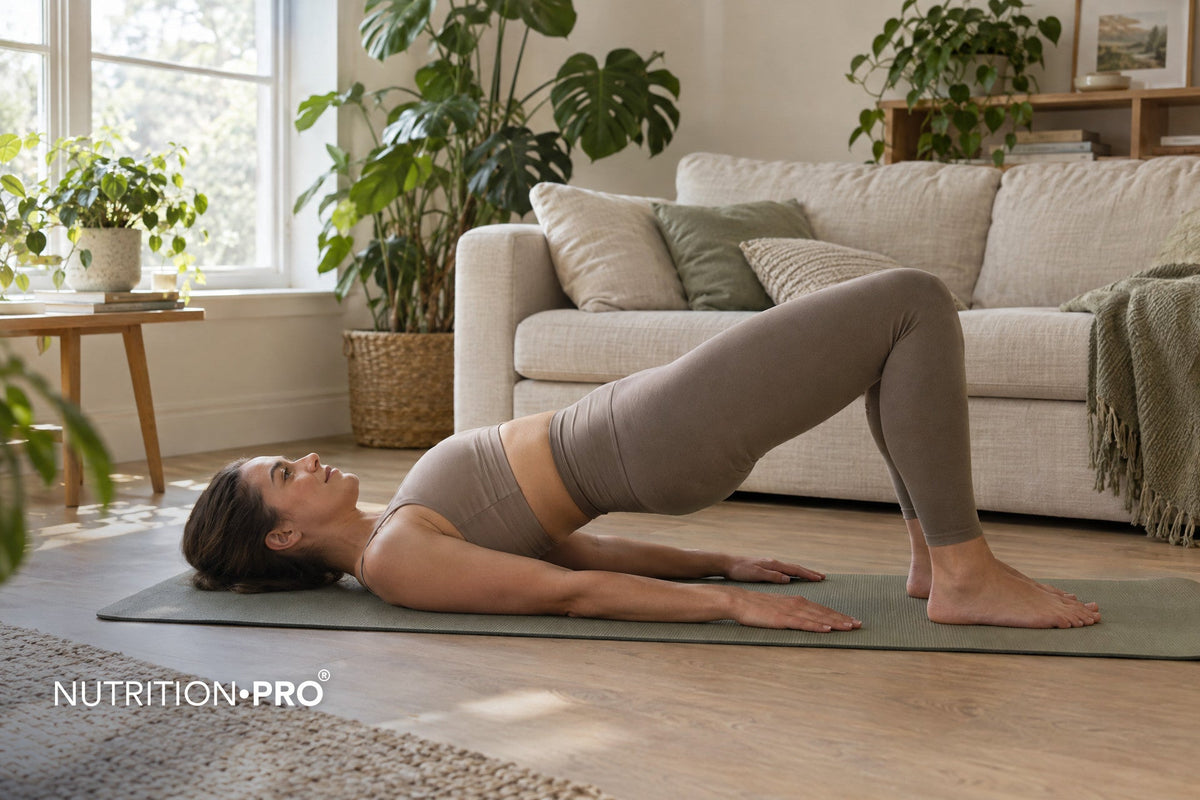
A mat, thirty minutes and a corner of your living room are all you need for mat Pilates. And practicing at home holds up: in a trial of 40 sedentary women, adherence to classes followed via video conference from home reached 80%, compared to 74% for the same classes in a studio, with progress showing no significant difference between the two groups in core stability, abdominals, balance and flexibility.
This guide brings together what studies identified via PubMed show, details basic exercises step by step with their common mistakes and simplified versions, then proposes a typical 30-minute session and an 8-week program.

What studies show : in beginners, 6 to 12 weeks of mat Pilates, 2 to 3 times per week, improved abdominal endurance and flexibility, and online classes produced progress with no significant difference from studio classes in a small 8-week trial. Experienced practitioners activate the deep trunk muscles more: 62% of their maximum in practitioners, 32% in novices. Trials remain small.
In practice : learn lateral breathing, then about ten exercises in simplified version, three times 30 minutes per week, adding 2 repetitions every two weeks. Wall Pilates has not yet been evaluated as a program, and Pilates performs no better than other exercises on waist circumference.
- Starting Pilates: what studies show
- At home, online or in studio
- Deep muscles at work
- Breathing and positioning: the basics
- Exercises on your back, step by step
- On your belly, on your side and in plank position
- Wall Pilates: what we know about it
- Abs and core stability
- Duration, frequency and typical 30-minute session
- Painful back, osteoporosis, pregnancy: precautions
- Joints and recovery: collagen
- The 8-week program
- Frequently Asked Questions
Starting Pilates: What the Research Shows
In a randomized 12-week trial, 25 of 50 moderately active middle-aged adults, randomly selected, completed two one-hour classes per week following a basic routine of approximately 25 floor exercises: compared to the control group, they improved abdominal endurance, hamstring flexibility and upper body endurance, but neither their posture nor their balance. In 9 novices, 8 weeks of three one-hour sessions added 14 partial sit-ups and 7.5 cm to the sit-and-reach test, and reduced 2.7 cm from waist circumference, in a non-randomized study with tiny sample size, compared to 13 active controls, where the Pilates group started lower in sit-ups.
Breathing also improves. In 62 sedentary or lightly active women aged 18 to 44, 16 sessions increased the strength of inspiratory muscles and the volume of air with each breath, compared to the control group. A study without a control group, in 16 sedentary women, found after 8 weeks stronger respiratory muscles and thicker transverse and oblique muscles on ultrasound.
On a larger scale, a synthesis of 12 studies in adult women, of which 7 (279 participants) measured flexibility, found improved flexibility, with an effect size of 0.69, between medium and large: by convention, 0.2 corresponds to a small effect, 0.5 to a medium effect and 0.8 to a large effect.
Most trials involve a few dozen participants, often women, followed for 6 to 12 weeks. Their results are consistent, but the quality of evidence is often judged to be weak: read the figures in this guide with this caveat.
At home, online or in studio
Practicing at home eliminates travel time and fixed schedules. For healthy adults, two small trials show that you can also progress with an instructor via video conferencing.
In 40 sedentary women aged 20 to 45, the same Pilates mat program, twice 45 minutes per week for 8 weeks, was followed either via video conference from home or in studio. Adherence reached 80% at home and 74% in studio, and both groups progressed, with no significant difference between them (similar effect sizes except for balance), in planks, sit-ups, knee push-ups, single-leg balance and flexibility. The gain in sit-ups was substantial, that of planks was minimal. The trial had fewer participants than planned.
Lazarowitz Zanzuri C, Hadas D, Hutzler Y, et al. Healthcare (Basel) 2024;12(7):724. DOI: 10.3390/healthcare12070724
In 33 young adults, 6 weeks of online Pilates with a physical therapist, three hours per week, improved all trunk endurance tests, with no change in the control group. In 80 people with multiple sclerosis, a DVD program, twice weekly for 8 weeks, reduced fatigue and depressive symptoms with no reported adverse effects; participants progressed from 4 to 10 repetitions per exercise, 2 more every two weeks, a progression that our program follows.
The difficulty at home remains adherence: a review of 7 studies in adults averaging 50 years or older with chronic musculoskeletal conditions found good adherence to group classes, but poor adherence to home exercises. Schedule your sessions like appointments, or follow a live class.
Plan for a space of approximately two meters by one meter and a non-slip mat. A thin non-slip mat, like our NUTRITION•PRO Pilates Mat 3 mm in microsuede over rubber, remains stable during weight-bearing and prioritizes movement precision. With a video, a mirror placed to the side becomes your correction tool.
Deep muscles at work
Electromyography measures the electrical activity of a muscle, as a percentage of its maximal contraction, and ultrasound measures its thickening. These studies, involving a few dozen volunteers, describe one exercise, not its long-term effects.
Asked to draw in their lower abdomen for 12 seconds targeting half their maximal contraction, 10 Pilates practitioners activated the transverse and internal oblique at 62% of their maximum, compared to 32% for 13 inexperienced people, who did not reach the target and varied more from trial to trial. Practitioners also engaged their lower back muscles, at 52% compared to 12%.
Barbosa AC, Vieira ER, Silva AF, et al. J Bodyw Mov Ther 2018;22(2):467-470. DOI: 10.1016/j.jbmt.2017.05.002
In 19 women who had never practiced, a trunk flexion with Pilates breathing activated the transverse and internal oblique more than with normal breathing. In a plank with one leg lifted, in 20 women, gently drawing the navel toward the spine brought the activity of these muscles, on the side of the lifted leg, to 58% of their maximum, compared to 43% when contracting the entire abdominal wall and 27% with no instruction; contracting the entire wall however better limited pelvic rotation (2.2 degrees, compared to 3.8 and 6.5).
In 44 practitioners, transverse thickening followed a clear order: dead bug (on back, arms extended to ceiling, hips and knees at 90 degrees, position held by drawing in the belly), then side plank, bridge, hundred and starting position, with the authors proposing the last two for warm-up and beginners. In 17 novices, four dynamic Pilates exercises, including double leg stretch and criss-cross, activated the rectus abdominis more than sit-ups and crunches. And in 16 women, teaser and long spine on mat required more from the rectus abdominis than on apparatus: mat work is nothing like a second-rate option.
| Measured Performance | What sensors show | Study |
|---|---|---|
| Drawing in the lower abdomen, beginners and advanced practitioners | 62% of maximum transverse and internal oblique in advanced practitioners, 32% in beginners | Barbosa, 2018 |
| Pilates breathing during trunk flexion | Transverse and internal oblique more active than in normal breathing | Barbosa, 2015 |
| Plank with leg raised, three cues | 58% when drawing in the navel, 43% when contracting the entire wall, 27% without cue | Jung and Oh, 2022 |
| Five floor exercises, ultrasound | Dead bug, then side plank, bridge, hundred and base position | Tsartsapakis, 2023 |
| Pilates abdominals versus crunches | Rectus abdominis more active for four dynamic Pilates exercises | Silva, 2015 |
Breathing and alignment: the fundamentals
The cues in this section and the following two are practical advice from Pilates instruction, not study results.
Lateral breathing. Hands on the lower ribs, inhale through your nose while spreading the ribs to the sides, without lifting the shoulders or puffing out the belly, then exhale through your mouth while letting the ribs close and the lower abdomen draw in, 8 to 10 times. Common mistake: forcing the exhale until the neck tenses. Easier version: a scarf tied around the ribs, to push against during inhalation.
Neutral pelvis and imprint. Lying down, knees bent, feet hip-width apart, maintain a small natural curve under the lower back for floor exercises. Legs in the air, bring the lower back slightly closer to the mat while exhaling, without tucking the glutes: this landmark prevents the back from arching when the legs move away.
The center and tempo. With each exhale, gently draw the navel toward the spine, without holding your breath, especially if you have high blood pressure. Prefer 5 slow and precise repetitions to 10 rushed ones: if a movement forces you to build momentum or hold your breath, return to its easier version.
Exercises on your back, step by step
1. The hundred (hundred). Lying down, legs in table position, knees above hips, curl your head and upper back up to the tip of your shoulder blades, gaze toward your knees. Arms extended near the floor, pulse your arms with small movements, inhaling for 5 pulses and exhaling for 5, up to 100. Common mistakes: pulling on the neck, belly puffing out, shoulders raised. Easier version: feet on the floor, head resting, 50 pulses. Progression: legs extended toward the ceiling, then slightly lower.
2. The roll-up (roll-up). Lying down, legs extended, arms above your head. Exhale while lifting your head, shoulders and back vertebra by vertebra until sitting up, stretch yourself out over your legs, then slowly unroll. Common mistakes: using momentum with your arms, letting your feet lift off, collapsing back in one piece. Easier version: sitting with knees bent, hands behind the thighs, unroll halfway then roll back up.
3. Single leg circles (single leg circle). Lying down, one leg extended toward the ceiling, the other on the floor, draw 5 circles the size of a ball in each direction, without moving the pelvis. Common mistakes: circles too large, pelvis rolling, supporting leg lifting off. Easier version: supporting leg bent, foot on the floor, and raised leg slightly bent.
4. Single leg stretch (single leg stretch). Head and shoulders curled as for the hundred, bring one knee toward your chest while extending the other leg diagonally, and alternate legs with each exhale. Common mistakes: extended leg so low that the back arches, neck pulled. Easier version: head resting and extended leg higher, toward the ceiling.
5. The bridge (shoulder bridge). Lying down, knees bent, exhale while tucking your pelvis and lifting your back up to your shoulder blades, then lower yourself vertebra by vertebra. Common mistakes: arching at the top, pushing on the neck, knees splaying outward. Easier version: a simple pelvic tilt. Progression: one leg extended at the top of the bridge. In a study of 60 women with or without chronic lower back pain, the bridge on the mat engaged the gluteus maximus more than two machine exercises, and pain increased less after floor exercises.
On the belly, on the side, and in supported positions
6. Swimming (swimming). Lying face down, arms and legs extended, lift them slightly and alternate small kicks, right arm and left leg then the reverse, inhaling over 5 beats and exhaling over 5. Common mistakes: lifting the head, excessive arching, bending the knees. Easier version: on all fours, slowly extend one arm and the opposite leg, hold for 3 seconds, then switch.
7. Side kicks (side kick). Lying on your side, body aligned, lift your top leg to hip height and swing it forward in two small beats, then backward, without rolling your pelvis, 8 times per side. Common mistakes: pelvis rolling, waist sagging, back arching backward. Easier version: bottom leg bent and simple lifts of the top leg.
8. Spine stretch forward (spine stretch forward). Sitting, legs apart, feet flexed, arms extended in front, exhale while rolling your spine forward, head first, as if over a large ball, then unroll. Common mistakes: shifting from the hips with a flat back, raising the shoulders. Easier version: knees slightly bent, or sitting on a folded towel.
9. The saw (saw). Same position, arms open in a cross, rotate your torso toward the right leg, then exhale while reaching the outside of your right foot with your left hand, pinky finger forward as if sawing, while the right arm extends backward. Return to center, then switch sides. Common mistakes: lifting the opposite buttock, rounding without rotating. Easier version: knees bent and reduced range of motion.
10. The plank and its variations. On your forearms and the tips of your toes, body aligned, core engaged, breathe while holding for 15 to 30 seconds. Common mistakes: buttocks too high, pelvis sagging, holding your breath. Easier version: knees on the ground, or hands on a chair. The contact points should not slip: the non-slip rubber base of our Pilates mat anchors each posture to the ground. To progress: the side plank, knee on the ground first, second for the transverse in the ultrasound study, then plank with one leg lifted.
Wall Pilates: what we know about it
Wall Pilates uses the wall as a support, alignment guide, or resistance: bridge with feet against the wall, rolling standing with back against the wall, wall chair, wall push-ups. It should not be confused with the Wall Unit, a spring-loaded Pilates apparatus mounted on the wall.
We found no trials in PubMed evaluating a wall Pilates program. The only measurement of a Pilates exercise on a wall support we found concerns the teaser performed on the Wall Unit, in 15 practitioners: the four trunk and hip muscles measured worked less than on the reformer, and three of them less than on the mat. On this apparatus, the teaser was therefore less demanding; the study says nothing about a bare wall.
The wall chair, common in these sessions, was studied in another context: in a network meta-analysis of 270 randomized trials and 15,827 participants, isometric training lowered resting blood pressure by 8.24 mmHg for systolic and 4.00 mmHg for diastolic, with the wall chair ranking first for systolic. Our guide on blood pressure after 60 details the role of exercise.
In practice, the wall helps you feel spinal alignment and eases the plank and push-ups; breathe without holding during holds. Without trials, its benefits remain those of the exercises that comprise it.
Abs and core strength
Abdominal endurance is the most consistent effect in trials among beginners: it improved in the 25 practitioners in the 12-week trial and the 9 novices mentioned above, and in the video conference trial the gain in crunches was significant while plank improvement remained weak. The study without a control group in 16 sedentary women measured a thicker transverse after 8 weeks.
Silhouette changes less. A meta-analysis of 10 studies finds Pilates on the mat not superior to other exercises, or no training, on body mass index, lean mass, body fat percentage, and waist circumference; the synthesis in women cited above found a weight loss, with no significant effect on waist circumference. A flatter belly comes from fat loss: our articles on flat belly and on visible abs detail what works.
Pilates' advantage remains its progression, from easier versions to long levers and planks. After pregnancy, separation of the rectus abdominis muscles or urinary leaks warrant an assessment with a midwife or physical therapist before resuming rolling exercises like the hundred or roll-ups.
Duration, frequency, and typical 30-minute session
The World Health Organization recommends all adults do strength training at least 2 days per week, plus 150 to 300 minutes of moderate-intensity endurance, and older adults activities combining balance and strength at least 3 days per week. Pilates covers mainly strength training; for endurance, walking is the simplest complement, as detailed in our guide on daily step count.
Trials in beginners used 2 to 3 sessions of 45 to 60 minutes per week. For cardiorespiratory fitness, a meta-analysis of 12 trials with low to very low quality evidence measures a large effect (effect size of 0.96), on the mat as on equipment, from 1,440 cumulative minutes, or 2 one-hour sessions per week for 3 months.
Progression matters as much as frequency. In people with back pain, a gentle version of Pilates gave results very similar to an intense version, with fewer side effects: it is better to gradually add repetitions than to force from the start. The initial muscle soreness decreased over weeks in the video conference trial; our guide on muscle soreness details how to manage them.
Painful back, osteoporosis, pregnancy: precautions
Back pain. A Cochrane review of 10 trials and 510 participants found Pilates more effective than minimal care for pain, by 14 points on a 100-point scale in the short term (low-quality evidence), with no demonstrated superiority over other exercises. A network meta-analysis of 217 trials ranks it among the most effective exercises, along with the McKenzie method, while noting that the exercise you enjoy remains the best way to stick with it. First, get a diagnosis established.
In 168 adults aged 18 to 60 suffering from chronic low back pain, one hour of supervised Pilates twice weekly for 6 weeks had very similar effects on pain and disability, at both high and low intensity. Adverse effects were less frequent at low intensity (absolute risk reduction of 20 points): the authors recommend the gentle version.
Coelho ACS, Dourado JF, Lima POP. J Physiother 2025;71(2):100-107. DOI: 10.1016/j.jphys.2025.03.002
Osteoporosis. The 2022 British consensus recommends that people with osteoporosis engage in muscle strengthening, adapted impact activities, and back extension exercises, and for safety, avoid postures with marked spinal flexion, both during exercise and in daily life. The roll-up, the hundred with head lifted, spine stretch, and saw should therefore be validated by a physiotherapist, especially after a vertebral fracture; swimming, bridge, and plank adapt more easily.
Pregnancy. In the absence of complications or contraindications, physical activity during pregnancy is safe and desirable according to the American College of Obstetricians and Gynecologists, which specifies that certain adaptations may be necessary as the body changes. This program is not designed for pregnancy: have it adapted by your midwife, doctor, or trained professional, and likewise after childbirth.
Back pain radiating down the leg, tingling or loss of strength, pain waking you at night, fever or unexplained weight loss: consult before resuming any activity. During the session, stop in case of sharp pain, dizziness, unusual breathlessness, or chest pain.
Joints and recovery: collagen
Collagen, a structural protein of tendons, ligaments, and cartilage, has been tested with training in several placebo-controlled trials, but never with Pilates: we found no trials combining the two in PubMed.
In 147 university athletes suffering from effort-related joint pain, without joint disease, 10 g daily of collagen hydrolysate as a drink for 24 weeks reduced pain more than placebo on six criteria, including pain while walking (−1.11 points versus −0.46) and carrying objects (−1.45 versus −0.83). The difference was more marked in the 63 athletes suffering from knee pain. Only data from 97 participants could be analyzed.
Clark KL, Sebastianelli W, Flechsenhar KR, et al. Curr Med Res Opin 2008;24(5):1485-1496. DOI: 10.1185/030079908x291967
In this trial, athletes took 10 g per day of a specific collagen hydrolysate (CH-Alpha) as a beverage; our Marine collagen powder provides 10 g of type 1 marine collagen Naticol® per daily dose. The quantity is the same, but the collagen differs, and our formula was not tested in these studies.

In 180 active adults aged 18 to 30 experiencing knee discomfort during exercise, 5 g per day of specific collagen peptides for 12 weeks reduced this pain by 21.9 mm on a visual scale, compared to 15.6 mm with placebo. Our Marine collagen to drink provides 5 g of Naticol® marine collagen per 25 ml shot: the same quantity, again with a different collagen than the one used in the trial.
In 77 non-menopausal women beginning strength training, 12 weeks at three sessions per week with 15 g per day of specific collagen peptides added 1.0 kg of lean mass compared to 0.4 kg with placebo and removed 1.5 kg of fat mass compared to 0.7 kg, with no difference in leg strength. In 59 active women combining endurance and strength training, the same dose added 0.8 kg of lean mass compared to 0.3 kg, with no difference in strength or muscular endurance.
| Population | Dose and duration | Result versus placebo |
|---|---|---|
| 147 athletes with exercise-related joint pain | 10 g per day, 24 weeks | Pain reduced on six criteria, 97 participants analyzed |
| 180 active adults experiencing knee discomfort | 5 g per day, 12 weeks | Exercise-related pain: −21.9 mm versus −15.6 mm |
| 77 women beginning strength training | 15 g per day, 12 weeks | Lean mass: +1.0 kg versus +0.4 kg |
| 59 active women, endurance and strength training | 15 g per day, 12 weeks | Lean mass: +0.8 kg versus +0.3 kg |
These trials used gym training and 15 g per day of a different collagen than ours: they suggest a slight bonus on lean mass, without replacing training. See our article on collagen and joints and our guide to daily dosage of marine collagen. During pregnancy or breastfeeding, consult a healthcare professional before using our collagen powder; our drinkable collagen is not recommended during these periods.
The 8-week program
This program follows the parameters of the cited trials: 3 sessions per week, totaling 90 minutes as in the video conference trial, exercises that are initially easier, then 2 additional repetitions every two weeks, as in the DVD trial. It is designed for a healthy adult who is just starting out.
At this pace, the 1,440 minute threshold associated with an effect on cardiorespiratory fitness is reached around the sixteenth week. Continue with intermediate exercises or 45-minute sessions, and retest every 4 weeks.
A soft and absorbent microsuede on a non-slip rubber base, 61 x 173 cm for 3 mm thickness: a thin and stable mat, designed for Pilates, yoga, mobility and meditation, that rolls up in one motion to move from the living room to the studio.
See the Pilates MatOur Marine collagen powder provides 10 g of Naticol® marine collagen per day, as much as the hydrolysate tested in athletes, with a different collagen.
Frequently asked questions
What Pilates exercises should beginners do?
Lateral breathing and pelvic positioning, then about ten basic exercises in an easier version: the hundred with feet on the ground, the roll-up halfway, leg circles, single leg stretch, bridge, swimming on all fours, side kicks, spine stretch, saw and plank with knees on the ground.
Can you do Pilates at home without an instructor?
The trials tested live classes with an instructor via videoconference, not solo practice: in 40 sedentary women, they showed progress with no significant difference from the studio, with 80% adherence. A mirror and easier versions compensate for the lack of correction; in case of pain or pathology, prefer professional supervision.
How many times a week should beginners do Pilates?
Two to three times a week, as in most trials with beginners. The World Health Organization recommends muscle strengthening at least 2 days a week. At first, leave one rest day between two sessions and walk on the other days.
How long should a beginner Pilates session last?
The trials used 45 to 60 minute sessions. Three 30-minute sessions per week equals 90 minutes, the same as two 45-minute classes from an 8-week trial: however, this breakdown was not compared in the trials.
After how long do you see the effects of Pilates?
Progress in abdominal endurance, core stability and flexibility were measured after 6 to 12 weeks, at 2 or 3 sessions per week. Cardiorespiratory fitness requires approximately 3 months at 2 one-hour sessions per week, according to a meta-analysis with low quality evidence.
Is Wall Pilates effective?
No trial has yet evaluated a wall Pilates program. On a spring device fixed to the wall, the Wall Unit, the teaser engaged three of the four measured muscles less than on the floor, which does not provide information about the bare wall. The chair against the wall, studied separately, lowers blood pressure in isometric training trials.
Does Pilates tone the abs?
It primarily improves their endurance: several trials in beginners measure more sit-ups after 8 to 12 weeks, and the criss-cross activates the rectus abdominis more than the crunch. For a flatter stomach, Pilates performs no better than other exercises on waist circumference: fat mass loss remains essential.
Are online Pilates classes as effective as studio classes?
In healthy adults, the data points in that direction: in an 8-week trial, improvements in core stability, abdominals, balance and flexibility did not differ significantly between videoconference and studio, with adherence of 80% versus 74%.
Which mat should you choose for home Pilates?
A non-slip mat, long enough to lie on, thin enough to remain stable in weight-bearing positions and soft enough for floor work. The Nutrition•pro NP Pilates Mat measures 61 x 173 cm for 3 mm thickness, in microsuede on a non-slip rubber base.
Can you do Pilates with back pain?
Often yes, after medical advice: in chronic lower back pain, Pilates is among the most effective exercises for pain and disability, and a gentle version produced results very similar to an intense version, with fewer adverse effects. Pain radiating down the leg requires medical consultation.
Is Pilates recommended for osteoporosis?
Strengthening, balance and back extension are recommended, but the British consensus advises avoiding postures with strong spinal flexion: the roll-up, the hundred with head raised, spinal stretch and the saw should be validated by a physical therapist.
Sources
The studies cited below were identified via PubMed.
- Kloubec JA. Pilates for improving muscle endurance, flexibility, balance and posture. Journal of Strength and Conditioning Research, 2010;24(3):661-667. DOI
- Rogers K, Gibson AL. Effects of an eight-week traditional mat Pilates program on adult fitness. Research Quarterly for Exercise and Sport, 2009;80(3):569-574. DOI
- Vieira KJV, Carvalho LC, Borges JBC, et al. The respiratory effects of a Pilates method protocol: a randomized clinical trial. Journal of Bodywork and Movement Therapies, 2022;32:149-155. DOI
- Giacomini MB, da Silva AM, Weber LM, Monteiro MB. The Pilates method increases strength and performance of respiratory muscles as well as the thickness of abdominal muscles. Journal of Bodywork and Movement Therapies, 2016;20(2):258-264. DOI
- Bajčetić Č, Rudović V, Novaković M, et al. Effects of Pilates programs on body composition, flexibility, muscle strength, balance, functional performance and respiratory function in adult women: systematic review and meta-analysis. Sports (Basel), 2026;14(9):407. DOI
- Lazarowitz Zanzuri C, Hadas D, Hutzler Y, et al. Remote Pilates training improves fitness in healthy women: a randomized controlled trial. Healthcare (Basel), 2024;12(7):724. DOI
- Suner-Keklik S, Numanoglu-Akbas A, Cobanoglu G, et al. An online Pilates program improves proprioception and trunk muscle endurance: a randomized controlled trial. Irish Journal of Medical Science, 2022;191(5):2133-2139. DOI
- Fleming KM, Coote SB, Herring MP. Home-based Pilates against anxiety, depression, and fatigue symptoms in people with multiple sclerosis: an 8-week randomized controlled trial. Multiple Sclerosis Journal, 2021;27(14):2267-2279. DOI
- Denham-Jones L, Gaskell L, Spence N, Pigott T. Systematic review of the effectiveness of Pilates on pain, disability, physical function and quality of life in older people with chronic musculoskeletal conditions. Musculoskeletal Care, 2022;20(1):10-30. DOI
- Barbosa AC, Vieira ER, Silva AF, et al. Pilates experience and muscle activation during abdominal hollowing maneuver. Journal of Bodywork and Movement Therapies, 2018;22(2):467-470. DOI
- Barbosa AW, Guedes CA, Bonifácio DN, et al. Pilates breathing technique increases electromyographic amplitude of deep abdominal muscles in untrained individuals. Journal of Bodywork and Movement Therapies, 2015;19(1):57-61. DOI
- Jung EJ, Oh JS. Effects of abdominal hollowing and bracing maneuvers on trunk muscle activity and pelvic rotation angle during Pilates leg pull front exercise. Healthcare (Basel), 2022;11(1):60. DOI
- Tsartsapakis I, Gerou M, Zafeiroudi A, Kellis E. Ultrasound thickness of transversus abdominis during common Pilates exercises in young and middle-aged women. Journal of Functional Morphology and Kinesiology, 2023;8(3):110. DOI
- Silva GB, Morgan MM, Gomes de Carvalho WR, et al. Electromyographic activity of rectus abdominis during dynamic abdominal Pilates exercises. Journal of Bodywork and Movement Therapies, 2015;19(4):629-635. DOI
- Dias JM, Menacho MO, Mazuquin BF, et al. Comparison of electromyographic activity of the anterior trunk during two Pilates exercises, the teaser and longspine, in healthy individuals. Journal of Electromyography and Kinesiology, 2014;24(5):689-697. DOI
- Oliveira NT, Freitas SM, Fuhro FF, et al. Muscle activation during Pilates exercises in people with nonspecific chronic low back pain: a cross-sectional case-control study. Archives of Physical Medicine and Rehabilitation, 2017;98(1):88-95. DOI
- Werba DD, Cantergi D, Tolfo Franzoni L, et al. Electrical Activity of Core Muscles During the Teaser Exercise in Pilates on Different Types of Equipment. Perceptual and Motor Skills, 2017;124(2):452-461. DOI
- Edwards JJ, Deenmamode AHP, Griffiths M, et al. Physical Training and Resting Blood Pressure: A Large-Scale Pairwise and Network Meta-Analysis of Randomized Controlled Trials. British Journal of Sports Medicine, 2023;57(20):1317-1326. DOI
- Cavina APS, Pizzo Junior E, Machado AF, et al. Effects of the Pilates Method on Mat on Body Composition: Systematic Review with Meta-Analysis. Journal of Physical Activity and Health, 2020;17(6):673-681. DOI
- Bull FC, Al-Ansari SS, Biddle S, et al. 2020 WHO Guidelines on Physical Activity and Sedentary Behaviour. British Journal of Sports Medicine, 2020;54(24):1451-1462. DOI
- Pessôa RAG, de Oliveira LC, Vitor GBB, de Oliveira RG. Effects of Pilates Exercises on Cardiorespiratory Fitness: Systematic Review and Meta-Analysis. Complementary Therapies in Clinical Practice, 2023;52:101772. DOI
- Coelho ACS, Dourado JF, Lima POP. High or Low Intensity Pilates Has Similar Effects on Pain and Disability in Non-Specific Chronic Low Back Pain: A Randomized Trial. Journal of Physiotherapy, 2025;71(2):100-107. DOI
- Yamato TP, Maher CG, Saragiotto BT, et al. Pilates for Low Back Pain. Cochrane Database of Systematic Reviews, 2015;2015(7):CD010265. DOI
- Hayden JA, Ellis J, Ogilvie R, et al. Some Types of Exercise Are More Effective Than Others in Chronic Low Back Pain: A Network Meta-Analysis. Journal of Physiotherapy, 2021;67(4):252-262. DOI
- Brooke-Wavell K, Skelton DA, Barker KL, et al. Strong, Stable and Straight: British Consensus on Physical Activity and Exercise in Osteoporosis. British Journal of Sports Medicine, 2022;56(15):837-846. DOI
- American College of Obstetricians and Gynecologists. Physical Activity and Exercise During Pregnancy and the Postpartum Period: ACOG Committee Opinion Number 804. Obstetrics and Gynecology, 2020;135(4):e178-e188. DOI
- Clark KL, Sebastianelli W, Flechsenhar KR, et al. 24-week study on collagen hydrolysate as a dietary supplement in athletes with activity-related joint pain. Current Medical Research and Opinion, 2008;24(5):1485-1496. DOI
- Zdzieblik D, Brame J, Oesser S, et al. Influence of specific bioactive collagen peptides on knee discomfort in young physically active adults: a randomized controlled trial. Nutrients, 2021;13(2):523. DOI
- Jendricke P, Centner C, Zdzieblik D, et al. Specific collagen peptides combined with resistance training improve body composition and regional muscle strength in non-menopausal women: a randomized controlled trial. Nutrients, 2019;11(4):892. DOI
- Jendricke P, Kohl J, Centner C, et al. Influence of specific collagen peptides and combined training on cardiometabolic parameters and performance in women: a randomized controlled trial. Frontiers in Nutrition, 2020;7:580918. DOI


