

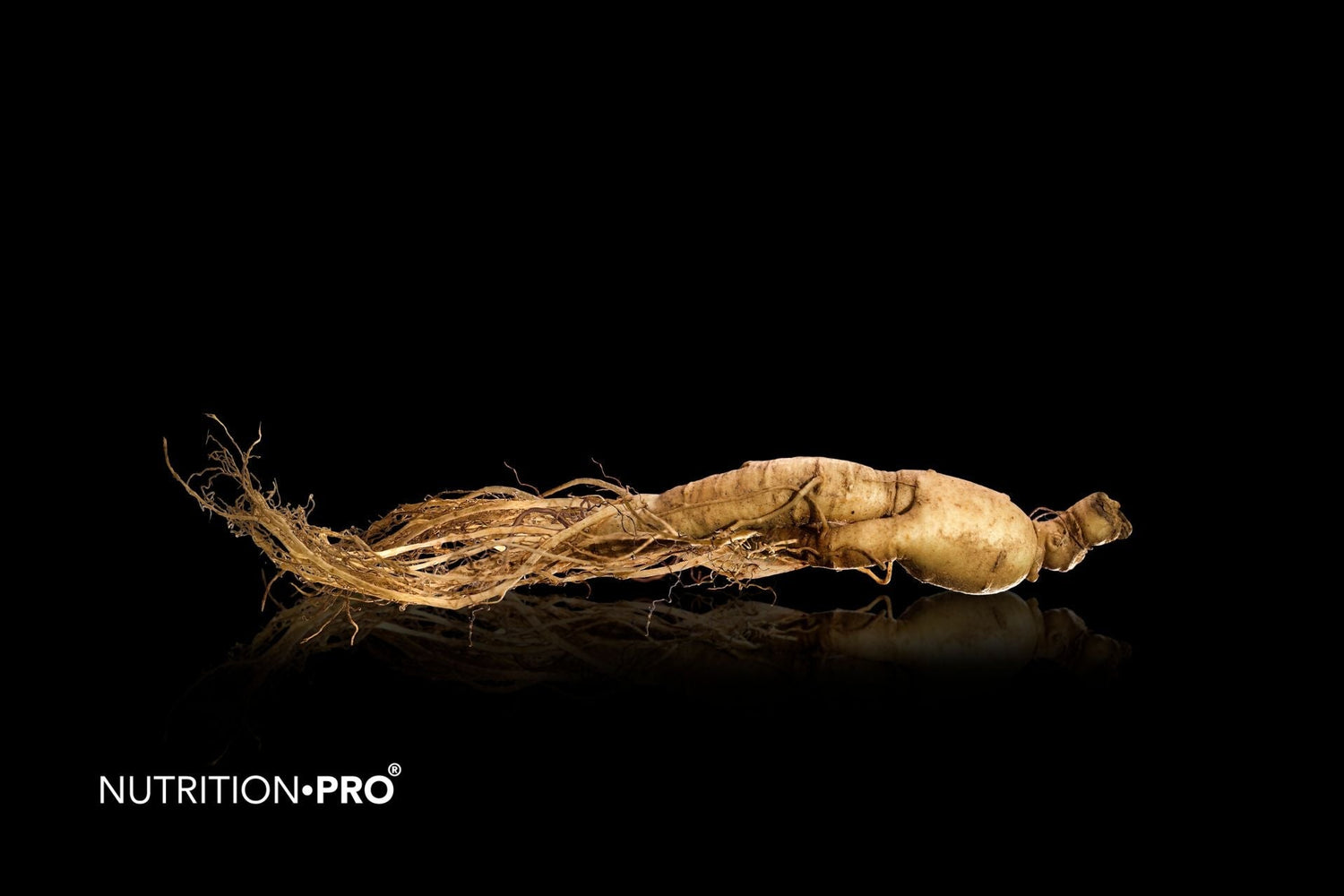
Red, white, American, powder or capsules: standing in front of the ginseng shelf, it's hard to find your way. Good news, these names mainly refer to the same root treated in different ways, and the right choice depends above all on your objective. Here's how to decide in just a few minutes, without the jargon.
This article is part of our ginseng dossier: for the complete picture (benefits, dosage, precautions), see our complete ginseng guide.

Panax ginseng root steamed and processed into 100% organic powder, freely dosed in a beverage or used in cooking.

The same organic red ginseng, in convenient capsules without the characteristic taste, for a simple and portable supplement course.
Red and white ginseng come from the same plant, Panax ginseng: white is simply dried, red is steamed then dried, which transforms its composition (57 ginsenosides identified, Maillard products, better stability; Wang, Am J Chin Med, 2024). Result: red is more invigorating and most studied for energy and vitality; white offers a gentler effect. American ginseng (Panax quinquefolius) is another species, more oriented toward concentration and serenity (Bell, Eur J Nutr, 2021). Between powder and capsules, it's all a matter of convenience: same ginseng, you choose. And watch out for false ginseng (eleuthero), which isn't real ginseng.
Red or White: What's the Difference?
First thing to understand: red ginseng and white ginseng are not two plants, but one single plant, Panax ginseng (Asian ginseng), prepared in two different ways. White ginseng corresponds to fresh roots simply air-dried after harvest. Red ginseng, on the other hand, is obtained by steam-cooking the roots under controlled conditions, before drying: it then takes on a reddish hue and a more pronounced taste (Wang, Am J Chin Med, 2024).
Why Red is Richer: The Cooking Process
That's the whole point of steaming: heat triggers chemical reactions that modify the root's profile.
Steam cooking transforms some of the ginsenosides into process-derived compounds (including Rg3), along with Maillard reaction products and improved stability. In total, 57 ginsenosides have been characterized in red ginseng, compared to a profile closer to the fresh root for white ginseng.
Wang CZ, et al. Am J Chin Med 2024;52(1):35-55. DOI: 10.1142/S0192415X24500022
The Rg3 is moreover presented as a characteristic constituent of red ginseng (Feng, Scientific Reports, 2024). However, an honest clarification is in order: more ginsenosides does not automatically mean more effective for all uses. Red is especially the most tonifying and the most studied (particularly for energy and male vitality), which makes it a solid choice, without disqualifying white.
Red vs White: The Comparison
| Criteria | Red Ginseng | White Ginseng |
|---|---|---|
| Plant | Panax ginseng | Panax ginseng (the same) |
| Processing | Steamed then dried | Air-dried |
| Composition | Modified profile, rare ginsenosides (Rg3) | Close to fresh root |
| Character | More invigorating | Gentler |
| Storage | Increased stability | More sensitive |
| Level of evidence | Most studied (energy, vitality) | Less specific data |
In powder or capsule form, a quality root, certified organic, to incorporate as a cure.
Discover red ginseng →What about American ginseng?
Alongside Asian ginseng, there is American ginseng (Panax quinquefolius), cultivated in North America. Tradition considers it more refreshing and calming, whereas Asian ginseng is rather warming and invigorating. On the research side, it has mainly been evaluated for cognition and mood : an American ginseng extract improved attention, working memory, and certain aspects of mood in young adults (Bell, Eur J Nutr, 2021). In short: for an energy boost, go for the Asian red; for concentration support without stimulation, the American makes sense.
Powder or capsules: which form?
Once the type is chosen, the form remains, and there is no universal right answer, only yours:
| Form | Benefits | Ideal if |
|---|---|---|
| Powder | Flexible dosage, for beverages or cooking, economical | You like to adjust doses and incorporate it into your preparations |
| Capsules | Convenient, tasteless, regular dosage, portable | You want simplicity and to avoid the characteristic taste |
Our red ginseng powder and our red ginseng capsules contain the same organic root: simply choose the format that fits best into your daily routine.
Which to choose based on your goal
To decide at a glance:
Choosing your ginseng well (quality)
Beyond red or white, quality makes all the difference. Three benchmarks:
First, the proper botanical name : only Panax ginseng (or Panax quinquefolius for American) is true ginseng.Eleuthero, sold under the name "Siberian ginseng," is not and does not contain ginsenosides. Next, a ginsenoside content indicated and a traceable origin : this is a guarantee of a standardized product, especially since adulterated products circulate and require specific methods to distinguish them (Wang, Am J Chin Med, 2024). Finally, a organic certification, which limits exposure to unwanted residues. Our complete guide details the dosage according to the form.
Precautions
Regardless of the type chosen, at high doses ginseng can cause insomnia or nervousness (morning intake recommended). It is not recommended during pregnancy and breastfeeding, and requires caution in cases ofhypertension, of coagulation disorders, or use ofanticoagulants orantidiabetic medications. If you are under treatment or have any doubt, consult a healthcare professional.
Frequently asked questions
What is the difference between red ginseng and white ginseng?
It's the same plant, Panax ginseng, but processed differently. White ginseng is simply air-dried after harvest; red ginseng is steamed then dried, which changes its color and composition (Wang, Am J Chin Med, 2024). Red is more invigorating and better preserved, white is closer to fresh root.
Is red ginseng better than white?
Not necessarily. Red is more concentrated in certain ginsenosides and more invigorating; it is the most studied for energy and male vitality. But a richer profile doesn't automatically mean superior for everything: white remains a good choice for a gentler effect. The best one is the one that matches your goal.
Why is red ginseng more concentrated?
Because steam cooking transforms some of the ginsenosides into rarer compounds (such as Rg3), creates Maillard reaction products, and improves stability. A phytochemistry review identified 57 ginsenosides in red ginseng (Wang, Am J Chin Med, 2024).
What is American ginseng?
It's a different species, Panax quinquefolius, cultivated in North America. Traditionally considered more calming than invigorating Asian ginseng, it has mainly been studied for cognition and mood (Bell, Eur J Nutr, 2021). Prefer it if you're seeking concentration and serenity rather than an energy boost.
Ginseng in powder or capsules: which to choose?
Both contain the same ginseng; it's a matter of convenience. Powder allows free dosing and use in drinks or cooking; capsules are convenient, without the characteristic taste, and easy to carry. Choose according to your lifestyle.
What is black ginseng?
Black ginseng is obtained by steaming ginseng (white or red) multiple times, which further concentrates certain compounds (Wang, Am J Chin Med, 2024). It's a rarer and more processed form, less common than red.
Which ginseng to choose for energy and fatigue?
Red ginseng is the most indicated: it is the most invigorating and the most studied for fatigue and vitality. See our dedicated article on ginseng and fatigue for details.
How to recognize quality ginseng?
Verify that it is indeed Panax ginseng (and not fake ginseng), a stated ginsenoside content, clear origin, and ideally organic certification. Standardization and traceability are the best indicators, as adulterated products exist (Wang, Am J Chin Med, 2024).
Is Siberian ginseng real ginseng?
No. Eleuthero, often called Siberian ginseng, is not a Panax and contains no ginsenosides. It's another adaptogenic plant, not to be confused with true ginseng (Panax ginseng).
What precautions should be taken with ginseng?
At high doses, ginseng may cause insomnia or nervousness. It is not recommended during pregnancy and breastfeeding and requires caution in cases of hypertension, blood clotting disorders, or when taking anticoagulants or antidiabetic medications. If you are undergoing treatment, consult a healthcare professional.
- Panax ginseng
- Asian ginseng, the plant from which red ginseng and white ginseng are derived.
- Red ginseng
- Panax ginseng root steamed and then dried, more concentrated and invigorating.
- White ginseng
- Panax ginseng root simply air-dried, closer to the fresh root.
- Ginsenosides
- Active compounds specific to ginseng, responsible for most of its effects.
- Rg3
- A rarer ginsenoside, formed notably during the steam-processing of red ginseng.
- Panax quinquefolius
- American ginseng, a distinct species, traditionally more calming.
- Eleuthero
- An adaptogenic plant incorrectly called "Siberian ginseng," without ginsenosides.
- Wang CZ, Zhang CF, Zhang QH, Yuan CS. Phytochemistry of red ginseng, a steam-processed Asian ginseng. Am J Chin Med 2024;52(1):35-55. DOI: 10.1142/S0192415X24500022
- Feng F, Ko HA, Truong TMT, et al. Ginsenoside Rg3, enriched in red ginseng extract, improves lipopolysaccharide-induced suppression of adipose thermogenesis. Sci Rep 2024;14(1):9157. DOI: 10.1038/s41598-024-59758-1
- Bell L, Whyte A, Duysburgh C, et al. American ginseng (Cereboost) on mood and cognition in healthy young adults: a randomized, placebo-controlled trial. Eur J Nutr 2021;61(1):413-428. DOI: 10.1007/s00394-021-02654-5


