

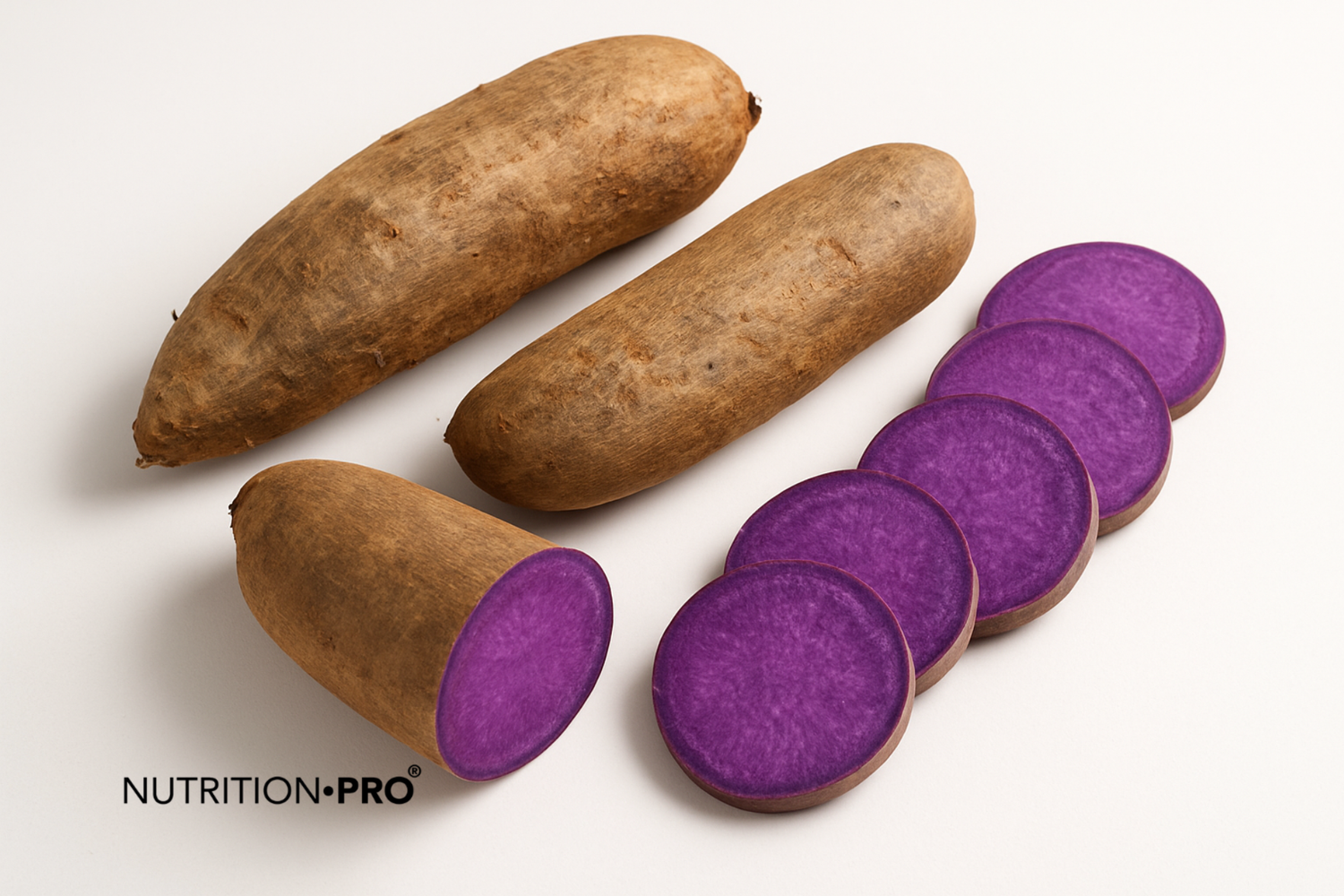
It's everywhere: in smoothies, in vividly purple pastries, in colorful plant-based milks. Ube, or purple yam, has gone from traditional Filipino ingredient to global phenomenon. But behind that spectacular color, what is genuinely interesting from a nutritional standpoint, and what is simply hype?
In this complete guide, we separate the trend from the facts. You'll find out what ube really is, how to tell it apart from taro and purple sweet potato, what the science says about its anthocyanins, its true nutritional profile, its effects on digestion and satiety, and how to choose and enjoy it, particularly in powder form. A colorful superfood, yes, but explained honestly and backed by sources.

All the color and anthocyanins of ube in an easy-to-measure format. One spoonful in a smoothie, a yogurt or a cake batter, and your creations take on a natural purple hue, with no food coloring.
Ube (Dioscorea alata) is a purple yam from Southeast Asia and an icon of Filipino cuisine. Its deep purple color comes from its anthocyanins, antioxidant pigments: according to PubMed, their antioxidant activity has been confirmed in ube (Moriya 2015), and a meta-analysis links dietary anthocyanins to a lower cardiovascular risk (Kimble 2018). It should not be confused with taro (white flesh, neutral taste) or purple sweet potato (a different species). Nutritionally, it is a colorful starchy food that provides carbohydrates, fiber and a little potassium. Its fiber supports digestion (Barber 2020). You can cook with it or, more simply, use it as a powder. It is neither a weight-loss product nor a medicine: it is a good food to include in a varied diet.
- What is ube?
- Ube, taro, purple sweet potato: telling them apart
- Where does ube come from? History and rise to fame
- The real nutritional profile of ube
- Anthocyanins, ube's real treasure
- What the science says about its benefits
- Ube, fiber and digestion
- Ube, carbohydrates and blood sugar: the caveat
- How to eat ube
- How to choose a good ube powder
- Precautions and proper use
- Frequently asked questions
1. What is ube?
Ube (sometimes spelled ubé in French) is a tuber of the species Dioscorea alata, known in English as purple yam. What sets it apart at first glance is its intense purple color, ranging from lavender to deep violet, which comes from its high content of anthocyanins, natural pigments in the flavonoid family. Once cooked, it develops a melt-in-the-mouth texture and a gentle, mildly sweet, vanilla-like flavor, very different from an ordinary yam, which is mealier and blander.
This natural sweetness is one of the keys to its success: it makes it possible to create delicious desserts while keeping added sugar down. Long eaten as a staple in tropical regions, ube is now being rediscovered in the West as a superfood, as much for its photogenic color as for its nutritional profile. It is now available as a purée, but above all as a powder, a practical format that lets you enjoy it without having to track down the fresh tuber, which is rare in Europe.
Still, a sense of proportion is needed from the outset: ube is an interesting food, not a magic potion. Its nutritional value is real, but it belongs within a balanced diet, not on the shelf of remedies. That is exactly what we are going to look at, point by point, drawing on the available scientific data.
2. Ube, taro, purple sweet potato: telling them apart
The mix-up is common, because these three tubers look alike and are often sold or cooked interchangeably. Yet they share neither the same botany, nor the same taste, nor the same profile. Here is how to tell them apart clearly.
Ube (Dioscorea alata)
The true purple yam of Asia.
Naturally purple flesh, a mildly sweet, vanilla-like taste and plenty of anthocyanins. This is the one that colors Filipino desserts and trendy creations. A star of healthy baking, it is the subject of this article.
Purple sweet potato (Okinawa)
Ipomoea batatas, not a yam.
A completely different botanical family. Firmer flesh, an earthier and less sweet taste. Often mistaken for ube in Western recipes, but it is a different food with a different pigment profile.
Taro
White flesh, not purple.
Its flesh is white or gray and speckled, its taste neutral and starchy. It is high in starch but contains far fewer anthocyanins than ube. The purple tint of taro-based preparations often comes from added ingredients or from confusion with ube.
This distinction is not just a botanist's detail. If you are specifically after the anthocyanins and the natural purple color, ube is what you need, not taro (which isn't purple) and not necessarily purple sweet potato (whose pigments are different). This matters when choosing a powder: make sure it really is ube (Dioscorea alata), not a blend or a substitute.
3. Where does ube come from? History and rise to fame
Ube has been grown for a very long time in the Pacific islands and Southeast Asia, where it was a valuable staple that could thrive in tropical climates and keep well. But it is above all in the Philippines that it has gained emblematic, almost cultural status. There, it is at the heart of famous traditional desserts such as ube halaya (a thick purple yam jam cooked with milk and sugar), as well as cakes, breads, frozen desserts and the famous ube ice cream. This popularity, deeply rooted in everyday cooking, served as a springboard.
Its worldwide spread is more recent. With the rise of social media and the craze for colorful, natural foods, ube has won fans far beyond Asia. Its purple color, spectacular and impossible to reproduce faithfully with common natural colorings, has made it a star of Instagram and TikTok: purple lattes, smoothie bowls, layer cakes, donuts. Beyond the visual effect, its nutritional value, and its anthocyanins in particular, then caught the attention of nutrition enthusiasts and brands. To explore this fascinating story further, see our dedicated article on the origins of ube in the Philippines.
It is also worth pointing out why ube took off visually where other superfoods stayed under the radar: its color. Achieving such a pure, natural purple in the kitchen is rare, and almost impossible with standard natural colorings without it turning gray or blue. Ube delivers that shade with no artifice, which has made it a favorite of pastry chefs and content creators. This aesthetic side, often mocked, has one virtue: it has brought a genuinely nutritious food to a wide audience, where a green vegetable would struggle to go viral. What remains is to look past the image and understand what is really inside.
This journey, from ancestral food to global trend, partly explains the confusion surrounding it: between the marketing that presents it as a miracle cure and the reality of a nutritious but ordinary tuber, there is a gap that this article sets out to bridge. Let's now look at what it actually provides.
4. The real nutritional profile of ube
Let's be precise and honest, because many articles exaggerate. Ube is above all a starchy food: its main nutritional role is to supply complex carbohydrates, and therefore energy. On top of that come fiber that is useful for regularity, plus a little potassium and vitamin C. Here are the approximate figures per 100 g of cooked ube.
Nutritional profile of ube (per 100 g, cooked)
Indicative average values, which vary with variety, ripeness and cooking method.
What should you take from this table? That ube is comparable to other starchy roots such as sweet potato or ordinary yam: a good source of energy, a decent amount of fiber, a little potassium. It is not extraordinarily rich in vitamins (its vitamin C content, for example, is modest and drops with cooking). The marketing that turns it into a vitamin bomb is overstating things. The real point of interest is the anthocyanins, the pigments responsible for its color, which you won't find in an ordinary starchy food. This is where science offers something concrete, and it is the subject of the next two sections.
5. Anthocyanins, ube's real treasure
If ube deserves special attention, it is thanks to its anthocyanins. These compounds belong to the large flavonoid family, plant molecules studied for their antioxidant role. They are what color many fruits and vegetables red, purple and blue: blueberries, blackcurrants, red cabbage, black grapes and, of course, ube.
One feature of ube is worth noting: its anthocyanins are partly acylated, meaning they are bound to chemical groups that make them more stable, particularly to heat and light. This stability is an asset, because it helps the pigments hold up better during processing and cooking. That is precisely what researchers studied in ube from the Philippines.
Acylated anthocyanins were isolated from Philippine purple yam, and their antioxidant activity was assessed and confirmed using antioxidant capacity assays.
According to PubMed, Moriya C et al. 2015, Bioscience Biotechnology and Biochemistry (analysis of the pigments of Dioscorea alata). DOI: 10.1080/09168451.2015.1027652
To understand why antioxidants matter, a word about oxidative stress. Our bodies constantly produce free radicals, unstable molecules generated by cellular respiration, pollution, smoking or an unbalanced diet. In excess, they can damage cells. Antioxidants, anthocyanins among them, help neutralize these free radicals and maintain a balance. This is a general, well-established mechanism in biology, and it explains why antioxidant-rich foods attract so much interest. That said, having them on your plate is useful but in no way replaces a healthy lifestyle overall: no single antioxidant makes up for an unbalanced way of life.
In plain terms: ube's color is not just an aesthetic asset; it reflects the real presence of compounds whose antioxidant activity can be measured in the lab. What remains to be seen is what this means for health, and this is where we need to be rigorous about what the science does, and does not, allow us to say.
6. What the science says about its benefits
Let's stay rigorous, because that is what separates reliable information from a marketing promise. What has mainly been studied is anthocyanins as a family of compounds, not ube specifically in clinical trials. Two levels of evidence coexist, and they need to be told apart.
First level: ube does contain active anthocyanins, as we have just seen (Moriya 2015). Second, broader level: what do we know about the effect of dietary anthocyanins on long-term health? A meta-analysis of cohort studies offers a measured perspective.
A higher dietary intake of anthocyanins is associated with a reduced risk of coronary heart disease and cardiovascular mortality, with no significant association observed for stroke or myocardial infarction taken separately.
According to PubMed, Kimble R et al. 2018, Critical Reviews in Food Science and Nutrition (meta-analysis of prospective cohort studies). DOI: 10.1080/10408398.2018.1509835
The distinction is crucial: this is an observed association for dietary anthocyanins in general, not proof that eating ube protects the heart. Ube is one worthwhile source of anthocyanins among others. So we cannot say that ube “prevents cardiovascular disease”: that would be a misleading claim. What we can honestly say is that ube provides anthocyanins, and that dietary anthocyanins show favorable associations in epidemiological research.
Finally, a third study confirms ube's value as a source of antioxidants in processed foods. According to PubMed, researchers showed that replacing part of the wheat flour with ube flour increases the anthocyanin content, the phenolic compound content and the antioxidant capacity of the resulting bread (Tamaroh 2021, DOI: 10.1155/2021/5586316). In other words, ube can enrich a recipe with antioxidants, which is consistent with its profile. Here again, these are laboratory measurements on the food itself, not a health effect demonstrated in humans.
7. Ube, fiber and digestion
Beyond anthocyanins, ube provides dietary fiber (around 4 g per 100 g cooked), both soluble and insoluble. And fiber is one of the best-documented pillars of a healthy diet. A landmark review takes stock of the evidence.
Dietary fiber intake is associated with overall metabolic health, notably through insulin sensitivity, and the gut microbiota acts as a mediator of fiber's beneficial effects, including appetite regulation.
According to PubMed, Barber TM et al. 2020, Nutrients (review of the benefits of dietary fiber). DOI: 10.3390/nu12103209
In practical terms, the fiber in ube supports regular bowel movements, feeds the gut microbiota (the good bacteria in the colon ferment it) and contributes to satiety, that feeling of fullness that helps you avoid eating beyond your hunger. It is a real asset, but one to keep in perspective: ube has no more fiber than a green vegetable, legumes or a fruit such as a pear. It contributes to your overall fiber intake without being an exceptional source on its own. To raise your fiber intake significantly, you can also rely on dedicated foods such as psyllium.
8. Ube, carbohydrates and blood sugar: the caveat
Here is a point that marketing often glosses over, and one that deserves to be stated clearly. Ube is high in carbohydrates (about 27 g per 100 g cooked). It is a starchy food, just like potatoes, rice or ordinary yam. It therefore raises blood sugar when you eat it.
Its fiber and the nature of its starch may slightly temper this rise compared with a refined carbohydrate, but that does not make it an “anti-sugar” food or one to eat without limits. Claiming that ube “regulates blood sugar” would be misleading: it provides carbohydrates, period. For someone with diabetes, or simply watching their blood sugar, the right habit is to count ube as part of the starch portion of the meal, not on top of it. This is an important point of caution, which we return to in the precautions section.
9. How to eat ube
In the kitchen, ube is a treat for the eyes and the palate: purée (ube halaya, the base of many desserts), naturally colored ice creams, cakes, pancakes and, of course, the famous purple lattes and smoothies. Its naturally sweet taste often lets you cut back on added sugar, which appeals to fans of more natural cooking. For practical, tested ideas, see our easy ube recipes.
In Europe, however, the fresh tuber is rare and expensive. This is where ube powder comes into its own: it delivers the color and the anthocyanins in a simple format, with no preparation and a long shelf life. One to two teaspoons are enough to color and flavor a yogurt, a bowl of porridge, a smoothie or a cake batter. It is the most accessible way to enjoy ube day to day.
A few practical ideas for using the powder effortlessly: a spoonful in your morning smoothie (banana, plant-based milk, ube), sprinkled over a bowl or a yogurt, mixed into pancake or waffle batter for a spectacular color, or whisked into a hot latte with frothed milk. As for storage, keep the powder away from light and moisture in a tightly sealed container: anthocyanins are sensitive to light, and good storage preserves the color. Avoid boiling it for long; stirring it in at the end of preparation is enough.
For the full culinary experience, authentic desserts and the pleasure of cooking. Ideal if you can find the tuber or imported purée and accept that cost and availability will vary.
For simplicity and consistency day to day. Easy to measure, long shelf life, perfect for smoothies, yogurts and quick bakes. The practical, economical choice in Europe.
Our organic ube powder follows the same logic: enjoying purple yam hassle-free, with an organic raw ingredient sourced from the Philippines. To find out whether it truly deserves its superfood status, also read our dedicated analysis: is ube an effective superfood?
10. How to choose a good ube powder
Not all ube powders are equal. Here are the practical criteria for choosing well, whether you buy from us or elsewhere.
100% ube, nothing else
The label should list only ube (Dioscorea alata). Be wary of blends and of added sugar, flavorings or colorings. Real ube powder does not need to be artificially colored: its hue comes from its anthocyanins.
A clear provenance
A stated origin, ideally the Philippines, ube's historic homeland, is a sign of a trustworthy product. An organic powder also guarantees the absence of synthetic pesticides and production to a defined set of standards.
A natural purple
The color should be a natural purple to mauve, neither washed-out (a sign of poor or degraded raw material) nor neon (a possible sign of added coloring). Color is a good indicator of anthocyanin content.
Our organic ube powder meets these criteria: 100% organic purple yam, sourced from the Philippines, with no additives. It is your guarantee of getting ube's true color and true pigments. To round out a broader antioxidant approach, you can pair it with other superfoods such as açaí, which is also rich in anthocyanins, or with an antioxidant complex in capsule form.
Ube and other purple foods: how does it compare?
Ube is often presented as an exceptional superfood, but it is useful to place it among its anthocyanin-rich cousins. Blueberries and blackcurrants are benchmarks in this area, often with higher anthocyanin levels. Açaí, an Amazonian berry, is also renowned for its wealth of antioxidant pigments. Red cabbage, black grapes and blackberries complete the list.
So what sets ube apart? Not absolute antioxidant superiority, but its nature: it is a starchy food, not a fruit. It therefore provides energy, fiber and anthocyanins all at once, in a format you can cook like a potato or drink as a latte. This culinary versatility, together with its spectacular, stable color, is what makes it original, more than any record-breaking levels. The right nutritional habit is not to look for the “most powerful” purple food, but to vary your sources: a little ube, some blueberries, red cabbage, açaí. Diversity beats concentrating on a single product. That is, in fact, the principle behind a well-formulated antioxidant complex: combining several complementary sources.
This perspective matters if you want to eat ube sensibly: neither shunning it (it has real strengths) nor putting it on a pedestal (it is not miraculous). One more good food in a colorful, varied diet: that is its rightful place.
11. Precautions and proper use
It pays to keep a cool head amid the hype. Ube is a good food, but it is not a remedy. A few common-sense pointers: it is a starchy food, so it counts toward your carbohydrate intake; its fiber may contribute to satiety, but it will not make you lose weight by magic; and no therapeutic claim (anti-inflammatory, detox, disease prevention) can be attributed to it, since the available data concern anthocyanins in general and not ube in clinical trials.
On the digestive side, as with any high-fiber food, eating a lot of it all of a sudden can cause bloating: increase the amounts gradually. And bear in mind the blood sugar point covered above: ube provides carbohydrates.
Frequently asked questions
What is ube?
Ube is a variety of purple yam of the species Dioscorea alata, native to Southeast Asia and very popular in the Philippines. Its naturally purple flesh owes its color to its wealth of anthocyanins, pigments with antioxidant properties. Once cooked, it develops a soft texture and a mildly sweet, vanilla-like taste, which explains its success in baking and in so-called healthy recipes.
What is the difference between ube, purple sweet potato and taro?
All three foods are purple but belong to different botanical families. Ube (Dioscorea alata) is a purple yam with a mildly sweet taste. Purple sweet potato (Ipomoea batatas, Okinawa variety) is a different species, with firmer flesh and an earthier taste. Taro has white, speckled flesh and a more neutral taste, and is high in starch. Ube is the one that stands out for its anthocyanin content.
What are the benefits of ube?
Ube is studied mainly for its wealth of anthocyanins, which are antioxidants. According to PubMed, research has isolated ube's anthocyanins and confirmed their antioxidant activity (Moriya 2015). In addition, a meta-analysis of dietary anthocyanins in general (Kimble 2018) observed an association with a lower cardiovascular risk. Ube also provides fiber and micronutrients such as potassium. These data mainly concern anthocyanins and do not constitute health claims specific to the tuber.
How do you eat ube?
In the kitchen, ube is eaten as a purée (ube halaya) or in ice creams, cakes, pancakes, lattes and smoothies, to which it brings color and natural sweetness. In powder form, it blends easily into a yogurt, a smoothie, porridge or a baking mix, so you can enjoy its color and anthocyanins without having to cook the fresh tuber, which is hard to find in Europe.
Does ube help you lose weight?
Ube is not a weight-loss product. Like any starchy food, it provides carbohydrates and calories. Its fiber may contribute to satiety as part of a balanced diet, but it will not make you lose weight on its own. Weight loss depends on an overall calorie deficit. It is better to see ube as a colorful, nutritionally interesting starchy food than as a slimming food.
Can you eat ube every day?
Yes, as part of a varied diet and in reasonable portions. Ube is a food, not a medicine: it fits in like any other starchy food. When the powder is taken as a supplement, the recommended amounts should be followed. If you have a medical condition, are on medication, are pregnant or are in any doubt, it is best to seek advice from a healthcare professional.
Is ube good for people with diabetes?
Ube is a carbohydrate-rich starchy food: it raises blood sugar just as rice or potatoes do. Its fiber tempers this rise slightly, but it should be counted as part of the starch portion of the meal, not treated as a free food. A person with diabetes can eat it in controlled amounts, ideally after consulting their doctor or dietitian.
- Ube
- Purple yam of the species Dioscorea alata, native to Southeast Asia, with purple flesh.
- Dioscorea alata
- Scientific name of ube, known in English as purple yam.
- Anthocyanins
- Plant pigments in the flavonoid family, responsible for red, purple and blue colors and endowed with antioxidant properties.
- Acylated anthocyanins
- A particular form of anthocyanins, more stable to heat and light, found notably in ube.
- Antioxidant
- A compound that helps neutralize free radicals and limit oxidative stress in cells.
- Starchy food
- A food rich in complex carbohydrates (starch) and a source of energy. Ube is one of them.
- Ube halaya
- A thick purple yam jam, an iconic traditional dessert of the Philippines.
Information drawn from PubMed. The data describe the state of research on ube and anthocyanins and do not constitute health claims attributed to a product.
- Moriya C, Hosoya T, Agawa S, et al. New acylated anthocyanins from purple yam and their antioxidant activity. Biosci Biotechnol Biochem 2015;79(9):1484-92. DOI: 10.1080/09168451.2015.1027652
- Kimble R, Keane KM, Lodge JK, Howatson G. Dietary intake of anthocyanins and risk of cardiovascular disease: a systematic review and meta-analysis of prospective cohort studies. Crit Rev Food Sci Nutr 2019;59(18):3032-3043. DOI: 10.1080/10408398.2018.1509835
- Tamaroh S, Sudrajat A. Antioxidative characteristics and sensory acceptability of bread substituted with purple yam. Int J Food Sci 2021;2021:5586316. DOI: 10.1155/2021/5586316
- Barber TM, Kabisch S, Pfeiffer AFH, Weickert MO. The Health Benefits of Dietary Fibre. Nutrients 2020;12(10):3209. DOI: 10.3390/nu12103209


