

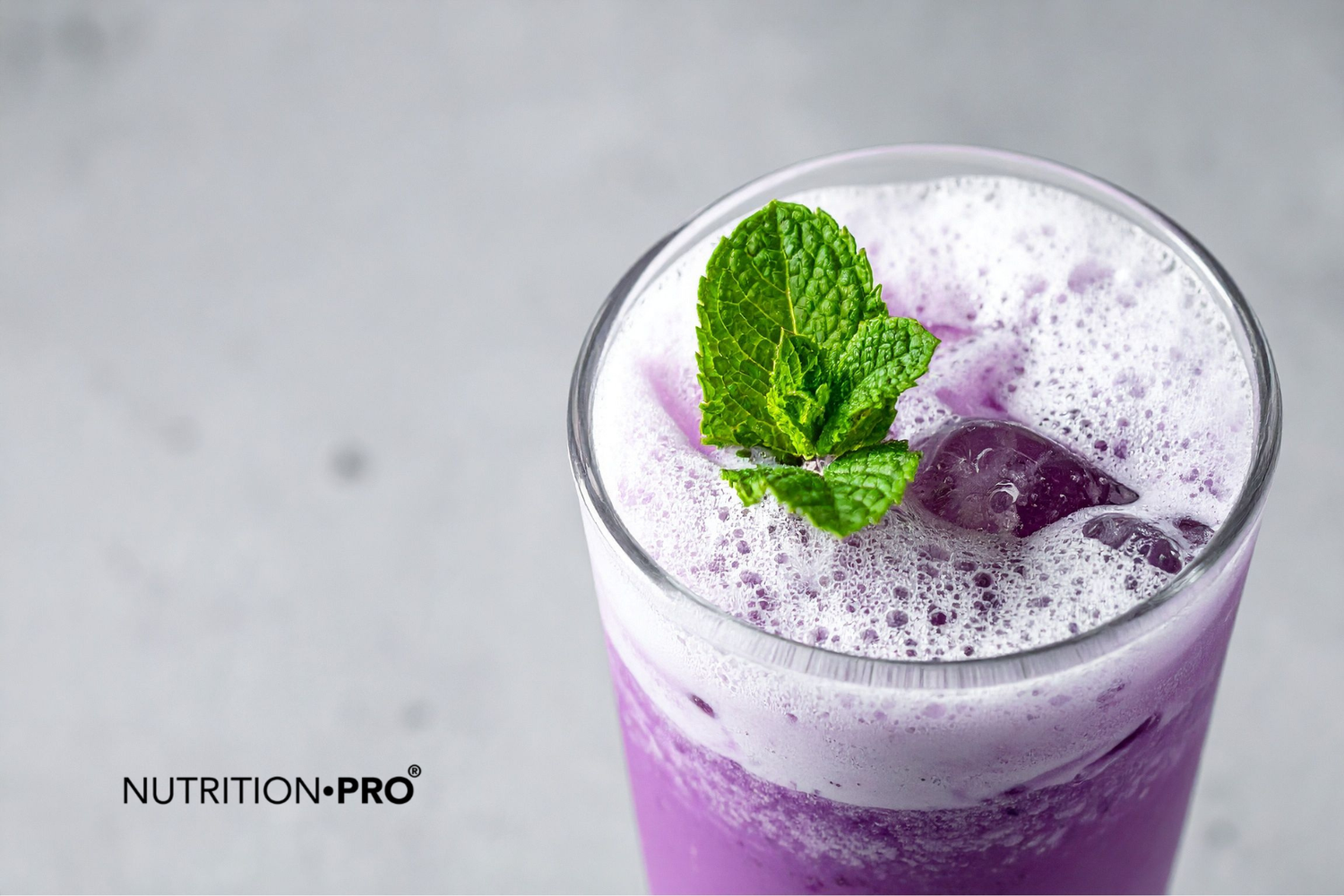
A striking purple hue, a massive presence in smoothies, ice creams and colorful bowls: ube has become a star of the wellness scene. You see it everywhere, credited with every virtue imaginable. But behind the “Instagrammable” glow, one question deserves an honest answer: is ube really a superfood, or just a passing fad carried by its color?
In this article, we settle the question, with the evidence to back it up. And the answer is rather good news: behind the color, ube is a genuinely high-quality food, rich in anthocyanins and fiber, with a solid nutritional foundation. The only trap is not ube itself, but the processed products that exploit it. We explain how to enjoy the real thing and steer clear of the fakes.

If you want to enjoy real ube rather than a sugary dessert that merely borrows its name: a powder made from 100% organic purple yam, with no added sugar or coloring. The food, not the marketing.
The verdict: yes, ube is a genuinely good food, not just an Instagram trend. It is a starchy food that really is rich in anthocyanins, antioxidants whose activity has been confirmed in ube itself (Moriya 2015), and a worthwhile source of fiber (Barber 2020). It has a long history of traditional use and real nutrient density. The only real trap is industrial marketing: many “ube” ice creams and desserts are mostly colored sugar. The solution is simple: choose a 100% ube powder or purée, with no additives, to enjoy the food as it is. Chosen well, ube earns its place.
1. The verdict at a glance
Rather than make you read 2,000 words before reaching a conclusion, here is our verdict up front. The rest of the article explains and justifies it.
Our verdict
A real health food, provided you choose it well
Good news: ube is more than an Instagram trend. It is a colorful starchy food that really is rich in anthocyanins and fiber, with a long history of traditional use and real nutrient density. Its strength: delivering antioxidants in a delicious, natural form. The only point to watch is not ube itself, but the processed products that reduce it to a food coloring. Chosen in a pure, minimally processed form, it is an excellent food to work into your routine.
Its real strengths
- Rich in antioxidant anthocyanins (Moriya 2015)
- Good source of fiber (Barber 2020)
- 100% natural purple color, no colorings
- Long traditional use and a mild flavor
- Versatile: drinks, desserts, breakfast
Traps to avoid
- Sugar-laden processed “ube” desserts
- Products where ube is merely a coloring
- Needless extras: sugar, flavorings, additives
2. Where does the ube craze come from?
Ube (Dioscorea alata, purple yam) has been eaten for centuries in the Philippines, Vietnam and Indonesia, mostly in traditional desserts. Long confined to local use, it enjoyed a spectacular revival in the 2010s, driven by one unbeatable asset: its color. A bold, natural purple, almost impossible to achieve any other way, which made it a star of Instagram and TikTok in ice creams, mochi, donuts and lattes.
Its popularity, then, was born of image before nutrition. And that is precisely what breeds doubt: can a food that went viral for its color have real value, or is it just colorful hot air? It is the healthy reflex to have with any superfood of the moment, from açaí to matcha by way of moringa: ask whether the science keeps pace with the hype, or whether the product lives on its marketing alone.
The word “superfood” itself deserves a closer look. It has no regulatory definition: neither EFSA in Europe nor any other health authority recognizes it as a category. It is a purely commercial term that guarantees nothing about a food's quality or effects. Seeing it on a package therefore tells you nothing meaningful; above all, it signals a marketing position. Keeping that in mind is the best protection against overselling. For the full background on the food, see our guide to ube and its Filipino history.
3. What's true: the nutritional substance
Good news for ube: it does not rest on its image alone. Its central asset is its anthocyanins, the purple pigments responsible for its color. And here the science is clear and specific to ube.
Acylated anthocyanins have been isolated from Philippine purple yam, and their antioxidant activity was assessed and confirmed using antioxidant capacity assays.
Source: PubMed, Moriya C et al. 2015, Bioscience Biotechnology and Biochemistry. DOI: 10.1080/09168451.2015.1027652
The second real strength: fiber. Ube provides a decent amount (around 4 g per 100 g), which helps with regularity and with feeling full. Fiber is among the best-supported elements in nutrition (Barber 2020, DOI: 10.3390/nu12103209). Finally, as a complex carbohydrate, it supplies energy more gradually than refined sugar does. Three concrete strengths, then, that set ube apart from a merely hollow trend.
4. The only promises that need qualifying
Let's be clear: qualifying is not the same as running it down. Ube has real strengths, and that is exactly why it doesn't need anyone to invent superpowers for it. Yet some content credits it with therapeutic virtues: a “detox” action, an “anti-inflammatory” effect, “cardiovascular protection.” These claims have not been demonstrated for ube itself; they come from studies on anthocyanins in general, a large family found in many fruits.
What can honestly be said, and it is already encouraging, is that a meta-analysis found an association between a high intake of dietary anthocyanins and a reduced cardiovascular risk.
A higher dietary intake of anthocyanins is associated with a reduced risk of coronary heart disease and cardiovascular mortality, with no significant association for stroke or heart attack taken on their own.
Source: PubMed, Kimble R et al. 2018, Critical Reviews in Food Science and Nutrition (meta-analysis of cohort studies). DOI: 10.1080/10408398.2018.1509835
The distinction is a healthy one: this is an association, for anthocyanins in general, not proof that a specific food protects the heart. Ube is a good source of anthocyanins, on a par with blueberries or blackcurrants, and it has the added advantage of being a filling starchy food that is versatile in the kitchen. So there is no point overselling it as a medicine: presented for what it is, a good food rich in antioxidants, it is already convincing.
5. The real trap: ultra-processed marketing
Here is the heart of the problem, and it is what feeds the suspicion of a “passing fad.” Ube's success has pushed the industry to churn out purple products: ice creams, colored milks, cookies, snacks. Yet in many of these products, ube is nothing more than a coloring, sometimes even replaced by artificial colors, drowned in ultra-processed matrices loaded with sugar and additives.
The result: an “ube dessert” can contain more sugar than actual ube, and bear almost no nutritional resemblance to the original tuber. This is where marketing takes over from nutrition, and where the consumer gets taken in. The golden rule: read the ingredient list. If ube comes after sugar in the list, or if there are colorings, you are buying a dessert, not a superfood.
In practice, a few habits help you sort the good from the bad. Check where ube ranks in the ingredient list: ingredients appear in descending order of weight, so the higher up it is, the better. Be wary of wording such as “ube flavoring” or “ube flavor,” which often signals that there is no real ube inside. Look out for colorings (E163 for anthocyanins, but also synthetic purple dyes) added to recreate the hue when real ube is missing. And compare the sugar content in the nutrition table: a product that far exceeds the sugars of a piece of fruit no longer has much of a functional food about it.
This is not an indictment of ube, just an observation: the tuber is not to blame for what is done to it. The same reasoning applies to most foods that come into fashion. The value lies in the raw or minimally processed food, not in the spin-off product riding on its name.
6. How to enjoy real ube
If ube appeals to you, here is how to get the most out of it without falling into the marketing trap. Favor minimally processed forms: 100% ube (Dioscorea alata) powder or purée, with no added sugar, flavoring or coloring. Powder is the most practical option in Europe: one to two teaspoons in a smoothie, a yogurt or a batter is enough.
Work it in as a colorful starchy food within a varied diet, not as a miracle supplement. And vary your sources of antioxidants: ube, yes, but also blueberries, blackcurrants, red cabbage and açaí. Diversity beats fixating on a single food. Our organic ube powder meets these criteria: 100% purple yam, no additives. For ideas on how to use it, see our easy ube recipes.
Frequently asked questions
Is ube really a superfood?
The word superfood is a marketing term with no regulatory definition, but in substance, ube delivers on its promise as a quality food: it really is rich in anthocyanins, antioxidants whose activity has been confirmed in ube itself (Moriya 2015), and it provides useful fiber (Barber 2020). So it is a very good food, both nutritious and delicious. The only thing to avoid is processed products that turn it into little more than a sugary coloring.
Is ube just a passing fad?
No, not only. Its popularity stems from its photogenic color, but unlike many trends, ube has real nutritional substance: anthocyanins, fiber, complex carbohydrates. The problem is not the food, but the way marketing misuses it in ultra-processed desserts where it serves only as a coloring.
What are the real benefits of ube?
The documented, honest benefits: a supply of antioxidant anthocyanins (Moriya 2015), fiber that supports digestion (Barber 2020), and a natural color. Dietary anthocyanins in general are associated with a lower cardiovascular risk (Kimble 2018), but that does not prove that ube protects the heart. It cannot be credited with any anti-inflammatory or detox effect.
Should you buy ube products?
It depends on the product. A 100% ube powder or purée, with no added sugar or coloring, is a good way to enjoy the food. Processed ube ice creams, cookies and desserts, on the other hand, often contain more sugar than actual ube, and sometimes colorings: there, the fad wins out over nutrition.
Is ube suitable for people with diabetes?
Ube is a starchy food rich in carbohydrates: it raises blood sugar like any other starchy food. Its fiber tempers that rise a little, but it must be counted as part of the meal's starch portion. In its natural form or as an unsweetened powder, it can be included in controlled amounts. Sweetened ube desserts, however, are best avoided. If you have diabetes, ask your doctor for advice.
- Superfood
- A marketing term with no regulatory definition, referring to a food presented as exceptionally beneficial.
- Anthocyanins
- Plant pigments of the flavonoid family, responsible for red to purple hues, with antioxidant properties.
- Antioxidant
- A compound that helps neutralize free radicals and limit oxidative stress in cells.
- Ultra-processed
- An industrial product that has undergone extensive processing, often high in sugar, additives and colorings.
- Dioscorea alata
- Scientific name of the purple yam (ube).
Information drawn from PubMed. The data describe the state of research on ube and anthocyanins, and do not constitute health claims attributed to any product.
- Moriya C, Hosoya T, Agawa S, et al. New acylated anthocyanins from purple yam and their antioxidant activity. Biosci Biotechnol Biochem 2015;79(9):1484-92. DOI: 10.1080/09168451.2015.1027652
- Kimble R, Keane KM, Lodge JK, Howatson G. Dietary intake of anthocyanins and risk of cardiovascular disease: a systematic review and meta-analysis of prospective cohort studies. Crit Rev Food Sci Nutr 2019;59(18):3032-3043. DOI: 10.1080/10408398.2018.1509835
- Barber TM, Kabisch S, Pfeiffer AFH, Weickert MO. The Health Benefits of Dietary Fibre. Nutrients 2020;12(10):3209. DOI: 10.3390/nu12103209


