

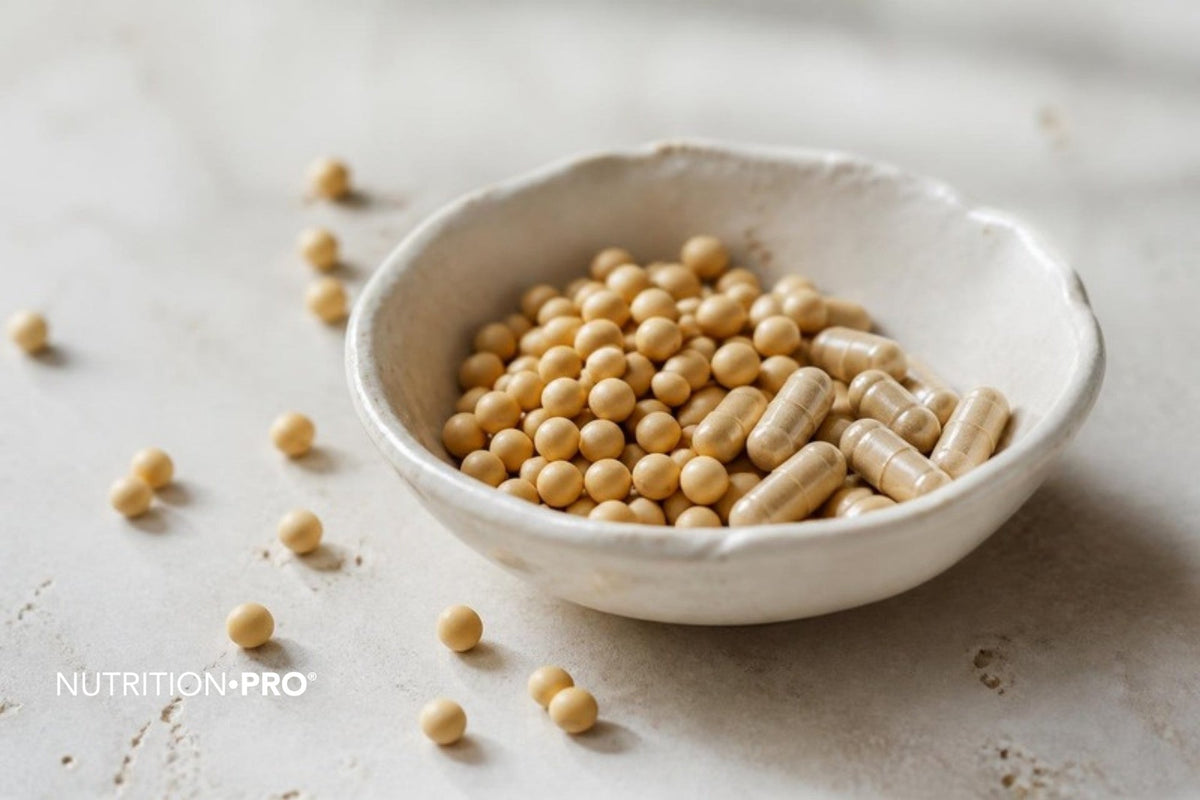
Soy isoflavones are among the most studied and most debated supplements for menopause. In a meta-analysis of double-blind trials, they reduced the frequency of hot flashes by 20.6% more than placebo, at a median dose of 54 mg per day: a real, modest, and slow effect.
This guide brings together studies identified via PubMed: isoflavones and equol, efficacy according to dose and duration, bone and cholesterol, then safety point by point (endometrium, breast cancer, thyroid, interactions), other phytoestrogens, and medical options.

Efficacy : soy isoflavone extracts reduce the frequency of hot flashes by 20.6% and their intensity by 26.2% more than placebo, especially if they provide more than 18.8 mg of genistein per day. It takes an average of 13.4 weeks to reach half of the maximum effect. Hormone therapy remains significantly more effective, with 75% fewer hot flashes compared to placebo.
Safety : in healthy postmenopausal women, meta-analyses find no effect on endometrial thickness or breast density, but a 5-year trial at 150 mg per day found 3.37% endometrial hyperplasia versus 0% under placebo. In breast cancer survivors, dietary soy is associated with fewer recurrences, but the effect of concentrated supplements on recurrence has not been studied, and in animal models genistein was able to counteract an aromatase inhibitor. In case of a history of breast cancer or hormone-dependent disorder, phytoestrogen supplements should be avoided.
- Isoflavones: what are we talking about?
- Equol: why women don't all respond the same way
- Hot flashes: what meta-analyses show
- Dose, genistein, and time to effect
- Bone, cholesterol, sleep, and skin
- Endometrium: what biopsies and ultrasounds show
- Breast cancer: what we know, what we don't
- Thyroid: levothyroxine, iodine, and subclinical hypothyroidism
- Interactions and who should abstain
- Kudzu, red clover, hops: other phytoestrogens
- Hormone therapy and non-hormonal options
- Frequently asked questions
Isoflavones: what are we talking about?
Isoflavones are polyphenols classified among phytoestrogens : their structure allows them to bind to estrogen receptors, preferably to the beta receptor. They are therefore described as selective modulators: depending on the tissue, their effect can be close to estrogens, null, or opposite. Their effects cannot be inferred from those of hormone therapy.
In soy, the three main isoflavones are genistein, daidzein and glycitein, which represent approximately 50%, 40%, and 10% of the total, respectively. They are almost all present in the form of glycosides, bound to a sugar that the intestine releases before absorption; miso, tempeh, or natto contain some in free form, called aglycone. Studies disagree on better absorption of this form, and doses are expressed in aglycone equivalent to compare products.
Exposure varies enormously by country. A 2016 review estimates average adult intake at approximately 30 to 50 mg per day in Japan, compared to less than 3 mg per day in the United States, Canada, and Europe. A supplement of 50 to 100 mg per day thus places a European woman at the level of a Japanese woman or beyond, in concentrated form.
<<<34>>> Soy soja provides mainly genistein and daidzein. Red clover also contains biochanin A and formononetin, which convert to genistein and daidzein. Kudzu root contains mainly puerarin (19 to 80% of its isoflavones according to analyses cited by a 2021 trial), then daidzein and daidzin. Our Kudzu provides 750 mg of root for two capsules, with no indicated isoflavone content: its effects cannot be inferred from trials on standardized extracts.
Equol: why women don't all respond the same way
Once in the intestine, daidzein can be transformed by certain bacteria into equol, a molecule more active on estrogen receptors than daidzein. Not everyone has these bacteria: according to the 2016 review, approximately 25% of non-Asian people and 50% of Asian people are equol producers.
The hypothesis, debated since 2002, is that equol producers benefit more from isoflavones, hence trials of equol itself in non-producers.
Six trials (779 perimenopausal or postmenopausal women) were included, five pooled (728 women): three reported significant benefit, two found none. Overall, equol given to non-producers reduced the frequency or intensity of hot flashes, with a risk of bias generally judged as low.
Daily JW, Ko BS, Ryuk J, et al. J Med Food 2019;22(2):127-139. DOI: 10.1089/jmf.2018.4265
These results remain debated: the North American Menopause Society, in its 2023 position statement, recommends neither equol nor soy foods and extracts for hot flashes, due to insufficient consistent data.
Hot flashes: what meta-analyses show
Our hot flash guide details the mechanisms; here is what the main reviews say about isoflavones.
In 17 trials versus placebo (13 for frequency, 9 for intensity), soy isoflavones extracted or synthesized, at a median dose of 54 mg per day in aglycone equivalent for 6 weeks to 12 months, reduced hot flash frequency by 20.6% and intensity by 26.2% more than placebo. Beyond 18.8 mg of genistein per day, the effect on frequency was more than twice as pronounced. Heterogeneity was high.
Taku K, Melby MK, Kronenberg F, et al. Menopause 2012;19(7):776-790. DOI: 10.1097/gme.0b013e3182410159
A meta-analysis published in JAMA in 2016, on 62 studies and 6,653 women, associates phytoestrogens with 1.31 fewer hot flashes per day, and soy isoflavones alone with 0.79 fewer hot flashes and a slight decrease in vaginal dryness, with no significant effect on night sweats; 74% of trials presented a high risk of bias in at least three domains.
The 2013 Cochrane review (43 trials, 4,364 women) could only pool limited data and concluded that there is no conclusive evidence for phytoestrogens as a whole, but noted that four trials of extracts providing more than 30 mg of genistein per day consistently reduced hot flashes. Depending on the trial, placebo alone reduced them by 1% to 59%.
A more recent meta-analysis, on 5 trials and 425 women, found no significant effect on symptoms, but a decrease in depressive symptoms, with a high risk of conflicts of interest in the included trials. For red clover, a meta-analysis of 8 trials found 1.73 fewer hot flashes per day, greater in women with at least 5 hot flashes per day and taking 80 mg of isoflavones per day or more.
| Summary | Result on hot flashes | Reported limitations |
|---|---|---|
| Taku, 2012, 17 trials, soy extracts | Frequency −20.6 %, intensity −26.2 % compared to placebo | High heterogeneity |
| Franco, 2016, 62 studies, phytoestrogens | −1.31 flushes per day; soy alone −0.79; night sweats unchanged | 74 % of trials at high risk of bias |
| Cochrane, 2013, 43 trials | No conclusive evidence; extracts with more than 30 mg of genistein favorable | Data rarely poolable, placebo effect from 1 to 59 % |
| Kanadys, 2021, 8 trials, red clover | −1.73 flushes per day | Results highly heterogeneous |
For 8 to 10 flushes per day, one to two fewer is a real but partial gain, measured in addition to the decline observed under placebo.
Dose, genistein and time to effect
The genistein appears to be the most consistent factor: in the 2012 meta-analysis, the threshold of 18.8 mg per day, median across trials, separated the most effective products from the others. According to the 2016 review, approximately 40 mg of total isoflavones from whole soy provide this amount.
Second key point: time to effect. A modeling of 16 trials (approximately 1,710 women) estimates the maximum effect of soy isoflavones, placebo removed, at 25.2 % fewer flushes, or 57 % of that of estradiol (44.9 %). But it takes 13.4 weeks to reach half of this effect, compared to 3.09 for estradiol, and at least 48 weeks to reach 80 % of it: 12-week trials are too short to judge.
More is not necessarily better: in a 2-year trial in 248 postmenopausal women for less than 5 years, 200 mg of soy isoflavones per day reduced neither bone loss nor symptoms, and the soy group reported more hot flushes and constipation.
Bone, cholesterol, sleep and skin
Bone. Results depend on the product. In a 2-year Italian trial in 389 postmenopausal osteopenic women, 54 mg of genistein per day increased bone density in the lumbar spine (+0.049 g/cm² versus −0.053 g/cm² under placebo) and at the femoral neck, without changing endometrial thickness; digestive disorders were more frequent (19% versus 8%) and fractures were not measured. Conversely, 200 mg of soy isoflavones per day did not slow bone loss over 2 years: −2.0% in the spine versus −2.3% under placebo.
In the genistein trial, both groups received calcium and vitamin D: our article on vitamin D deficiency provides an update, and our Plant-based Vitamin D3 provides 1,000 IU per drop, at a rate of 2 drops per day for adults.
Cholesterol. According to a meta-analysis of 11 trials, soy isoflavones lower LDL-cholesterol by 0.13 mmol/L (3.58%) and total cholesterol by 1.77%, with no effect on HDL or triglycerides, more so in cases of high cholesterol. A real but modest effect. On soy proteins, see our comparison of plant-based and animal proteins.
Sleep. No synthesis retained here had sleep as a primary criterion, and the JAMA review did not find a significant reduction in night sweats: nothing supports its use as a sleep aid.
Skin. According to the 2016 review, a few small trials suggest a reduction in wrinkles, all with design limitations: preliminary data. Our article on collagen and wrinkles presents other approaches.
Endometrium: what biopsies and ultrasounds show
The endometrium, the lining of the uterus, is sensitive to estrogen: the question therefore arises for isoflavones.
Meta-analyses are reassuring regarding thickness. A synthesis of 23 trials and 2,167 women found no change in endometrial thickness, and even a slight decrease beyond 54 mg per day; the three Asian trials suggested a slight increase, not statistically significant. Another, of 40 trials and 3,285 postmenopausal women (median dose 75 mg per day, 24 weeks), found no effect on thickness (−0.22 mm, not significant), vaginal maturation, FSH or estradiol; it was partially funded by the American soy sector, and one of its co-authors works for an institute funded by this sector. In a 3-year American trial in 224 women, 80 or 120 mg per day did not change endometrial thickness or hormones, and genistein at 54 mg did not change thickness over 2 then 3 years in the Italian trial.
In 376 healthy postmenopausal women with an intact uterus, 150 mg of isoflavones per day in soy tablets were compared to placebo over 5 years, with biopsies at baseline, 30 months, and 5 years (298 women completed). No cancer was detected, but endometrial hyperplasia appeared in 3.37% of women taking soy, versus none in the placebo group: according to the authors, this raises questions about the long-term safety of phytoestrogens for the endometrium.
Unfer V, Casini ML, Costabile L, et al. Fertil Steril 2004;82(1):145-148. DOI : 10.1016/j.fertnstert.2003.11.041
Ultrasound thickness is not the same as endometrial hyperplasia on biopsy, and this trial is the only one this long with repeated biopsies, at a higher dose than most trials. A 3-year trial at 154 mg per day (224 women) did not find more hyperplasia with soy, but biopsies were only performed as clinically indicated. The Cochrane review finds no endometrial stimulation up to 2 years. In summary: at usual doses and over the medium term, no demonstrated effect; beyond 3 years at high doses, the only trial with systematic biopsies calls for caution. Any postmenopausal bleeding should be reported to a physician.
Breast cancer: what we know, what we don't
In women without cancer: the cohorts. A meta-analysis of 14 prospective studies associates isoflavone consumption with a slightly lower breast cancer risk (relative risk 0.89). But this appears only in Asian populations (0.76), not Western populations (0.97, not significant), and the authors do not find a dose-response relationship. These are associations with dietary soy: they do not prove a protective effect and do not inform about supplements.
In cancer survivors: the cohorts. In the Shanghai study (5,042 women, median follow-up of 3.9 years), the quarter consuming the most soy protein had a 29% lower risk of death and a 32% lower risk of recurrence compared to the quarter with the lowest intake (4-year mortality: 7.4% versus 10.3%), whether the tumor was hormone-sensitive or not, with or without tamoxifen.
In 9,514 survivors of invasive breast cancer followed for an average of 7.4 years, in two American cohorts and one Chinese cohort, dietary consumption of at least 10 mg of isoflavones per day after diagnosis was associated with a 25% lower risk of recurrence, which was significant, and a non-significant decrease in breast cancer mortality. The association held true for both American and Chinese women.
Nechuta SJ, Caan BJ, Chen WY, et al. Am J Clin Nutr 2012;96(1):123-132. DOI : 10.3945/ajcn.112.035972
What trials measure. On breast density, a marker of breast cancer risk, a meta-analysis of 8 trials and 1,287 women finds no effect in postmenopausal women (−1.10%), but a slight increase before menopause (+1.83%), which disappeared in one of the three sensitivity analyses; in the 3-year extension of the Italian trial (138 women), density did not change. A 6-month trial in high-risk women did not reduce breast cell proliferation, and in premenopausal women, the Ki-67 index increased from 1.71 to 2.18 in the soy group, with no significant difference from placebo. In 140 women with early-stage cancer, soy protein taken 7 to 30 days before surgery did not modify Ki-67, but tumors in women with the highest blood genistein overexpressed cell cycle genes, leading the authors to suggest a possible adverse effect in some women.
The reassuring cohorts involve dietary soy, from 10 to over 40 mg per day. No trials found evaluated concentrated supplements on recurrence in cancer survivors, who were excluded from Cochrane review trials. In cases of personal or family history of breast cancer, our phytoestrogen-based herbal supplements are therefore not indicated, and the place of dietary soy should be discussed with your medical team.
Thyroid: levothyroxine, iodine, and subclinical hypothyroidism
When the thyroid functions normally, the data are rather reassuring. A meta-analysis of 18 randomized trials found no variation in thyroid hormones (free T3 and T4), only a small increase in TSH (0.248 mIU/L) of uncertain clinical significance. A review of 14 trials concluded there was little evidence for an adverse effect when iodine intake is adequate, and the 3-year American trial found no thyroid effect.
Three situations require attention. First, iodine : the same review notes a theoretical concern, drawn from in vitro and animal studies, if iodine intake is low or the thyroid is compromised, and advises caution.
In 60 people with subclinical hypothyroidism, elevated TSH with still-normal thyroid hormones, 30 g of soy protein providing 16 mg of phytoestrogens per day for 8 weeks were compared to 30 g of soy protein providing only 2 mg. Six women progressed to overt hypothyroidism after the 16 mg period, representing a 3.6-fold increased risk. During the same period, blood pressure, insulin resistance, and CRP decreased with 16 mg.
Sathyapalan T, Manuchehri AM, Thatcher NJ, et al. J Clin Endocrinol Metab 2011;96(5):1442-1449. DOI : 10.1210/jc.2010-2255
Finally, levothyroxine. A published case describes a 45-year-old woman who had thyroid surgery and required high doses of levothyroxine: she was taking a soy protein cocktail right after her tablet, and spacing the two apart allowed her to reduce the doses. According to the review of 14 trials, hypothyroid individuals do not need to avoid soy, but their dose may need to be adjusted: discuss this with your doctor.
Interactions and who should refrain
Anti-hormonal breast cancer treatments block the estrogen receptor (tamoxifen) or its production (aromatase inhibitors such as anastrozole or letrozole). A molecule that binds to the same receptor therefore raises questions.
In ovariectomized mice carrying estrogen-sensitive breast cancer cells, a diet enriched in genistein stimulated tumors and cancelled, in a dose-dependent manner, the effect of letrozole ; the authors call for caution in women treated with letrozole. The 2016 review recalls comparable results with tamoxifen in mice.
The data in women point in another direction, but relate to diet. In the Shanghai cohort, the favorable association with soy also existed under tamoxifen. In a Chinese cohort of 524 women under anti-hormonal treatment followed for 5.1 years, postmenopausal women consuming more than 42.3 mg of dietary isoflavones per day had a 33% lower recurrence risk, including under anastrozole; before menopause, consumption was not linked to mortality. These associations say nothing about concentrated supplements.
Personal or family history of breast cancer, and any treatment with tamoxifen or aromatase inhibitor. Hormone-dependent disorders : cancer of the uterus or ovaries, endometriosis, fibroids. Pregnancy and breastfeeding. Hormone therapy in progress, except on medical advice. Hypothyroidism : only with doctor's approval. Postmenopausal bleeding : consult first. And do not combine multiple phytoestrogen-based supplements.
Kudzu, red clover, hops: other phytoestrogens
Kudzu. Trials on menopause are rare. In Hong Kong, 127 women aged 50 to 65 received 3 months of root powder equivalent to 100 mg of isoflavones, hormone therapy, or nothing: kudzu modified neither cholesterol nor FSH and LH, and the authors could not demonstrate an overall benefit, except for an improvement in overall cognitive score and attention compared to no treatment, to be confirmed according to the authors. Our article on kudzu and menopause revisits its use, and the one on clinical trials of kudzu on the doses studied.
Fifty postmenopausal women received for 4 weeks an ethanolic extract of kudzu root, 0.84 to 2.52 g per day, or 113 to 338 mg of puerarin. The symptom score decreased significantly in 4 out of 5 groups, down to −7.1 points out of 44, and a bone resorption marker by 34.2% in the best group. Adverse effects, mostly mild, affected 90% of participants, notably headaches (30%) and hot flashes (26%). Funded by a biotechnology company, the trial had no placebo group, which prevents estimating the extract's own effect.
Bihlet AR, Byrjalsen I, Andersen JR, et al. Front Pharmacol 2021;12:760629. DOI: 10.3389/fphar.2021.760629
Our Kudzu provides 750 mg of kudzu root per two vegetable capsules. This is not the extract from this trial and its isoflavone content is not indicated: these results are not applicable to it. It is not recommended in case of personal or family history of breast cancer, pregnancy, breastfeeding, or hormone-dependent disorder. In the 2021 trial, participants were advised to avoid alcohol, due to reported effects of kudzu on its metabolism. See also our article on side effects of kudzu.
Red clover is better studied: 1.73 fewer hot flashes per day across 8 heterogeneous trials, but no significant difference in the Cochrane review when pooling 5 trials of the same extract.
Hops contains 8-prenylnaringenin, identified in 1999 as more active in laboratory settings than other known plant phytoestrogens; the authors saw this as a possible explanation for menstrual disorders reported among hop workers. In a trial of 67 women, a hop extract standardized to 100 µg of 8-prenylnaringenin per day performed better than placebo at 6 weeks but not at 12 weeks, and the 250 µg dose was less active.
Our Menopause Bio contains no soy, but it does contain hop, therefore a phytoestrogen: like Kudzu, it is not recommended in case of personal or family history of breast cancer.

No trial has tested this formula, and its 480 mg of hop is not comparable to the extracts standardized for 8-prenylnaringenin used in trials. Long-term use not recommended, dose not to be exceeded. Kudzu and Menopause Bio both contain phytoestrogens: do not combine them without medical advice. Menopause Bio also provides 300 mg of maca, to be used cautiously if you are taking our Organic Maca. Our complete menopause guide presents other options.
Hormone Therapy and Non-Hormonal Options
A Cochrane review of 24 trials and 3,329 women shows that oral hormone therapy reduces the frequency of hot flashes by approximately 75% compared to placebo, which alone reduced them by 57.7%: hence the importance of evaluating any option against placebo.
According to the 2022 position of the North American menopause society, hormone therapy is the most effective against hot flashes and genitourinary syndrome, and prevents bone loss and fractures. Its risks depend on the type, dose, duration, route, timing of initiation, and addition of progestin. The benefit-risk ratio is considered favorable before age 60 or within 10 years following menopause, without contraindication, and less favorable beyond that (coronary heart disease, stroke, venous thrombosis, dementia).
Without hormones, the 2023 position of the same society supports cognitive-behavioral therapies, clinical hypnosis, certain antidepressants, gabapentin, fezolinetant and oxybutynin, but not soy or equol. These choices should be made with your doctor; our article on perimenopause helps prepare for this consultation.
| Option | Documented Benefit | Risks and Precautions | Level of Evidence |
|---|---|---|---|
| Soy isoflavone extracts | Hot flashes −20.6% in frequency and −26.2% in intensity compared to placebo, slow effect | Endometrial hyperplasia in a 5-year trial at 150 mg; to be avoided if history of breast cancer | Moderate, heterogeneous trials |
| Genistein 54 mg | Increased bone density over 2 years in women with osteopenia | Digestive disorders (19% vs 8%); fractures not measured | One large trial, one team |
| Red clover | −1.73 hot flash per day | Same precautions as isoflavones | Limited, heterogeneous results |
| Kudzu | Symptoms reduced in a 4-week open trial without placebo; no benefit demonstrated in a 3-month trial | Phytoestrogens; avoid alcohol during intake in the trial | Very limited |
| Hop extract | Inconsistent effect in a small 12-week trial | Contains an active phytoestrogen | Very limited |
| Hormone therapy | Hot flashes −75% compared to placebo; bone prevention | Depending on type, dose, age, and time since menopause | High |
The level of evidence indicated in this table is our reading of the cited studies.
From kudzu root (Pueraria montana var. lobata), which naturally contains isoflavones such as puerarin, daidzin, and daidzein. Two vegetable capsules per day provide 750 mg of root, with a large glass of water, in a single dose or in two spaced doses.
View KudzuLooking for a soy-free formula? Discover Organic Menopause, five organic plants combined in vegetable capsules.
Frequently asked questions
Are soy isoflavones effective against hot flashes?
Modestly. In a meta-analysis of double-blind trials, soy isoflavone extracts reduced the frequency of hot flashes by 20.6% and their intensity by 26.2% more than placebo, at a median dose of 54 mg per day. Results vary greatly from one trial to another, and hormone therapy remains significantly more effective, with approximately 75% fewer hot flashes.
How long does it take for isoflavones to work?
Several months. An analysis of 16 trials estimates that it takes an average of 13.4 weeks to achieve half of the maximum effect, compared to 3.09 weeks for estradiol. It is reasonable to assess the effect at 3 and then 6 months.
What dose of soy isoflavones for menopause?
Trials used a median dose of 54 mg per day in aglycone equivalent, and products providing more than 18.8 mg of genistein per day were most effective. In a 2-year trial, 200 mg per day was no better than placebo on symptoms.
Are soy isoflavones dangerous?
In healthy postmenopausal women, meta-analyses find no effect on endometrial thickness, breast density, or thyroid hormones. However, a 5-year trial at 150 mg per day found 3.37% endometrial hyperplasia compared to 0% under placebo. They should be avoided in cases of breast cancer history, hormone-dependent disorder, pregnancy, or breastfeeding.
Isoflavones and breast cancer: what risk?
In survivors, dietary soy is associated with fewer recurrences in cohorts, for example 25% fewer with at least 10 mg per day in 9,514 women. These are associations, and the effect of concentrated supplements on recurrence has not been studied in this population. In case of history, phytoestrogen supplements should be avoided.
Can you take isoflavones with tamoxifen or an aromatase inhibitor?
Not without the oncologist's approval. In mice, genistein stimulated estrogen-sensitive breast tumors and canceled the effect of letrozole. Cohorts in women concern dietary soy and do not provide information on concentrated supplements.
Do soy isoflavones act on the thyroid?
When the thyroid functions normally, a meta-analysis of 18 trials finds no variation in thyroid hormones, only a small increase in TSH. In case of subclinical hypothyroidism, 16 mg of phytoestrogens per day were associated with more frequent progression to overt hypothyroidism, and soy can reduce levothyroxine absorption: discuss with your doctor.
What is equol?
It is a molecule produced from daidzein by certain intestinal bacteria. Approximately 25% of non-Asian people and 50% of Asian people produce it, and the hypothesis is that producers respond better to isoflavones.
Is food soy and supplements the same thing?
No. In Japan, adults consume an average of 30 to 50 mg of isoflavones per day in food form, compared to less than 3 mg in Europe. A supplement provides a concentrated dose, and reassuring studies on food soy do not automatically apply to supplements.
Does kudzu contain isoflavones like soy?
Yes, but mainly puerarin, with daidzein and daidzin. Trials on menopause are rare, small, and limited in design, and kudzu requires the same precautions as soy, particularly in case of a history of breast cancer.
Sources
The studies cited below were identified via PubMed.
- Taku K, Melby MK, Kronenberg F, et al. Extracted or synthesized soy isoflavones reduce the frequency and intensity of menopausal hot flashes: systematic review and meta-analysis of randomized trials. Menopause, 2012;19(7):776-790. DOI
- Li L, Lv Y, Xu L, Zheng Q. Quantitative efficacy of soy isoflavones on menopausal hot flashes. British Journal of Clinical Pharmacology, 2015;79(4):593-604. DOI
- Maclennan AH, Broadbent JL, Lester S, Moore V. Oral estrogens and estrogen-progestin combination versus placebo for hot flashes. Cochrane Database of Systematic Reviews, 2004;2004(4):CD002978. DOI
- Unfer V, Casini ML, Costabile L, et al. Effects on the endometrium of prolonged treatment with phytoestrogens: randomized, double-blind, placebo-controlled study. Fertility and Sterility, 2004;82(1):145-148. DOI
- Ju YH, Doerge DR, Woodling KA, et al. Dietary genistein abolishes the inhibitory effect of letrozole on the growth of aromatase-expressing estrogen-dependent human breast cancer cells (MCF-7Ca) in vivo. Carcinogenesis, 2008;29(11):2162-2168. DOI
- Nechuta SJ, Caan BJ, Chen WY, et al. Soy food consumption after breast cancer diagnosis and survival: detailed analysis of combined data from cohorts of American and Chinese women. American Journal of Clinical Nutrition, 2012;96(1):123-132. DOI
- Messina M. Soy and health, update: evaluation of clinical and epidemiological literature. Nutrients, 2016;8(12):754. DOI
- Bihlet AR, Byrjalsen I, Andersen JR, et al. Efficacy and safety of multiple dosing regimens of a kudzu root extract on bone and cartilage remodeling and menopausal symptoms. Frontiers in Pharmacology, 2021;12:760629. DOI
- Daily JW, Ko BS, Ryuk J, et al. Equol reduces hot flashes in menopausal women: systematic review and meta-analysis of randomized clinical trials. Journal of Medicinal Food, 2019;22(2):127-139. DOI
- The North American Menopause Society. 2023 Position of the North American Menopause Society on non-hormonal treatments. Menopause, 2023;30(6):573-590. DOI
- Franco OH, Chowdhury R, Troup J, et al. Use of herbal therapies and menopausal symptoms: systematic review and meta-analysis. JAMA, 2016;315(23):2554-2563. DOI
- Lethaby A, Marjoribanks J, Kronenberg F, et al. Phytoestrogens for vasomotor symptoms of menopause. Cochrane Database of Systematic Reviews, 2013;2013(12):CD001395. DOI
- Gençtürk N, Bilgiç FŞ, Kaban HU. Effect of soy isoflavones given to women in the climacteric period on menopausal symptoms and quality of life: systematic review and meta-analysis of randomized trials. Explore, 2024;20(6):103012. DOI
- Kanadys W, Barańska A, Błaszczuk A, et al. Evaluation of the clinical relevance of red clover extract for alleviating hot flashes and menopausal symptoms in perimenopausal and menopausal women: systematic review and meta-analysis of randomized trials. Nutrients, 2021;13(4):1258. DOI
- Levis S, Strickman-Stein N, Ganjei-Azar P, et al. Soy isoflavones in the prevention of bone loss and menopausal symptoms: a randomized double-blind trial. Archives of Internal Medicine, 2011;171(15):1363-1369. DOI
- Marini H, Minutoli L, Polito F, et al. Effects of the phytoestrogen genistein on bone metabolism in osteopenic menopausal women: randomized trial. Annals of Internal Medicine, 2007;146(12):839-847. DOI
- Taku K, Umegaki K, Sato Y, et al. Soy isoflavones lower total and LDL cholesterol in humans: meta-analysis of 11 randomized trials. American Journal of Clinical Nutrition, 2007;85(4):1148-1156. DOI
- Liu J, Yuan F, Gao J, et al. Oral isoflavone supplementation and endometrial thickness: meta-analysis of randomized placebo-controlled trials. Oncotarget, 2016;7(14):17369-17379. DOI
- Viscardi G, Back S, Ahmed A, et al. Effect of soy isoflavones on markers of estrogenicity: systematic review and meta-analysis of randomized trials. Advances in Nutrition, 2025;16(1):100327. DOI
- Alekel DL, Genschel U, Koehler KJ, et al. SIRBL study on soy isoflavones and bone loss: effects of a 3-year trial on hormones, adverse events, and endometrial thickness in postmenopausal women. Menopause, 2015;22(2):185-197. DOI
- Marini H, Bitto A, Altavilla D, et al. Breast safety and efficacy of aglycone genistein on bone loss after menopause: follow-up study. Journal of Clinical Endocrinology and Metabolism, 2008;93(12):4787-4796. DOI
- Quaas AM, Kono N, Mack WJ, et al. Effect of supplementation with isoflavone-rich soy protein on endometrial thickness, hyperplasia, and endometrial cancer risk in postmenopausal women: randomized trial. Menopause, 2013;20(8):840-844. DOI
- Dong JY, Qin LQ. Soy isoflavone consumption and risk of incident or recurrent breast cancer: meta-analysis of prospective studies. Breast Cancer Research and Treatment, 2011;125(2):315-323. DOI
- Shu XO, Zheng Y, Cai H, et al. Consumption of soy-based foods and survival after breast cancer. JAMA, 2009;302(22):2437-2443. DOI
- Hooper L, Madhavan G, Tice JA, et al. Effects of isoflavones on breast density in non-menopausal and postmenopausal women: systematic review and meta-analysis of randomized trials. Human Reproduction Update, 2010;16(6):745-760. DOI
- Khan SA, Chatterton RT, Michel N, et al. Soy isoflavone supplementation to reduce breast cancer risk: phase II randomized trial. Cancer Prevention Research, 2012;5(2):309-319. DOI
- Shike M, Doane AS, Russo L, et al. Effects of soy supplementation on gene expression in breast cancer: randomized placebo-controlled study. Journal of the National Cancer Institute, 2014;106(9):dju189. DOI
- Otun J, Sahebkar A, Östlundh L, et al. Systematic review and meta-analysis of the effect of soy on thyroid function. Scientific Reports, 2019;9(1):3964. DOI
- Messina M, Redmond G. Effects of soy proteins and isoflavones on thyroid function in healthy adults and hypothyroid patients: a literature review. Thyroid, 2006;16(3):249-258. DOI
- Sathyapalan T, Manuchehri AM, Thatcher NJ, et al. Effect of soy phytoestrogen supplementation on thyroid function and cardiovascular risk markers in patients with subclinical hypothyroidism: a randomized, double-blind, crossover study. Journal of Clinical Endocrinology and Metabolism, 2011;96(5):1442-1449. DOI
- Bell DS, Ovalle F. Use of a soy protein supplement and increased need for levothyroxine. Endocrine Practice, 2001;7(3):193-194. DOI
- Kang X, Zhang Q, Wang S, et al. Effect of soy isoflavones on recurrence and death from breast cancer in patients receiving adjuvant hormone therapy. Canadian Medical Association Journal, 2010;182(17):1857-1862. DOI
- Woo J, Lau E, Ho SC, et al. Comparison of Pueraria lobata and hormone replacement therapy in the management of menopausal health consequences. Menopause, 2003;10(4):352-361. DOI
- Milligan SR, Kalita JC, Heyerick A, et al. Identification of a potent phytoestrogen in hops (Humulus lupulus L.) and beer. Journal of Clinical Endocrinology and Metabolism, 1999;84(6):2249-2252. DOI
- Heyerick A, Vervarcke S, Depypere H, et al. First prospective, randomized, double-blind, placebo-controlled study of a standardized hop extract for relief of menopausal symptoms. Maturitas, 2006;54(2):164-175. DOI
- The North American Menopause Society. 2022 Position statement of the North American Menopause Society on hormone therapy. Menopause, 2022;29(7):767-794. DOI


