

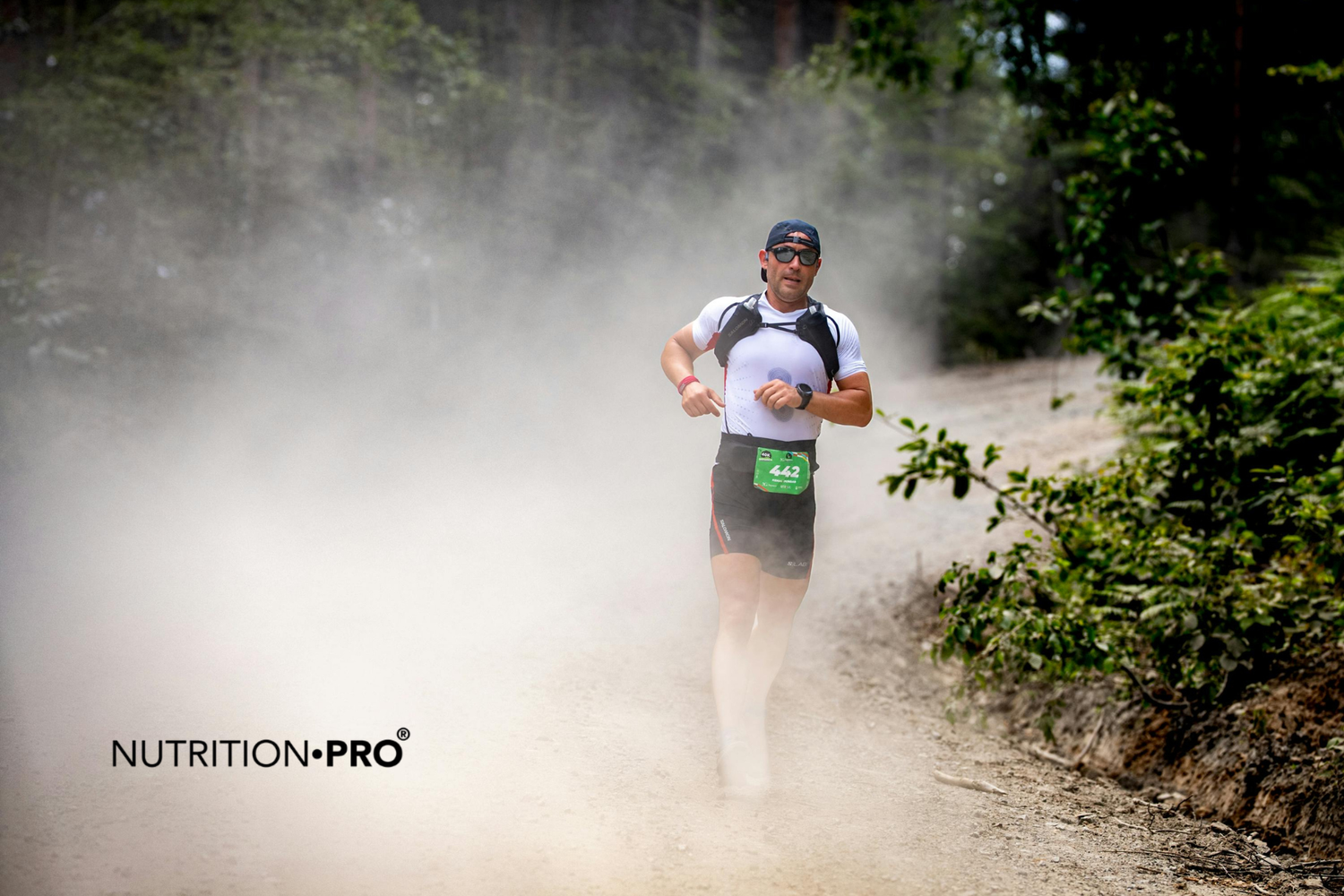
In trail running, nutrition is not a supplement to training: it is often what decides between finishing and dropping out. On road races, a nutrition mistake costs minutes. On a long format, in semi-autonomous conditions, with elevation gain and sometimes night running, it costs the race. Dropouts due to digestive issues or energy depletion are among the most frequent, and they are largely avoidable.
This guide covers the subject in its entirety: what elevation gain and duration really change compared to the marathon, carbohydrate strategy and the role of solid foods, hydration and sodium with the pitfall of excess water, the cramping question addressed honestly, then supplements. And for the latter, the same method as in all our guides: what has an authorized European claim, what is based on claims without authorization, and what is purely marketing.

What trail running changes. The duration, which makes nausea inevitable if you don't vary flavors and textures. The elevation gain : climbs are often covered on foot, at reduced intensity, which opens a window for eating solid food impossible on road; descents, meanwhile, cause specific muscle damage and extend recovery. And semi-autonomy : between two aid stations, you only have what you carry.
The reference points. 30 to 60 g of carbohydrates per hour up to two and a half hours, up to 60 to 90 g beyond that by combining multiple types of carbohydrates, knowing that in ultra distance the upper range is often unattainable in practice. Drink regularly and do not neglect sodium : on very long formats, absorbing large quantities of pure water without sodium poses a real risk. On cramping, let's be clear: no anti-cramping claims are authorized for any ingredient.
- What trail running changes compared to road running
- Carbohydrate strategy and the place of solid foods
- Hydration, sodium and the pitfall of excess water
- Cramping, honestly
- Descents and muscle recovery
- Supplements with authorized claims
- What has evidence, but no claim
- The four-phase protocol
- The most frequent mistakes
- Frequently asked questions
What trail running changes compared to road running
Duration, first. A long trail run far exceeds marathon effort duration, and an ultra can last dozens of hours. Total needs explode, but above all a new phenomenon emerges: flavor fatigue. After several hours, the problem is no longer knowing what to eat on paper, it's managing to swallow something else. A perfect plan on paper is worthless if your mouth refuses the twelfth gel.
Elevation gain, next, and that's the structural difference. Climbs are often covered on foot, so at reduced intensity. Blood remains more available for digestion, which opens a window to eat solid food impossible at road running pace. It's a real advantage of the format, provided you've anticipated it. Conversely, descents stress the muscle in eccentric contraction, which causes more muscle damage than climbing.
Semi-autonomy, finally. Between two aid stations, you only have what you're carrying. This transforms nutrition into a calculation exercise : race profile, aid station locations, estimated time between them, target hourly intake, plus a margin. The race regulations also set the mandatory equipment and minimum water quantities, which vary from one race to another: this is the only reference that matters.
Carbohydrate strategy and the role of solid food
The basic principle remains that of endurance: glycogen reserves don't cover the effort, so carbohydrates must be supplied regularly. Standard guidelines:
| Effort duration | Indicative hourly intake | Trail specificity |
|---|---|---|
| Up to 1 hour | Intake generally not necessary | Reserves are sufficient |
| 1 to 2.5 hours | 30 to 60 g of carbohydrates per hour | Liquids and gels are generally sufficient |
| Beyond 2.5 hours | Up to 60 to 90 g per hour | Introduce solid food, alternate textures |
| Very long formats | Often below the upper range | Nausea and digestion become limiting factors |
Honesty is required on this last point: on an ultra, aiming for 90 g per hour over fifteen hours is theory. Between heat, taste fatigue and a closing stomach, a more modest intake that's actually absorbed is better than an ambitious goal abandoned at the sixth hour.
The three rules that work
- Start early. The first intake is taken well before the first sign of decline. When the need is felt, absorption comes too late.
- Eat on climbs, drink on descents. The walked climb is your digestive window; the descent, where the stomach is jostled, is better suited to liquids. It's a simple organization that makes a big difference.
- Alternate before getting fed up. Sweet and salty, liquid and solid, from the start of the race. Bringing a backup option with a radically different taste from your main product is cheap insurance.
Hydration, sodium and the trap of excess water
Sweat losses vary enormously from one runner to another, and increase with heat and duration. The practical rule boils down to two points: drink regularly in small amounts rather than a lot at once, and take in sodium, the main electrolyte lost in sweat.
This is precisely what carbohydrate-electrolyte solutionscover, with two authorized claims: theimprovement of water absorption during exercise and the maintenance of endurance performance during prolonged endurance exercise.
Consuming large quantities ofpure water for several hours, without sodium intake, can lead to a dilution of blood electrolytes. This is a serious medical situation, documented in ultra-endurance events, and the intuitive reflex to "drink as much as possible" contributes to it. Warning signs include nausea, headaches, confusion or swelling. The prudent approach is to drink according to thirst rather than on principle and to take in sodium. During a race, any unusual symptom should lead to the aid station without delay.
A simple test to do during training: weigh yourself before and after a long outing, under comparable conditions, to estimate your personal losses. This is far more useful than a general recommendation, as the difference between two runners can be substantial.
Cramps, honestly
Let's start with the legal framework, because it settles a large part of the debate: no anti-cramp claims are authorized in the European Union, for magnesium or any other ingredient. A brand that promises you an end to cramps is operating outside the regulatory framework, regardless of its arguments.
On the substance, the causes of effort-related cramps remain debated. Two main hypotheses coexist: a neuromuscularorigin, linked to fatigue and an imbalance between contraction and inhibition mechanisms, and a hydro-electrolyticorigin, linked to losses in water and sodium. They are not mutually exclusive, and the mechanisms are likely multiple depending on the situation.
What we can say with certainty:
- What magnesium can claim : contributing to reduced fatigue, normal muscle function and electrolyte balance. Three authorized claims, relevant in trail running, but which are not an anti-cramp promise.
- What works most often in practice : a pace adapted to the elevation gain, training that has genuinely included descents, and a coherent hydration and sodium strategy.
- What to read in a recurring cramp : recurring cramps at the same point during a run generally signal a pacing or specific preparation issue, rather than a supplement deficiency.
In the moment, the response remains simple: slow down, gently stretch the affected muscle, and gradually resume.
Descents and muscle recovery
The descent engages muscles in eccentric contraction : they produce force while lengthening, to brake. This mode of contraction causes more muscle damage than climbing or flat terrain, hence the pronounced soreness and longer recovery than after a road race of equivalent duration.
Two nutritional consequences. First, protein intake is particularly important in trail running, both during preparation and after the race: proteins contribute to the maintenance and growth of muscle mass, an authorized health claim that takes on full meaning in light of this repeated damage.
Next, recovery must be planned. In the hours following arrival, combine carbohydrates and protein and rehydrate. In the days that follow, prioritize light movement over complete rest, and accept a very gradual return to training. Resuming intensity because sensations feel better is the best way to drag out lasting fatigue.
Supplements with authorized claims
| Ingredient | Authorized claim | When it's relevant |
|---|---|---|
| Carbohydrate-electrolyte solutions | Improve water absorption during exercise and contribute to maintaining endurance performance during prolonged endurance exercise | During the race and long outings |
| Carbohydrates | Contribute to the restoration of normal muscle function after prolonged exercise that has depleted glycogen stores | In the hours following arrival |
| Proteins | Contribute to the maintenance and growth of muscle mass | Throughout preparation, and after descents |
| Magnesium | Contributes to reducing fatigue, normal muscle function, and electrolyte balance | Training load, prolonged sweat losses |
| Iron | Contributes to normal oxygen transport, normal formation of red blood cells and hemoglobin, and reducing fatigue | Only on blood test results and medical advice |
| Vitamin C | Increases iron absorption and contributes to reducing fatigue | In combination with iron intake |
| Vitamin D | Contributes to the maintenance of normal bone structure, normal muscle function, and normal calcium absorption | Winter preparations, high impact volume |
Descents cause muscle damage that flat terrain does not produce. Proteins contribute to the maintenance and growth of muscle mass, an authorized claim that makes it the foundation of recovery between outings. Should be combined with carbohydrates in the hours following exercise to replenish reserves in parallel.
See 100% Whey IsolateWhat has data, but no authorized claim
| Ingredient | What is studied | Regulatory status |
|---|---|---|
| Caffeine | Heavily used on night sections | No authorized performance claims; substance on the anti-doping monitoring program |
| BCAA | Branched-chain amino acids, heavily marketed for endurance | No authorized claims |
| Nitrates, beet juice | Research on effort efficiency | No authorized claims |
| Creatine | Valid claim, but for a different type of effort | Targets very intense short-duration exercise bouts, not prolonged endurance |
| "Anti-cramp" products | Causes of cramps still debated | No authorized anti-cramp claims, regardless of ingredient |
The case of caffeine deserves a nuance specific to trail running: it is massively used on night sections, where the perceived issue is as much vigilance as performance. This changes nothing about the regulatory framework, but explains its place in runners' packs. Two precautions are always worthwhile: never test an unusual dose on race day, and be wary of products that combine it with other stimulants sometimes not declared, a topic developed in our guide on banned substances in sport.
The four-phase protocol
The most common mistakes
- Waiting until you're hungry. When the energy dip arrives, absorption is already behind. Start early and stay consistent.
- Bringing only one flavor. On a long format, flavor fatigue is inevitable. A backup option that's radically different costs just a few grams and saves hours.
- Not testing with elevation gain. A plan validated on flat terrain tells you nothing about what happens on climbs or after two hours of descent.
- Drinking only plain water for hours. Sodium matters as much as volume, and excess plain water alone is not harmless on long formats.
- Underestimating your pack calculation. Running out of fuel between distant aid stations is an organizational error, not a fitness issue.
- Self-supplementing with iron without a blood test. The riskiest mistake: excess iron is harmful.
- Looking for an anti-cramp product. No such health claims are authorized; the problem is addressed through pacing and preparation.
- Returning to intensity too quickly. Sensation returns before muscle strength, especially after significant descending.
In trail running, the best nutritional strategy is not the most optimized on paper: it's the one your stomach still accepts after several hours of effort. It's built through long runs with elevation gain, product by product, and it always includes a plan B. A gel discovered at an aid station will never compensate for absent nutritional preparation.
Frequently asked questions
Format and energy
How does trail nutrition differ from road nutrition?
By three elements. The duration, often significantly longer than that of a marathon, which makes nausea inevitable if you don't vary your intake. The elevation gain: climbs are often covered on foot, at lower intensity, which opens a window to eat solid food impossible on flat terrain. And the descents, which cause specific muscle damage and make recovery longer. Add to this semi-autonomy: between two aid stations, you only have what you carry.
How many grams of carbohydrates should you consume per hour in trail running?
Guidelines place intake around 30 to 60 g per hour for efforts of one to two and a half hours, and up to 60 to 90 g beyond that by combining multiple types of carbohydrates. In trail running, the difficulty is practical: over very long durations, reaching the upper range is often impossible, between nausea, heat, and digestive troubles. A more modest intake that is actually absorbed is preferable.
Can you eat solid food during a trail run?
Yes, and it's an advantage of the format. Walking sections on climbs are run at reduced intensity, which allows the digestive system to function properly. Many trail runners alternate gels and drinks on rolling sections, and solid food on climbs and at aid stations. The rule remains the same: anything never tested on a long outing should not be discovered on race day.
How do you avoid nausea on an ultra?
By varying tastes and textures from the beginning of the race, rather than waiting until you can't tolerate anything. Alternate sweet and salty, liquid and solid, and carry at least one backup option different from your main product. On long formats, the problem is almost never knowing what to eat: it's managing to swallow something after eight hours.
What should you pack nutrition-wise?
The calculation is based on the course profile: identify the location of aid stations, estimate your time between two points, and multiply by your target hourly intake, with a safety margin. Add provisions for an emergency, an option with a different flavor, and sodium. Equipment and minimum water quantities are specified in the race regulations, the only authoritative reference.
Hydration and Safety
How do you manage hydration and sodium in trail running?
Drink regularly in small quantities, taking into account heat, duration, and your personal sweat rate. Sodium is as important as water: it's the main electrolyte lost in sweat, and over very long efforts, drinking large amounts of pure water without sodium can be problematic. Carbohydrate-electrolyte solutions meet this need, with two authorized claims.
Can you drink too much water during an ultra?
Yes, and it's an important safety point. Consuming large quantities of pure water over several hours, without sodium intake, can lead to dilution of blood electrolytes, a serious medical situation. Suggestive signs include nausea, headaches, confusion, or swelling. Caution means drinking according to thirst rather than on principle and adding sodium. If in doubt during the race, go to the medical aid station.
How do you avoid digestive troubles in trail running?
Three levers. Train your gut by testing planned intakes during long runs with elevation gain, increasing progressively. Reduce fiber intake in the twenty-four to forty-eight hours before the race. And adjust during the race: slow down slightly, switch to liquids, or dilute more when your stomach shuts down. Digestive troubles are among the leading causes of DNF.
Cramps and Recovery
Does magnesium prevent cramps?
No anti-cramp claims are authorized in the European Union, for magnesium or any other ingredient. What magnesium can claim are three authorized claims: contributing to reduced fatigue, to normal muscle function, and to electrolyte balance. The causes of effort-related cramps remain debated, between neuromuscular fatigue and hydro-electrolytic losses.
What do you do when a cramp occurs during the race?
In the moment, slow down, gently stretch the affected muscle, and gradually resume. In the long term, the most effective levers are preparation-related: an pace adapted to the elevation, training load that has truly prepared you for descents, and a consistent hydration and sodium strategy. Systematic cramps at the same point signal a pacing or preparation problem.
Why do descents hurt so much the next day?
Because descent uses muscles in eccentric contraction, that is, while lengthening to brake. This contraction mode causes more muscle damage than climbing, hence marked soreness and longer recovery than after a road race of equivalent duration. It's also why protein intake matters particularly in trail running.
How do you recover after a trail run or ultra?
In the hours that follow, combine carbohydrates and protein: carbohydrates have an authorized claim on restoring normal muscle function after long-duration effort that has depleted glycogen stores, and protein has a claim on maintaining and building muscle mass. Rehydrate, then plan a very gradual return to activity.
Supplements
Which supplements have authorized claims for trail running?
Carbohydrate-electrolyte solutions improve water absorption during exercise and contribute to maintaining endurance performance. Carbohydrates contribute to restoring normal muscle function after long-duration effort. Proteins contribute to maintaining and building muscle mass, which matters with descent-related damage. Magnesium covers fatigue, muscle function, and electrolyte balance, and iron covers oxygen transport, only based on blood work.
Is iron a concern for trail runners?
Yes, as with all distance runners, because iron participates in oxygen transport. It has several authorized claims: normal oxygen transport, normal formation of red blood cells and hemoglobin, fatigue reduction. But you never supplement with iron on principle: excess is harmful, and only blood work prescribed and interpreted by a physician tells you whether supplementation is justified.
Is caffeine useful on night sections?
It is widely used on nighttime formats, but no performance claim has been authorized in the European Union. It is not prohibited in sport, though it is on the World Anti-Doping Agency's monitoring program. Two precautions: never test an unusual dose on race day, and be wary of products combining it with other stimulants sometimes not disclosed.
Should you take BCAAs in trail running?
Branched-chain amino acids have no authorized health claims in the European Union. For a runner whose daily protein intake is already sufficient and well distributed, their added benefit is limited. In trail running, nutritional priority lies with carbohydrates, sodium, and digestive tolerance.
Is creatine useful in trail running?
Its authorized claim targets successive series of very intense short-duration exercises, which doesn't match the profile of a long trail run. As with marathons, the validated effect does not concern prolonged endurance. It's not a priority product for this sport: carbohydrate strategy, hydration, sodium, and recovery contribute far more.
What place does vitamin D have for trail runners?
Vitamin D has authorized claims on maintaining normal bone structure, normal muscle function, and normal calcium absorption. These elements interest distance runners, whose skeleton absorbs a significant volume of impacts. In France, skin synthesis is very low from October to March, a period covering much of winter training preparations.
Where do you start for your first long trail run?
By testing in a long outing with elevation gain exactly what you plan to use in the race, product by product, gradually increasing hourly quantities. Then study the course profile and race regulations to calculate what you need to carry between two aid stations. These two steps cost nothing and prevent most unpleasant surprises.
Glossary
- Elevation gain
- Total cumulative climbs of a route, a parameter that determines pace, duration, and therefore the entire nutritional strategy.
- Eccentric contraction
- A mode of muscle contraction where the muscle produces force while lengthening, typical of descent movements, responsible for muscle damage in trail running.
- Semi-autonomy
- A racing rule requiring runners to carry their own water, food, and equipment between aid stations.
- Taste fatigue
- Gustatory weariness that appears during prolonged efforts, making it impossible to continue with an overly monotonous eating plan.
- Carbohydrate-electrolyte solution
- A beverage combining carbohydrates and minerals, with authorized claims regarding water absorption and the maintenance of endurance performance.
- Authorized health claim
- A formulation evaluated and approved at the European level, the only legally usable wording to attribute an effect to a nutrient.
Sources
- European Commission. Register of authorized nutritional and health claims, particularly for carbohydrate-electrolyte solutions, carbohydrates, proteins, magnesium, iron, vitamin C, and vitamin D. ec.europa.eu
- World Anti-Doping Agency. Prohibited list and monitoring program. wada-ama.org
- The hourly carbohydrate intake figures cited correspond to benchmarks widely used in endurance nutrition; they require individualization and prior digestive training. Equipment and mandatory water quantities are governed by the regulations of each race.


